
Stocks & Equities
The market is speaking to us and it is nervous. Beware the Ides of March, eh, Brute? Perhaps we can still get our ‘Sell May (maybe April) and Go Away’ peak, but models are bearish for 2014, despite Janet Yellen and despite Jeremy Siegel. And, what does Alan Greenspan have to say? While some financial commentators argue that the stock market has turned into a bubble, former Federal Reserve Chairman Alan Greenspan disagrees. “That’s not to say we may not be near highs, but you don’t get the buoyancy, the type of movements – what I would call the equity premium that characterizes a bubble or euphoria,” he told CNBC. Recall, I compared Greenspan to a New York City Taxicab driver who repeatedly slammed on the accelerator, the breaks and then the accelerator during his tenure. Remember, ‘irrational exhuberance’ from the mid 1990s – way, way ahead of the market peak? He was dead wrong. The fact he has now take the opposite position should be warning enough to all of us.
The major averages finished the Tuesday session near their lows with the Russell 2000 (-1.0%) leading the slide. The S&P 500 lost 0.5% with nine sectors ending in the red. Equities indices started the day with modest gains and spent the first two hours of action in the neighborhood of their flat lines.

The DJ was down 67.43 at 16351.43. The record high was posted on December 31 at 16588.25. Downside potential is 14720 when and if the correction resumes under the February 5 low. If I’m wrong and we breakout, the potential toward DJ 18000 emerges.
The S&P 500 was 9.54 at 1867.63, touching 1883.57, a new bull market high on March 7. Upside potential is now ultimately toward 2000. Downside potential is 1627 and then 1480 if we break under 1737.92.
The Dow Transports were down 20.18 at 7560.07, touching 7627.44, a new record high on March 7.
The Russell 2000 was down 13.49 at 1187.05. On March 4 we touched a new bull market high of 1212.82.
The Nasdaq Composite was off 27.26 at 4307.19, touching 4362.50, a new bull market high on March 6. The Nasdaq Composite is being ‘engineered’ higher back up to its record high of 5132.52 from 13 years on March 12, 2000!
Wednesday’s economic data was limited to the Wholesale Inventories report:
Wholesale inventories increased 0.6% in January after increasing an upwardly revised 0.4% (from 0.3%) in December. The Briefing.comconsensus pegged inventory growth at 0.4%. Inventory growth in the durables sector slowed, increasing 0.4% in January after a 1.2% gain in December. Nondurable inventories rose 0.8% in January after falling 0.9% in December. Unfortunately, the strong gain in inventories was likely not planned. Sales, which edged up a slight 0.1% in December, crashed in January and fell 1.9%.
Today, the weekly MBA Mortgage Index will be released at 7:00 ET while the Treasury Budget for February will be reported at 14:00 ET.
Do you subscribe to the Leibovit VR Gold Letter?
It can be purchased at www.vrgoldletter.com. The Leibovit VR Gold Letter tracks precious metals, guns, and energy.
Greenspan: Stocks Aren’t in Bubble Territory
“That’s not to say we may not be near highs, but you don’t get the buoyancy, the type of movements – what I would call the equity premium that characterizes a bubble or euphoria,” he tells CNBC.
“Two or three years ago, we were at the highest level of equity premium, a rate of return on equity that the markets require. We had had the highest equity premium in 50 years. It’s come down a bit.”
Greenspan says the Fed can’t prevent bubbles. “You can try to defuse it. You’ll fail, as we did in 1994,” he explains. “Unless you break the back of the actual euphoria that generates the bubbles, you’re bound to fail. And the result of that is something that is outside the hands of the Fed.”
Asked if there’s a bubble in Silicon Valley acquisitions, Greenspan answers, “Bubbles are not the problem. Bubbles, by definition, will deflate. It’s the institution which holds toxic assets which is a critical issue.”
For example, when the dot-com stock bubble burst in 2000, huge losses resulted. “But it was essentially in those types of institutions which were not leveraged,” he notes.
“At the time, households, they weren’t. Other pension funds, mutual funds, they took a huge hit. But to get a crisis, you need serial default.”
And, of course, no serial default occurred then. “If you look at the effect on the GDP, it was virtually negligible,” Greenspan argues.
He is very concerned about banks being adequately capitalized. “There’s nothing superior to that.” But he’s not too impressed with the Dodd-Frank financial reform law.
“Coming from what’s in Dodd-Frank, the diagnosis is basically wrong,” he maintains.
“We’re getting into a situation where the problem is wholly in the capital area. We went into the Lehman Brothers [crisis] with Lehman holding 3 percent tangible capital. You can’t function that way.”
Dodd-Frank is holding back the economy. “The difficulty is when I was at the Fed we had a few rulings a year,” Greenspan says.
“Those rulings were extended because you had to go through all sorts of loops and circles of discussing with your colleagues and regulatory areas. And we managed to do that.”
But Dodd-Frank includes a huge number of requirements, he adds. “I don’t think there’s enough time to do it,” he said. “And I don’t think it’s going to work. In fact, I wrote an op-ed piece immediately after Dodd-Frank carried on. I said this isn’t going to work, and it hasn’t.”
Don’t hesitate! Sign up today for the 2014 AFM Model!
MARKET SIGN UP TODAY!
MENTORING – ONE ON ONE:
Would you be interested in personal stock market trading mentoring services personally with internationally recognized market guru and former Louis Rukeyser ‘Wall Street Week’ ELF, Mark Leibovit? The answer is personal mentoring services and they are coming soon! Learn the secrets of the Leibovit Volume Reversal (VR) – learn techniques never before published or revealed for the past 40 years! Learn how to interpret and profit from the use of the Leibovit VR ‘Add-on’ indicator whether you are a Metastock user or an ESignal user! Please email us to get on the waiting list at mark.vrtrader@gmail.com.
VR signals are currently available through Metastock and a launch on eSignal is scheduled in the Spring.
Here is an introduction to the eSignal platform with the VR ‘Add-on’ tool coming in the next few weeks:
In the meantime use the following link to sign up for Metastock:
The Volume Reversal ™ is a registered trademark and can only be used or quoted after receiving express written permission fromVRTrader.com and Mark Leibovit.

Oil collapsed from $7 from $105 – $98 in the last 7 trading days. Josef Schachter sounded the alarm on Oil decling at this year’s Outlook Conference. The price breakdown over the last few days has shown he was right. Moreover Josef thought it can go a lot lower too. With Josef’s 35 years of experience in oil and gas investment management for Institutional firms, I keep an eye out for articles that fit his scenario. This one by OilPrice.com fits the bill for someone wanting to play a decline in Oil in a more conservative manner. – Editor Money Talks
Hedging A Short Crude Position: 2 Stocks To Consider
 Hedging is a concept too often misunderstood, or worse, badly executed. To many investors and traders, a hedge simply consists of a trade that directly opposes their main position. They may be long a portfolio of stocks, and then buy puts on an index, for example. To my mind this isn’t hedging, it’s just effectively cutting your position size. You could achieve the same thing by just selling some of your stocks. A good hedge is one that gives some degree of protection against an adverse move in your position, but still has a chance…

While Stocks continute to soar, the real winner so far in 2014 is last years big loser. This gentleman Sy Harding makes some very interesting points in this article below, not the least being that despite Stocks great big gain of 26% last year they are really only up 1.9% net so far in 2014. Meanwhile last years big loser, gold bullion, which was down 28% last year, is up 12% so far this year. More stunning, Gold Mining Stocks which where down a huge 49% last year on average, are up 20% so far this year. In short, Sy lays out some interesting thoughts in this analysis below. Personally I found it interesting reading and thought you might too. – Editor Money Talks
Safe Havens Are Trouncing Stocks So Far This Year
Investors are going crazy for stocks, piling into individual stocks and equity mutual funds at a near record pace. Investor sentiment polls confirm the high level of bullishness. Margin debt is at record highs. Brokerage firms and polls of investor groups show individual investors have unusually high portfolio allocations skewed to stocks and away from bonds and cash.
Households continue to pull money out of municipal bonds, of which they are the largest holders. Thomson Reuters reported this week that new municipal bond sales hit a 14-year low in February, “as individuals continue to flee from bonds to put their money into the rising stock market”.
But wait a minute.
Who is selling the stock to those clamoring for more? Someone must be, given that stocks are barely up for the year so far. Who is buying the bonds individuals are fleeing from, since demand for bonds seems to have them rising in price in spite of the selling?
That also shows in the data.
The S&P 500 was up 26% last year. So far this year it is up just 1.9%. The Dow is down 1.0% for the year so far. The Nasdaq is doing better, up 3.5%.
However, mutual funds and ETFs invested in 20-year bonds (TLT), were down 16% last year, but are up 6% so far this year.
I’m not confident that bonds can continue their 2014 rally. That will almost surely depend on the direction of the stock market. I have been saying for some time that bonds will only rally if the stock market rolls over into a serious correction.
However, gold bullion, which was down 28% last year, is up 12% so far this year. The gold mining stocks, down 49% last year on average, are up 20% so far this year.
[Must Read: Ned Schmidt: The Bear Market in Gold Is Over]
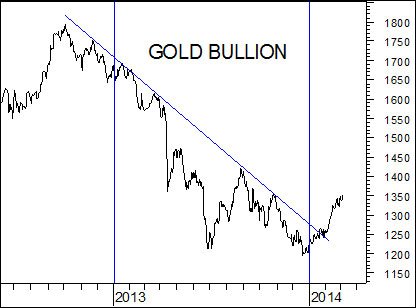
In my January 3 column ‘Will 2013 Winners Also Be Winners in 2014’, I noted how it is often a mistake to chase the previous year’s winners after they have already had several years of gains. I quoted John Rekenthaler, V.P. of research at fund-ranking service Morningstar, who says that almost always “Investors piling into the hottest funds of the previous period will be sorry, since the lower ranked funds tend to be the winners over the next three-year period.”
I noted in that column that if it is advisable for investors to choose from the previous period’s losers there was one stand-out – gold.
So far that is working out. Gold down 37% last year from its 2011 peak, is up 12% so far this year.
Gold does have a few positives going for it this year that it didn’t have last year, in addition to the much lower price.
For instance, beginning in 2012, India, the world’s largest consumer and importer of gold, raised its import tax on gold from 2% to 10%, in an effort to cool off demand for gold (which was draining off too much cash from India’s economy). The move worked to slow demand for gold, but created a hardship for India’s important jewelry manufacturing and exporting industry. Beginning last fall India has been cutting back the gold tax, and is expected to continue to do so.
Gold is also the traditional hedge against global instabilities and uncertainties.
It was spiked up to its record $1,900 an ounce in 2011 as the ‘Arab spring’ uprisings, which began in Egypt in 2010, began to proliferate into neighboring countries. Those uprisings settled down considerably in 2012 and 2013, and gold plunged in its 37% bear market decline.
However, this year’s eruption of violence in South Sudan, and the civil wars in Syria and Ukraine (now with Russia’s involvement), among other global hotspots, have global uncertainties back in the headlines.
We primarily utilize technical analysis for our buy and sell signals, but the fundamentals seem to also support a positive outlook for gold. So far this year, it also confirms the notion that the previous period’s losers are often the winners in the next period.
In the interest of full disclosure, my subscribers and I have positions in the gold bullion SPDR Trust Gold etf, symbol GLD, and the gold mining stocks etf Market Vectors Gold Miners, symbol GDX.


 With gold near $1,350, and the world worried about war breaking out in Ukraine, today an acclaimed money manager spoke with King World News about $10,000 gold, Russia, China, the United States, and Ukraine. Stephen Leeb has a friend who is one of the best Chess Coaches in Russia, and his perspective on what is going on makes this article worth reading – Editor Money Talks
$10,000 Gold, Russia, China, The United States & Ukraine
Leeb: “Eric, I’m focused on geopolitical factors and how desperate the West seems to be to keep this world running. Every day that goes by there are more signs of desperation. Putin is giving no sign whatsoever of backing down in Ukraine. It’s very clear that he is going to annex the Crimea….
“He will also make a run at other eastern Ukrainian enclaves where there are a lot of Russians. I think the United States and Europe are going to be left holding the bag.
Part of the desperation on the part of the West is because of the fact that Putin has tremendous access to energy resources, whereas the West does and it doesn’t. The costs of fracking are incredibly high, and the public has no idea about the chemicals that really go into fracking. Almost every single one of the chemicals that goes into fracking has a negative health effect.
The reason I am suspicious of the government’s motives with fracking is because this is really our only card left to play. We don’t have any real viable energy resources in the Western world, aside from fracking. We cannot satisfy demand for energy unless we go to extremes.
We are looking at a geopolitical crisis right now where there is no answer — where the West is powerless. There is a tremendous alliance between Russia and China over natural resources. What is not making the headlines is the fact that the president of China just had a long conversation with Merkel, Cameron, and Obama. Did you see that anywhere in the headlines?
I can tell you the nature of that conversation: The president of China warned the West not to start any trouble. He also told them not to slap any sanctions on Russia. Meanwhile, the United States is supporting a Ukrainian regime without legitimacy, that also has extreme Nazi-style support. One of the biggest concentration camps in World War II was right outside of Kiev. How does it make any sense for the West to support these thugs, Eric? The answer is, it doesn’t.
But every day the West is becoming less and less powerful. So how can we rely on the the U.S. dollar to remain as the world’s reserve currency? How can we rely on the euro to be the second most desirable currency in the world? It makes no sense, and people are starting to get this message. This is why gold has bottomed.
The real run in gold, the one that takes us to $10,000, that comes when people realize that ‘the emperor has no clothes.’ Yes, China has problems but they are many steps ahead of us. Russia also has the right idea. Today Russians live much freer than they ever did in the past 400 years.
I have a friend who travels to Russia each year. He is one of the best chess coaches in Russia. He owns property in Russia, and he knows people all over the country who verify that the country is freer today than it has ever been. Putin’s popularity within Russia is also higher than it’s ever been.
So this is why the West is acting out of such desperation. They know the clock is ticking against them and their dominance of the world. But all of the propaganda in the West is to convince the people that the West is still number one. This is not true. The emperor’s clothes are coming off, and the gold market is going to reveal this at some point.
We may have a few more chapters to complete before we see $10,000 gold, but this book will be completed. And when the book is completed, this world will not be recognizable. What we are seeing right now is the last gasp effort on the West’s part to show its dominance.
We are literally witnessing history before our eyes. We are living through a point of inflection and the West is desperate to hold on to what it has but we won’t be able to do it. The bottom line is the move to $10,000 gold will mark a dramatic shift of power from West to East. It will also mark the end of Western dominance altogether.”
IMPORTANT – KWN has released more interviews since this one was published

A fall in copper to near four-year lows combined with increasing concern about China’s economic slowdown sent a wave of unease on Wednesday through world financial markets.
Global stocks fell for a fourth day and copper, often regarded as a proxy for China’s economic fortunes, hit its lowest level since 2010 after Shanghai futures had again fallen by their 5 percent daily limit.
U.S. stock futures prices pointed to another negative start for Wall Street later, with little in the way of U.S. data to drag attention away from the China anxiety.
In Europe, bourses from London to Lisbon tumbled .FTEU3 and safe-haven German government bonds were in demand as the jitters added to the effects of the tug-of-war over Crimea, which has pitted Russia against Ukraine and the West.
“Markets are watching what is happening in copper with awe and trepidation,” said Societe Generale head of currency strategy Kit Juckes. “It’s partly ongoing concern about Chinese growth (or lack thereof) and nagging worries about the Ukraine. And partly it is just that the commodity bubble burst last year and not everyone noticed.”
Copper’s fall follows China’s first domestic bond default which has raised concerns about a possible unraveling of the many loan deals which have used the metal as collateral.
CHINA CHILL
Economists are concerned that recent moves by Beijing to stamp out speculation on its rising currency and overly easy lending may have overshot and will damage the world’s second largest economy.
This is adding to broader strains on emerging markets as they try to cope with shifts in global attitudes while recovering economies such as the United States begin to phase out the cheap money churned out in recent years.

-
I know Mike is a very solid investor and respect his opinions very much. So if he says pay attention to this or that - I will.
~ Dale G.
-
I've started managing my own investments so view Michael's site as a one-stop shop from which to get information and perspectives.
~ Dave E.
-
Michael offers easy reading, honest, common sense information that anyone can use in a practical manner.
~ der_al.
-
A sane voice in a scrambled investment world.
~ Ed R.
Inside Edge Pro Contributors

Greg Weldon

Josef Schachter

Tyler Bollhorn

Ryan Irvine

Paul Beattie

Martin Straith

Patrick Ceresna

Mark Leibovit

James Thorne

Victor Adair