Gold & Precious Metals

Falling Empires & Surging Silver

Not long ago, Elisabeth and I walked the streets of Rome — once a little village of seven hills founded in 753 B.C. that rose to rule the world from the Atlantic coast to the Persian Gulf.

At its height, Rome claimed 120 million citizens and subjects, nearly half the world’s entire population.

Its land area stretched across 2.5 million square miles, more than the total of all West and East European countries today (with the exception of Russia).

What caused its demise?

For the answer, Edward Gibbon’s Decline and Fall of the Roman Empire has long been the bible of historians. Gibbon attributed Rome’s decline to the gradual weakening of its military — the outsourcing of its defense to questionable foreign mercenaries and the dilution of Roman martial virtues.

But in recent years, historians, sociologists and economists have begun to recognize a series of closely linked economic factors that played a larger role in the empire’s decline than previously believed. And while in Rome, I saw some of the evidence…

First, The Remnants of

Excessive Government

Spending Are Everywhere.

The Roman Forum, the Arch of Titus and many more were built out of pure marble and probably cost the Ancient Roman Empire the equivalent of hundreds of billions in the context of today’s economy.

The massive Castel Sant’Angelo, on the banks of the Tiber at the other end of the Via della Conciliazione from St. Peter’s basilica, was built by the Emperor Hadrian as a mausoleum for himself and his successors — another huge drain on Rome’s coffers.

Screen Shot 2014-03-16 at 9.15.22 AMThe Pantheon, a great circular temple located near Piazza Navona, could easily have cost billions more. It’s one of the few that still stands virtually the same as when it was built nearly 1,900 years ago.

A clear pattern visible to trained observers: The most magnificent structures were built in the early years of the Empire, between 50 B.C. and 200 A.D. But in the third and fourth centuries, the big civic building projects dropped off rapidly as Rome was forced to spend more on its military and social services.

One major exception: The vast Aurelian walls that snake their way through modern-day Rome, built in 270 A.D. But unlike the structures of earlier years, these were strictly military fortifications — not temples or public buildings.

Rome’s coffers were further drained by the cost of its vast standing army of 500,000.

Nor was it cheap to keep the restless populace happy and distracted. Rome paid a fortune for its network of great games and spectacles — the equivalent of $100 million per year, according to historians, which, in proportion to their resources, would be the equivalent of thousands of times more today.

Plus, Rome dug itself into a financial hole with huge pension liabilities owed to a growing mass of retired soldiers and bureaucrats.

Second, Much Like the Western World Today,
Rome Was Drained by Threats from the East.

Most people think the primary attacks against Rome came from the north — frequent battles with Germanic tribes such as the Ostrogoths and the Visigoths, which for centuries harassed the Roman Empire … plus even bloodier conflicts with the Huns, stampeding from Eurasia.

But now, recent studies are shifting much of the blame to the East — especially Persia (now Iran), which Rome fought for more than 600 years.

First Rome battled the Parthian Empire, which included all of today’s Iran and Iraq.

Then, Rome battled the even larger Sassanid Persian Empire (A.D. 226 — 651), encompassing not only today’s Iran and Iraq, but also Kuwait, Saudi Arabia, all of the Persian Gulf states, Afghanistan, Pakistan, Syria, Lebanon and others.

Three of the biggest names among Roman leaders — Pompey, Mark Anthony, Trajan — became enmeshed in battles against the Persians. Many others suffered similar losses.

Indeed, historian Peter Heather, in his recently published The Fall of the Roman Empire, suggests that it was Rome’s long entanglement with the Persian Gulf and Mid-East empires that largely sealed its fate.

And it was primarily the colossal spending to meet the growing Persian threat that forced the Roman government to seek new sources of revenues, which leads me to …

The Third Factor That Drove Rome
to Ruin: Excessive Taxation!

In the early days of the Empire, the tax burden to Romans was minimal: Citizens paid a sales tax, but it was capped at only 1 percent. Land taxes were limited to 10 percent to 20 percent of the land’s yield. Inheritance taxes were only 5 percent. Import duties and tariffs were inconsequential. And there was a tiny per-person head tax, based on a regular census.

In this low-tax environment, the Roman economy prospered. But as the costs of maintaining the Imperial army grew, so did the tax burden.

Rome began to levy special income taxes and fees — like the primipili pastus, an obligation of local landowners to supply all rations necessary for a garrison … or the follis, a tax on senatorial estates.

The taxes became so onerous that heirs routinely declined large inheritances because they couldn’t afford to pay the taxes required. Middle-class Romans went bankrupt. Upper-class Romans soon joined them.

Tax revenues plunged. Rome was strapped for cash. And it could no longer pay its professional soldiers — mostly Germanic tribal mercenaries — to guard its northern borders.

Another pillar of the empire was crumbling.

The Fourth and Fatal
Blow to Rome: Inflation!

image2The silver content of the most common coin, the denarius, was a hefty 90 percent in the age of Nero (54 — 68 A.D.).When the Roman government needed more funding and had difficulty raising more tax revenue, it did what nearly all governments have done before and since: It manufactured more money and debased its currency.

Two centuries later, by the reign of Claudius II (268 — 270 A.D.), it was down to a meager 0.2 percent.

The price of silver surged dramatically as inflation raged.

Plus, one historian estimates that the cost of a measure of Egyptian wheat rose from seven to eight drachmas in the second century to 120,000 in the third century — an inflation of 15,000 percent.

And it was the combination of all these factors — not just the Goths or the Huns — which was the true cause of Rome’s demise.

Fair Warning

Let this be fair warning to all governments, especially our own, regarding the grave perils of overspending and overbuilding … overtaxing its people while squandering their wealth … overextending the military and … overinflating the economy while debasing the currency.

If each of these blunderous policies were being scrupulously avoided in America today, we might be able to breathe a sigh relief. But, alas, nothing could be further from the truth.

The facts:

Overspending: U.S. government spending is still out of control. After an endless parade of shutdowns, sequesters, debates and deals, nothing has changed. Money continues to pour out of the nation’s coffers in torrents. Waste is still rampant. And future obligations, such as Medicare and Social Security, still threaten to bust the country.

Overtaxing: Despite repeated promises by our leaders to stem the rise in taxes, overtaxation remains a huge burden for most Americans.

This year, for example, Tax Freedom Day won’t come until April 18, five days later than last year. Until that date, every single penny earned by the average American needs to be set aside for paying this year’s taxes. Only after that date is your money yours to keep.

Overinflating the economy. This is ongoing. As we have demonstrated here repeatedly, with its $3 trillion in money printing, the Fed is inflating some of the greatest bubbles of all time.

Overextending the military: At the height of war in Iraq and Afghanistan, the Pentagon reported that the U.S. government virtually exhausted the resources of its armed forces and had to pull more National Guard troops away from their homeland defense and disaster relief operations.

Meanwhile, due to its lack of forces, U.S. military experts have pointed out that any conflict with the Persian Gulf’s largest power — Iran — would have to be restricted almost entirely to an air war. A U.S. ground attack would be almost impossible.

What about a conflict in Syria or involvement in Ukraine? The same kinds of limits to our military resources are a big factor in our policy decisions for each.

What This Means for You Today

First, don’t assume our government can continue to overtax, overspend and overinflate without consequences; and one of the most obvious is a surge in key prices, especially silver and gold.

Another consequence is a bubble-and-bust cycle for the financial markets.

Second, each bubble brings both a danger and an opportunity.

If you can identify the specific companies that truly deserve your hard-earned money on their own merits, you get TWO powerful growth factors working in your favor — the earnings engine of the company itself AND the winds in your sails from the Fed.

But if you pick the wrong investments, or you hold the investments for too long as they become overvalued, you’re likely to be among the victims of the inevitable bust that follows.

Third, if we continue down this path, don’t expect American global power — and the American dollar — to avoid a serious decline.

Already, with the crisis in Ukraine, it’s clear that America’s largest former cold-war adversary is rebuilding its empire.

Already, relatively smaller counters, like Iran and North Korea, feel they’re empowered to thumb their noses at the United States with impunity.

Already, a non-democratic nation — China — has been the new locomotive of the world economy, accumulating foreign reserves that are far larger than ours were at their peak.

Bottom line: As America’s military and financial hegemony weaken, so will our currency. And that decline will drive up not only the cost of living but also the value of hard assets, especially silver and gold.

For more specific guidance, be sure to stay tuned with Money and Markets every day.

Good luck and God bless!

Martin


also….

 
THIS WEEK’S TOP STORIES

European Stocks May Face Triple Threat, No Matter Ukraine’s Future
By Mike Burnick

EDITOR’S PICKS

Boldly Going Where Others Fear to Tread Can Profit the Savvy Investor

by Jon Markman

One of the main things holding people back from being smart investors in emerging tech stocks today is their searing memory of being crushed in the 2000 and 2008 bear markets. People feel that they may have been fooled once, and they may have been fooled twice, but they sure as heck won’t be fooled again.

Three Things to Keep in Mind for Your Portfolio as Markets Seesaw

by Bill Hall

The Dow Jones Industrial Average began the year at 16,577 and declined 5 percent during January. February proved to be much better for stock investors as the Dow recovered much of the previous month’s loss, closing the month at 16,321.71. That translates to only a 1.5 percent loss for stocks during the first two months of the year.

How Strong Are Stocks? Just Weight and See

by Douglas Davenport

To determine how well the U.S. stock market is doing from day to day, most investors look to a couple of popular indexes

The Dow Jones Industrial Average, of course, measures the value of 30 equities that are supposed to track economic activity. But most investors pay more attention to the S&P 500, which is more representative of the true breadth of the U.S. economy.



Down & Out: The French Flee a Nation in Despair

Numbers you should know

87  The number of new taxes initiated by Socialist leader, Francois Hollande in the last two years.

57  The percentage of public expenditure of GDP in France (highest in the world).

Word to the wise

“How stupid do you think we are? I have visited the factory a couple of times. The French workforce gets paid high wages but works only 3 hours a day. They told me that’s the French Way.”

Maurice Taylor, President of Titan International in a leaked letter to the French Minister who was imploring Taylor not to close a Goodyear Tire plant in France. 


France: A Case Study In Socialism: Does It Work?

frenchman with wine 2

For several years I have been saying that France will be the next big financial shoe to drop in Europe and the repercussions will be felt by everyone. France offers a case study in one of the easiest to understand, yet most often ignored facts by those that push big government.

That is – when prices and costs change – people’s behavior changes.  It is never as easy as saying governments receive more revenue by raising taxes because at some point people will leave the country or change other behavior that reduces government revenue.

The following article by Anne-Elisabeth Moutet published in the Telegraph received unprecedented response. It outraged some French people because it challenged France’s well entrenched welfare state while others are outraged that the government is blind to the consequences of its actions

The point is that the results in terms of record numbers of people without work, record youth unemployment, record debt and flatlining economic growth speak for themselves.

The question is – how far down that same road do we want to go? – MC

Down and out: the French Flee a Nation in Despair

By Anne-Elisabeth Moutet

A poll on the front page of last Tuesday’s Le Monde, that bible of the French Left-leaning Establishment (think a simultaneously boring and hectoring Guardian), translated into stark figures the winter of Francois Hollande’s discontent.

More than 70 per cent of the French feel taxes are “excessive”, and 80 per cent believe the president’s economic policy is “misguided” and “inefficient”. This goes far beyond the tax exiles such as Gerard Depardieu, members of the Peugeot family or Chanel’s owners. Worse, after decades of living in one of the most redistributive systems in western Europe, 54 per cent of the French believe that taxes – of which there have been 87 new ones in the past two years, rising from 42 per cent of GDP in 2009 to 46.3 per cent this year – now widen social inequalities instead of reducing them.

This is a noteworthy departure, in a country where the much-vaunted value of “equality” has historically been tinged with envy and resentment of the more fortunate. Less than two years ago, the most toxic accusation….

Continue reading the full article HERE

This Is The Van Gogh of Oil Plays

Van Gogh’s case is tragic. But this malady is actually one of my favorite things about the investment business. Specifically, that when a company does something truly great and ground-breaking, investors usually don’t get it—at first.

The Van Gogh syndrome is happening right now in the oil business. Where advances in drilling tech are creating outsized investment returns—which are being completely ignored by investors and project developers. Entire article below:

also This week in Pierce Points:
 
Barrick stockpiled unique uranium. The major miner is building a significant supply source as by-product from copper production in Zambia.

China turned its coal into plastic. Reports suggest that 80 to 100 Chinese coal-to-olefins plants may be under construction, potentially tying up coal supply.

Australian oil production hit a 44-year low. The nation’s flagging output has sent the supply-demand gap soaring to over 200 million barrels yearly.

Myanmar officially became a player in tin. With a potential shortagelooming for the little-discussed metal, a less-discussed Asian nation may be a development target.

Another Gulf Shelf producer disappeared. Energy XXI’s bid for EPL Oil & Gas marks the passing of the last independent acreage package in this surprisingly hot play.  


This Is The Van Gogh of Oil Plays

Regarding the last item above, an artist friend reminded me this week of an evergreen quote from Walt Whitman:

“To have great poets, there must be great audiences.”

So true. How many master creators have gone unappreciated in front of uncomprehending masses? Even a virtuoso like Van Gogh was largely disregarded in his time—simply because audiences weren’t yet able to digest his boldness and brilliance.

Van Gogh’s case is tragic. But this malady is actually one of my favorite things about the investment business. Specifically, that when a company does something truly great and ground-breaking, investors usually don’t get it—at first.

The Van Gogh syndrome is happening right now in the oil business. Where advances in drilling tech are creating outsized investment returns—which are being completely ignored by investors and project developers.

It’s happening in the shallow-water Gulf of Mexico. Where companies are quietly creating some of the best returns on capital in the oil business.

This month we got updated reserves reports from U.S.-listed E&Ps—verifying the Gulf’s trend in motion.

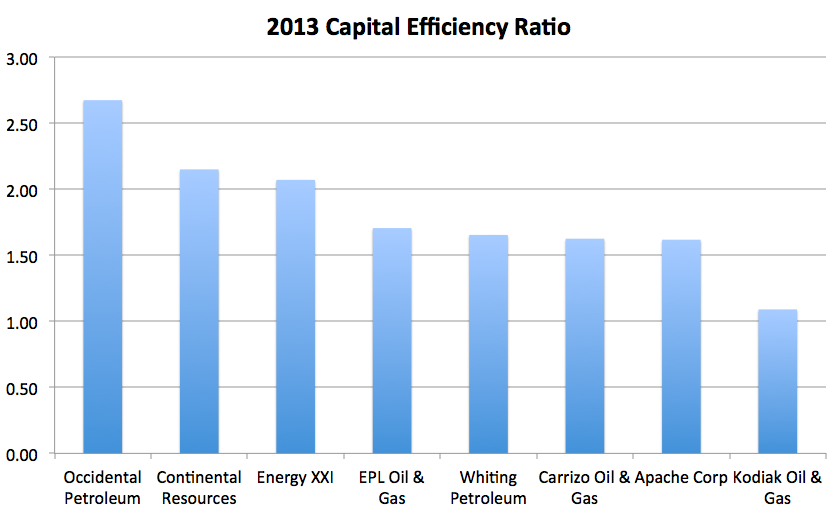
Look at the numbers. Below, I’ve put together “capital efficiency ratios” for leading oil producers across a number of U.S. plays (I’m working on a more comprehensive report covering these numbers, which I plan to make available in the coming weeks). This is a simple metric—showing how many dollars in asset value a company created for each dollar spent on exploration, development and acquisitions. The higher the number, the more value a firm is creating.

Screen Shot 2014 03 15 at 12.00.53 AM

One name stands out from this analysis: Energy XXI (Nasdaq: EXXI). Because the company is achieving some of the best returns in the business—and not in a hot play like the Bakken or the Eagle Ford. But rather, in the out-of-the-way locale of the Gulf Shelf.

This region was traditionally worked by majors like Apache and Exxon. But those big players have been pulling out of late. With the play being seen as fully-explored and lacking in discovery upside.

That may be true. But there are still massive amounts of oil remaining here within known fields. Identified oil in place across the Shelf’s ten largest fields totals more than 3.6 billion barrels.

This is where firms like Energy XXI come in. The company has been picking off old oil fields from the majors—and using new drilling technology to go after all of the crude left behind.

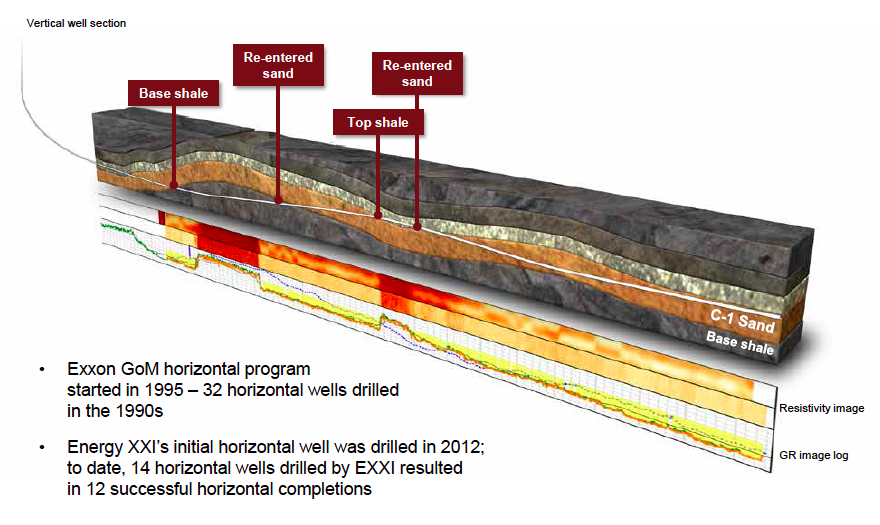
The engineering behind this is of course advanced. But one of the major tacks is using horizontal drilling technology to go after by-passed pay.

Here’s how it works. The Gulf of Mexico reservoirs are largely a “deltaic” system. A setting where you get lots of sandstone layers piled on top of each other.

These sand reservoirs can be quite thin. Sometimes only several feet thick. Historically that was usually too small to be worth completing. Operators would simply pick the thick sands on a well log, and leave the skinny ones behind pipe.

But technology has changed that. With the main improvement being the accuracy of horizontal drilling.

Over the last few years, the oil services industry has made big advances in Measurement While Drilling (MWD) technology. Systems that tell drillers precisely where the drillbit is located in the subsurface. Using such advances it’s today possible to guide a horizontal well hundreds or even thousands of meters through a thin sandstone without veering too much up or down, out of the reservoir. Below is a schematic from a recent Energy XXI presentation.

Screen Shot 2014 03 15 at 12.11.54 AM

That new technology means bypassed zones in Gulf Shelf reservoirs can now be recompleted. Better technology also means faster drilling, which creates lower well costs when you’re paying a per-day rate to keep a rig on site.

This is easy money, relatively speaking. There’s little exploration risk. As long you get the engineering right, you can add production and new reserves efficiently from old oil pools.

That’s why Energy XXI has been turning a dollar spent on development into an industry-leading $2.07 in assets.

Investors however, don’t understand this ground-breaking performance yet. Rather than commanding a premium for its growth potential (the way many onshore shale E&Ps are), Energy XXI today trades at a 25%discount to the value of its proved reserves. The company is simply seen as a boring, shallow-water play.

The overlooked opportunity here is interesting from a pure investment angle—and even more so from a projects perspective. Because no one has yet taken the value-creating drilling advances proven in the Shelf and put them to work in other oil plays.

Now is the time to do so. Because we’re at a pivotal period in the development of drilling services. My analysis over the last few weeks (thanks to those of you who provided input) reveals that a number of new, game-changing technologies are now available to oil developers. Tech that makes the U.S. horizontal drilling revolution ready for export.

This is driven by “bolt on” tools that can be attached to existing rigs anywhere in the world. Greatly improving accuracy. And allowing us to target millions of barrels in bypassed pay zones at mature fields.

Such strategy is creating some of the best returns in the business, as we speak. And it’s not going to remain a secret for long. For those of you working in clastic reservoirs globally, I’m starting up a new project immediately to unite new technology with the right oil fields. If you’ve got a fit, drop me a line at dforest@piercepoints.com. It’s going to be a story for the ages—and an unparalleled opportunity for early movers.

Like Van Gogh’s paintings, this seismic shift in the industry is taking observers some time to understand. But once they grasp the emerging numbers, it will be a work of art.

Here’s to the revolution not being televised,
   
Dave Forest
 
dforest@piercepoints.com / @piercepoints / Facebook

Fed President ‘Worried’ About a Crash

charles-plosser-630x356One of the men who runs the Federal Reserve System is worried about the potential effects of the central bank’s own policies, which involves printing more money.



Philadelphia Federal Reserve President Charles Plosser also acknowledged that he and his colleagues don’t understand all the policies’ effects.

“Well I am very worried about the potential for unintended consequences of all this action,” Plosser said on CNBC’s Squakbox program. The action Plosser was referring to is quantitative easing, the Federal Reserve’s attempt to simulate the economy by buying $65 billion worth of bonds each month.

Some observers believe QE is what is driving the stock market to new highs. There also are those who think a stock market crash and an economic downturn will result when QE ends.

Plosser thinks that the economy is recovering but that the effects of quantitative easing could threaten that recovery. Quantitative easing is supposed to stimulate the economy by keeping interest rates low. Keeping interest rates low encourages lending and economic activity. Critics have called it printing money and easy money.

full article HERE

With continued chaos and uncertainty in Markets, the 90 year old Richard Russell who has been publishing the Dow Theory Letter for 60 years (he was the first newsletter writer) gives his assessment of the current situation and his opinion on how one can protect themselves, and even profit from the chaos he believes is coming soon. – Money Talks

 “The US is now actually borrowing to pay off the interest on its huge and growing debt.  The Treasury continually issues bonds.  But who will buy them?  Can you believe it, the US is reduced to actually buying its own debt via the Federal Reserve.  What does the Fed buy our debt with?  It buys our own debt with money that it conjures up out of thin air by means of a bookkeeping entry.  The Fed has been doing this for years and the Fed’s basket of bonds is now over $4 trillion dollars worth of assorted bonds.

The continuing buying of bonds (QE), now $60 billion every meeting, has driven stocks up to overvalued levels.  Companies are taking advantage of the lower rate environment in the limited period that these low rates are going to be around.

Now the Fed is trimming back its QE ($10 billion less at each meeting, so far) with the thought that QE will be completely removed by the end of the year — this on the hope that the US economy by year end will be strong enough to function on its own without any QE.  After February’s report that more jobs had been created than predicted, the Fed’s plan to eliminate QE was strengthened.

As to valuations, the S&P 500 now trades at 16 times its component companies’ earnings for the past year.  That is double its level of five years ago and almost identical to the level at which stocks topped out at the beginning of the decline in October, 2007.  Nobel Prize winner Robert Shiller puts the S&P at 25 times average earnings, far above the historical average of 15.5. 

Technically, the tech-heavy NASDAQ has five distribution days on its ledger, and the S&P has one distribution day.  From another technical standpoint, on Friday the D-J Transportation Average closed at a new record high, although the Dow failed to confirm.  At this point valuations are of no particular use, nor are the technicals.  It’s now a matter of how long and how far the players are willing to bet on the markets continuing to levitate.

Since this is a manipulated market, I have little to tell me if or whether this market is at or near trouble.  You stay in as long as the stock market continues to make headway, and you cash out when the early signs of trouble appear (assuming they do appear).  Clearly, the traders in this market believe that when trouble appears, they can exit quickly while at the same time capturing most of the profits they have gained from the five-year ascent.

Note that much of the poor economic statistics have been blamed on the inclement weather.  Now that the worst weather may be over, we will get a clear and more honest picture of the US economy.”

Russell added: “America has produced two documents that surpass anything ever produced by any country before.  These are the Declaration of Independence and the Constitution of the United States.  I believe these documents were God given.  And for this reason, they cannot be destroyed by time or by a bear market.  After much consideration, I have concluded that the future of the United States is a good one. 

Turning to the stock market, this market is as directionless as any I have ever dealt with.  I’ve given it a lot of thought as to the correct investment stance.  My conclusion is that I will sit with gold and a small amount of cash and simply await developments. 

In reading many investment advisories, I note that many highly intelligent advisors are warning of a deadly market crash.  Others present long lists of stocks to buy.  Still others note that the reason the stock market has been doing as well as it has is based on the manipulation of the Fed and its copious portions of QE.  I don’t see anything wrong with the position of standing still and observing.  

My stance is to sit with gold, and to watch history unfold.  Every speck of gold ever discovered or mined has value today.  This is a fact that gold haters choose to ignore.  Gold represents pure wealth and it does not need the backing of any group of men or of any nation.  The dollar was originally described as a specific weight of silver.  Gold is both a currency and an item of pure wealth.  

Gold is frequently mentioned in the Bible, and desire for it is built into the DNA of the human race.  I’ve chosen to sit with gold and watch history unfold.  If the market continues higher, I will not be envious, since I am where I want to be.  If the market lapses into a bear market, I’ll be happy to be on the sidelines, and I’ll hope for the best.”


To subscribe to Richard Russell’s Dow Theory Letters CLICK HERE.


About Richard Russell


Russell began publishing Dow Theory Letters in 1958, and he has been writing the Letters ever since (never once having skipped a Letter). Dow Theory Letters is the oldest service continuously written by one person in the business.


Russell gained wide recognition via a series of over 30 Dow Theory and technical articles that he wrote for Barron’s during the late-’50s through the ’90s. Through Barron’s and via word of mouth, he gained a wide following. Russell was the first (in 1960) to recommend gold stocks. He called the top of the 1949-’66 bull market. And almost to the day he called the bottom of the great 1972-’74 bear market, and the beginning of the great bull market which started in December 1974.


Letters are published and mailed every three weeks. We offer a TRIAL (two consecutive up-to-date issues) for $1.00 (same price that was originally charged in 1958). Trials, please one time only. Mail your $1.00 check to: Dow Theory Letters, PO Box 1759, La Jolla, CA 92038 (annual cost of a subscription is $300, tax deductible if ordered through your business).


test-php-789