
 For those investors who have grown used to the relatively minor geo-political crises of the past few years, the developing situation in the Ukraine and the Crimea must come as an unexpected communiqué from the early 20th Century.There can be little doubt that the drama will impact financial markets.
 The Gold Report: In a call with Sprott clients last week, you said that the junior resource market is at an intermediate-term top right now and there will be good summer entry points. Why is the market at a top now instead of May, which is more typical? Should investors wait until the summer entry points to get into good juniors?
I want to draw people’s attention to the fact that the market is up 40% in some cases from its bottom. Amazingly, people are more attracted to that than a market that exhibited bargain basement prices.
Although I believe that the market has bottomed, we’re going to be in an upward channel with higher highs and higher lows, but we are certainly going to exhibit the volatility that the market is famous for. It’s my suspicion that the summer doldrums will see lows that, while higher than last summer, are substantially lower than the prices that we’re enjoying today.
TGR: Gold has been above $1,300/ounce ($1,300/oz) for several weeks. Is that influencing the market?
RR: Gold certainly is a bellwether commodity for the junior resource sector. For 25 years, people have referred to junior mining in many circumstances as junior gold. That’s misinformation because the junior resource sector encompasses a variety of commodities. My suspicion is that we have put in lows in the precious metals and they will trade higher, but not straight up. The gains will need to be consolidated. It will be volatile on the way up.
TGR: If it’s a misconception that gold is the bellwether commodity, what key commodities do you look at to support the claim that we bottomed out in the summer of last year?
RR: Virtually the entire complex, with the exception of copper, which has stayed pretty weak. Zinc has begun to cooperate. While uranium hasn’t cooperated, the sentiment for uranium juniors and the premium associated with Uranium Participation Corp. (U:TSX) has certainly done better. The energy complex has seen oil up $10/barrel and natural gas doubled. Platinum and palladium are up substantially, although that may be a consequence of fears about an embargo against Russian palladium supplies and a response to labor unrest in South Africa. However, generally, the whole commodities complex, including the soft commodities, even in the face of bumper grain crops, is doing well since last summer.
TGR: What do you attribute that to?
RR: There are a couple of reasons. The whole sector was oversold. We’ve participated in a bit of a dead cat bounce. The long-term thesis has a lot to do with the increasing ability of the bottom of the demographic pyramid to increase its standard of living, which involves more commodities. I’d say that the great unsung hero of a rebound in the fortune of commodity producers has been the increasingly constrained supply of resources. The demand side on resources has been very slow because this recovery in the West has been a false, paper recovery. It hasn’t been accompanied by capital spending or jobs. It’s an interest rate-led recovery with flat auto sales and home starts.
What has kept commodity prices stronger than what some investors thought they would be has been the constrained supply growth in the face of constrained demand. In sectors that were regarded as horrifically oversupplied, like natural gas, two things have happened: Cheap natural gas prices have led to more utilization of gas for power generation at the same time that Mother Nature threw the polar vortex at us.
This sort of supply response isn’t limited to natural gas. On the precious metals side, the industry has spent tens of billions of dollars during the past 15 years on exploration, construction and production. The production numbers for precious metals have been going sideways for gold and silver and going down for platinum and palladium. Supply constraints on a global basis led to the bottoming and then the recovery of commodity pricing.
TGR: If we don’t have enough supply to meet demand, even if demand stays flat, we would see commodity prices going up. But aren’t we still seeing some growth in developing countries as the poor become richer and invest in commodity-intensive products?
RR: That will be evident in future years. This year is simply a recovery from the oversold conditions of 2013. That’s normally the way bear markets become bull markets; they normally are a reaction to oversold situations.
TGR: Are the capital markets coming back to the commodity groups now to finance them? Will that financing ultimately result in increased supply?
RR: There is an increasing amount of equity available for the better companies in the junior resource space. This is precisely the set of circumstances that we talked about in our interview last summer, which we referred to as bifurcation. The best 20% of the issuers have begun to find bids, not just in the junior capital markets, which is where the share prices are up, but also in financing markets. An increasing number of bought financings are getting done. For the bulk of the juniors, of course, that capital isn’t available—and good riddance. They’ll go away.
Probably a bigger question is going to be where the project and development financing will come from. The large private sector banks that used to fund construction and permanent finance for major resource projects have been less willing to take those loans onto their balance sheets, choosing instead to become financial arrangers. A situation where everybody’s a financial arranger and nobody’s a funder means that projects haven’t been getting funded.
We believe that the likely lenders going forward will be sovereign wealth funds and superannuation or pension funds with a long-term horizon. But that hasn’t worked itself out yet. While there is a refreshing ability for the better juniors to get stop-gap equity financing, what is still missing from this market is the senior project financing. That’s something that Sprott is working very hard to address.
TGR: What will be the catalyst that will move sovereign wealth funds, pension funds or Sprott into doing those large capital financings?
RR: The time horizons of 10–20 years that are required in project finance correspond well to the needs of pension, superannuation and sovereign wealth funds. Because they are already equity investors, the balance sheet risk with being a senior secured lender will fit well with their needs. It’s just something that they haven’t done before. This is a natural progression that hasn’t occurred yet, and we hope to facilitate it.
TGR: Why is there a natural progression of moving these large project capital financings to a pension or sovereign wealth fund?
RR: Legislation in place now on a global basis for large banks forces them to be providers of capital to sovereign governments. If JPMorgan Chase has a loan to Greece on its books that is selling at 70% of par, European Union rules allow JPMorgan to carry that bond at 100% of par if it says it intends to hold it to maturity. In other words, the rules allow the bank to mark the loan to myth as opposed to the market. If the same sort of loan was made by JPMorgan to a private party, even a solvent private party, unlike an insolvent sovereign, the carrying value on that loan would have to be reduced, which would reduce the capital base of the bank.
As a response, the banks have become conduits that accept deposits on a global basis and borrow very short-term money from sovereign lenders and then relend the money to sovereign borrowers on a longer-term basis. They profit from the same type of arbitrage—borrowing short and lending long—which was the demise of the U.S. savings and loan business. This may or may not be a great business strategy. It’s one they’ve been, in effect, forced into as a consequence of banking regulations that came about after the 2008 liquidity crisis.
TGR: How might that play out over the next decade?
RR: That’s a many headed question. If we have a situation where short-term interest rates go up—where central banks are less able to manipulate short-term interest rates—it will have an extremely unpleasant outcome for the large banks.
TGR: You mentioned earlier that Sprott was looking at playing a role in that natural progression from the large banks to other types of fundees. What specifically is the role for Sprott there?
RR: Sprott has had discussions with many of the largest sovereign and pension investors in the world, including the National Pension Service of Korea, for which we manage some money. We have begun the process of educating these very large investors about the nature of project finance and how project finance might solve some of their investment needs. It’s an area that these very large investors hadn’t had much experience or interest in.
TGR: We’ve been talking about major debt project funding. Might these also come up in private placement opportunities, or do private placements fund other types of resource opportunities?
RR: Private placements have traditionally been on the exploration, development or preconstruction side of junior natural resource companies. This range of companies enjoyed unprecedented access to capital in 2003–2011. The consequence of that access to capital was a spectacular bull market that gave way to a spectacular bear market where the excesses of that period had to be exorcised. The issuers confused the optimal conditions with normalized conditions. The consequence has been that companies believe that the pricing circumstance that they enjoyed in 2003–2011 was normal as opposed to optimal. Issuers will be forced to be rational in 2014 simply as a consequence of their need for capital.
TGR: Are the latest financings discriminating or financing broadly across the sector?
RR: It’s been very discriminating, and it has to be. The junior resource business taken as a whole is valueless. Almost three-quarters of the issues on the exchange have no net-present value (NPV). The arithmetic consequence of that is any financing these poor quality companies do takes place at sub-$0 cost of capital. The better companies have found a bid. The better companies have been able to attract the financing. We need to take the bottom half of this industry and we need to flush it so that more money is focused on better projects and better companies.
TGR: Are you feeling a bit cautious about the potential continuing upmarket?
RR: I feel great about it. My experience has been that bear markets are always the authors of bull markets. While history doesn’t repeat, it certainly rhymes. The severity of the decline that we have experienced was at once the consequence of the extraordinary bull market that preceded it, but it’s also indicative of the type of response that we’re going to enjoy.
Make no mistake, the magnitude of this decline was as spectacular as anything I’ve seen since the mid-1980s. I feel the bull market that we are going to come into sometime in the next 18 months to 2 years will probably be as good a bull market as any I’ve ever experienced, and I’ve experienced some spectacular ones.
TGR: I was looking at the performance of the Sprott funds. The energy fund returned 23.4% in Q3/13 and Q4/13 while the gold and precious metals fund had a return of -4.2%. If the resource market bottomed in the summer of last year, how do you explain the difference between these two funds?
RR: The uptick in oil and gas equities happened faster because free cash flows recovered more quickly and because these energy issuers are generally better companies. It was easy to measure the impact of higher natural gas prices on the oil and gas juniors because they were producing. When the natural gas price went off its $1.90 million British thermal units ($1.9 MMBtu) low up to $4 MMBtu, the impact on producers’ income statements on a quarterly basis was immediate and dramatic.
An increase in the gold price from $1,100/oz to $1,300/oz for a company that is not yet producing gold is one that has to be factored in an NPV calculation to future cash flows. It took longer to work its way through the system.
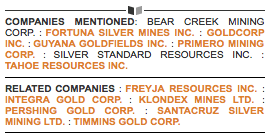
TGR: There have been some really dramatic turnarounds so far this year in the gold and precious metals fund: Tahoe Resources Inc. (THO:TSX; TAHO:NYSE) was down 9% in Q4/12 and is up 48% year to date (YTD); Guyana Goldfields Inc. (GUY:TSX) was down 36% in Q4/13 and is up 67% YTD; and Silver Standard Resources Inc. (SSO:TSX; SSRI:NASDAQ) was up 25% last year, and is up 44% this year. What do you attribute this dramatic turnaround to over the last few months?
RR: It’s a turnabout in market sentiment. The middle part of last year, the stock charts went sideways on no volume—exhausted sellers, exhausted buyers. At the end of last year, those stocks began to catch some bids. The people who had to sell, sold. We began to notice small inflows of cash at Sprott into our resource-oriented mutual funds at the end of last summer. We were no longer forced sellers, and we became nominal buyers.
I think our experience mirrored the experience of the rest of the institutional investing community. The consequence was fairly dramatic moves up on small volumes in some ludicrously oversold equities. We’ve come into a period where there’s a better balance between buyers and sellers.
TGR: Are you expecting to see modulation in increases in the fund because it had a dramatic turnaround?
RR: That’s the theme of this call. My suspicion is that we’ve been through the worst of the bear market, that the bear market bottom will not be a “V,” it will be saucer shaped, and it will take 12–18 months from now before we’re truly in a bull market. The gains that we’ve just enjoyed will need to consolidate. They may go a little higher before they go lower, but the truth is that a recovery will see higher highs and higher lows, and will also feature the volatility that this sector is so famous for. The recovery is in its very early stages.
TGR: Can you comment on some of these companies in the fund that have had large YTD performances?
RR: I think we have a combination of circumstance here. Tahoe is, if not the finest, then one of the finest silver deposits in the world. It answered the question of “could it overcome its social license issues and mine construction issues by getting into production.” It delivered value. The naysayers were proven wrong. The small increase in the silver price certainly helped it, too.
Similarly, Primero Mining Corp. (PPP:NYSE; P:TSX) outperformed production expectations and then announced an acquisition of a development project that allowed the market some visibility as to how it might grow going forward.
Guyana Goldfields simply was a recovery from a ridiculously oversold level.
Silver Standard delivered improved performance in Argentina. It added some meat to the bones. The market liked the fact that it, in the last six months of last year, seemed to get its hands on the production difficulties that it was having at the Pirquitas mine.
More recently, the company enjoyed a tremendous share price spurt as a consequence of its acquisition of the Marigold mine in Nevada from Goldcorp Inc. (G:TSX; GG:NYSE) that shows the way for it to increase cash flow and profits on an accretive, per-share basis. It might allow Silver Standard to develop the rest of its portfolio internally without external funding.
Bear Creek Mining Corp. (BCM:TSX.V) got social license in Peru. There had been questions as to whether either of the company’s development projects would be able to be developed given local opposition in Peru. Bear Creek got the backing of every prominent local group and a landmark agreement between the central government of Peru and the local government that would allow for more equitable distribution to the region of tax, royalties and the social rents from mining. Historically, in Peru, the regions have borne all the costs of mining while the center has collected all the social rent.
Fortuna Silver Mines Inc. (FSM:NYSE; FVI:TSX; FVI:BVL; F4S:FSE) continues to impress with its ability to operate midsize silver mines. Its two operations have consistently met its promises. That set it apart from an industry where probably 75% of the project news has been disappointing. Fortuna, as a consequence of meeting projections quarter after quarter, has begun to develop a loyal shareholder base among silver speculators.
TGR: With St. Patrick’s Day on the horizon, what company is really going to have the luck of the Irish and bring in the green?
RR: For your readers in the West and the Southwest, water will be a real important topic of discussion. We’ve had a situation in the West and the Southwest where water has been priced politically, which means it’s been delivered as a right irrespective of its supply and the cost of distributing it. The consequence of that has been gross misdistribution, which has worked as long as nature has cooperated. But nature this year has ceased to cooperate. We’re going to see tremendous distortions in water pricing across the West and the Southwest, and that will have spinoffs in areas like food cost. The very low cost of food that Americans have enjoyed in the last 40 years has had to do with the subsidies afforded to farmers for water supply.
Here in California, there are now several water districts whose allocation of water from the state and federal government is zero. Growing, as an example, almonds or pistachios or plums—pick a crop, really—in the summer in California with zero water allocation is very difficult. This is going to be a subject that is going to play very large among investors. It’s something that Sprott has been involved in through my own efforts for two decades. It’s something that we’re trying to get a lot more involved with in the next two or three years.
California had a pretty good drought in 1977 that caused us to do things like flush our toilets on alternative days and not wash our cars. It had much more profound economic consequences than that. The interesting thing for Californians to note is that since 1977, two important things have changed: There are 12 million more of us with our straws in the sponge, but the sponge hasn’t increased at all. At the same time, the safety valve Californians had from the Colorado River is gone. The consequences will be very dramatic.
Since 1977, people have moved to places like Phoenix, Tucson, Salt Lake City and Las Vegas. We don’t have the ability to overdraw our allotment anymore. The way that we got out of the predicament in 1977 is not a way out this time. It’s going to have profound consequences. I don’t know what they are, but it’s going to have profound consequences.
TGR: How do you play the water sector and this drought? You can’t get more rain. Are we looking at desalination? Are we looking at better water conservation?
RR: There is no play in the near term. The answer in the intermediate term is going to have to be more market pricing for water—and people are going to hate that. The way I’m playing it is to buy shares of companies that own water rights associated with their agricultural operations. My bet is that the California legislature does something that’s logical. I realize that’s a bet that plays against history. But my hope is that farmers are allowed to cease doing stupid things such as growing rice in the desert and are allowed to sell the water that they would have wasted growing rice in the desert to people who want to use it to flush toilets and brush teeth. If that takes place, there’s as much as a 90% arbitrage in the converting of agricultural water to urban and municipal use.
If we did that, by the way, we wouldn’t have a water crisis in California. We’d have a lot less agricultural production. But the truth is, if we had a market-clearing price for water in California, we wouldn’t be having this discussion at all.
TGR: But if we had a market-clearing price for water in California, what would happen to the agricultural component of the California economy? What would that mean overall for the state?
RR: Remember that California agriculture contributes less that 4% of state GDP and consumes 85% of the state’s water. I suspect that gross farm receipts would stay the same. We would have 25% or 30% of the farmland in California fallow, and we would have higher crop prices across lower production. That’s the inevitable consequence that we have to face. The idea that we take water and we irrigate a desert to cut eight crops of alfalfa and we export that alfalfa in bales to China for its dairy industry is the equivalent of us exporting water below our cost of production to subsidize the Chinese dairy industry. If you say to suburban homeowners, the Cadillac communists in West L.A. or Mill Valley, that they have to sacrifice $150,000 worth of landscaping at their houses, or be willing to pay 300% or 400% more for water so that they can subsidize the production of dairy in China, the political equation regarding water pricing in California could change. And that would confer enormous benefits on the people who understood the arbitrage of marking privately held agricultural water rights to market.
TGR: What’s to keep the California government from taking away those agricultural water rights or redefining them so that that arbitrage is minimized or eliminated?
RR: Zero. The People’s Republic of California will ultimately confiscate the product of intelligent savers but, mercifully, California is extremely inefficient, and it won’t get around to fashioning the political compromise necessary to steal that wealth for three or four years.
TGR: Can you share with us some of these companies that have water rights that can turn agricultural water into urban-use water to take advantage of this arbitrage situation?
RR: Sure, with a caveat that these are companies I own as opposed to companies that I recommend to your readership. I own J.G. Boswell Co. (BWEL:OTCPK), which is the largest of the California corporate farmers; Limoneira Co. (LMNR:NASDAQ), which is a grower and developer in Ventura, Calif.; and PICO Holdings Inc. (PICO:NASDAQ), which is the Physicians Insurance Company of Ohio, a water-rights owner in Nevada and Arizona.
TGR: That’s ironic. The Physicians Insurance Company of Ohio owns water rights in Arizona and Nevada?
RR: That’s a story for a different interview.
TGR: I appreciate your time, Rick.
RR: My pleasure. Thank you.
Rick Rule, CEO of Sprott US Holdings Inc., began his career in the securities business in 1974. He is a leading American retail broker specializing in mining, energy, water utilities, forest products and agriculture. His company has built a national reputation on taking advantage of global opportunities in the oil and gas, mining, alternative energy, agriculture, forestry and water industries. Rule writes a free, thrice-weekly e-letter, Sprott’s Thoughts.
Read what other experts are saying about:
Related Articles
- Leading Indicators from the Superstars of Resource Investing
- Derek Macpherson: Is It a Love Affair or a Tryst?
- Paul Adams: Investor-Friendly Australian Projects Around the World
Want to read more Gold Report interviews like this? Sign up for our free e-newsletter, and you’ll learn when new articles have been published. To see a list of recent interviews with industry analysts and commentators, visit our Streetwise Interviews page.
DISCLOSURE:
1) Karen Roche conducted this interview for The Gold Report and provides services to The Gold Report as an employee. She or her family own shares of the following companies mentioned in this interview: None.
2) The following companies mentioned in the interview are sponsors of Streetwise Reports: Tahoe Resources Inc., Guyana Goldfields Inc., Primero Mining Corp. and Fortuna Silver Mines Inc. Goldcorp Inc. is not associated with Streetwise Reports. Streetwise Reports does not accept stock in exchange for its services or as sponsorship payment.
3) Rick Rule: I or my family own shares of the following companies mentioned in this interview: Tahoe Resources Inc., J. G. Bozwell Co., Limoneira Co. and PICO Holdings Inc. I personally am or my family is paid by the following companies mentioned in this interview: None. My company has a financial relationship with the following companies mentioned in this interview: None. I was not paid by Streetwise Reports for participating in this interview. Comments and opinions expressed are my own comments and opinions. I had the opportunity to review the interview for accuracy as of the date of the interview and am responsible for the content of the interview.
4) Interviews are edited for clarity. Streetwise Reports does not make editorial comments or change experts’ statements without their consent.
5) The interview does not constitute investment advice. Each reader is encouraged to consult with his or her individual financial professional and any action a reader takes as a result of information presented here is his or her own responsibility. By opening this page, each reader accepts and agrees to Streetwise Reports’ terms of use and full legal disclaimer.
6) From time to time, Streetwise Reports LLC and its directors, officers, employees or members of their families, as well as persons interviewed for articles and interviews on the site, may have a long or short position in securities mentioned and may make purchases and/or sales of those securities in the open market or otherwise.