
Stocks & Equities
Byron Wien makes the case for another massive rally in stocks in his full analysis HERE. Wien spent 21 years as Chief (later Senior) U.S. Investment Strategist at Morgan Stanley and co-authored a book with George Soros. Below is a brief summary of his detailed analysis – Editor Money Talks
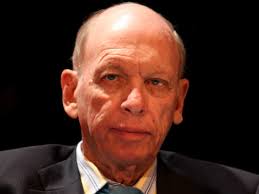 In his most recent market commentary, Wall Street legend Byron Wien lays out a sensible, reasonable case that the S&P 500 could climb to 2300.
That’s 17% higher from current levels.
The main ingredients for Wien’s calculation: 3% economic growth, 7% earnings growth, and continued stock buybacks.
From Wien’s latest post on Blackstone’s blog:
“One of the problems limiting investor enthusiasm may be valuation. If the S&P 500 earns $115 in 2014, it is selling at 17.1x earnings. Market peaks have occurred historically at 25x–30x times earnings. On that basis, the market is fairly valued but not exceedingly expensive. The average trailing 12-month price-earnings ratio when the inflation rate is 0%–4% is 17… If the economy grows at a rate of 3% real during the remainder of the year and inflation is 2%, then nominal growth should be 5%. With productivity increases continuing and share buybacks, the S&P 500 should be able to show improvement of 7% over the $108 in operating earnings of 2013 and that would put us at $115. With considerable cash on corporate balance sheets, share buybacks should continue. Therefore, if earnings reach my target and the S&P 500 sells at 20x, we could reach 2300, which is 17% above the present level or more than 20% above the index price at the start of 2014.”
Wien also writes that, “Very few investors see that as a possibility because the market did so well in 2012 and 2013 and strong previous performance breeds caution about the future,” but says that just because the market performed well one year doesn’t mean it won’t the next.
In fact, Wien notes that when the S&P 500 has gained 25% in a year, it has been positive the following year each time has happened since 1990.
Overall, Wien’s primary concern for the market is a negative impact from geopolitical turmoil, saying that any of the situations in Ukraine, Israel and the Middle East flaring up further could pressure oil prices or challenge the “present world order” and unsettle financial markets.
But citing a recent Bloomberg poll that indicates 61% of respondents were worried about a market bubble, or thought the market was currently in one, Wien says this is an encouraging contrary indicator.
Wien says that of course, the market cannot go up forever, but writes: “I see neither a recession nor a bear market in sight even thought we are five years into the economic and market recovery. Let’s hope geopolitical turbulence doesn’t upset that outlook.”

Global Gold: Can you tell us your opinion on the recent developments and events in the world like the Middle East? Will these events in that region further escalate? Will they have a long-term impact?
 Marc Faber : Today, we find ourselves with the same anti-free market interventionists who set up the Federal Reserve, the US Treasury and the US government. These same incompetent professors and academics also run foreign policy in America and then go and intervene in the affairs of Libya, Syria, Egypt, Iraq or Afghanistan. And as can be expected, they mess up just about everything. We have this Wolfowitz Doctrine that says they don’t want to tolerate any other major power such as the Soviet Union or China. So they want to contain these countries. When these countries become economically more and more important, the tensions, in my view, are only going to increase.
I think it’s unlikely that the West will take any action. First of all, they don’t have the money. Second, a survey done by the US military stated that over 71% of their youth are unqualified to join the military for a number of reasons, including educational, behavioral and health conditions. So, if 71% of American youth are not qualified, it means the US doesn’t have the labor force to actually implement its foreign policies. And so they resort to private contracting companies that create more problems than solutions.
I’m very negative about the Middle East. I think the whole region will blow up. Eventually Iraq will be divided into three different countries: the Kurds, the Sunni in the North and the Shiites in the South. All I can say is that, in general, financial markets are not paying sufficient attention to this.
read more @ http://goldsilverworlds.com/investing/marc-faber-expect-a-deflationary-bust-in-asset-markets/
Marc Faber is an international investor known for his uncanny predictions of the stock market and futures markets around the world.Dr. Doom also trades currencies and commodity futures like Gold and Oil.

But the politics haven’t….
{mp3}/mikesdailycomment/mc080114xy{/mp3}

June’s FMQ components have now been released by the St Louis Fed, and it stands at a record $13.132 trillion. As can be seen in the chart above, it is $5.48 trillion more than an extension of the pre-Lehman crisis exponential growth trend. At this point readers not familiar with the construction of FMQ and its purpose may wish to refer to the original paper, here.
It should be borne in mind that there may be seasonal factors at play, with dips in the growth rate discernable at this time of year in the past. So the slower growth rate of FMQ, up $44bn between April and June when it might have risen $150-200bn, is not necessarily due to tapering of QE3. If tapering was responsible for slowing growth in FMQ, we could expect to see some tightening in short-term interest rates. But as the chart of 3-month T-bill rates shows they have been in a declining trend since last November.

The chart confirms that tapering seems to be having little or no effect on money markets and therefore the growth rate of fiat currency.
Weakness in interest rates is also consistent with poor economic demand. This week the first estimate of Q2 GDP was released which came in at an annualised 4%, substantially above market estimates of 3.1%. This outturn conflicts sharply with the lack of any meaningful demand for money, until one looks at the underlying estimates.
Of this 4% increase, the change in real private inventories added 1.66%. In other words GDP based on goods and services actually sold was only 2.34%. That changes in unsold goods, which is what inventories represent, should be part of final consumption is a dubious proposition, but need not concern us here. According to the technical note accompanying the release, figures for inventories and durable goods (which showed an incredible rise of 14%) are estimated and not hard data, so are subject to future revision. On this basis, the surprise GDP figure is little more than a government econometrician’s guess until the real data is available. Suspicions that these guesses err on the optimistic side are confirmed by the experience of the Q1 GDP figure, which was revised sharply downwards from first estimates when hard data eventually became available.
Whichever way we look at FMQ, it continues to expand at a frightening pace irrespective of the GDP outturn and its flaws. Furthermore, a look at the most recent Fed balance sheet confirms this view, showing that the 1st August figure will be considerably higher, unless there is an offsetting contraction of bank credit.
There is little sign of any such contraction. We can conclude from short-term market interest rates that the US economy is going nowhere fast, contrary to this week’s GDP estimate, and that demand for credit continues to come from essentially financial activities. But given that GDP estimates turn out to be far too optimistic, what if the US economy stalls or even slumps? Won’t that lead to a reversal of FMQ’s growth trend?
This is essentially the argument of the deflationists. In a slump they expect a dash from credit into cash as asset prices tumble. The counterpart of credit is deposits, the major components of FMQ. And without Fed intervention FMQ would rapidly contract. But in the event of a slump the Fed cannot be expected to stand idly by without taking extraordinary measures: in the words of Mario Draghi at the ECB, whatever it takes.
If you want to get worried about long-term stock market valuations, this week’s chart should do the job.
….continue reading full commentary & two more charts HERE

July 31, 2014

-
I know Mike is a very solid investor and respect his opinions very much. So if he says pay attention to this or that - I will.
~ Dale G.
-
I've started managing my own investments so view Michael's site as a one-stop shop from which to get information and perspectives.
~ Dave E.
-
Michael offers easy reading, honest, common sense information that anyone can use in a practical manner.
~ der_al.
-
A sane voice in a scrambled investment world.
~ Ed R.
Inside Edge Pro Contributors

Greg Weldon

Josef Schachter

Tyler Bollhorn

Ryan Irvine

Paul Beattie

Martin Straith

Patrick Ceresna

Mark Leibovit

James Thorne

Victor Adair