Asset protection

Shocking Truth About The Missing U.S. & German Gold Hoards

shapeimage 22Today one of the most highly respected fund managers in Singapore takes King World News readers around the world on a shocking trip down the dangerous and secretive rabbit hole of the missing U.S. and German gold hoards.  Below is what Grant Williams, of Vulpes Precious Metals Fund, had to say in this fascinating interview.

Eric King:  “Grant, in yesterday’s KWN interview William Kaye was accusing the US government of using disinformation agents in the gold community to sell the ‘fairy tale’ that the United States still has its entire 8,100-ton gold hoard safely vaulted in the U.S.  He pointed out that Germany was supposed to get a tiny portion of its gold back (300 tons), which is allegedly safely stored in the U.S., and so far they have received only 5 tons and it wasn’t even the same gold Germany deposited.”

Williams:  “The German gold repatriation situation has been fascinating from Day 1 and continues to be.  I think the motives behind making that announcement have probably been overtaken by events.  From the moment Hugo Chavez repatriated the Venezuelan gold, I said this is the start of a game of musical chairs that is going to end very, very badly….

…….Continue reading the Grant Williams interview HERE...

Bitcoin Trading Alert: On The Brink of a Possible Reversal

Yesterday, Bitcoin crashed temporarily on BTC-e. We described this in our last alert:

(…) earlier today we saw a massive sell-off which brought the price of Bitcoin down from around $460 to $309 (!) in a matter of minutes. The currency erased most of the losses in the subsequent quarter of an hour and has stabilized around $440 since then.

Right now it seems that the move down to $300 is not representative of the sentiment so we wouldn’t bet on such a move at this moment. Also, the level at which Bitcoin has paused today is around $450 which corresponds to a similar level on Bitstamp.

The actual reason for the rapid decline on BTC-e can only be summarized by stating that somebody sold a lot of currency. We’ve read a more speculative analysis aiming to present a possible cause of the decline:

The event started at 1:36 PM (UTC+1) when large sell orders began to show up on the third largest western Bitcoin exchange BTC-e. Downwards momentum increased steadily as the orderbook became increasingly thin, crashing prices to a low of USD 309 per Bitcoin at 1.43 PM. In the following minutes prices rebounded swiftly on thin volume back to around USD 442 as arbitrage traders started to take advantage of the discount relative to other exchanges.

BTC-e is one of the few large exchanges that offer margin trading to their clients via the MetaTrader platform since November 2013, but the details of who excactly provides the funds necessary for margin trading have remained unclear. The shape and especially timing of the crash points towards margin traders being liquidated (or stop orders being executed), similar to what happened on Bitfinex a couple of days ago.

However, unlike Bitfinex which is transparent about open swap positions, BTC-e does not provide important data which would be needed to provide a more thorough analysis and so this last statement can only be considered a good guess.

So, it might be possible that the crash was caused by margin calls. Does this change anything?

While a move from $460 to $309 is definitely an important event, it doesn’t actually represent the market sentiment. Bitcoin came back from the slump and the losses were erased. The implications here are more important for Bitcoin traders using BTC-e. It seems that the exchange might be currently prone to such wild swings. It’s best to keep an eye on the price action on the exchange so to identify other possible “flash crashes.”

Since the crash didn’t have a lasting effect on the market, it seems that such events might not be as important for investors, even short-term ones, as it would seem at first sight.

Let’s take a look at the charts to see if anything has changed since yesterday.

34862 a

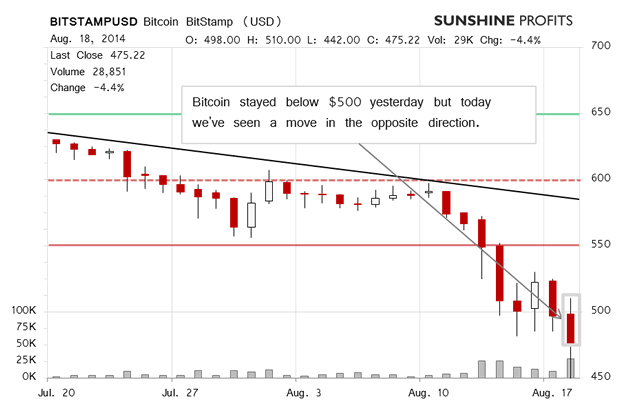
Yesterday, Bitcoin went further down, to around $475. The volume was significant, the highest during the whole recent decline and the highest since Apr. 25. Yesterday was a significant day in the Bitcoin market. In our last alert, we wrote:

(…) the recent move down has already been quite strong. There was a surge in volume and now we’re seeing less trading than earlier during the decline. We’ve already seen a strong move down being followed by a breather (Saturday) and more depreciation (yesterday and today). This might suggest that most of the move down is already behind us.

On the other hand, what we’ve seen today (this is written before 8:30 a.m. ET) still looks like a pretty pronounced move down. These two hints give us a mixed picture.

What might be decisive now is the fact that we’re getting close to $450, the level at which Bitcoin stabilized in May and the starting level of the last strong rally (May-June). This level might stop the declines.

So far (this is written before 7:15 a.m. ET), $450 has in fact stopped the decline. The action today hasn’t been decisive in any direction but it seems that we might be seeing the beginning of a reversal. The volume, however, is lower than yesterday. This weakens the implications of today’s action.

34862 b-1

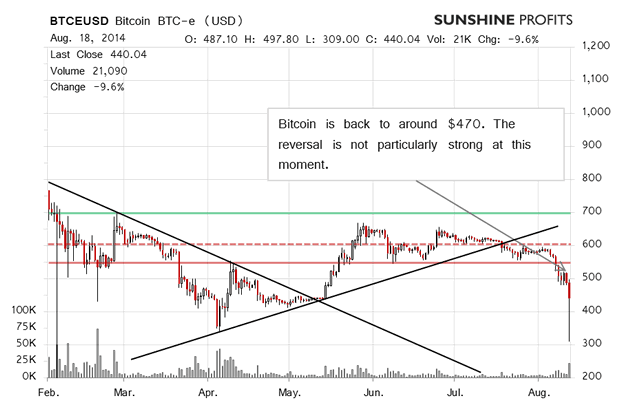
On the long-term BTC-e chart we saw a strong move down yesterday on explosive volume. As we’ve already mentioned, Bitcoin hit $309 at one point during the day before coming back to around $440 at the end of the day.

Today, we’ve seen a move up on lower volume. This move has been more visible than the action on BitStamp but the volume doesn’t quite support a reversal. It is only natural to ask yourself if we’re actually seeing the beginning of a new rally now. This is what we’ve done. We share our insight with you.

Currently it seems that the action today supports a reversal at this time. This is not supported by volume which makes us weary of long speculative positions at this time. Whether Bitcoin closes the day higher than yesterday (or, at least, not much lower than yesterday) is one of two important signals of a possible change in the short-term situation.

The second indication of an improvement would be a move above $500. This is not automatic, mind. If we see a move above $500, we will still need to evaluate whether the situation supports a move up or if we’re seeing more sideway action.

Summing up, in our opinion no speculative positions should be kept in the market at this time.

Trading position (short-term, our opinion): no positions.

Oil Trading Alert: Crude Oil – Similarities to November

On Friday, crude oil gained 1.82% as news of escalating tensions in Ukraine outweighed mixed U.S. economic data. Because of these circumstances, light crude bounced off a support zone created by the Fibonacci retracement levels and came back near the previous lows. Will we see further rally in the coming days?

On Friday, data showed that U.S. producer price inflation rose 0.1%, core producer price inflation (without food, energy and trade) rose 0.2% in July and U.S. industrial production rose 0.4% in the previous month. Although these numbers were quite positive, the preliminary Thomson Reuters/University of Michigan consumer sentiment index dropped to a nine-month low of 79.2 in August (missing analysts’ expectations for a rise to 82.5), while the New York Federal Reserve said that its Empire State manufacturing index fell to a four-month low of 14.69 this month from 25.60 in July.

Despite these mixed numbers, geopolitical events in Eastern Europe supported the price. News that Ukrainian troops destroyed a portion of a Russian column of armored vehicles inside the country fueled concerns that the conflict will escalate and disrupt crude shipments out of Russia. As a result, crude oil bounced off the recent lows and came back above $97 per barrel. Will the rally continue? Let’s check what can we infer from the technical picture (charts courtesy of http://stockcharts.com).

34855 a large

Larger Image

In our Oil Trading Alert posted on Aug 6, we wrote the following:

(…) we should keep in mind that sell signals remain in place (despite the fact that the CCI and Stochastic Oscillator are oversold), which suggests that even if we’ll see a short-term improvement, the commodity may test the strength of the 200-week moving average (…) – similarly to what we saw several times in the past (for example in April, November 2013 and also at the beginning of the year).

As it is clear from the weekly chart, the situation developed in line with the above-mentioned scenario. Although crude oil reached our downside target in the previous week, this deterioration was only temporarily (at least from today’s point of view) and the commodity rebounded – just like in the past (we marked these points with green). As is well known, the history tends to repeat itself, therefore, we believe that crude oil will move higher from here in the coming week (or weeks). At this point, it’s also worth noting that oil bulls have an additional ally at the moment- the rising, long-term support line, which supports a pro-growth scenario.

What is the short-term perspective?

34855 b large

Larger Image

Quoting our Oil Trading Alert posted on Aug 6:

(…) if crude oil declines below the recent lows, closing the day below them, we may see a drop to the next downside target around $94.76-$95.21, where the strong support zone (created by the 76.4% and 78.6% Fibonacci retracements based on the entire 2014 rally and the Jan. 27 bottom) is.

Looking at the daily chart, we see that although crude oil declined sharply to the above-mentioned downside target on Thursday, the green support zone withstood the selling pressure, which triggered an equally strong upswing on the following day. Despite this move, the commodity still remains below the resistance zone created by the March low and the recent highs, which suggests that we may see a pullback later in the day. If this is the case, light crude could re-test the strength of the green support zone. Nevertheless, even if we see such price action, it seems to us that the next sizable move will be to the upside. The reason? When we take a closer look at the chart and compare the current situation to the one that we saw at the end of November, we clearly see that back then the support zone created by the 76.4% and 78.6% Fibonacci retracements successfully stopped the decline, triggering an upward move, which corrected over 38.2% of earlier losses. As we have pointed out before, the history tends to repeat itself, which suggests that we’ll likely see a similar price action in the coming days. In this case, we may see an increase to around $99.73-$99.96, where the very strong resistance one(created by the 38.2% Fibonacci retracement evel based on the entire June-Aug decline, the 200-day moving average and the black declining resistance line) is.

Before we summarize today’s Oil Trading Alert, we would like to draw your attention to positive divergences between all three indicators and the price of light crude (we also saw similar readings in November) , which suggests that corrective upswing is just around the corner.

Summing up, although crude oil extended losses and hit a fresh multi-month low of $95.26 in the previous week, it seems to us that the combination of the rising long-term support line, the 200-week moving average and the green support zone marked on the daily will be strong enough to stop further declines. Taking into account all similarities to the situation that we saw in November, we believe that the next move will be to the upside. If we don’t see a continuation of the decline today, we will strongly consider opening long positions tomorrow or in the following days.

Very short-term outlook: mixed with bullish bias
Short-term outlook: mixed
MT outlook: mixed
LT outlook: bullish

Trading position (short-term; our opinion): No positions are justified from the risk/reward perspective at the moment, but we will keep you informed should anything change.

Thank you.

The Bull Market In Equities Has A Long Way To Run

Summary

  • We have benefited from a prolonged multi-decade bull market in bonds and a sharp equity market rally post crisis.
  • The slope of the treasury yield curve indicates no change to current market trends.
  • Credit capacity is high for both commercial and household borrowing.
  • We are bullish on the US economy and US equity markets.

Equity markets in the US have bounced back over the past couple of weeks and have shown strong momentum to the upside. We are now well into the fourth year of a rising equity market and we might now reasonably ask the obvious questions: When this might end and how should we allocate our capital?

Lets put the current interest rate and equity market into historical context.

…….click image to continue reading

28399113-14083976163395042-Armchair-Quarterback origin


….click image to continue reading

  1. In any market, but especially precious metals, price pullbacks rarely proceed according to expectations. 
  2. Most “buying opportunities” are perhaps better defined as gulags and torture chambers. Regardless, it’s almost impossible to build retained wealth without enduring a significant amount of pain, so please click here now
  3. That’s the weekly CRB general commodity index chart. I’ve suggested that 2014 is a key year of transition, away from system risk and deflation, towards some growth and lots of inflation. 
  4. Lead by gold, the CRB began the year with a strong rally, as the Fed began to taper its QE program. The rally lost momentum in March, and a decline began in June. 
  5. The 284 – 287 area is a key Fibonacci and HSR (horizontal support and resistance) zone. Note the position of the 14,3,3 Stochastics indicator, aka the “weekly chart stoker”. Downside momentum appears to be waning, and gold has outperformed most commodities during the decline.
  6. The next intermediate trend movement for the CRB index, and for gold, should be to the upside. 
  7. On that note, please click here now. At about 2PM on Wednesday, the next FOMC minutes get released, and key US housing start numbers will be reported today. The bottom line: With the CRB index approaching solid support, any gold-negative news is not likely to move the price of gold lower than $1275.
  8. The upside numbers of importance are $1325, $1347, and $1392. This is a different market than it was, when QE was the main theme of global gold price discovery. While it will likely take much longer than most investors expect for gold to rise significantly, it will still rise, and gold and silver equities are poised to do extremely well.
  9. A lot of gold analysts believe that the Dow is poised to collapse, and when it does the Fed will bring back its QE program, causing the price of gold to soar. 
  10. Unfortunately, I think they are dead wrong. The Dow is certainly overdue for a significant sell-off, but most value investors are on the sidelines now (including myself), and they would likely buy any decline of size. As the economy builds momentum, factory capacity utilization continues to grow, creating inflation. 
  11. The money created by QE is likely to make higher inflation appear faster than a normal economic upswing would, and many institutional money managers would be likely to buy gold stocks rather than gold, as that happens. Gold is bought when system risk is perceived to be the main theme in play. Gold equities are bought when strong growth, and inflation created by that growth, are in play.
  12. In a worst case scenario, where the economic recovery suddenly stalls and reverses, I would emphatically argue that the Fed might engage in a one-time stimulus, but a return of QE is highly unlikely. 
  13. A return to QE would make the Fed look weak, which it isn’t.
  14. Instead, a “gold band” would likely be the next tool the Fed brings out of its tool box, if the economy crashed. 
  15. A gold price band is simply a watered down form of gold revaluation. In an emergency situation, the Fed could be authorised by the US Treasury to quickly establish a moderately higher trading band for gold, likely between $1500 and $1800 area. That would be phenomenal news for gold and silver equity investors, but perhaps not such good news for anyone caught holding giant leveraged short positions on the COMEX.
  16. Please click here now. That’s the GDXJ daily chart. Over the past month, most commodities have suffered nasty declines, while junior gold stocks have shown tremendous resilience. Note the nice green up channel that is now in play.
  17. Copper is in the news, and according to some mainstream media it is declining, and that’s “bearish” for commodities. Please click here now . The commercial traders are now slightly net long copper. Please click here now. This daily copper chart suggests there is little cause for concern about deflation. Note the bullish posture of my stoker oscillator, at the bottom of the chart! 
  18. The Western gold community is likely on solid footing in 2014 – 2015, regardless of whether the economy grows and creates inflation, or whether it suffers a black swan crash event. The weight of the evidence suggests that strong economic growth, and even stronger inflation, is what lies ahead over the next twelve months.
  19. While a number of lightweight analysts and mainstream media analysts have spent the past week comparing Chindian gold demand to the demand during the spring of 2013, heavyweight bank economists are focused on the overall bullish trend in play. Physical gold demand must be compared to a multi-year trend, not simply to QE-oriented selling of ETF holdings that occurred during the spring of 2013. 
  20. Please click here now. As this snapshot of SPDR holdings shows, once again Western investors have bought price weakness. Over the past week, SPDR holdings increased nicely, from the 795 tons area, to about 797. The new breed of SPDR investor is not QE-oriented. They’re likely inflation-oriented, and certainly strong-hand buyers of price weakness.
  21. Globally, there is a tremendous fundamental floor for gold. Please click here now. Thailand is a significant source of gold demand, and the top bullion dealers there are working on a spot exchange that could rival or even surpass the Singapore market. 
  22. China is also “on the move” in the gold world. Please click here now. This snapshot, courtesy of The Economic Times, shows China adding 3 more gold importers to its roster, with the goal of bolstering its role in global gold price discovery. 
  23. Please click here now. This chart compares the US dollar to the Indian rupee. There’s a bearish wedge in play for the dollar, and the central bank is generally quite happy with the current trading range. 
  24. With interest rates at 8%, the Indian central bank is likely to embark on a modest rate cutting cycle in 2015 -2016, while the Fed gently tightens, in response to growing concerns about inflation. That could cause enormous amounts of capital to flow into Indian equity markets, and out of US stock and bond markets. Gold benefits tremendously, from these twin price drivers. As an asset, gold feels spectacularly strong in its year of transition, and it’s getting stronger…. every day!

Aug 19, 2014
Stewart Thomson
Graceland Updates
website: www.gracelandupdates.com
email for questions: stewart@gracelandupdates.com 
email to request the free reports: freereports@gracelandupdates.com

Tuesday Aug 19, 2014
Special Offer
: Send an email to 
freereports@gracelandupdates.comand I’ll send you my free “silver hyper trader” report. I’ll show you how to place silver trades with stop losses, on the 60 minute chart, to maximize reward and minimize risk!

Graceland Updates Subscription Service: Note we are privacy oriented. We accept cheques. And credit cards thru PayPal only on our website. For your protection we don’t see your credit card information. Only PayPal does.

Subscribe via major credit cards at Graceland Updates – or make checks payable to: “Stewart Thomson” Mail to: Stewart Thomson / 1276 Lakeview Drive / Oakville, Ontario L6H 2M8 / CanadaStewart Thomson is a retired Merrill Lynch broker. Stewart writes the Graceland Updates daily between 4am-7am. They are sent out around 8am. The newsletter is attractively priced and the format is a unique numbered point form; giving clarity to each point and saving valuable reading time.

Risks, Disclaimers, Legal
Stewart Thomson is no longer an investment advisor. The information provided by Stewart and Graceland Updates is for general information purposes only. Before taking any action on any investment, it is imperative that you consult with multiple properly licensed, experienced and qualifed investment advisors and get numerous opinions before taking any action. Your minimum risk on any investment in the world is 100% loss of all your money. You may be taking or preparing to take leveraged positions in investments and not know it, exposing yourself to unlimited risks. This is highly concerning if you are an invetor in any derivatives products. There is an approx $700 trillion OTC Derivatives Iceberg with a tiny portion written off officially. The bottom line:

Are You Prepared?

test-php-789