
Timing & trends
This is a quick, executive summary of the week’s stories, with a link to the full articles online …
Death of the Old Guard
The world’s elite money people gathered in cozy Jackson Hole, Wyoming, to discuss monetary policy. Are they in tune with what is really happening? Mike Larson takes a look at this Old Guard of monetary policy. Click here to read all about it.
 Gold Mining Shares: New Great Buying Opportunities
The last time gold mining shares were as undervalued and neglected by investors as they are now was in 2008. The index of mining stocks then soared 266 percent in just two years. Will history repeat over the next few years? Mike Burnick examines the opportunities ahead for gold and mining stocks. Click here to read more.
Retailers in Focus
Many observers have dismissed traditional retailers as being unable to compete in the near environment, where on-line sellers are dominating over the brick-and-mortar peers. The sector is drawing particular attention right now, with the companies coming off their second-quarter reporting season. Are there opportunities left in the sector? What’s the future? Don Lucek takes a look. Click here to read more.
A High-Yield Investment
 Do you know what a BDC is and the investment opportunities offered by the sector? Bill Hall takes a look. Click here to read more.
A Monster Investment
Here we are again with markets that react positively to negative news, especially now when many people are fretting over the possibility of interest-rate hikes. Jon Markman looks at this and other issues, including a Monster investment. Click here to read more.
Reflections on a World Going Mad …
What a mess the world is in today. It’s more important now than ever to protect and grow your wealth. How do you do that? Larry Edelson gives you a clear road map. Click here to read more.
Mike Larson — The Week’s Hot News
Money and Markets columnist Mike Larson takes a look at key financial and political events around the globe after the market close. Here are the week’s highlights:
Making Money From Energy Requires Tearing Up the Old Playbook! Click here.
Wage Earners Get Stiffed! Millionaires Get Rich (er)! Click here.
Sick of Paying Tolls? Then Buy Energy “Toll Road” Stocks! Click here.
Long-Term “Car-gage” Loans the Road to Disaster? Click here.
Best wishes,
The Money and Markets Team
The post Gold Stocks, High Yields, Retailers and More … appeared first on Money and Markets – Financial Advice | Financial Investment Newsletter.

 At 90 years old and still going strong, the Godfather of newsletter writers, Richard Russell, warned about a new and terrifying government confiscation that people now need to worry about. The 60-year market veteran also discussed major markets, gold, inflation, and included four fantastic charts as well.
“Since 2007, the world’s central banks have collectively put more than $10 trillion into the financial system. This kind of money printing is literally unheard of in modern history. And it has set the stage for a roaring wave of inflation.” — Graham Summers, analyst
Russell: “We got the news out of Germany, the economic engine of Europe. For the second quarter Germany’s GDP was down .02%. Meanwhile Europe’s second largest economy, France, is flatlining. Italy, number 3, is in recession, and the rest of Europe is floundering. A recessionary Europe is bound to hit US exports. Now every nation wants a lower currency to aid their exports.
The key to the picture is expressed in this opening sentence from a front page column in Financial Times — “What does it take to persuade the European Central Bank to start quantitative easing?” Being in recession, the euro should be in trouble.
With the world in a deflationary recession, I now doubt we’ll see new highs in the D-J Averages. But with enough QE, it might be possible.
With deflation enveloping the world, investors have been racing to buy Treasury bonds, whose yields have sunk to record lows. My survival choice in investments continues to be silver and gold — the physical kind if possible.
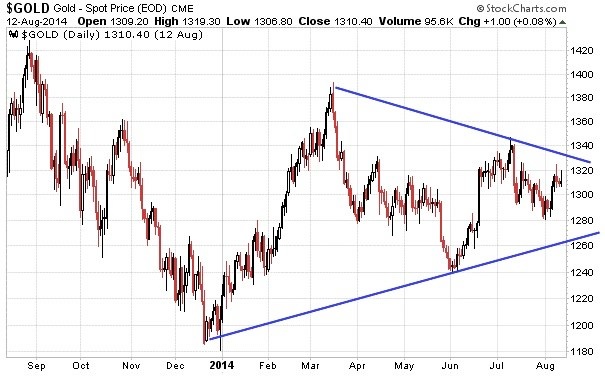
Below we see Gold forming a huge symmetrical triangle pattern. A rise to 1330 would move Gold above the upper trendline of the triangle and would be a highly bullish move. My bet is that in due time, Gold will break out above the upper limits of the triangle. If that happens, Gold will move into a new and powerful phase of its bull market.
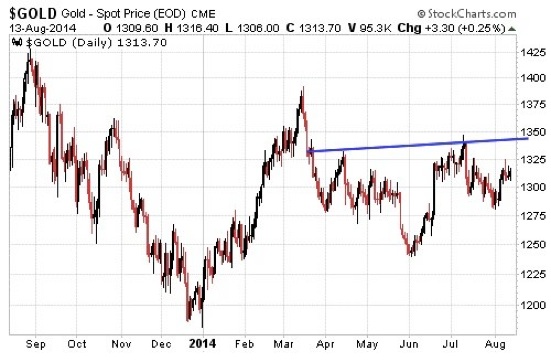
 Below is another chart of gold. Here we see a potential head-and-shoulders bottom in gold. Gold is now “working” on its right shoulder. A price of 1350 would be needed to complete the pattern. At 1350 I would expect gold to rocket higher.
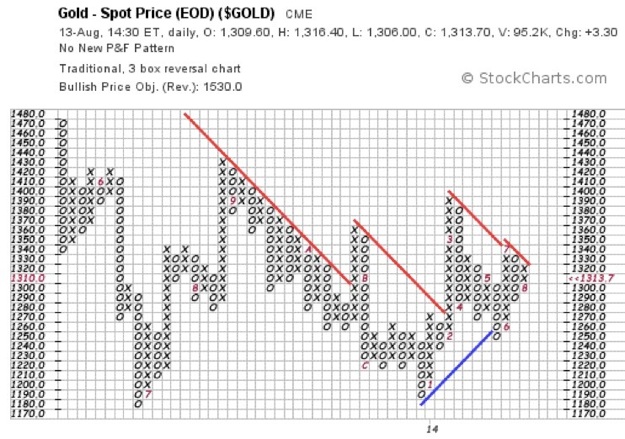
Wait, I’m not finished yet. The P&F chart below looks to me like a coiled spring. If gold hits the 1350 box, then technically this base could send gold into the 1500s. Meanwhile, we await the action of the market. Incidentally, if gold does break out to the upside, I think it will be telling us that the Fed will towards more QE.
In the good ol’ days from the 1800s into the 1930s every country was on the gold standard. This meant that you could take your paper money to a bank, turn it in to a teller and receive gold coins. Each nation had its own gold coins and it is notable that when the nation went off the gold standard and you could no longer collect gold for your paper money, in due time that paper money lost purchasing power, until ultimately it became worthless. This also occurred to the US dollar, which since it went off the gold standard in 1933 has lost 95% of its purchasing power. For your interest, I show 20 of the leading nations’ gold coins, with the amount of gold content (GC) shown in each.
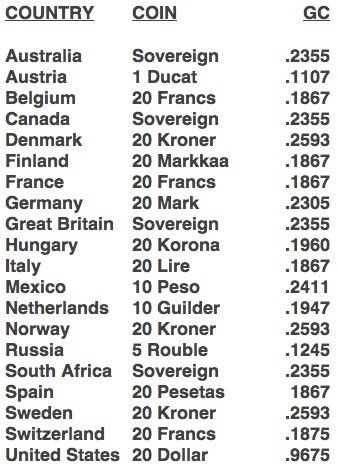 The sovereign was minted in seven different locations depending on the British controlled nations. The sovereign was the most widely recognized gold coin in the world. Now, with the US gold standard eliminated, it seems only a matter of time before the dollar’s purchasing power dwindles to nothing.
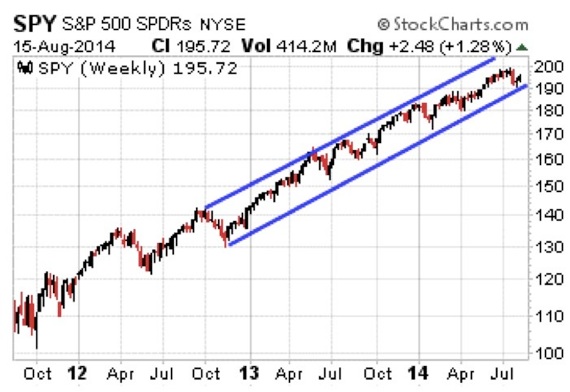
Is there one chart that is key to the whole market picture at this time? I think the chart below may be it. Here we see the SPY crawling up a three-year channel. A price of 190 would take the S&P below the lower trend line. At 190 the rate of ascent would be ruptured.
What are the chances that this long channel will be violated? Frankly, I thought the stock market would head higher, but I’ve learned not to argue with my charts. Clearly the SPY is now testing its lower trend line and only Mr. Market will tell us whether this trend line is fated to hold.
Today it finally happened: I received an advertisement from a firm featuring a scare I’ve been waiting for. There are two ways for the government to handle its outrageous debts. The first is reneging, as per Argentina, but this is unthinkable. The second way is via inflation — inflate enough and your debts appear to shrink.
Ah, but there’s a third way, and it’s confiscation of wealth. Don’t think this is impossible, because governments will do whatever they have to to remain in power. How about confiscating all individual wealth above $200,000, for which the government will give you stubs which will say IOU. This will be a switch on the 1933 confiscation of gold. This time it may be confiscation of cash. Finally, something new to worry about.”
King World News note: I would encourage everyone around the world to sign up for Russell’s commentary. Russell witnessed the Great Depression firsthand, he flew B-17 bombing missions in World War II, and he has studied markets for 60 years. To subscribe to legendary Richard Russell’s Dow Theory Letters CLICK HERE.
© 2014 by King World News®. All Rights Reserved. This material may not be published, broadcast, rewritten, or redistributed. However, linking directly to the blog page is permitted and encouraged.
IMPORTANT – KWN has many more interviews being released today.
The audio interviews with Bill Fleckenstein, Gerald Celente, James Dines, Michael Belkin, Dr. Paul Craig Roberts, Andrew Maguire, Art Cashin, Michael Pento, MEP Nigel Farage, David Stockman, John Hathaway and Marc Faber are available now. Other recent KWN interviews include Jim Grant and Felix Zulauf — to listen CLICK HERE.
Eric King

With gold again on the decline, it’s time to take a look and focus on gold’s big picture.
This eases a lot of doubt, especially when companies like Goldman Sachs are bearish on commodities. We’ll focus on silver and palladium too.
GOLD: Still looking good
Looking at gold’s big picture since 1968, you’ll see what we mean.
Chart 1A shows that gold’s decline of the last few years looks small in the big picture, within the mega uptrending channel since 1968.

Note that gold has had two major bull markets, in the 1970s and in the 2000s.
The major rise in the 70s didn’t break its bull market red uptrend until several years after the peak in 1980.
The bull market red uptrend since 2001, however, is still intact. On a big picture basis, it’ll be important to see if this trend holds.
That is, as long as gold stays above the lows of last year, at $1210, this trend will stay solid.
And according to gold’s leading long term indicator (B), it’s extreme low area…
Since these low areas tend to coincide with bottoms in the gold price, this tells us that gold is totally bombed out and the lows of last year are unlikely to be broken.
All things considered, it increasingly looks like 2015 could be the year of a strong change to the upside.
SILVER: Big Picture is bullish
Silver is similar to gold (see Chart 2). It’s still in a major uptrend since 2002 within an almost 50 year uptrending channel. And its leading indicator is similar to gold’s.

Silver tends to outperform gold when both are bullish. So once gold starts rising in earnest, silver could then make up for lost time.
PALLADIUM: In its own league, but also leading
Palladium has risen 21% this year. It’s clearly one of our star performers.
It’s actually been in a perfect storm type of situation this year (see Chart 3).
Palladium is produced by Russia and South Africa. The ongoing tensions in Russia and uncertainty have been keeping palladium strong. The long strike in South Africa gave the extra push upward.

Palladium’s big picture is bullish. The chart shows palladium approaching its 2001 record high area, as it continues heading towards the top of its 44 year upchannel.
Its leading indicator also backs up a bullish scenario. Technically and fundamentally, palladium is set to rise much further.
You want to stay onboard! For now, that goes for gold and silver too.

 Are you prepared for an “exit”? If the Fed pursues an “exit” from ultra low interest rate policy, are you prepared for an exit from the stock market should things turn South? We discuss how investors prepare, noting the most common mistakes investors make along the way.
Are you prepared for an exit?
No, you are not. We know because we meet investment advisers that have dropped their defensive strategies because they were losing clients. Those we meet that say they are prepared think they can get out at the right time should the markets topple over as the Fed exits; our guess is pigs will learn to fly before many will get that timing right. And those who don’t rely on luck are the first to tell us they don’t think they are fully prepared, as it’s rather difficult to predict how things will unfold.
Should you prepare for an exit?
There’s a group of investors that say an “exit” is ludicrous – there’s no way the Fed will pull off an exit.
It turns out we sympathize with that view, but think getting ready for a Fed exit is still paramount. As I wrote in my book Sustainable Wealth, a prudent investor plans for different scenarios. Any scenario that has a non-negligible probability with a potentially profound impact on one’s portfolio should be taken into account. We don’t really have to go much further than this, as all we have to do is look at today’s market: in today’s markets, risk premia are highly compressed. This may sound academic, but what it means is that investors downplay the risk embedded in risky assets. We can see that through investors bidding up junk bonds and buying debt of weaker Eurozone countries. We can also see it in the stock market, where volatility is lower than what has historically been considered normal (i.e. the VIX index is at an unusually low level). In plain English, this means markets may be priced to perfection. And that’s where the problem is: the world isn’t perfect. As such, just the hint of a Fed exit might cause havoc in the market, even if it is never actually pursued. Please read ‘Instability the New Normal‘ for an in-depth analysis on how this may unfold.
Five common mistakes investors make
The much more difficult question is how does one prepare in earnest for an “exit.” After all, any strategy not fully invested in the stock market appears to have under-performed. What not to do is a lot easier to say than what to do. Five common mistakes investors make:
• Feeling like you’re losing out because you’re not keeping up with the stock market. No:you should develop a financial plan tailored towards your circumstances. You should not care how much the guy or gal next to you, or the “market” makes.
• Feeling like you haven’t saved enough for retirement and as a result should invest in the stock market to make up the shortfall. No: Warren Buffett got to the point when he said: “The stock market has a very efficient way of transferring wealth from the impatient to the patient.” The prudent investor waits to find good values; the impatient investor is bound to invest at the top by chasing trends.
• Feeling like you can’t invest more because you don’t make enough money. For most,spending, not income is the problem. Remember the days back in college when you could live off very little? Spending $80 a month on a phone bill is a luxury, not a necessity.
• Not spending any time researching investment options. Many spend more time researching which HDTV to buy than researching an investment. Just because you can buy the world with a push of a button, doesn’t mean you should. You worked hard to earn those savings; now spend a little time researching what to do with your savings.
• Not understanding true diversification. Diversification is not about labels, but correlation. When policy makers are very engaged in the markets, asset prices may no longer reflect fundamentals, but instead reflect the next perceived intervention by policy makers. In practice, this has meant that many investments have been highly correlated in recent years. Differently said: if everything has gone up in your portfolio of late, you have a problem.
How do you prepare for an exit?
All successful investment strategies I have encountered have in common that they are based on a plan. A plan that takes into account where one comes from, where one is planning to go; how one intends to get there, with appropriate checks along the way. If this sounds obvious, you would be surprised how few are adhering to these basic principles. And why would I mention these basic principles in the context of a Fed exit? Two reasons: first, one should not lose sight of basic investment principles in addressing any one situation; and second, the best of plans are impacted when others are not living up to their part of the bargain. What I’m referring to is that the Fed – which arguably has a profound impact on asset prices – does not appear to follow those basic principles in conducting monetary policy. The only thing we really know about the Fed’s so-called exit is that Janet Yellen would like to keep monetary policy accommodative to help the convicted felons get a job (as discussed in her first policy public speech since becoming Fed Chair). This characterization may sound unfair, but it’s the simplistic conclusion I have to draw when given her focus on employment, her expressed desire to help ‘Main Street,’ the fact she has never pushed back when being labeled a dove, and her rejection of a rules-based framework to monetary policy.
That said, let’s address these basic principles in the context of an exit:
Where we came from: This did not start in 2007 or 2008, but has long been in the making. For in-depth analysis over the past 10 years, please read up on our Merk Insights. For purposes of today, we shall note that investors were burned in 2000, as well as in 2008; wages for many have stagnated. We have endured years of low interest rates, making it difficult if not impossible for many pensioners to live off the income generated by their fixed income investments. Many investors have moved to embrace a riskier mix of investments than they are comfortable with, but stick with their allocations as long as they don’t get burned. To us, this increases the odds of a crash, as those investors may not stick around when the going gets rough.
However, we know a few things about this journey: geopolitical tensions have been rising. In ‘Instability the New Normal‘, we argue that this is a symptom of the times as policy makers blame minorities, the wealthy, and foreigners when they have trouble balancing the books; rarely ever do they blame themselves. Government deficits are not sustainable; yet, there might not be enough wealthy to tax, either. In that environment, central banks may be pressured to keep rates lower for longer; in fact, we recently argued we might see negative real interest rates for years, even as nominal rates may rise. In a best-case scenario, as we have seen in recent years, this may inflate asset prices, but it may be foolish to base one’s long-term outlook on such gains to continue. Instead, financial repression may persist.
We live in an environment where both government and consumers are heavily indebted, with foreigners owning much of the debt, creating the perverse incentive to debase the value of the debt (through inflation or a weaker currency) to have foreigners that don’t vote hold the bag. As someone with savings, don’t trust your government to take care of you. This applies whether you are based in the U.S. or many other countries. You are on your own.
How to get there, with appropriate checks: If you just avoid the five mistakes listed above you are already in much better shape than most to achieve your goals. Checking one’s progress applies during good as well as during bad times. When times are rough, remembering one’s priorities (to cut back on unnecessary expenses, continue putting money aside for key goals) is important. When times are good, it’s important to take chips off the table, to rebalance one’s portfolio.
At times, I see investors be reasonably diligent about choosing an investment, but then fall into the trap of justifying one’s investment at any cost. A good cross-check of whether to keep an investment is whether the conditions that lead one to invest in the first place persist. Meaning, if one buys company ABC because of good management, then reflect on whether management is still good. If one buys it because of great earnings momentum, well, are earnings still growing? If one buys it because it was cheaper than its peers based on some metric, then, you guessed it, does that still apply? As you might imagine, buying a stock – or ETF – because some pundit recommended it on TV is a bad idea, as you are unlikely to be around when he or she changes his or her mind.
A great way to check one’s portfolio is to have it stress-tested against different scenarios. A great temptation in today’s social media driven world is to only listen / like / follow folks one agrees with. But to make a market, we need disagreement amongst voluntary participants. A key reason we publish so much is to engage the public in an effort to receive feedback, so that we can consider viewpoints we might have ignored. An extreme example of that was in the summer of 2012 when we published the Merk Insight ‘Draghi’s Genius‘; we did not change our mind upon receiving an avalanche of disapproval, but it kept us on our toes. Similarly, we encourage anyone to look beyond their circle of friends to get out of their comfort zone when it comes to testing investment ideas.
Putting it to work
Just as former Fed Chair Bernanke was talking about his toolbox, investors may want to consider assembling their own tools to navigate what’s ahead. Note:
• Cash is an asset class. Investors don’t like to pay their advisers for holding cash. There are clear downsides, as I would even go as far as arguing that cash isn’t even risk free given that your purchasing power is at risk. Still, cash that should come with minimal interest rate and credit risk plays a role (I say “should” as not all ‘cash’ is created equal). If you manage your own money, don’t be afraid of cash; if you have someone manage money on your behalf, don’t hold it against them if they stay on the sidelines – they might be protecting you from potential losses elsewhere.
• If you are looking for diversification in today’s environment, consider alternative investments. At a recent conference on alternative investments, a large wealth manager argued – and I would agree – that 20% of alternative investments in a portfolio are advisable if one wants it to have a real impact on performance. If I look at the portfolio allocation of Harvard’s Management Company in 2013, they only had a U.S. equity allocation of 11%, but when it comes to alternatives, aside from a 16% allocation to private equity, they held a 15% allocation to absolute return; a 2% allocation to commodities; a 13% allocation to natural resources; importantly, they did not feel the need to chase yield, with a high yield allocation of only 2%. This isn’t investment advice and we are not suggesting everyone should replicate Harvard’s allocation, but this should give food for thought.
• Stocks might crash. Having just mentioned an asset allocated with an infinite investment horizon, it may be counter-intuitive to now caution about what may happen in the near to medium term. I can tell you that I’m personally concerned about a crash and am taking precautions. To the extent investors are exposed to stocks, I would encourage them to consider a strategy that employs some sort of hedging or protection; if, indeed, the markets continue to soar, this allows one to participate in some of the upward move. An alternative, of course, is to simply reduce the market exposure and leave the remainder un-hedged. It’s just that if you were to ask me for my favorite investment idea today, it is to get ready for a severe correction in the market; as such, at the very least, I like to have cautioned investors.
• Bonds might be one of the worst investments over the next 10 years. But aren’t bonds supposed to rise due to so-called safe haven demand? They just might, and year-to-date bonds have done rather well. But the math doesn’t add up. If I look out 10 years, I don’t see how we can finance our deficits. Something has to change. I’ll leave it for others to find value in bonds. Personally, I don’t want to touch them with a 10-foot pole.
• The action may be in the currency markets. If I’m wrong on bonds it’s likely because central banks succeed in keeping rates low. But if they keep rates at artificially low levels, two things will happen: first, bonds won’t compensate investors for the risks they take. And second, there ought to be a valve, as the market can’t be fooled in the long-run. That valve may well be the currency markets. If bonds plunge central banks could step in to contain their decline, the currency may act as a valve. If you think this is only a problem for Japan, think again, as the U.S. is vulnerable to similar pressures. This is the key reason why we have made the currency markets our home turf, so that we may be able to stay a step ahead of policy makers as currency wars evolve.
• Gold as insurance? We may think the currency market is where the action is, but while investors have a (all too often misguided) view about the euro and the yen, it’s difficult to get investors excited about the Swedish krona. Frankly, we also like to keep it simple. And the simplest insurance against the mania of policy makers may well be gold. That doesn’t mean gold will always go up; it doesn’t even mean gold will go up more than, say, silver. But gold is influenced by fewer dynamics than other commodities because of its comparatively low industrial use. The fact that it’s ‘just a brick’ is a feature rather than a bug: because it’s not the gold that’s changing, it’s the value of the dollar or currencies. For more details as to why I own gold, please download “Why I Own Gold.”
We have a webinar coming up discussing in more detail and more specifically what investors can do to prepare themselves for a potential Fed exit from the ultra-low interest rate environment. Please register to be notified of our upcoming webinars.
If you haven’t done so, also make sure you sign up for Merk Insights. If you believe this analysis might be of value to your friends, please share it on your favorite social media site.

Editor’s Note: Folks are getting nervous that the Fed may be about to hike rates.
After all, it has already met its original inflation target of 2%. It has also already met its original unemployment rate target of 6.5%.
In today’s Weekend Edition, Bonner & Partners income analyst Jim Nelson reveals why this means big changes in one highly profitable income-investment vehicle.
He also reveals the unusual strategy he reckons is the single best way to boost your income today…
Everyone has an opinion on what will happen when the Fed finally raises rates.
Will stocks shrug it off?
Will they crash?
You can make an educated guess. But the truth is it’s impossible to know.
What we do know is that the mere threat of rising rates is already having a profound impact in one unusual, but highly profitable, income-investing vehicle…
If you’ve been following the news, you’ve probably heard of the $44-billion deal to consolidate the Kinder Morgan family of companies.
Kinder Morgan is the fourth largest energy company in North America. But it isn’t an explorer, driller, drilling-services company or producer. Instead, it owns interest in or operates about 80,000 miles of oil and gas pipelines. Think of it as a giant “toll road” that picks up fees for the use of its pipelines from energy producers and shippers.
But Kinder Morgan is also known for pioneering the master limited partnership – or MLP – structure… or at least what modern day MLPs look like.
If you’re an income investor, you’ll probably already know all about MLPs…
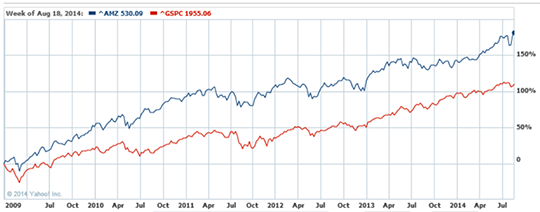
That’s because they have been one of the best performing sectors in the market. As you can see, MLPs (in blue, represented by the Alerian MLP Index) have crushed the stock market (in red, represented by the S&P 500 Index) as a whole:
If you’re not already familiar with this structure, don’t worry. MLPs are a tax vehicle developed in the 1980s. They are publicly traded – like an ordinary stock – but act as what’s known as a “pass-through entity.”
MLPs must derive most of their cash flows – about 90% – from real estate, natural resources and commodities. And they must pass their earnings directly on to shareholders… and to the general partners that manage them. If they can pass these two tests, they get generous tax breaks.
Up until now, the Kinder Morgan group has been made up of two pipeline MLPs, Kinder Morgan Energy Partners L.P. (NYSE:KMP) and El Paso Pipeline Partners L.P. (NYSE: EPB), as well as Kinder Morgan Management (NYSE:KMR), a holding company.
But the big news shaking up the income-investing world is that Kinder Morgan – in a deal that is set to become the second largest in the history of the energy business – will scrap its MLPs and roll the whole group into a single non-MLP entity.
This makes sense in a rising-interest-rate environment. Because MLPs retain almost no cash after paying their partners, new builds have to be financed through debt.
And this is where rising interest rates come into play…
If its debt costs rise, Kinder Morgan’s ability to expand and grow will be severely impaired. That’s the real business effect of rising interest rates.
By breaking up the partnership, its new owner will be able to issue new stock… hold back a portion of earnings… and operate these assets without the restrictions MLPs come with.
That may be good for Kinder Morgan. But income-hungry investors will lose out on a great deal. Kinder Morgan Energy Partners was yielding 5.7% a year — three times what the average S&P 500 stock yields.
Another potential source of worry for investors in MLPs is political…
Reuters recently reported that the IRS has temporarily stopped issuing the private letter rulings (PLRs) companies seek when setting up new MLPs.
There are also signs that MLP’s tax-advantage status is coming under new scrutiny at the Department of the Treasury.
In response to questions about this from Reuters, a Treasury spokesperson wrote:
We at Treasury are looking into the effects of these transactions on future tax revenues.
Instances where the tax base may be eroded serve as a reminder of why we need Congress to enact business tax reform that broadens the tax base and lowers tax rates.
The potential impact of rising rates, coupled with the potential for changes to the tax code, could spell the ruin of this income-rich sector.
So, what can you do to find alternative sources of income?
There is a way that is highly unusual – yet highly effective. It’s what the copywriters at Bonner & Partners call the “Instant Dividend” strategy.
It’s a pretty accurate description, actually. The income from this strategy hits your account instantly.
Don’t worry: It’s got nothing to do with the bond market. Or bank-loan ETFs.
And it’s got big advantages over dividend stocks, too…
The income payments it generates really are instantaneous. So, you decide exactly when to collect.
Compare that to dividend-paying stocks. These generally pay out on a quarterly basis. That means you have to wait up to three months to collect.
I even expect “Instant Dividends” to trounce the yields available on existing MLPs.
Here’s the entire story on Instant Dividends, so you can check it all out for yourself.

-
I know Mike is a very solid investor and respect his opinions very much. So if he says pay attention to this or that - I will.
~ Dale G.
-
I've started managing my own investments so view Michael's site as a one-stop shop from which to get information and perspectives.
~ Dave E.
-
Michael offers easy reading, honest, common sense information that anyone can use in a practical manner.
~ der_al.
-
A sane voice in a scrambled investment world.
~ Ed R.
Inside Edge Pro Contributors

Greg Weldon

Josef Schachter

Tyler Bollhorn

Ryan Irvine

Paul Beattie

Martin Straith

Patrick Ceresna

Mark Leibovit

James Thorne

Victor Adair