
Stocks & Equities
Last week I said, “It looks like the S&P 500 can clear 2,000 before our next pullback.”
The S&P 500 climbed above 2,000 each day this week in intraday trading, and closed above this key level Tuesday (2,000.02) and Wednesday (2,000.12).
Just prior to these new all-time closing highs, I suggested it was time to invest in stocks again. And at an individual stock-picking level, we’ve been closely following one S&P 500 component, United Parcel Service (UPS).
Let’s see how “Brown” is delivering this week. I’ll also reveal another name that’s looking ripe for a breakout …
UPS had dropped from a high of $105.09 to its price last week of $99.35. The approach discussed was to buy the stock and to buy a put to protection from any more downside action.
A couple weeks ago we exited the UPS put, and now the recommendation is to be long the stock. The put was closed out at $4.05. So the new cost basis is $97.25, which adds in the gain on the put.
The stock is at $97.38, as of Wednesday night’s close, so what was a loss is now a gain and we remain confident the low is in. Stay long the stock.
Stocks are generally on the rise, and our Market Crash Indicators remain at 75% invested for a second week after ending the third five-week period of 50% invested since we began that model.
At 75% invested, we suggest owning the SPDR S&P 500 (SPY). But another stock index, the small cap Russell 2000, is also on the rise.
Last week I said setups abound for the Russell 2000 but we needed “final” confirmation of the move (as opposed to trading on just the “potential”). We now have that confirmation.
The Russell 2000, via the iShares Russell 2000 ETF (IWM), is back above its last retracement from the May low to July high at $115.80.
This is looking like a breakout to buy.
Gold is also poised for a breakout. Gold via the SPDR Gold Trust (GLD) is stuck in a range here of $124 to $128, but keep in mind that September is usually a strong month for gold.
But Will September Continue
To Be Strong for Stocks, Too?
Next week the big dogs return to their desks and volume should improve as we enter the fall trading session.
Key to successful trading in the fall will be tracking volume.
Remember, for every buyer there is a seller … BUT the price at which shares are sold determines whether the buyers or sellers are in control.
A tool I use called the Erlanger Volume Swing (EVS) tracks up-to-down volume. It’s excellent for determiningwhen trading volume is really positive or negative, as opposed to “kind of” positive or negative.
Total volume for the period being reviewed is divided into two portions according to the position of the close between the period’s true high and true low.
- True high is the higher of the period’s high and the prior period’s low.
- True low is the lower of period’s low and the prior period’s high.
In other words, this volume indicator looks at the previous low and compares it to the current high.
If there is little difference, then the move is artificial and likely to fail. However, if day after day we observe a nice spread, then we know some large player is accumulating shares.
The importance of the EVS is to know when it is above or below 0. When it moves above 0, it is time to buy. It’s time to sell when it breaks below 0.
‘Volumes’ of Reasons to Buy IWM
As noted above, the Russell 2000 is starting to gain traction. So, let’s look at the EVS on the iShares Russell 2000 ETF (IWM).
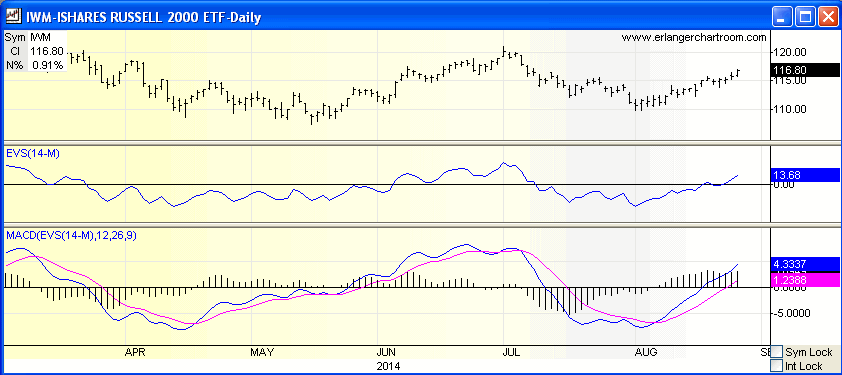
I prefer to look at EVS on both a daily and weekly basis. The daily EVS turned positive on the Aug. 19 close.
A nice way to track improvement on EVS is to create a Moving Average Convergence/Divergence (MACD) line on the EVS. Doing this produced an aggressive buy signal on Aug. 7.
The MACD confirmed when the signal and diffusion lines moved above 0 on Monday.
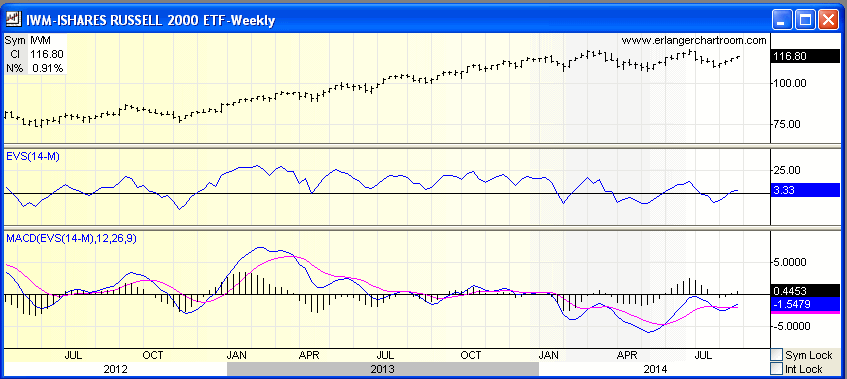
The weekly EVS is currently positive. It turned down the week of July 14 and positive again last week.
The weekly MACD on EVS is still below 0, but the diffusion line is above the signal line.
Even Light Trading Volume
Can Produce Strong Signals
Although moves in the market can be exaggerated by low volume, the EVS still works well in summer-light trading conditions. This model has done a great job of revealing legitimate buying activity.
Personally, I create my own scoring system using the daily and weekly EVS with the MACD on EVS. Currently, the daily gets 2 out of 2 points. One point is given for a positive EVS and a positive MACD on EVS.
The weekly get 1.5 out of 2 points. A point is given for a positive EVS and the MACD has yet to get a point. However, the cross nets 0.5, and the overall score is a 3.5.
This ranking system is my way of quantifying EVS across multiple time frames in such a way that I am right 75% of the time.
Bottom line, I will not buy a stock with a score below 2.5 and even then it would be started as a partial position.
Key to this fall will be the ability to buy weak stocks that have begun to rebound on the EVS from both a daily and weekly basis.
The IWM looks like a buy here because it’s breaking out, and I will be keeping a close eye on this indicator for more stock and ETF names to send your way in the coming months.
Cheers and Hit ‘Em Straight,
Geoff Garbacz

Quotable
“Well first of all, tell me: Is there some society you know that doesn’t run on greed? You think Russia doesn’t run on greed? You think China doesn’t run on greed? What is greed? Of course, none of us are greedy, it’s only the other fellow who’s greedy. The world runs on individuals pursuing their separate interests. The great achievements of civilization have not come from government bureaus. Einstein didn’t construct his theory under order from a bureaucrat. Henry Ford didn’t revolutionize the automobile industry that way. In the only cases in which the masses have escaped from the kind of grinding poverty you’re talking about, the only cases in recorded history, are where they have had capitalism and largely free trade. If you want to know where the masses are worse off, worst off, it’s exactly in the kinds of societies that depart from that. So that the record of history is absolutely crystal clear, that there is no alternative way so far discovered of improving the lot of the ordinary people that can hold a candle to the productive activities that are unleashed by the free-enterprise system.”
― Milton Friedman
Commentary & Analysis
Euro: High wire acts and hand grenades
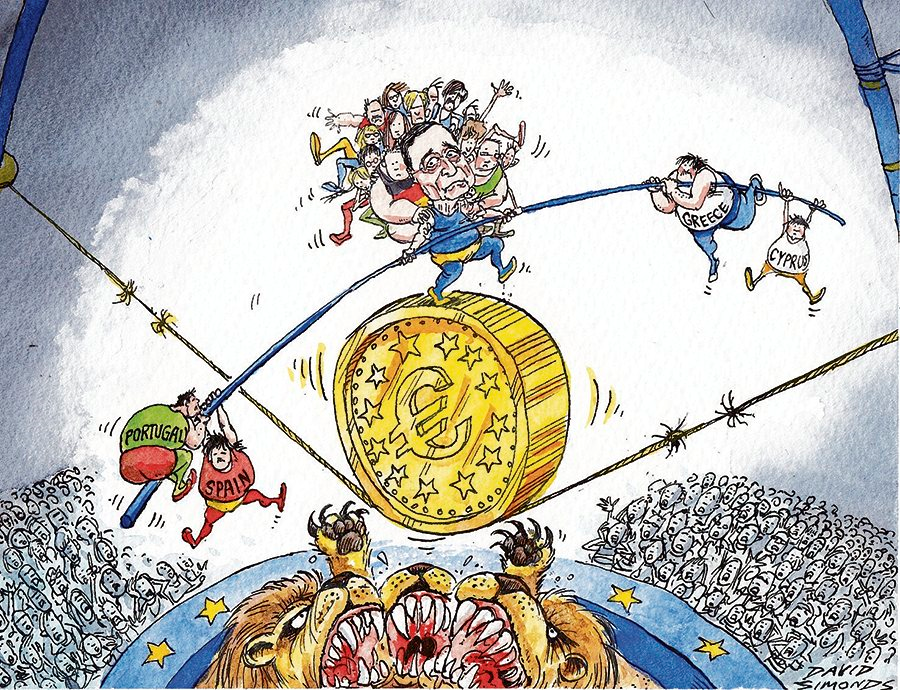
You’ve got to hand it to European Central Bank President Mario Draghi. He is a talented showman (and personally seems like the kind of guy you wouldn’t mind sipping a dram or two with). If he worked in a circus he would be the hi-wire act—a real daredevil who juggles a bowling ball, chain saw, and wheel of cheese as he inches along the wire; with no net of course. And to make it even more interesting, imagine in the middle of Mr. Draghi’s death defying feat, some French guy stands up and throws a hand grenade into the center ring. I think that is what just happened this week.
Two days ago…from The Guardian:
“France has entered uncharted political waters after the Prime Minister, Manuel Valls, presented his government’s resignation amid a political crisis triggered by his maverick economy minister who called for an end to austerity policies imposed by Germany.
[Arnaud] Montebourg, 51, [French economic minister] fired his first broadside in an interview with Le Monde on Saturday and followed up with a speech to a Socialist party rally the following day. In a veiled reference to President François Hollande, he said that conformism was an enemy and ‘my enemy is governing’. ‘France is a free country which shouldn’t be aligning itself with the obsessions of the German right,’ he said, urging a “just and sane resistance”.
As we say in the south: “Them is fightin words.”
In short, French economic troubles have been caused by the German’s adherence to fiscal discipline required under the single currency regime, according to Mr. Montebourg. I am sure none of France’s problems have anything to do with its nutty Socialism and incredibly inflexible labor policies. But the damage is done. The feces are now floating in the proverbial punchbowl for all to see.
It may or may not be Germany’s fault. Germany taxpayers have made real commitments to the zone while maintaining their individual balance sheet discipline, when others haven’t. So, whether right or wrong, it is a dangerous game indeed for the euro for high-level French officials to debate this stuff in public. The single currency could survive Greece leaving. It can survive the UK leaving the Eurozone. But it cannot survive if France says “game over.”
I guess the French policymakers either forgot, or don’t have a similar saying as we do in the US: Be careful what you wish for it may come true. What I mean is the French were very excited to get Germany to sign on to the single currency regime initially. They believed it was possible to financially control, or at least tame, Germany in a way that hasn’t proved possible on the battlefield. Silly idea indeed!
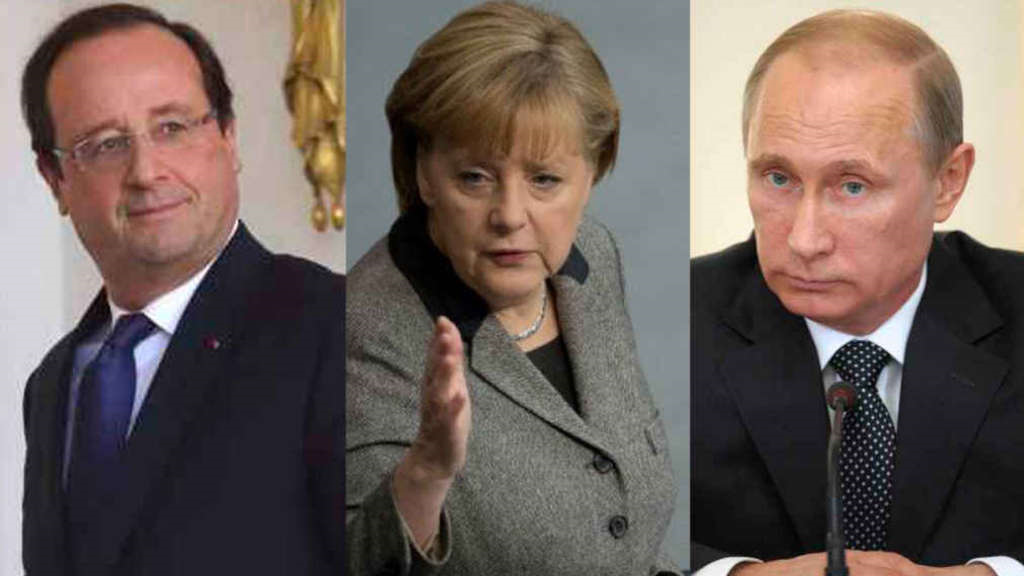
You think you’re a busy person, just think of German Chancellor Angela Merkel. She is in the midst of negotiating some type of stalemate between Ukraine and Russia before it turns into an unmitigated disaster for Germany and Europe (something US policy makers seem to be rooting for). She has to now figure out how to placate France and not be seen abandoning her commitment to fiscal responsibility across the Eurozone. Otherwise, all actions on that score and her credibility ring a bit hollow going forward. Yikes. And in addition, she has to run to the store and buy a disposable cell phone every other day to keep the NSA snoops away. Busy, busy, busy… Likely why she doesn’t vacation as much, or play golf and basketball every day of the week, no matter the crisis of the moment, as our President does.
Back on February 24th 2014, in Currency Currents, I asked the question: “Does Germany want deflation?” [Based on the email I received from that missive, it wasn’t a piece which endeared me to the average German citizen, shall we say. But please keep in mind when I pen these silly missives, I am almost exclusively talking about a country’s government policies—not its people. Heck, when it comes to lousy government, you can’t get much worse than where we are in the US now, given where we came from. I said to my wife the other day. It seems the United States used to export liberty, free market ideals, and decent cultural standards, for the most part. Now it seems we export war, regulation, and cultural rot, in my humble opinion. Try not to blame its people. Most of us aren’t happy with the path America is taking. ]
I’d like to share the payoff part of the piece I wrote back in February in light of recent French “concerns”…
And this from Leto Research shows how dominant Germany’s net international investment position has become since the euro single currency regime began implementation back in 2002:
“Germany leads the group of Eurozone net lenders with a net international investment position (NIIP) of €1.26 trillion or 51% of its GDP. This is almost as high as China’s net international investment position and much higher than China’s as a percent of GDP.
“Germany’s status as Europe’s premier lender was acquired as a result of the introduction of Euro bank notes in 2002. On that year, Germany’s NIIP was €107 billion or 5.1% of its GDP. Seven years later, in 2008, it had grown to €631 billion or 25.5% of GDP. Over the following five years of Eurozone debt crisis management, Germany’s NIIP doubled to €1,262 billion or 51% of GDP.”
Implications are these:
- Deflation would further improve Germany’s net lender position in Europe.
- Because net lending is a claim on assets, German industrial companies acquire more productive assets of periphery countries as deflationary pressures intensify.
Already the pressure on the periphery countries is leading to a brain drain of the best and brightest young professionals into Germany; or become recruits of powerful German companies in the region. Germany in effect is sucking the productive cream off of the Eurozone. Hats off—it is a brilliant strategy even if by happenstance—which seems unlikely to me.
—————-
As I said, it may be brilliant strategy on the part of Germany; and what is wrong with that? Countries don’t really have allies it seems to me. They have relations they find beneficial. They have countries they find dangerous. But all countries vie for position against those they do and don’t like. So should Germany be faulted for outsmarting and rest of the pack? Did everyone who joined the euro expect Germany to eventually be the sugar daddy out of altruism?
The fact is Germany has benefited from deflation and the austerity that caused it, when you consider its strategic positioning. That is not to say Germany wouldn’t have rather seen the Eurozone prosper; they likely would have because they effectively have a much lower currency to compete with using the euro than they would if they were still using the D-mark, i.e. they want that game to continue.
The question it seems to me for France to answer is this: Will France’s long-term competitive positioning as a country be benefited from remaining within the single currency regime (the gold standard in the Eurozone forcing deflation upon its members) or would it be better off to return to the French franc and be able to use its currency as a mechanism for cross-border competitiveness instead of wage and asset deflation? This question for the first time now seems clearly on the table—in full public view.
And while many are now focused on the French-German question, our hero Mario is still inching along the high wire doing his thing; trying to maintain focus on his technique and professional training. One slip and there is an even bigger mess in the center of the ring where the hand grenade just exploded.
Jack Crooks
President, Black Swan Capital
Twitter: @bswancap

“Interest rates on Treasury securities, which have been exceptionally low since the recession are projected to increase in the next few years as the economy strengthens and to end up at levels that are close to their historical averages (adjusted for inflation).” – Budget Outlook for 2014, Congressional Budget Office.

Had the Congressional Budget Office done the math, as outlined in the table above, it might not have appeared so nonchalant about the prospect of Treasury paying the historical average interest rate on the massive federal debt.
The historical average interest rate paid by the Treasury Department from 1990 – 2013 calculates to 5% and to 7% from 1971 – 2013. The current average interest rate paid by Treasury across the range of maturities is 2.4%. At 5% Treasury would more than double its interest payments from $416 billion annually to $867 billion. At 7%, Treasury interest rate payments would balloon to $1.2 trillion nearly triple the current interest payment annually.
Tax revenues amount to $2.8 trillion. As a result interest would take up 31% of revenues at the 5% average rate, and 43% at the 7% average rate. In short, the federal government might be seen by the rating services in either instance as ultra-high risk, or possibly even technically bankrupt. As it stands the St. Louis Fed puts the sovereign debt to GDP ratio for the United States at 103.3%. Anything over a 100% ratio is considered over-indebted.
Keep in mind that the federal government will have added nearly $1 trillion (or more) to the national debt when fiscal year 2014 comes to a close end of September, and no one sincerely believes that the borrowing is going to come to a standstill, or even that it is going to be cut significantly.
The federal government in short is ensnared in a debt and interest rate trap of its own making from which it will be difficult to extricate itself. Pundits and market analysts alike might believe that the Fed is going to raise interest rates at some point in the future, but the reality of higher interest rates might bring far worse consequences than can be achieved by simply staying the course. Some small, even token, rate hike is tolerable, but a return to historical norms could reap consequences in the general economy far beyond the direct effect on the federal government’s fiscal status.
It is a matter of convenience, perhaps even good politics, to be discreet about the relationship between the Treasury’s debt, its associated interest rate burden and the Fed’s ability to raise rates. Sooner or later, though, the Federal Reserve and the Treasury Department will be faced with the hidden and unavoidable consequences of raising interest rates to the historical norms, and the interest rate trap will becomes apparent to the financial markets, including gold. The Federal Reserve is already reacting to the problem by deliberately keeping interest rates down. Blaming that policy on the employment problem, though, might someday soon become a slight of hand played to an increasingly skeptical audience.
The implications for gold
The Everyman edition of Edward Gibbon’s History of the Decline and Fall of the Roman Empire comprises some six volumes and nearly 4000 pages. Rome was not built in a day and, as Gibbon’s work reveals, it was not lost in a day. What we are challenged to recognize with respect to U.S. monetary policy today is not an event, but a process. The decline of the dollar since the United States went off the gold standard in 1971 has not come in a handful of sudden, cataclysmic events like formal devaluations, but gradually and consistently, over a period of four decades coinciding with the steady decline of the dollar. That process is likely to continue.

Gold has had long periods where it gained in value during those four decades, periods when it lost value, and periods when the price was stagnant. The over-riding trend, though, has been to the upside. In fact the long-term linkage between the rising U.S. national debt and a rising gold price is one of the most enduring features of the contemporary fiat money economy president Richard Nixon launched in 1971. (See chart)
Since the early 2000s, when gold’s most recent bull market began, periods of stagnation like the one we are in now have reaped the highest rewards for the patient buyer. The lesson here is one as old as the gold market itself: The time to buy is when the market is quiet. As an old friend and client used to say (he recently passed away) when the market was stuck in the $300 range: It is not a question of if but when. He lived to see his prediction come true and his estate reaped a small fortune from his gold coin holdings.
The continuing inability of the U.S. federal government to come to grips with its fiscal problems largely explains the enduring, some would say stubborn, presence of gold coins and bullion in millions of investment portfolios around the world – including those of central banks, hedge funds and sovereign wealth funds. Until such time as fiscal rectitude takes hold in the halls of Congress — an unlikely proposition any time soon – current gold owners are likely to hold tight and new gold owners are likely to continue joining their ranks. In the end, contemporary gold owners by and large do not own gold to become wealthy, but to protect the wealth they already have.
“There’s a growing gap between what central banks are telling us about inflation versus what people are really experiencing in day-to-day life. There are a lot of reasons for this but I think it’s important to understand that [nation] states are broke, and therefore they are looking at ways to default on their own citizens. And inflation is one of those mechanisms. So it’s not surprising they don’t tell you that’s what they are doing.”
– Philippa Malmgren, former White House official, White House liaison to the Federal Reserve and member of the President’s Working Group on Financial Markets (Plunge Protection Team) ina King World News interview.
September Gold Notes
– Stocks are up about 2% year to date and gold is up about 8%. So after all is said and done – after all the saucy anti-gold and pro-stocks rhetoric is filtered through the various media – the inarguable reality is that gold has been a better performer than stocks thus far this year. . . .and by a significant margin.
– There is much talk about gold demand being down in China thus far this year, but that development needs to be put into context. Physical metal, not paper trading, dominates the China gold market. Simply put, today there is not as much physical metal available for China’s import as there was in 2013 when the London-Zurich-Shanghai pipeline was operating at full tilt. Most of that gold was sourced from ETFs and those funds are now once again net buyers of the metal. With ETF metal now off the table, of course China’s imports are down. Gold market pundits, both friend and foe, should stop fretting about short-term Chinese demand and focus on the fact that whenever large quantities of the physical are made available the Chinese are all too willing to take it up. Put enough physical metal on the market and you will see China’s imports rise.
– Gold stocks are said to lead the physical metal particularly when a major turnaround is in the offing. Gold stocks this year, using the XAU Index as an indicator, are up 25%. This bodes well for the metal itself going into the annual kick off to the Fall investment season in September. As noted earlier, gold metal is up 8% thus far this year – so there is a considerable gap between these two components of the gold market.
– “No wonder there is no joy in the land, even if the Dow Jones Industrial Average is bouncing in and out of record highs. The Obama presidency is nearing the final turn. Savers have been devastated. The market isn’t what it seems. No one wants to lend and no one wants to borrow. Unemployment is still above where it was when Congress gave the Fed a mandate to bring it down. A new Fed chairman has made jobs her signature. But will anyone at Jackson Hole ask whether it is the fiat nature of our money that got us into this hole in the first place?” – A recent New York Sun editorial
– Fiat money is probably here to stay, but its presence is easily addressed in the private investment portfolio through the simple expedient of gold ownership. Recall gold’s price history since fiat money was first introduced in 1971. Then recall its history since 2008 — and the dawn of the crisis which Jackson Holers still find themselves addressing six years later. As the Sun’s editor so incisively states in the same editorial quoted above:“We celebrate, say, the sages of Berkshire Hathaway. Yet the value of a share of Berkshire has plunged to something like 159 ounces of gold from the 269 ounces of gold a share was at, say, the day that George W. Bush acceded to the White House.”(Perhaps that nettlesome fact of economic life is what drives the Sage’s antipathy to yellow metal.) Put yourself above the jury-rigged economics — Jackson Hole or otherwise. Save in gold.
– Richard Russell remains one of my favorite analysts simply because he is about as down-to-earth as they come. In a recent interview at KWN, he warns of a stock market crash saying that “trees don’t grow to the sky.” He advises: “Stay with silver and gold and pray for the good of the nation. I must say that I’m fascinated to see how the US will deal with its surging and compounding debts. What worries me is the continuousness of those two eternals — Inflation and War.” Some more hard won wisdom from a money master: “I have picked silver and gold as my form of capital preservation. Both are trading solidly in fixed ranges, which is fine with me. If the stock market drops 25% and a money manager is down 23%, he considers it a good performance. That’s not the way I see it. If the stock market is down 25%, and gold remains in its trading range, I consider that an excellent outcome.”
– Ernest Hemingway: “The first panacea for a mismanaged nation is inflation of the currency; the second is war. Both bring a temporary prosperity; both bring a permanent ruin. But both are the refuge of political and economic opportunists.”
————————————
Michael J. Kosares is the founder of USAGOLD and the author of “The ABCs of Gold Investing – How To Protect and Build Your Wealth With Gold.” He has over forty years experience in the physical gold business. He is also the editor of Review & Outlook, the firm’s newsletter which is offered free of charge and specializes in issues and opinion of importance to owners of gold coins and bullion. If you would like to register for an e-mail alert when the next issue is published, please visit this link.
USAGOLD Review & Outlook is the contemporary, web-based version of our client letter, which traces its beginnings to the early 1990s under the News & Views banner. Its principle objectives have always been to keep our clients informed of important developments in the gold market; condense the available gold-based news and opinion into a brief, readable digest; and counter the traditional anti-gold bias in the mainstream media. That formula has won it a five-figure subscription base (and growing). In addition to our regular newsletters, we occasionally publish in-depth special reports that focus on events and developments of interest to gold owners.
Valued for its insight, accuracy and reliability, this publication is linked and reprinted regularly by a large number of websites both in the United States and around the globe. It also enjoys the goodwill of countless websites, individuals and organizations who contribute regularly to its content. To this group, we owe a deep debt of gratitude.
Disclaimer – Opinions expressed on the USAGOLD.com website do not constitute an offer to buy or sell, or the solicitation of an offer to buy or sell any precious metals product, nor should they be viewed in any way as investment advice or advice to buy, sell or hold. USAGOLD, Inc. recommends the purchase of physical precious metals for asset preservation purposes, not speculation. Utilization of these opinions for speculative purposes is neither suggested nor advised. Commentary is strictly for educational purposes, and as such USAGOLD does not warrant or guarantee the the accuracy, timeliness or completeness of the information found here.

Is a looming war coincident with a depressed gold price and a stock market peak an example of — staring into the great abyss?
From Peter Cooper:
“A five-year regime of artificially low interest rates is responsible for a bubble in stocks, bonds, real estate, emerging markets and many other asset classes…What would you rather own when staring into the great abyss?”
 James Rickards regarding the crisis with LTCM in 1998 and the banking crisis in 2008:
“What the crisis of 1998 and the crisis of 2008 had in common and what the next crisis will have in common is that regulators and risk managers are using the wrong models to understand and measure risk. And if you have the wrong models you will get the wrong results every time. … So the system becomes very vulnerable to a rapid collapse. … That’s why I’m expecting another financial crisis rather sooner than later.”
James Rickards on the Fed and money printing:
“So the Fed is trying the same remedies: The money printing goes on and the banking system continues to inflate which is setting us up for an even bigger crisis.”
The world has looked over the edge of the great abyss many times before. Supposedly the financial world was close to collapse during the LTCM crisis and also during the Paulson TARP crisis. Regarding another great abyss from Zero Hedge:
“In front of 3 witnesses, Bank of England Governor Eddie George spoke to Nicholas J. Morrell (CEO of Lonmin Plc) after the Washington Agreement gold price explosion in Sept/Oct 1999. Mr. George said, ‘We looked into the abyss if the gold price rose further. A further rise would have taken down one or several trading houses, which might have taken down all the rest in their wake. Therefore at any price, at any cost, the central banks had to quell the gold price, manage it. It was very difficult to get the gold price under control but we have now succeeded. The US Fed was very active in getting the gold price down. So was the U.K.'”
And today leverage and the derivatives market is MANY times larger than it was in 1998-99.
And the geopolitical situation seems much more dangerous and unstable than in 1998-99.
And the groups in the middle-east are most definitely not “playing nice” with each other.
And many more nations are bypassing the use of the US dollar for international trading.
And the mood of the people, so it seems, in Europe, the U.S. and the U.K. is much darker and less confident than in the “dot-com” exuberance of 1999.
And 9-11 and all of the after-effects had not yet happened in 1998-99.
The next crisis/correction/crash might be far worse than the 2000 – 2002 debacles or the 2008 financial crisis.
Further, US stocks look like they are in a bubble similar to 1999 and 2000. Consider the following monthly chart of the S&P 500 Index since 1984. Notice the blue line peaks in 1987, 1994, 2000, 2007, and 2014. A major stock market peak every 7 years deserves our attention, especially since it is peaking along with dollar and bond bubbles (generational low interest rates), massive global QE, geopolitical disasters, foreign policy failures, and the probability of new and devastating wars.

From General Martin E. Dempsey, U.S. chairman of the Joint Chiefs of Staff regarding ISIS and expanding the war in Iraq and nearby countries:
“This is an organization that has an apocalyptic end-of-days strategic vision that will eventually have to be defeated.”
The same article goes on to state that:
“Dempsey noted that destroying ISIS will require ‘the application of all the tools of [U.S.] national power – diplomatic, economic, information, military.”
And “truly defeating ISIS would require full scale war that would involve fighting in Iraq and Syria.”
The looming war coincident with an all-time stock market peak and other distortions is the edge of the abyss. A new war, a derivative crash, a spike in crude oil prices, another scandal, a dollar collapse, or perhaps a failure to deliver on gold contracts could trigger a stock market correction/crash, another massive debt increase, and an upward spike in the price of gold.
Gold has gone down for nearly three years, while the stock market has gone up for well over five years. The reversal may not occur tomorrow or next month, but it will occur.
This is, in my opinion, a time for caution in the stock and bond markets and for purchases of gold and silver. It is better to leave the Wall Street party early than to crowd the exit doors with about 500 million others who overstayed their welcome at the Wall Street “stocks always go up” extravaganza.
Furthermore the “high-frequency-traders” can levitate the S&P and suppress gold prices for only so long. Eventually the prices for bonds, stocks and gold will be reset in accordance with the realities of massive “money printing,” exponentially increasing debt, generational-low interest rates, huge deficits, escalating war in the middle-east, and Asian purchases of physical (not paper) gold.
Market peaks, market crashes, political crises, wars, deficits, debts, and cycles of confidence and despair seem to be inevitable in our current financial structure.
Are you prepared?
Additional reading:
Alasdair Macleod Ukraine: A Perspective From Europe
Clive Maund: Will the US Succeed in Breaking Russia?
The DI: Black Swans on Final Approach
Washingtons Blog: Former Mafia Crime Boss

Despite the lackluster dog days of summer trading in the financial markets — nearly every single market on the board is now reaching critical inflection points.
I told my Real Wealth Report subscribers all about it in my latest issue — including my specific recommendations on how to seize this moment in time.
In today’s column, I will tell you what I am seeing — plus I’ll give you a road map to help you see for yourself where the fireworks are likely to begin in each of the major markets.
But before I do, let’s take a look at the major underlying fundamental forces at work.
I’m not going to bore you with all the details, nor am I going to address the stuff of corporate earnings, balance sheets, economic stats, etc.
For in the end, traditional types of analysis don’t matter all that much today.
What matters the most today is the psyche of the financial markets and the forces they are truly responding to, each market in its own way.
I see two major fundamental forces at work impacting all markets:
 First and foremost is the ramping up of the war cycles that I have been warning you about for over two years.
They are based on scientific studies of both domestic and international war data extracted from the annals of Raymond Wheeler’s studies on war and subjected to rigorous fact-finding.Make no mistake about it: The cycles of war that I have studied — starting in my college years over 38 years ago — are real.
They are as concrete as the seasons of the year, and they tell you, in no uncertain terms, when society is likely to be most predisposed to conflict, both domestically and internationally.
The fact is that the war cycles are now ramping up all the way into the year 2020, and with an intensity that even I underestimated.
From Russia and Eastern Europe … to Nigeria … to Iraq and Syria … Jordan … Israel and Gaza.
From the Islamic State in Iraq and Syria (ISIS) killing thousands, beheading an American journalist, and threatening many more …
To China, brazenly occupying the South China Sea, the Senkaku and Spratly Islands, hunting down oil and gas resources, ignoring territorial rights of others, ready to wage war if need be …
To Ferguson, which is merely the beginning of civil unrest in our own country.
In Monday’s column, Martin told you how it is affecting families he personally knows in riskier parts of the world.
So imagine how geopolitical turmoil could be affecting large pension funds in other countries, funds with hundreds of billions of dollars.
Or large hedge funds whose managers are now adopting new trading styles — some even avoiding the commodity markets entirely, opting instead for venture capital investment in safer shores, like the U.S.
And if all that’s happening across the oceans isn’t bad enough, the war cycles won’t stop there …
Second, the draconian war-like measures that inept Western world leaders tend to implement every time their government’s balance sheets become bankrupt.
I’m talking about how leaders in Europe and the United States wage war against their own citizens.
How they hunt down the rich and raise a battle cry for class warfare … which later backfires by widening the gap between the rich and poor, often driving the rich out of town, along with their companies and jobs.
How they target the average citizen, by camouflaging hidden tax increases (such as Obamacare and the proposed myRA retirement plan) …
And how they brazenly implement actual wealth transfers from you to government coffers, such as Europe has done in the Cyprus haircut, forcing all bank depositors to pay when banks fail …
Or how they openly endorse the IMF’s recent 10 percent wealth surtax on every citizen, already in the works in Europe … and also actively considered behind closed doors in Washington.
Then there’s all that spying going on, all that trampling of basic rights to liberty, privacy and other basic freedoms.
It’s all part and parcel of how bankrupt empires fade away into the sunset, and we will be no different.
The ultimate end may be far away. But all of this is already beginning to have an astounding impact on financial markets.
The dollar for example, has now surged to its highest levels in almost a year, defying the pundits’ call for its immediate demise.
Or crude oil, its bear market about to end any day now, as it prepares for a major move higher.
Agricultural commodities, in a severe slump, but one which will end soon, leading to new bull markets in the prices of wheat, corn, soybeans.
Then there are the precious metals, where so many investors have given up hope: Yet despite the soaring dollar, gold, silver, platinum and palladium remain poised to soar in the weeks, months and years ahead.
Finally, consider the U.S. equity markets: The resilience you see in the stock market is for real, a sign of exactly what I’ve been warning you about …
That rising domestic and civil unrest and international conflict throughout the world is extremely bullish long-term for the U.S. equity markets.
Right now, my best advice is to watch my weekly system support and resistance levels, which I outline for you below, along with some short commentary.
For gold: Basing, building a new bull market. Importantly, the bullish forces for gold will gain complete control once the yellow metal closes above $1,406.80 on a weekly closing basis. But at no time must gold close below $1,259.90 — or the bear may suddenly return.
For silver: Same. Basing for a new bull market. Major resistance: $22.24. Major support: $19.20.
For mining shares, in general, per the ARCA Gold Bugs Index (HUI): Preparing for their next legs up. Major resistance: 252.43. Major support: 202.16.
Crude Oil: Current weakness putting the finishing touches on a major bottom formation. Major resistance: $104.35. Major support: $92.35.
Natural Gas: Same as crude oil, but extremely bullish long-term, with the potential to quadruple over the next three years. Major resistance: $4.1650. Major support: $3.58 to $3.72.
U.S. Dollar, basis the U.S. Dollar Index, nearest futures (DXU4): Just like the 1930s, the U.S. dollar is starting to show very resilient strength, due largely to frightened capital fleeing from other parts of the world, especially Europe. Major resistance: 82.330. Major support: 79.055.
U.S. Broad Equity Markets: The danger of a correction is still there. But, long-term, the U.S. equity markets are headed much higher. Via the broad-based S&P 500, major resistance is at 2,032.00. Major support: 1,889.50.
And remember, you can let me know what you think about precious metals, governments targeting their citizens, or anything else right here.
Best wishes, and stay safe …
Larry
The post A Road Map for the Markets … appeared first on Money and Markets – Financial Advice | Financial Investment Newsletter.

-
I know Mike is a very solid investor and respect his opinions very much. So if he says pay attention to this or that - I will.
~ Dale G.
-
I've started managing my own investments so view Michael's site as a one-stop shop from which to get information and perspectives.
~ Dave E.
-
Michael offers easy reading, honest, common sense information that anyone can use in a practical manner.
~ der_al.
-
A sane voice in a scrambled investment world.
~ Ed R.
Inside Edge Pro Contributors

Greg Weldon

Josef Schachter

Tyler Bollhorn

Ryan Irvine

Paul Beattie

Martin Straith

Patrick Ceresna

Mark Leibovit

James Thorne

Victor Adair