
Gold & Precious Metals
Oodles of readers want my head for turning temporarily bearish on gold again. They say I flip-flop too much.
They say I don’t know whether I’m coming or going. They think I’ve always been dead wrong on gold.
But the bottom line is this: I have nailed every major turn in the price of gold and other precious metals, including …
– The high at $850 in January 1980 and gold’s subsequent 20-year bear market.
– The precise bottom in September 2000 at $260 an ounce, just five dollars above the final bear market low at $255.
– The initial blast off that carried gold to over $1,000 an ounce by 2008.
– The 2008/2009 meltdown in all markets, when I told my subscribers to increase their allocation to gold from 15 percent to 25 percent, when gold fell below $700 …
– And they enjoyed gold’s next huge move up, which saw it explode higher all the way to $1,921 in September 2011.
And if that’s not good enough …
– On Sept. 18, 2011, I screamed from the rooftops that gold’s bull market was temporarily over, and that a three-year bear market would set in.
 I told my subscribers to get out of gold, or hedge. Two weeks later, I told my subscribers to exit all mining shares.
Fact is, I don’t know a single soul that has a better track record than I do in the precious metals and miners.
Yes, I did believe gold bottomed late last year at $1,180 an ounce. Yes, I did tell my followers to start getting their toes wet this past June. And I did believe that miners too had bottomed.
I was wrong. Though gold and mining shares did rally a tad, they essentially went nowhere. If you had acted on my forecasts and more importantly, traded lightly, you shouldn’t have suffered any major losses, and indeed, may have even made a little money.
Now, here are some more facts:
Fact #1: As I said last week, regardless of what the near term may bring, the long-term outlook for gold has not changed.
It’s still subject to powerfully bullish forces that will ultimately drive it to $5,000 an ounce and beyond — a massive flight to quality from investors around the world, due to the madness of bankrupt governments, rising geo-political conflict and more.
Fact #2: The extension of the bear market in the precious metals also opens up profit opportunities – to profit as the precious metals and mining shares decline. More on this in a minute.
Fact #3: As the precious metals and mining shares decline into early next year to their final lows, you will have even more opportunities to profit …
As the die-hard bulls get washed out of the markets, allowing you to scoop up the many bargains that will become available.
So how should you handle a further decline in precious metals and mining shares?
First, don’t expect them to completely crash. It’s far more likely that you will soon see a rather large bounce, one that could take gold, for example, back up to $1,258.50, $1,280 and as high as $1,300 …
While silver could bounce back to the $19.28 level or even to $20.
Second, following any decent bounce, expect gold to move down to the $920 to $970 level early next year, and silver down to the $15 area, perhaps even a bit lower.
Third, use the upcoming bounce to hedge any precious metals holdings you do not want to shed, for whatever reason, by purchasing an inverse ETF, such as …
– ProShares Ultra Gold (GLL) or PowerShares DB Gold Double Short ETN (DZZ) for gold.
– ProShares UltraShort Silver (ZSL) for silver.
For any mining shares you do not want to exit on a bounce, for whatever reason, I would hedge the holdings by purchasing shares in Direxion Daily Gold Miners Bear 3X ETF (DUST).
I can’t give you more specific hedge instructions, as I do for my Real Wealth Report members. But suffice it to say that I think it would be foolish not to hedge any holdings you don’t want to exit.
So watch the market closely and use any upcoming bounce to get some hedges in place via the above referenced inverse ETFs.
And most of all, don’t fret. Don’t worry. The long-term precious metals bull market is not in danger of going way. It’s intact. Gold is going to head well above $5,000 an ounce … silver to over $125 — my minimum targets …
And select good quality mining shares are going to double, then double again, and then double again, spinning off hundreds and even thousands of percentage gains in the years to come.
It’s virtually guaranteed. The world is a complete mess. Washington is bankrupt. Europe is even worse than bankrupt.
The rising war cycles are painting a very bleak picture going forward. Civil disobedience and war in Europe. Civil and international war in the Middle East.
War between Russia and Eastern Europe and the U.S.
War between China and Japan, also dragging the U.S. military into conflict in the Far East.
Rising civil discontent in virtually every form in our own United States.
All of these forces are etched in stone. They are coming. Revolutions. Rebellions. Social chaos within country borders and between country borders.
Between the rich and the poor. Between religions. Between capitalism and socialism. Between the public sector (government) and the private sector (citizens and private business).
Some astute observers, like Pope Francis, already know it’s here. He said that much in a speech in Italy a week and a half ago. “A piecemeal World War III,” he called it.
Thing is, right now it may seem piecemeal. In a year or two, max, it won’t be so piecemeal.
It will engulf every corner of the globe, every country, every market.
The world will be aflame.
Stay safe,
Larry

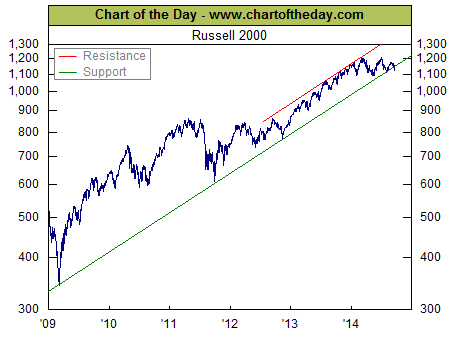
Last week’s Chart of the Day illustrated how the Russell 2000 was testing support of its post-financial crisis trend channel. Today’s chart zooms in to provide an update on one of the leading indices during the post-financial crisis rally. As today’s chart illustrates, the Russell 2000 has just broken below support (see green line) of what amounts to a relatively strong 5 1/2 year uptrend.
Quote of the Day
“When you come to a fork in the road, take it.” – Yogi Berra
Events of the Day
October 03, 2014 – Yom Kippur
October 06, 2014 – Supreme Court session begins
Stocks of the Day
— Find out which stocks investors are focused on with the most active stocks today.
— Which stocks are making big money? Find out with the biggest stock gainers today.
— What are the largest companies? Find out with the largest companies by market cap.
— Which stocks are the biggest dividend payers? Find out with the highest dividend paying stocks.
— You can also quickly review the performance, dividend yield and market capitalization for each of the Dow Jones Industrial Average Companies as well as the performance of the Dogs of the Dow.
Where should you invest? The answer may surprise you. Find out right now with the exclusive & Barron’s recommended charts of Chart of the Day Plus.
Mailing List Info
Chart of the Day is FREE to anyone who subscribes. Just go HERE

 You’ll recall from yesterday that the first secret to getting rich is that you cannot fear poverty. Otherwise, you can’t take the chances you need to take if you are to accumulate substantial wealth.
You’ll also recall that there are only three important decisions in life: what you do… where you do it… and with whom you do it.
Here, we continue our series with more on… what you do.
Imagine a man who is a great chef. He loves cooking. So he opens a restaurant, and it is an immediate success.
Seeing the possibilities, he takes his recipes, trains other chefs and opens other restaurants. Pretty soon, he has restaurants all over town… and the money is rolling in.
But now he is no longer doing what he likes to do. Instead of cooking, he’s running a complicated business; he’s become a manager and an administrator. He’s figuring out tax strategies, leverage and cost control.
“I’ve become a damned accountant,” he says. “I hate accounting.”
The real fun is getting money, not having it. Once you have it, the fun is over.
This is partly because of the nature of wealth. To get it, you have to be expansive, ambitious and optimistic. But once you have it, you have to change your personality to cope with it… protect it… and administer it.
Instead of being an entrepreneur… and a builder of wealth… you must become a custodian… and a conservator.
You can no longer be the same person you were. You have to assume that the worst will happen… because it probably will.
Now you have to be cautious, careful, distrustful, cynical… and pessimistic. You’re no longer expanding your wealth. Now, it shrinks as you do all you can to try to stop nature from running her course.
In short, you are no longer a young man full of energy and promise; you are now an old man trying to stop the clock.
And then, when you are no longer building a fortune, you have to do something else.
But what?
You look for things to do… ways to pass the time… things you can convince yourself are meaningful or fun. But they are usually just big time wasters – art… charities… sports… entertainments.
Often, the positions a rich person puts himself in are not only dull, but also they are fraudulent.
He has made a lot of money in one business, so he thinks he will be competent and successful in others. Remarkably, others think so too! So he could end up as chairman of a local hospital board or maybe the head of its investment committee.
But nothing in his career prepares him for the petty politics of a charity board of directors… or the deceptive nuances of the investment world.
He is not only miserable because he feels he is wasting his time, his projects also end in failure.
The hospital board gets into a nasty internal feud… and he cuts the hospital fund – and his own fortune – in half, mistakenly believing that he knows what he is doing.
We did not make that mistake. We have not retired. Still, we have suffered from wealth.
Tune in tomorrow to find out how…
Bill
Market Insight:
Beware of Overconfidence
From the desk of Chris Hunter, Editor-in-Chief, Bonner & Partners
If you’re watching the Dow and the S&P 500, it seems nothing can go wrong for investors.
For most folks, watching stock prices rise without so much as a 10% correction induces a very human response: They assume it “means” that prices will continue to rise.
As Yale economics professor and recent Nobel laureate Robert Shiller put it in his bookIrrational Exuberance:
Another aspect of overconfidence is that people tend to make judgments in uncertain situations by looking for familiar patterns and assuming that those patterns will resemble past ones, often without sufficient consideration of the reasons or the probability of the pattern repeating itself.
But overconfidence works in many different ways.
For example, Shiller carried out a survey of investors following the October 19, 1987, US stock market crash to investigate how overconfidence affects market prices.
He asked, “Do you think at any point on October 19, 1987, that you had a pretty good idea when a rebound was to occur?”
Of the individual investors surveyed who bought on that day, 47% said yes. And of the institutional investors surveyed who bought on that day, nearly 48% said yes.
According to Shiller:
Thus nearly half of those trading that day thought they knew what the market would do that day
Why would anyone think they could forecast what the stock market would do on a particular day – especially one as volatile and frightening as October 19, 1987?
This certainly does not conform to what we know about the forecastability of markets.
And when Shiller asked investors what made them think they knew when a rebound would occur, references were made to “intuition,” “gut feeling,” “common sense.”
His conclusion: These intuitive feelings play a large role in setting market prices.
The problem is your intuition is just as likely to be wrong as right. Past market movements, although often of interest, do not tell you what is coming next.
In fact, as far as we know, there is no way of determining near-term market moves in a consistent way.
That’s why it pays to focus on the long term.
As we wrote on Friday, if you look back as far as 1926 (the year one of the most extensive publicly available data sources starts) through December 2012, the 30% of stocks with the lowest P/Es has delivered 18.6% annualized returns. The 30% of stocks with the highest P/Es has delivered 10.9% annualized returns.
Clearly, your buy price, over long time horizons, is closely linked with your returns.
So, instead of trying to predict where prices will be in the future based on past price movements, focus instead on the price you pay for your investments.
You don’t know what the future holds. What you do know, with mathematical certainty, is that the lower the price you pay now, the higher your future returns will be. And the higher the price you pay now, the lower your future returns will be.
With the US stock market trading on valuations at the top of their historical range… now is not a promising time to buy for long-term investors.
If you are already invested in US stocks, consider taking some money off the table and increasing your cash balance. And consider using trailing stop losses to lock in your gains.
Further Reading: The US is heading down a difficult path. As Bill says, “It already lives on borrowed money… and borrowed time.” If you want to learn how this has happened and what you can do to overcome the financial challenges that will arise as the situation deteriorates, you simply MUST read Bill’s book The New Empire of Debt, which he co-wrote with Addison Wiggin.
It reveals, in often shocking detail, the financial realities the US faces and what the ultimate outcome may be. Claim your FREE hardcover copy of Bill and Addison’s book here. All we ask is that you cover the shipping cost.

 Most are familiar by now with the amazing story of investor John Paulson. Having predicted trouble in the mortgage market ahead of 2008, Paulson positioned one of his hedge funds to profit from a decline in the value of mortgages. The trade was so lucrative that the Wall Street Journal’s Gregory Zuckerman wrote a very worthwhile book about his prescience, The Greatest Trade Ever.
….continue reading “Stanley Fischer’s ‘Systemic Risk’ Hubris Sets The Stage For The Next Fed-Created Crisis”

Calgary set to break MLS records… Report highlights income gap between generations… Low rates likely to be the norm says BoC deputy… US existing home sales fall but market is good…
 Calgary set for record breaking September
A report from the Calgary Real Estate Board suggests that September could break records for MLS sales. The board says that sales are up 11.6 per cent on the same time last year, with 1,500 sales to 21st September and the pace continues. That could mean that this month will beat the record set in 2005 when 2,197 MLS sales were recorded. Last year came close with 1,919. New and active listings are both higher than last year, while realtors say prices are at a record for September. The luxury market in Calgary is buoyant and there has been a resurgence of single-family home sales after two months of year-over-year decline. Read the full story.
Report highlights generational income gap
Twenty-somethings are the first generation to be financially worse off than their parents. New figures from the Conference Board show that over the last thirty years the gap in incomes between older and younger workers has widened; in the 80’s it was 47 per cent, now it’s 64 per cent. The report shows that in many workplaces older workers are being paid more than younger colleagues for doing the same job and while there is often a premium paid for experience it is not always a factor in the wage differential. For the housing market it highlights a big problem of course; younger first-timers struggling to afford a home and older down-sizers affected by stagnation further down the ladder. While an overheated market may be a current factor, the income gap is a longer term concern for the market. Read the full story.
Low rates still needed says BoC deputy
There are signs that the interest rates may stay low for some time to come. Senior deputy governor of the Bank of Canada, Carolyn Wilkins says that output growth may stay lower than it was before the financial crisis and there may therefore need to be continued stimulus for the economy over a longer period. That would include lower interest rates; not the 1 per cent we have seen over the last four years, but more in the 3 to 4 per cent range rather than the 4.5 per cent of the mid 2000’s. Read the full story.
US existing homes fall back
Investors are scaling back their involvement in the US property market but this is unlikely to mean a return to dark days for the market. Figures from the National Association of Realtors show that August saw declines in existing home sales of 1.8 per cent, however this followed four months of increases and the level of sales is still the second highest of the year so far. The level of investors’ involvement was at its lowest for 5 years with expectation of interest rate rises during 2015. Outside of the investment world the US housing market is still showing positive signs with a steady rate of first-time buyers and buyers sentiment increasing. Read the full story.

-
I know Mike is a very solid investor and respect his opinions very much. So if he says pay attention to this or that - I will.
~ Dale G.
-
I've started managing my own investments so view Michael's site as a one-stop shop from which to get information and perspectives.
~ Dave E.
-
Michael offers easy reading, honest, common sense information that anyone can use in a practical manner.
~ der_al.
-
A sane voice in a scrambled investment world.
~ Ed R.
Inside Edge Pro Contributors

Greg Weldon

Josef Schachter

Tyler Bollhorn

Ryan Irvine

Paul Beattie

Martin Straith

Patrick Ceresna

Mark Leibovit

James Thorne

Victor Adair