
Bonds & Interest Rates
 As is well known now, Bill Gross resigned from Pimco last week. The market reaction to his departure was swift. Monday’s Wall Street Journalreported a $10 billion outflow from Pimco that some estimate could increase to $100 billion. Logic dictates that many of those billions will follow Gross to Janus.
Gross’s exit carries with it many implications, but arguably the least spoken of aspect of his departure is what it says about the machinations of the Federal Reserve. That billions will migrate with Gross is a powerful example of the obnoxious, and economy-sapping conceit that drives the Fed…..
…….continue reading HERE

 On September 26th, the English Parliament voted to join the U.S.-led bombing of ISIL, at least in Iraq. The news was received with relief by most in the Anglosphere world and throughout Europe. However, very little regard has been paid to the relative benefits and costs. The military actions that the UK has committed herself to conduct will have a low probability of achieving the stated objective of “degrading and destroying” ISIL. However, there is a much higher likelihood that air strikes from the UK will increase ISIL’s stated objective of projecting fear and terrorism deeper into the West. If that were to occur, the resulting implications for business will be difficult to project.
Despite apparent successes in very different conflicts in Libya and Kosovo, air power alone is unlikely to dislodge ISIL from its dominant position in Western Iraq and eastern Syria. The strategy is like trying to engage a boxer by throwing apples from outside the ring. It may bruise your opponent, but it will not result in victory. It may even cause retribution outside the ring, where the Queensbury rules do not apply. This is particularly apparent when one considers how the parliamentary authorization only applies to territory in Iraq, not Syria. If ISIL does not respect 20th Century borders, why should the West?
The U.S.-led air war appears set to achieve only limited degradation of ISIL’s capabilities. To succeed, air strikes would have to be coupled with a strong, organized, dependable and politically aligned ground force. That half of the equation is not available in Iraq or Syria. ISIL’s brutal “take no-prisoners” policies have been too much for the local, poorly motivated ground forces to confront. An air campaign can certainly be expected to slow ISIL’s progress but it should also be expected to heighten the likelihood of terrorist attacks, particularly within the U.S. and UK. Given the fragility of current markets, such an outcome could be financially catastrophic.
Why, therefore, did the British agree eventually to participate? This answer is far more complex than most care to admit.
The British approved of their government supporting the Allied cause in Gulf War I, which was seen as a legally justified reaction to Saddam Hussein’s invasion of Kuwait. But unlike Americans, the British public approved of George H.W. Bush’s decision to leave Saddam Hussein in place, after he was forced out of Kuwait.
Gulf War II, however, was a very different story. The British saw it as illegal and unwise to conduct an unprovoked attack on Iraq merely to replace a strong regime with sectarian chaos. Further, they feared the price in terms of blood and pointless military expenditures. Despite this, the need to preserve the Anglo-American ‘Special Relationship’ as the crucial tenant of UK defense policy proved more important to many British elites. But an already wary public turned away sharply when the WMDs could not be found and the invasion turned into a quagmire.
The aversion to further Middle Eastern adventurism came to the fore in August 2013 when the English Parliament voted by a majority of 13 not to join the U.S.-led bombing of Syria. Interestingly, the mainline media missed completely the crucial fact that this defeat was due largely to a rebellion by Conservative eurosceptic MPs who were angry with Cameron for failure to follow through on his “cast-iron guarantee” of an EU referendum.
Another ‘no’ vote could have been disastrous for Cameron’s political authority. So this time around his party whips took time to ‘bend’ the votes of malcontent MPs. As September is a period of Parliamentary recess and party conferences, this added to delays.
It also meant that Cameron needed to keep the bill highly focused, preventing Britain from joining the U.S.-led bombing outside of Iraq. In desert terrain, however, who will know whether British bombs are dropped on Syrian territory? Doubtless, British and even Australian Special Forces are already, or soon will be, working with Americans in Syria to identify strike targets.
Thanks to the ‘open-door’ immigration policies imposed on the UK by the EU, British civilians now are exposed irresponsibly and dangerously to Jihadist terrorism. Already, in some sectors within certain UK cities, sharia law rules, de facto. Mob scenes in Britain regularly depict banner hate that if shown or spoken by the native English would result in jail sentences. It is no accident that the bloodthirsty Jihadist responsible for beheading the British and American citizens spoke with an accent that grew up in immigrant communities within the UK.
British military probably warned their political leaders against an illegal, ineffective air war with the implication of a massive increase in domestic terrorism. However, in order to preserve the Special Relationship, likely they were overruled politically after delays.
Now, British and American civilians, with wide open borders and none of the personal protections granted their political masters, must face the threat of greatly increased, even horrific domestic terror.
Hopefully British and American politicians will decide eventually to spend on the effective policing of their borders and the physical protection of their people rather than wasting billions of dollars in pounding illusive targets on the enemy’s choice of ground-distant, near empty sands!
John Browne is a Senior Economic Consultant to Euro Pacific Capital. Opinions expressed are those of the writer, and may or may not reflect those held by Euro Pacific Capital, or its CEO, Peter Schiff.
Subscribe to Euro Pacific’s Weekly Digest: Receive all commentaries by Peter Schiff, John Browne, and other Euro Pacific commentators delivered to your inbox every Monday!

The first case of the lethal Ebola virus has been diagnosed in Dallas, Texas. It appears the man is believed to have contracted the virus in Liberia before travelling to the US nearly two weeks ago. Health officials say he is being kept in isolation. However, you can bet everyone on that plane was at least exposed. It does not appear that flying to Africa is a very good idea.
Cyclically, we are due for another plague. The Romans were great secretaries and tended to record events of this nature. When we analyzed the history of plagues, we found a strong correlation to Pi (π). The span of just the major plagues recorded by the Romans was 474 years divided by 6 events produces 79 and dividing that by Pi 3.14 gives us 25.15 years.
This is very close to the 8.6 frequency (3 x 8.6 = 25.8). Testing this frequency brought us to the Black Death/Plague of the 14th Century, the Great Influenza of the mid-19thCentury that killed many of my own family, the influenza of World War I, the Malaria epidemic of 1940, and the next target being 2019. Economically, the Black Death killed about 50% of the European population and created a shortage in labor. This resulted in altering the economy creating wages as landlords now competed for labor and serfdom came to an end in Western Europe (Russia continued into the 19th century).
It appears we have whatever can go wrong for civilization is going wrong. I always wanted to do one of those photo safari trips in Africa. It looks like that is not going to happen for a very long time.


Summary
- Volatility in foreign exchange market as investors flee euro and yen for liquid U.S. dollar.
- Euro and yen hitting multi-year lows. Inflation picking up outside US.
- US dollar seen as temporary safe haven. Could the US dollar be the next currency to decline?
- Precious metals and junior miners trading at historic discounts should be considered as an alternative to fiat currency.
- Deflations set the stage for hyper-inflations.
Over the past few months, I have seen an influx of capital and high net worth investors who are getting interested in the junior mining resource area. Now may be the worst time to panic out of the precious metals and junior mining sector into the overbought US dollar. Smart capital may be carefully looking at ways to diversify away from the euro and yen which has collapsed hitting multi-year lows. Inflation may pick up rapidly in Europe and Japan. The European Central Bank is printing euros (NYSEARCA:FXE) like crazy causing a collapse in the currency and its worst quarter in many years. This is a manipulative attempt to stimulate a weak economy and boost exports from the region.
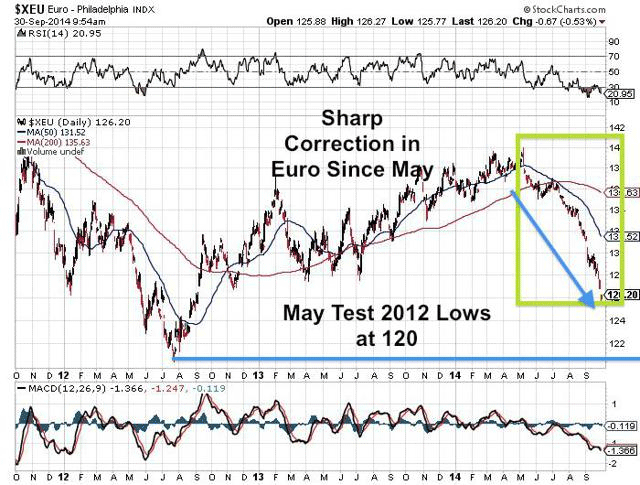
The flight of capital from Europe and Japan (NYSEARCA:FXY) has looked for temporary liquidity in the US dollar (NYSEARCA:UUP) which is hitting three year highs as investors expect the Fed will raise interest rates by 2015. But I wouldn’t count on that so quickly. Investors are also buying the S&P500 (NYSEARCA:SPY) large caps sitting on record cash positions. The US may be the most dangerous overbought market right now that could correct from those nosebleed levels delaying interest rate increase.
The US dollar has soared as a liquid alternative. For how long is the main question. Can the S&P500 continue to rally alongside the dollar? The yen and euro is collapsing. Could the US dollar be the next currency to fall or could it be the US equity markets which have gone up for three years now with no meaningful correction?
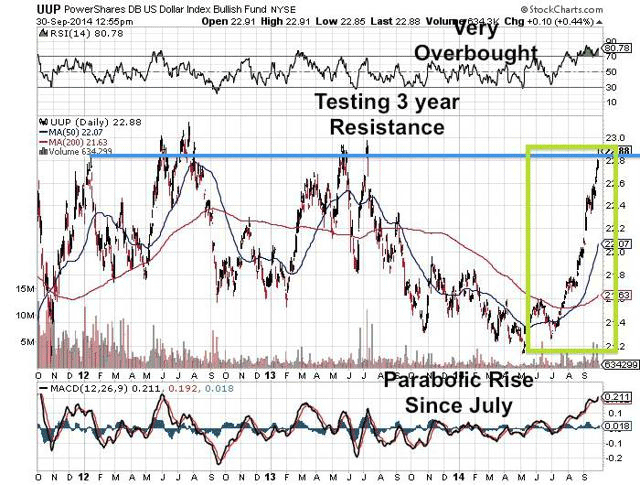
A strong US dollar could put pressure on the large US multinationals and S&P500 as US exports become more expensive. US deficits continue to soar to record levels and they must be paid with cheaper dollars.
Eventually, the large US dollar position should rotate into the commodities and natural resources as deflations set the stage for hyper-inflations.
What one must do during these periods is prepare for inflation to pick up by buying precious metals and junior miners. Deflationary periods do not last long. The long term trend favors inflation. Three to four years is already an extended period of time for a correction by historical standards.
Deflations breed the best buying opportunities as one can protect oneself ahead of the inflationary storm that may be directly ahead.
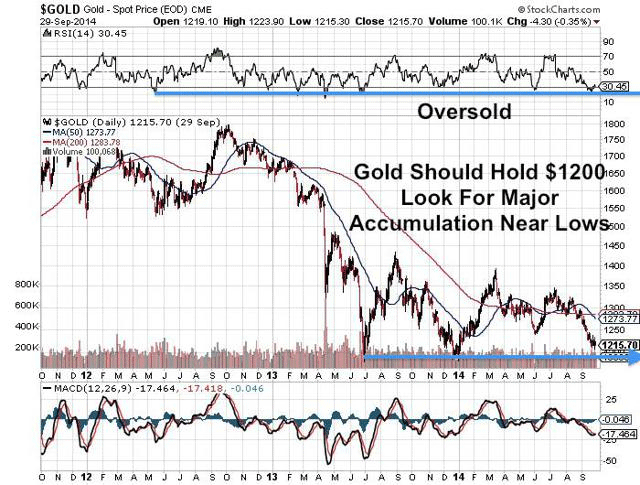
Gold (NYSEARCA:GLD) and silver (NYSEARCA:SLV) prices have been declining since 2011 but may soon bottom as the US dollar begins to test multi-year highs. The US dollar is very overbought as investors fear that the US will raise interest rates while other countries continue to print money like the ECB, Japan and China.
This rally in the US dollar should not last much longer as it may be a dead cat bounce before the next downturn. This may actually be a great time to transfer cash into real assets such as the junior miners (NYSEARCA:GDXJ) trading near multi-year lows.
The US deficit is continuing to increase especially as new wars are announced in Europe and the Middle East. The Fed will continue to support inflationary policies and prevent deflations at all costs.
Rising deficits and war are usually quite bullish for gold and bearish for the dollar. Silver is already in new four year lows trading below $18. Gold has not yet violated the $1200 mark but may soon bounce off that level. The Junior Gold Mining ETF is continuing to hold its 2014 lows.
Meanwhile, the US dollar is strong at new six year highs despite billions of dollars of bailout and quantitative easing. The Fed is running the risk of deflation and may actually be forced into more easing to boost inflation. The U.S. must pay back its record debts with cheaper dollars.
Right now, the bottles of champagne are popping in the US as real estate and equity markets continue to hit new highs. However, the piper must be paid and it is harder to pay down debts with a strong dollar. Don’t be surprised to see the Fed eventually make a reverse move to devalue the dollar to pay down debts. Expect more bubbles to explode not just in 3-D printing, but in social media stocks and get rich quick real estate scams.
There is a huge cash position waiting on the sidelines to buy real money such as gold and silver especially from the Europeans right now dealing with a currency on verge of collapse and China, which just announced a new Shanghai Gold Exchange. Major institutions are sitting on large amounts of US dollars/bonds and must transfer that into the form of real money in the form of gold, silver and ounces in the ground controlled by the junior miners.
Look for huge volume and accumulation in gold and silver over the next few weeks and in some high quality junior mining stocks. Negative capitulation followed by strong accumulation could be the indicator that the smart money expects gold and silver to bottom. The question for many is when this will occur. It should be soon as this correction in the junior miners has been one of the worst and longest in decades providing possibly a once in a generation buying opportunity.
###
Jeb Handwerger
email: thehandwergers@bellsouth.net
website: www.goldstocktrades.com
Gold Stock Trades Editor Jeb Handwerger is a highly sought-after stock analyst syndicated internationally and known throughout the financial industry for his accurate and timely analysis of the equities markets, particularly the precious metals sector. Subscribe to his FREE Newsletter right now.
Read full disclaimer by clicking here…

This Friday is Yom Kippur, the day when Jews around the world ask forgiveness for their transgressions from the year past. Rabbis remind the penitent to dwell on their sins of omission, in which they did nothing when a more thoughtful and proactive action was needed, and sins of commission, in which they actively participated in an unjust action. And while not all economists are Jewish, Gene Epstein the economics editor at Barron’s, offered his thoughts on how this applies to the group.
While Gene is certainly on to something, I think he could have gone much further in his finger pointing. Increasingly, economists are calling the tune to which businesses and consumers dance. Since their words and opinions matter, they may consider seeking forgiveness for what they have said, and what they have not.
Sins of Omission
Despite clear evidence that elevated prices in stocks, bonds and real estate remain a direct consequence of zero percent interest rates and quantitative easing, the crowd has asserted again and again that the prices are justified by the surging U.S. economy. There is very scant evidence upon which to base such an opinion.
Most economists have held very tightly to the view that was widely shared at the end of 2013; that 2014 will be the year that the U.S. economy finally shakes off the malaise of the Great Recession. And even though the script has failed to live up to these expectations, the economists haven’t seemed to notice.
During the First Quarter of this year, the economy contracted at an astounding annual pace of 2.1%. But economists and politicians were very insistent that the severe miss was solely a result of the difficult winter. Although severe winters can be a drag on an economy (my research shows that the 10 roughest winters over the last 50 years knocked about two points off the normal first quarter GDP), the snow could not fully explain a five point miss from what had been forecast by the consensus at the end of 2013. But that’s exactly what they did.
This omission was compounded by their reaction to the 2nd quarter rebound, which showed the economy expanding by 4.6%. But while the crowd was ready to dismiss the very weak first quarter GDP as being a weather-related anomaly, they were not willing to acknowledge the role played by the same anomaly in artificially boosting second quarter GDP. My research, based on figures from the Bureau of Economic Analysis, has shown that strong second quarter rebounds almost always follow sub-par weather-related first quarters. This makes intuitive sense as well. Activity that is delayed in winter gets unlocked in spring. But economists look at the second quarter as if it represents the entire year. But already plenty of evidence has emerged that should sow doubts on the remainder of the year.
Even with the strong second quarter, economists are choosing to gloss over the fact that growth in the entire first half came in at just 1.25%, far below the projections that most have for the calendar year. To get to 2.5% GDP growth, which would be typical of a weak year, not the first year of a long-awaited recovery breakout, GDP would have to come in at 3.75% for the entire second half. To hit 3% for the year, second half growth would need to be 4.75%.
But this will have to occur without the tail winds of Fed QE support and at a time of heightened geopolitical concerns, and a housing and stock markets that look increasingly weak and vulnerable to correction. As a result, economists should take off their rose-colored glasses and ratchet down their full year estimates to conform more closely to reality. But that is not happening.
Sins of Commission
Rather than seeing, hearing, and speaking no evil, some leading figures are much more culpable in spreading bad information. While this list could prove lengthy, here are the top two offenders.
Fed Chairwoman Janet Yellen – In her September press conference, Yellen made the stunning assertion that the Fed’s balance sheet, which in recent years has swelled to a gargantuan $4.5 trillion, will likely be reduced in size to “normal levels” by the end of this decade. While most accept this statement at face value, Yellen must know the absolute inability of the Fed to deliver on this promise.
To bring its balance sheet back to pre-crises levels of around $1 trillion, the Fed must sell about $3.5 trillion of debt over the next five years, or a pace of about $700 billion per year. This is a negative equivalent of about $58 billion per month in QE. Additionally, Yellen has claimed that this can be done without actively “selling” assets, and without tipping the economy back into recession. This claim is so fantastical that it must be considered active deception, a grave sin indeed.
First, if QE was necessary to inflate asset prices and create a wealth effect to drive consumer spending and power the recovery, how can the process be reversed without unwinding its effects and producing an even larger recession than the last? If the recovery is already stalling with interest rates still at zero, how can it gather more upward momentum if the Fed raises rates back to normal levels?
Secondly, if the Fed does not actively sell bonds into the market, it must hope to draw down the balance sheet by simply allowing older bonds to mature. This ignores the fact that the maturation process is far too slow to accomplish the task by the end of the decade, and it assumes that the Fed will not have to buy any new Treasury or Mortgage-backed bonds over that time. But in order to provide financing for ongoing Federal budget deficits, or to stimulate the economy if there were another economic downturn, the Fed would have no choice but to start buying again with both hands. Since the current “recovery” is already 15 months longer than the average post-war recovery, it would be illogical to assume that we can make it through the next five years without another recession.
Of course, by affirming its intention not to actively sell any of its holdings, Yellen is attempting to defray any concerns the markets might have over the impact such sales would have on bond prices. Lost on everyone, including Yellen herself, is that the impact on the markets is the same regardless of how the Fed’s balance sheet shrinks. Even if the Fed allows bonds to mature, the Treasury would then be forced to sell an equivalent amount of bonds into the market to repay the Fed. The fact that a distinction without a difference reassures anyone shows just how delusional market participants remain.
World bank President Jim Yong Kim – In an interview at September’s Clinton Global Initiative, the World Bank president urged the European Central Bank to follow the same “successful” experiments in quantitative easing that had been pioneered by the Federal Reserve. As proof of the policy’s success, Kim pointed to the stronger GDP growth that is expected in the US in 2015 and 2016. In other words, he is attempting to prove his point not by what has happened thus far, but by what the consensus expects to happen in a year or two. This is no way to argue a point. Dr. Kim is a smart guy and I suspect he knows this, hence another sin of commission.
It would be difficult to make the case that six years of Quantitative Easing has created a healthy US economy. In addition to the subpar first half of 2014 GDP growth, the labor market, consumer sentiment, and wage growth all show signs of stagnation. So Dr. Kim has no choice but to hang his hat on a bright future that he, and most mainstream economists, expect to be right around the corner. But dressing up a future possibility as a current certainty is a major foul in the business of economic forecasting. Dr. Kim, and others who have made similar claims, should fast an extra day.
Best Selling author Peter Schiff is the CEO and Chief Global Strategist of Euro Pacific Capital. His podcasts are available on The Peter Schiff Channel on Youtube
Catch Peter’s latest thoughts on the U.S. and International markets in the Euro Pacific Capital Summer 2014 Global Investor Newsletter!

-
I know Mike is a very solid investor and respect his opinions very much. So if he says pay attention to this or that - I will.
~ Dale G.
-
I've started managing my own investments so view Michael's site as a one-stop shop from which to get information and perspectives.
~ Dave E.
-
Michael offers easy reading, honest, common sense information that anyone can use in a practical manner.
~ der_al.
-
A sane voice in a scrambled investment world.
~ Ed R.
Inside Edge Pro Contributors

Greg Weldon

Josef Schachter

Tyler Bollhorn

Ryan Irvine

Paul Beattie

Martin Straith

Patrick Ceresna

Mark Leibovit

James Thorne

Victor Adair