



 Today, 90-year old Richard Russell, who has lived through depressions and booms, through good times and bad, through war and peace (Russell flew as a combat bombardier on B-25 Mitchell Bombers during World War II), the 60-year market veteran said we have witnessed the “ultimate bottom” in the gold and silver markets. More below:
Stocks & Equities

In this week’s issue:
- Weekly Commentary
- Strategy of the Week
- Stocks That Meet The Featured Strategy
In This Week’s Issue:
- Stockscores’ Market Minutes Video – Trading a Correction
- Stockscores Trader Training – Trading Tactics For Corrections
- Stock Features of the Week – Bottom Fishing Energy Stocks
Stockscores Market Minutes Video – Trend Reversals
There are ways you can make money from a market correction, in many ways it is an easy environment to trade profitably. Tyler highlights what he is doing while the market pulls back plus provides his weekly market analysis.
Click here to watch on Youtube
Trader Training – Trading Corrections
For a number of weeks, I have been cautious on the markets. Weakness has been lead by the small caps and commodity stocks and now that weakness has spread to the large caps. This week, the S&P 500 broke its long term upward trend line, setting up for what will likely be another 3 to 5% downward move before the next trend line of support is hit.
Here is a list of things to keep in mind when the market is correcting:
1. Stocks Can Go Down To Zero – I often hear investors tell me that they bought a stock because it had fallen so far already, it just had to bounce back. After all, stocks can not go down forever. Yes, that is true, stocks can only go down to zero and then they stop, but a stock that does go to zero is eternally gone. Do not buy something because it appears to be on sale, you should only buy something if it is more likely to go up than down.
2. Never Average Down – averaging down is the practice of buying more of a stock you are losing on as the price falls. Investment advisors sometimes refer to this as dollar cost averaging, but basically, it is all about buying more of a stock that has proven your original decision wrong. If you were betting on a horse that was in last place half way down the back straight of the Kentucky Derby, would you go back to the wager window and add more to your bet if you were able to? Of course not! Buying more when you are wrong is no different, so just wait until the market proves you right and average up.
3. Trade With Who Is In Control – next time you are in an airport, hop on one of those moving sidewalks that speeds you to the gate. When you get off, turn around and hop back on but this time, going against the traffic to understand what it is like trying to trade against the momentum of the market. Yes, it is possible but it sure is a lot harder than going with the flow. The market is no different; you will always have an easier time if you select strategies that are appropriate for the market condition. To understand whether the buyers are in control or the sellers, look at a chart of the stock or market index. If the tops are falling, the sellers are in control. If the bottoms are rising, the buyers are in control. So long as you can draw a line on the chart with a ruler, you can do this analysis and save yourself from a lot of difficulty.
4. Don’t Apply Logic – many investors make the mistake of using logic to make their trading decisions. The market
will do a lot of things that do not make any sense because the market has information that you don’t have. A stock that “should” be going higher may not because a large shareholder has learned that there are problems that the general public does not know about. Or perhaps a large shareholder has a liquidity problem and has to sell stock whether they like it or not. You can not argue with what the market does and you will never convince the market that it is wrong. You just have to do what the market tells you to do.
5. Don’t Take More Risk Than You Are Comfortable With – the great enemy of every investor is emotion. It makes us break our rules and lose our discipline. We are emotional because we have an attachment to money that we must learn to minimize if we are going to have a chance of beating the market. The first step toward that goal is to find comfort in the risks that you take. If your exposure to financial loss is too great, you will break the rules and forget your discipline because you don’t want to feel the pain of the loss. If all you are facing is a manageable amount of discomfort, you are more likely to trade well.
6. Markets Predict, Not React – the market is a leading indicator for the economy; it tends to move at least six months early. This means you can not look at the world around you and use what you see to make trading decisions. Since the market looks ahead, so too must you and think about what will happen in the future instead of what has already happened.
7. Diversification Does Not Mitigate Risk – this market is a perfect example of how you can not diversify away risk. An investor with money in bonds, commodities, industrials, technology and banking is feeling losses in all areas. The best way to manage risk is to limit losses. If the market proves you wrong on a decision, get out and take the small loss. Never let small losses grow in to big ones.
8. The Market Never Lies – all markets express the opinions of those who trade it and the wisdom of the crowd is far smarter than you or I can ever be. If you learn how to read the true message of the market, you can make money by doing what it tells you to do. If, instead, you try to outsmart the market, you will likely get your ego delivered to you in the form of debits to your trading account. Do you think you are smarter than thousands of people?
9. Everyone is Smart in a Bull Market – riding a trend is the best way to make money, but many investors confuse their trend timing with investment intelligence. The truly good traders are those that can beat the market in all market conditions. Don’t fall in to a false sense of security if you make money while everything is going up because you are likely to give it all back. For most, profits in the market are just short term loans.
10. Leverage is a Double Edged Sword – all of the problems that we are seeing in the market and the economy right now are because of leverage. Yes, you can improve your return if you borrow money to make money, but always remember that you can also increase the loss potential if the market goes against you. If you use leverage, it is even more important to manage risk and have discipline. If you don’t understand the true risk that the leverage of margin, options and other derivatives provide, don’t trade them.
Energy stocks have been in a steep downward trend as Oil has been moving lower over the past month. Oil is near support, the US Dollar is hitting resistance where it may stall, giving some relief to the Oil market. This week, I went in search of Canadian Energy stocks that pay a dividend, were doing well before Oil started its collapse and are now at or near long term support. These stocks have the best potential to make good bounce back in the short term.
Watch the charts, either an hourly or daily chart, for a break of the downward trend and then a break to the upside from a rising bottom. Those are good signs that the selling pressure is reversing.
1. T.ZAR
T.ZAR has fallen from $9.50 to $6 over the past few months and is now at the lows that held in the Spring of 2013. Historical yield 7.8%. Watching for a move up through $6.30.

2. T.BTE
T.BTE has fallen to its 2013 low but showed some strength on Friday, indicating it may be ready to make bottom. Historical yield 5.4%. Watching for a move up through $38.50.

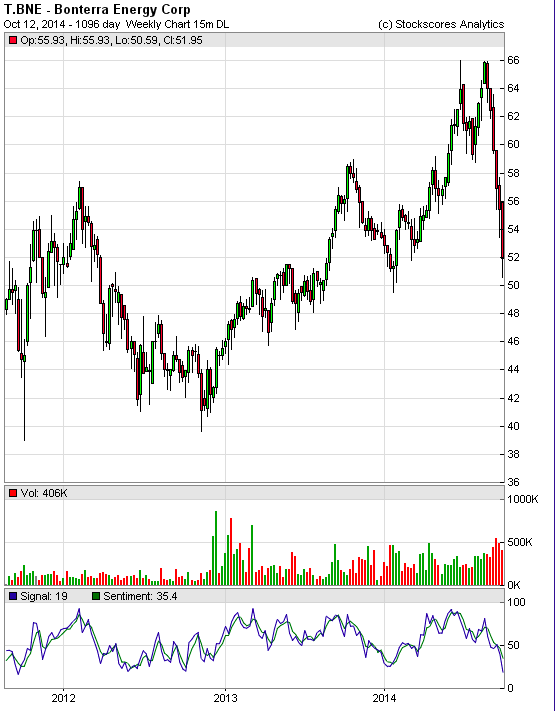
3. T.BNE
T.BNE was in a strong upward trend before the Fall but has now pulled back to test the lows for 2014. Historical yield of 5.4%. Watch for a break up through $53
The New Stockscores Trader Education Center – Sneek a Peek
Stockscores will be launching a new online trader education center in the next two weeks. Those who would like a sneek peek should register for the upcoming webinar:
Wednesday Oct 15 6:00pm PT, 9:00pm ET
Click here to register
I will also do a discussion of the current market and how I am trading it.
The Toronto Money Show
Join Tyler Bollhorn and a star-studded cast of financial experts at The World MoneyShow Toronto (Metro Toronto Convention Center) this October 16-18. Tyler will be speaking on Saturday Oct 18th at 12:45 – 1:30 on How to Find and Trade Hot Stocks.
Attendance is free but you must register. For more information, and to register, click here
References
- Get the Stockscore on any of over 20,000 North American stocks.
- Background on the theories used by Stockscores.
- Strategies that can help you find new opportunities.
- Scan the market using extensive filter criteria.
- Build a portfolio of stocks and view a slide show of their charts.
- See which sectors are leading the market, and their components.
Disclaimer
This is not an investment advisory, and should not be used to make investment decisions. Information in Stockscores Perspectives is often opinionated and should be considered for information purposes only. No stock exchange anywhere has approved or disapproved of the information contained herein. There is no express or implied solicitation to buy or sell securities. The writers and editors of Perspectives may have positions in the stocks discussed above and may trade in the stocks mentioned. Don’t consider buying or selling any stock without conducting your own due diligenc

 Today King World News is featuring a piece by a man whose recently released masterpiece has been praised around the world, and also recognized as some of the most unique work in the gold market. HERE is the latest exclusive KWN piece by Ronald-Peter Stoferle of Incrementum AG out of Liechtenstein.
…read it HERE

Unimaginable consequences?
These are not my words. They’re the words of the People’s Daily, the leading voice of the Chinese Communist Party. And they’re not a forecast or a speculation.
They’re a thinly-veiled threat!
In a moment, I’ll explain what I think those consequences might be — for the world and for you. But first let me give you a sense of how important this is and why I’m qualified to opine.
Hong Kong is the biggest financial center of the largest, most populous, fastest growing continent on the planet — Asia.
Only two other centers eclipse Hong Kong in power and size — New York, the financial capital of the world’s dominant superpower; and London, the center of the greatest empire in history.
Hong Kong’s banking, stock market, bond market and derivatives market are bigger than those of Frankfurt (the largest financial center of continental Europe) and of Tokyo (despite a national GDP that’s 22 times larger).
Tens of thousands of corporations, operating all over Asia, are incorporated in Hong Kong.
Over 1,600 companies, half based in mainland China, are listed on the Hong Kong Exchange.
And no matter what, if you want to do business in Asia, you almost invariably must go through Hong Kong.
I know from personal experience.
 In the early 1980s, I was working in Tokyo as a stock analyst for Wako Sh?ken, one of Japan’s larger brokerage firms.
And soon after I began there, my boss sent me off to Hong Kong for a project with their local subsidiary.
My task was to develop presentations about Japanese stocks, while interpreting from Japanese to English and to Cantonese. (They overestimated my linguistic abilities.)
Even back then, business at their Hong Kong subsidiary was a big deal for them — bigger than their subsidiaries or branch offices in New York, London, Dubai and a half dozen other centers. And that was 35 years ago, before Hong Kong’s meteoric expansion!
Why? Because of one single, powerful force that has propelled Hong Kong’s growth:
Freedom.
Freedom to trade, freedom from taxes, freedom from regulations, and above all, freedom from political interference or manipulation.
The authorities in Beijing seem to understand this — so much so that they’ve pursued something similar for Shanghai and other Chinese cities (within strict limits, of course).
What they don’t yet seem to understand is this: Economic and financial freedom cannot forever co-exist with political and social repression.
The Rise and Fall of
“Peaceful Co-Existence”
This is also an extremely important issue. So let me give you a quick overview.
Historically, the concept of peaceful co-existence was all about the relationship between communist and capitalist economies.
It first emerged in the early years of the Cold War. Moscow embraced it. But Beijing did not. And this landmark dispute became a key aspect of a great Sino-Soviet split — years of conflict, border clashes and even wars between the two communist powers.
Why did China and Russia disagree? One reason was because Mao Zedong rejected the idea out of hand. He called it “Marxist revisionism.” He argued that capitalism and communism are fundamentally incompatible.
Was he right? Or let me ask it this way …
Is it ultimately possible for capitalist free markets to survive under the thumb of an overarching — and over-reaching — communist dictatorship?
That is THE fundamental question that’s coming to a head in Hong Kong right now.
Now, some might argue that communism survives in China in name only. But that’s beside the point.
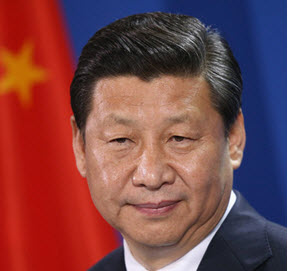 Indeed, that’s what Mao’s sixth successor, China’s president Xi Jinping, must decide very, very soon.
Whether it’s under the rubric of “communism,” “fascism” or some other -ism, the question still boils down to the same thing:
Is economic freedom ultimately
viable without political freedom?
If the answer is “no” … if it is not possible for capitalism to survive under a repressive dictatorship,” then …
Mr. Xi and China lose their most valuable single asset. They lose the richest, most prosperous 436 square miles of the entire Middle Kingdom, their pipeline to global capital, their gateway to Western markets. They lose what makes Hong Kong what it is.
But that’s not the only question Mr. Xi is worried about. In fact, no matter how valuable Hong Kong may be to him, it’s not even his greater concern.
“What could possibly be more important to President Xi than the fate of Hong Kong?” you ask.
It should be obvious: The fate of China.
Just go back to that fundamental question I asked you a moment ago. Turn it upside down. And then ask it this way:
Is it ultimately possible for dictatorships to survive as the grand masters of free-enterprise? Can they forever repress the demands for freedom of a rising middle class and newly-empowered corporate elites?
 For this question, no speculation is required, and no evidence is lacking.
A thorough — even a cursory — review of history gives us all the answers we might ever need. I know. Because I was there when it happened — several times, in fact.
You see, as a young stock analyst in my 30s, I saw a lot in Asia.
But as a student in my teens and early 20s, I also lived and traveled a lot in Latin America.
In Brazil, I saw the generals come to power after central bank money printing went wild. Then, twenty year later, I saw them fall as their stubborn rigidity gave way to free markets and free enterprise.
I was in Guatemala, El Salvador, and Nicaragua … Chile and Argentina … Uruguay and Paraguay … when those countries were in the throes of similar cycles — guerilla wars, states of siege, and worse.
More recently, I crisscrossed East Germany not long after the fall of the Berlin Wall.
A few years later, I visited one of the former “closed cities” of the Soviet Union (nuclear and aerospace centers that even Soviet citizens could not enter).
And I can tell you flatly: In every case, I saw how dictatorships come and go … how free markets, free enterprise — and freedom of self-determination — always prevail.
That’s the great lesson of history.
That’s what Mao Zedong was afraid of when he split from his communist counterparts in Moscow.
And that’s also the great fear of his sixth successor, China’s President Xi Jinping, the man who must decide history’s next major turn.
So what WILL be the final outcome of the Hong Kong crisis?
What will be the “unimaginable consequences” that China’s People’s Daily is referring to.
I cannot speak to what they’re able (or unable) to imagine. But I can tell you what’s in my mind …
Consequence #1 is a crackdown. Mr. Xi is resolute in his view that there is simply no other alternative.
He’s the hardest-line leader of China since Mao.
 His entire support base and source of power derive from a no-negotiation, no-compromise line in the sand he’s drawn between China’s Communist party leadership and China’s 1.4 billion people.
He’s convinced that, if he gives in to the tens of thousands mobbing the streets of Hong Kong, he will unleash pent-up revolutionary forces on the mainland akin to those that toppled the Berlin Wall and doomed the Soviet Union.
If he’s pushed against the wall, he will crack down!
Will it be as bad as the 1989 Tiananmen massacre, which killed thousands and shattered China’s democracy movement?
In terms of lives lost, I doubt it.
But in terms of global impact, it could be a lot worse.
Consequence #2 is a hotter phase of the new cold war. We’ve been warning you about a new cold war for over a year. Now it’s here.
And, depending on the consequences in Hong Kong, imaginable or not, we may be on the verge of a new round of escalation.
Already, Chinese authorities have warned the West to stay out of the conflict. Already, they’re accusing the West of fomenting the chaos.
Consequence #3 is a global money tsunami.
I’m not the only one who sees trouble ahead in Hong Kong.
Global investors also fear a massive police crackdown on tens of thousands of protesters, massive censorship of the media and the Internet, untold numbers of arrests, and worse.
In response, they have embarked on a new flight to quality — away from commodities, currencies and many stock markets.
The big island of safety in their view: The United States.
The big winner (for now): The U.S. dollar.
But make no mistake: Just as we warned you, global crises are spreading — from Russia … to Ukraine … to ISIS … to Europe’s economic woes … and now to Hong Kong.
Just as we predicted, these crises are driving wave after wave of flight capital to our shores.
And just as we said, all of this is reaching a crescendo, injecting more emotion into investor decision-making, including fear of global chaos.
The Global Dash for Cash
That’s why, over the past few days, most of this new capital has moved into cash or cash equivalents, earning practically zero yield.
It’s all clear as day. But it’s also raising urgent questions for investors like you and me …
How long will foreign investors be content to hold zero-yielding cash? How long will they sit there, dead in the water? When will they resume moving that money into stocks for a more decent return?
No one has the precise answer, of course. Markets could fall further.
That’s why, in my ultimate portfolio, I still have 83 percent of my money in cash.
That’s why I’m waiting patiently for bargains.
And that’s why, when the time is right, I will target exclusively top-quality investments that are the first choice of risk-adverse investors all over the world.
I suggest you do the same.
The full story of how my family and I have been building this strategy since 1930 … and why I’ve decided to implement it now for the first time … is on my website.
Good luck and God bless!
Martin

 You’ve likely heard that multitasking is problematic, but new studies show that it kills your performance and may even damage your brain.
Research conducted at Stanford University found that multitasking is less productive than doing a single thing at a time. The researchers also found that people who are regularly bombarded with several streams of electronic information cannot pay attention, recall information, or switch from one job to another as well as those who complete one task at a time.
A Special Skill?
But what if some people have a special gift for multitasking? The Stanford researchers compared groups of people based on their tendency to multitask and their belief that it helps their performance. They found that heavy multitaskers—those who multitask a lot and feel that it boosts their performance—were actually worse at multitasking than those who like to do a single thing at a time. The frequent multitaskers performed worse because they had more trouble organizing their thoughts and filtering out irrelevant information, and they were slower at switching from one task to another. Ouch.
Multitasking reduces your efficiency and performance because your brain can only focus on one thing at a time. When
you try to do two things at once, your brain lacks the capacity to perform both tasks successfully.
Multitasking Lowers IQ
Research also shows that, in addition to slowing you down, multitasking lowers your IQ. A study at the University of London found that participants who multitasked during cognitive tasks experienced IQ score declines that were similar to what they’d expect if they had smoked marijuana or stayed up all night. IQ drops of 15 points for multitasking men lowered their scores to the average range of an 8-year-old child.
So the next time you’re writing your boss an email during a meeting, remember that your cognitive capacity is being diminished to the point that you might as well let an 8-year-old write it for you.
Brain Damage From Multitasking
It was long believed that cognitive impairment from multitasking was temporary, but new research suggests otherwise. Researchers at the University of Sussex in the UK compared the amount of time people spend on multiple devices (such as texting while watching TV) to MRI scans of their brains. They found that high multitaskers had less brain density in the anterior cingulate cortex, a region responsible for empathy as well as cognitive and emotional control.
Learning From Multitasking
If you’re prone to multitasking, this is not a habit you’ll want to indulge—it clearly slows you down and decreases the quality of your work. Even if it doesn’t cause brain damage, allowing yourself to multitask will fuel any existing difficulties you have with concentration, organization, and attention to detail.
Multitasking in meetings and other social settings indicates low self- and social-awareness, two emotional intelligence (EQ) skills that are critical to success at work. TalentSmart has tested more than a million people and found that 90% of top performers have high EQs. If multitasking does indeed damage the anterior cingulate cortex (a key brain region for EQ) as current research suggests, it will lower your EQ in the process.
So every time you multitask you aren’t just harming your performance in the moment; you may very well be damaging an area of your brain that’s critical to your future success at work.
More by me:
What my company does: Emotional Intelligence Training and Emotional Intelligence Certification
I am author of the bestselling book Emotional Intelligence 2.0 and cofounder of TalentSmart, the world’s #1 provider of emotional intelligence tests and training, serving 75% of Fortune 500 Companies
—-read more HERE
Russell: Gold – I can’t prove it yet but I believe the last decline in gold knocked out the last of the gold bugs and gave gold, technically, a clean slate. I believe we saw the ultimate bottom of the gold bear market on Friday, and (yesterday) the whole universe of gold is higher, and closing at its high. Everything I have said about gold is also true about silver. I believe this is the time to invest in gold and silver if you have not done so already.
If I am correct, gold should act like the release of a compressed spring. Gold above 1300 would make me even more certain of my opinion, and gold above 1350 would represent a major buy signal. If you can’t handle physical gold, take a position in CEF, which represents physical silver and gold and is located in Canada.
….continue reading HERE
About Richard Russell:
Richard Russell began publishing Dow Theory Letters in 1958, and he has been writing the Letters ever since (never once having skipped a Letter). Dow Theory Letters is the oldest service continuously written by one person in the business.
Russell gained wide recognition via a series of over 30 Dow Theory and technical articles that he wrote for Barron’s during the late-’50s through the ’90s. Through Barron’s and via word of mouth, he gained a wide following. Russell was the first (in 1960) to recommend gold stocks. He called the top of the 1949-’66 bull market. And almost to the day he called the bottom of the great 1972-’74 bear market, and the beginning of the great bull market which started in December 1974.
The Letters, published every three weeks, cover the US stock market, foreign markets, bonds, precious metals, commodities, economics–plus Russell’s widely-followed comments and observations and stock market philosophy.
In 1989 Russell took over Julian Snyder’s well-known advisory service, “International Moneyline”, a service which Mr. Synder ran from Switzerland. Then, in 1998 Russell took over the Zweig Forecast from famed market analyst, Martin Zweig. Russell has written articles and been quoted in such publications as Bloomberg magazine, Barron’s, Time, Newsweek, Money Magazine, the Wall Street Journal, the New York Times, Reuters, and others. Subscribers to Dow Theory Letters number over 12,000, hailing from all 50 states and dozens of overseas counties.
A native New Yorker (born in 1924) Russell has lived through depressions and booms, through good times and bad, through war and peace. He was educated at Rutgers and received his BA at NYU. Russell flew as a combat bombardier on B-25 Mitchell Bombers with the 12th Air Force during World War II.

-
I know Mike is a very solid investor and respect his opinions very much. So if he says pay attention to this or that - I will.
~ Dale G.
-
I've started managing my own investments so view Michael's site as a one-stop shop from which to get information and perspectives.
~ Dave E.
-
Michael offers easy reading, honest, common sense information that anyone can use in a practical manner.
~ der_al.
-
A sane voice in a scrambled investment world.
~ Ed R.
Inside Edge Pro Contributors

Greg Weldon

Josef Schachter

Tyler Bollhorn

Ryan Irvine

Paul Beattie

Martin Straith

Patrick Ceresna

Mark Leibovit

James Thorne

Victor Adair