
Timing & trends
Asset bubbles go as far back as finance and speculation themselves. In the past, there have been bubbles in everything from tulips to railroads that have made or broke fortunes.
In today’s insanely connected world, the ability to create and burst market bubbles is even more amplified. For those uninitiated, a bubble is when speculation in a type of security inflates the price far beyond the fundamentals allow. While they can go for years or even decades, eventually reality takes hold and the bubble can crash in a much shorter time frame. In just the last 15 years, two notable bubbles were popped in the Dot-Com and housing markets.
Right now, market analysts think that there may be asset bubbles in other places as well. Student loans and bonds are some areas that people have pointed to. Even more notably, the US stock market in October has recently corrected and then subsequently climbed back in value. Some pundits thought it was the beginning of a major bubble burst and others are still calling for it, saying that asset prices are artificially inflated through Fed tampering.
However, bubbles are nothing new. As the infographic below points out, bubbles go as far back as finance and speculation themselves. In the past, there have been bubbles in everything from real estate to railroads that have made fortunes and decimated people’s finances. It is important to learn about these events because there are lessons associated with each one. History doesn’t repeat, but it often rhymes.
Of particular interest is the Tulip Mania bubble in Holland in the 17th century. Wikipedia has a great summary of it here, and also even has a price index of tulip bulbs. It’s a reminder of how something without any intrinsic value can get inflated in price beyond all sensibility. Note: fiat money also technically has no intrinsic value, as it is just paper that governments legislate must be used. (*Note: For a Larger Image go Is The Next Bubble About To Burst? – MT Ed)


 The two largest benefits of investing in Commercial Real Estate are as follows;
1. The landlord has more power than the tenant (anyone who is a residential landlord in Canada is aware that more often than not, landlords are at the mercy of their tenants); and
2. The owner has myriad opportunities to increase the value of the real estate asset by decreasing expenses, replacing a tenant with a better paying one, dividing space and charging more per square foot, changing the allowed use of the property, redeveloping the property, and so on.
….continue reading HERE

The market shows that investors have been following the wrong narratives for two years.
For the better part of two years, US markets have dominated investor interest on the belief that the Federal Reserve finally got it right with Quantitative Easing 3. T
The economy was about to hit escape velocity, economic growth would decouple from the rest of the world, and all would be well as we normalized interest rates.
The most important thing people did for me was to expose me to new things.
-Temple Grandin
Of course, the world is finally coming around to the idea that none of these narratives seems to be holding true, as US large-caps finally begin to falter and other areas of the investable landscape go down less in this environment.
And what the other narrative that didn’t pan out?
An emerging market crisis that caused those stock markets to collapse on the taper tantrum of 2013. It was argued that a rising rate environment in the US would result in emerging markets being toast. We never got the rising rate environment everyone was convinced would break those economies.
Now clearly, their economic growth is weak, but this has been known for some time and pessimism has dominated investor flows.
Yet, into the most recent period of stock market volatility, emerging markets seem to have held up well.
Our alternative ATAC Inflation Rotation Fund (ATACX) has the ability to position aggressively into emerging markets out of Treasuries once this period passes, given a subtle rotation into the volatility that seems to be happening.
Take a look below at the price ratio of the iShares MSCI Emerging Markets ETF (EEM) relative to theMSCI ACWI Index Fund ETF (ACWI).
A rising price ratio means the numerator/EEM is outperforming (up more/down less) the denominator/ACWI. Note the recent strength on the far right, and the ratio making higher lows recently into the Fall Epiphany where investors have suddenly begun to refresh the fear.

Emerging markets outperforming does not necessarily mean the secular bull market will continue. Rather, after a prolonged period of negativity around those countries’ economic activity, it is now repricing of prolonged period of optimism in developed markets that has caused them to outperform.
I believe commodities likely need to stabilize and the US Dollar likely needs to fall for a real period of absolute price gains to take place, but the crisis talk may change from emerging markets to developed ones.
That alone is a substantial new theme which could last years to come.
….also from Michael Gayed: The Wrong Rates Are Rising
The money quote, “Back in April every economist in a survey thought yields would rise. Guess what they did next.”
Every? The article refers to 67 economists polled by Bloomberg, all of whom would seem to believe in the quantity theory of money. This means they believe a rising money supply causes rising prices. That means they think the bond market expects inflation. Which means they expect the interest rate to rise, because investors will somehow demand more.
It didn’t happen because every assumption in that chain is false.
Many people also expect interest rates to rise after the Fed’s bond buying program — quantitative easing — ends. Let’s take a look at the yield on the 10-year US Treasury bond from 1981 through today. This graph is courtesy of Yahoo Finance, though I have labeled it as carefully as I could for the three rounds of QE so far.
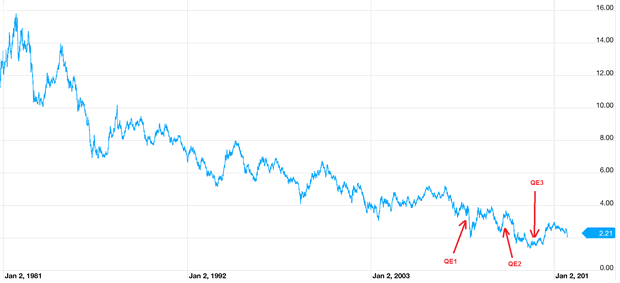
By zooming out to capture the entire time period of the bull market in bonds — i.e. the period of the falling interest rate — we can put QE in perspective.
The 10-year US Treasury bond now yields 2.21%. For reference, the 10-year German bund is 0.87% and the 10-year Japanese government bond is 0.48%.
It’s obvious from the chart, that QE is not the cause of today’s interest rate near 2%.
MarketWatch implicitly acknowledges that the conventional theory is 100% wrong. I have published an alternative, The Theory of Interest and Prices in a Paper Currency. It’s a long read in seven parts, but I have tried to keep it accessible to the layman.
Spoiler alert: I think interest rates will keep falling to zero, though of course there can be corrections.
The interest rate is pathological. It’s like an object that gets too close to a black hole. Once it falls below the event horizon, then a crash into the singularity of zero is inevitable.
You are cordially invited to The Gold Standard: Both Good and Necessary, in New York on Nov 1. There hasn’t been a real recovery from the crisis of 2008, and there won’t be until we return to the use of gold as money. Please come to this event to hear Andy Bernstein present the moral case for capitalism, and Keith Weiner present the case for the gold standard as the monetary system of capitalism.

When I coach investors and traders, I’m often asked what I think are the most common, most ruinous mistakes that investors make. Unfortunately, there are a lot of them.
There are mistakes like risking too much money on a single trade or investment … not using protective stops … not using disciplined money management … trading too often … not doing your homework … taking on too big a position in any market … not diversifying enough … and on and on.
Over time, I will explore each and every one of the above in greater detail, and more, to help you learn how to become a better investor and trader.
But in today’s column, I want to cover what I think is the most dangerous mistake investors make, bar none.
It’s what I call getting caught up in all the “market myths” that are always out there. Or put another way …
It’s having a set of preconceived notions
about what markets can and can’t do.
The fact of the matter is that markets can do whatever they want to do.
Markets are never wrong. Markets are never irrational.
 They are what they are and if you don’t understand a market, it’s not the market’s fault; the fault lies instead with your analysis.
For instance, have you ever heard someone say “a market is defying all logic?”
Or that a market is “disconnected from its underlying fundamentals?”
I’m sure you have. I hear those kinds of phrases all the time on shows on Bloomberg and CNBC.
But the fact of the matter is that …
Markets NEVER defy logic.
And they never defy the fundamentals.
Only people defy logic. Only people can make such statements about fundamental forces as well, because when a market is allegedly defying fundamentals, what it’s really doing is operating on fundamental forces that the analyst or investor simply hasn’t figured out yet.
I fully realize that what I’m talking about here is hard to grasp at first. But if you take the time to think deep and hard about what I’m saying, you will elevate your trading and investing to a whole new level. Markets are never wrong. Only people are.
Especially dangerous for most traders and investors is getting caught up in the various “market myths” that are out there.
For instance, how many times have you heard that rising interest rates are bad for the stock market, and that declining rates are good for stocks?
If you’re like any average investor, you’ve heard that theory literally hundreds, if not thousands, of times. Tune into any media show today, and I’m sure you’ll hear it at least once, if not more.
Most stock brokers, and the majority of analysts and newsletter editors, espouse the same causal relationship between interest rates and stock prices.
But the fact of the matter, the plain truth, is that there is no “standard relationship” between interest rates and stock prices. Period.
Consider the period from March 2000 to October 2002, where the Federal Funds rate declined from 5.85 percent to 1.75 percent, and the Nasdaq plunged 78 percent. Put simply, stocks and interest rates went down together! Exactly the opposite of what most would expect.
Or the period from March 2003 to October 2007, where the Federal Funds rate more than tripled and rose from 1.25 percent to 4.75 percent …
And the Dow exploded higher, launching from 7,992 to 13,930 — a 74 percent gain! Stocks and interest rates went higher together!
The fact is that the relationship between interest rates and stock prices varies considerably depending upon a host of factors, including the value of the dollar, inflation and where the economy is in terms of the economic cycle.
But the bottom line is this: Never assume anything and never, ever get caught in conventional thought about a market or you will most likely lose your shirt.
Let’s consider another myth that rising oil prices are bearish for stocks. That’s a bunch of baloney, too.
The fact is that there have been plenty of times when rising oil prices were bullish for stocks … and where falling oil and energy prices were bearish. Exactly the opposite of what most conventional thought tells you.
Or consider the normal view about a country’s widening trade deficit. The common theory is that a widening trade deficit is bad for stock prices and a narrowing deficit is good.
But history proves that it is entirely wrong, and nothing more than a myth.
Fact: From 1976 to 1998, the U.S. trade deficit ballooned from $6.08 billion to $166.14 billion, and guess what? The Dow Jones Industrials went from 848 to 9,343!
In truth, the relationship between the trade deficit or surplus and stock prices is exactly the opposite of what most pundits claim.
Or consider the myth about corporate earnings that says they have to rise for stock prices to continue higher. But from 1973 to 1975, the combined earnings of the S&P 500 companies rose strongly for six consecutive quarters, yet the S&P 500 Index fell more than 24 percent.
Moreover, according to research conducted by analyst Paul Kedrosky, since 1960, the average annual return on the S&P 500 was greatest when earnings were falling at a clip of 10 percent or more … while the smallest returns on the S&P 500 occurred when earnings were growing at up to 10 percent per annum!
In other words, rising corporate earnings does not guarantee rising stock prices, by any means. Nor do falling corporate earnings guarantee falling stock prices!
There are lots of myths or biases out there about relationships between economic fundamentals and markets, or between markets and other markets.
But the fact of the matter is that almost all of them are exactly that: Myths, and nothing more.
The bottom line: To avoid making the biggest investing and trading blunders …
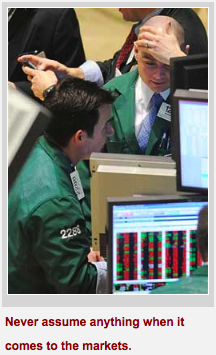
1. Never assume anything when it comes to the markets …
2. Question everything, and most of all …
3. Think independently!
Right now, gold is trying to bounce a bit. But it won’t get far. It’s headed lower overall. So I hope you took me up on my recommendation to hedge any holdings you have via the inverse ETFs I recommended in my past few columns.
The stock market, meanwhile, is also bouncing. But don’t be deceived: It’s headed lower for a while. So here, too, I strongly recommended hedging any positions you can’t exit, for whatever reason, via the inverse ETFs I recommended in my last column.
Stay tuned and best wishes,
Larry
…related:


-
I know Mike is a very solid investor and respect his opinions very much. So if he says pay attention to this or that - I will.
~ Dale G.
-
I've started managing my own investments so view Michael's site as a one-stop shop from which to get information and perspectives.
~ Dave E.
-
Michael offers easy reading, honest, common sense information that anyone can use in a practical manner.
~ der_al.
-
A sane voice in a scrambled investment world.
~ Ed R.
Inside Edge Pro Contributors

Greg Weldon

Josef Schachter

Tyler Bollhorn

Ryan Irvine

Paul Beattie

Martin Straith

Patrick Ceresna

Mark Leibovit

James Thorne

Victor Adair