
Stocks & Equities

5 Red Flags Raised by Stock Market’s Record Run

Screen Shot 2014-11-13 at 7.36.44 AM
Volatility, as measured by the CBOE VIX index VIX, +0.15%  after spiking higher in October, dropped back to year’s lows and at around 13 is well below historical averages. 

The exact “V” shaped recovery in both the VIX and S&P 500 seems unnatural. Previous pullbacks took much longer to recover from.

Jeffrey Saut, chief investment strategist at Raymond James, says the reasons to expect higher volatility are simple: historically, after long periods of low volatility, markets experience higher volatility. Others think it is the Fed’s exit from QE that will contribute to higher volatility. But whatever the reason, most people on Wall Street agree that volatility is going to be higher in the months to come, which means we are likely to see more pullbacks. Click HERE or Image for next Chart


What Happens When the Surf Is Down – Contemplating Stocks without QE

Some influences on the stock market are casual, subtle or open to interpretation, but the catalyst behind the current stock market rally really shouldn’t be controversial. As far as stocks go, we have lived by QE. The only question now is, whether we will die without it.


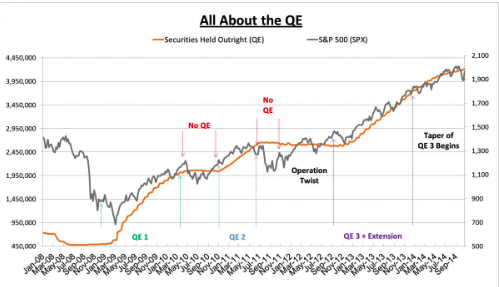
Since the financial crisis of 2008 stock prices have only risen when the Fed is either expanding its balance sheet, hinting that it will soon do so, or actively recycling assets to hold down long term interest rates. Absent any of these aggressive moves, stocks have shown a clear tendency to fall. Curiously, while most investors now believe that QE is in the past, and that the Fed will not even be hinting at a restart, few would argue that the current bull market is in danger. But a quick look at how much influence the Fed’s operations have had on market performance should send a chill down Wall Street. The Chart below should speak for itself:
 
Screen Shot 2014-11-12 at 11.28.16 AM
Created by EPC using data from the Federal Reserve and Bloomberg
 
In August 2007, the Federal Open Market Committee’s (FOMC) target for the federal funds rate was 5.25%. Sixteen months later, with the financial crisis in full swing, the FOMC had lowered the target for the federal funds rate to nearly zero, thereby entering the unfamiliar territory of having to conduct monetary policy without the ability to cut rates further. Six years later, rates are still at zero. This has left the Fed’s capacity to buy assets on the open market (now known as Quantitative Easing – QE) as their principle policy tool.


In order to stop the markets from crashing further in the Fall of 2008, the Fed announced a plan to purchase $600 billion in mortgage-backed securities (MBS) and agency debt. When first announced, the plan faced some political resistance even though most thought it would be a one shot deal. But when the opening salvo wasn’t enough to push stocks back up, on March 18, 2009, the Fed announced a major expansion of the program with additional purchases of $750 billion of agency MBS and $300 billion in Treasuries. That got the market’s attention.


Between March 6, 2009, when the S&P put in its low watermark, and March 2010, when this program (which would become known as QE1) came to an end, the Fed had expanded its balance sheet by $1.43trillion, or 247%. Over that time, the S&P 500 put in a rally of 71%, rising from a low of 683 to 1169 at the end of March 2010.


But when the dust settled, bad things started happening. From April to November 2010, QE was on hiatus, and the Fed’s balance sheet expanded by just 1.5%. In this environment, stocks fared quite poorly. From the end of QE1 to August 2010, stocks declined by about 11%, the first correction since the market began rallying in 2009. As the markets panicked, the Fed came to the rescue. On August 27 2010, at an eagerly anticipated speech at the Fed’s annual Jackson Hole Wyoming retreat, Fed Chairman Ben Bernanke strongly hinted that he was ready to launch another round of QE.


As it turns out, just a little tease was enough. The markets immediately started rallying, notching an approximate 18% gain in the final five months of 2010. The formal launch of QE2 occurred on November 3, 2010 when the Fed laid out a plan to purchase another $600 billion of mostly long-dated Treasury bonds. Like the first QE program, it was born with an expiration date (June 2011). By the time the program ran its course, the Fed’ balance sheet had swelled by 29.4% to $2.64 trillion, and the S&P 500 had rallied about 25% from its August 2010 lows. Fairly neat correlation.


But then the entire movie started again. When QE2 became a thing of the past in July 2011, markets turned south. With no QE wind at the back of Wall Street’s sails, and no hints that it would return soon, the S&P 500 put in a wicked 16% sell-off between July and August 19. A decent September rally soon petered out and by the end of September stocks were once again approaching their August lows.


Cut to Ben Bernanke charging on his cavalry horse, bugle firmly in hand. However, the Fed had become wary of falling into a predictable pattern of launching a fresh round of QE every time the market stumbled. So, on September 21, 2011, he announced the implementation of “Operation Twist,” which authorized the Fed to purchase $400 billion of Treasury bonds with maturities from 6 to 30 years and to sell bonds with maturities less than 3 years, thereby extending the average maturity of the Fed’s portfolio. By buying “on the long end of the curve” the plan hoped to push down long-term interest rates, thereby more directly stimulating mortgage origination and consumer and business lending. It was hoped that Twist would offer the benefits of QE without actually expanding the Fed’s balance sheet. A rose by another name could perhaps smell as sweet. And like the earlier QE plans, Twist was announced as a finite program with an expiration date.


Once again the markets responded, rallying about 25% from the end of September 2011 to the end of April 2012. But when Operation Twist stopped twisting, another sell-off predictably ensued. From April 27, 2012 to June 1, 2012, the S&P dropped 9%. So on June 20, 2012 the Fed extended Twist to the end of 2012, which would include an additional $267 billion of short term/long term debt swaps. From the time of the Twist extension announcement to September 14, 2012, the S&P 500 gained back more than the 10% it had lost. But towards the end of September the rally slowed and another fall threatened.


At this point I believe the Fed finally understood: No stimulus, no rally. And given that the surging stock market was a key element in creating the wealth effects that the Fed believed was essential to economic growth, they instituted a policy that would ensure market gains on an ongoing basis.


On September 13, 2012, the Fed announced a third round of QE which provided for an open-ended commitment to purchase $40 billion agency mortgage-backed securities per month. This unlimited QE eliminated the need for embarrassing re-launches every time the markets or the economy stalled. But the $40 billion monthly rate was apparently not enough to move stocks. From the time of the announcement to the end of 2012, the S&P declined about 2.3%. So then on December 12, 2012 the Fed voted to more than double the size of QE3 by authorizing monthly purchase of up to $45 billion of longer-term Treasury debt, on top of the mortgage debt they were already buying. The rest is history.


The past 18 months has seen lackluster economic performance, a deteriorating geo-political landscape, and, somewhat incongruously, a nearly relentless stock market rally. From the time QE3 was announced, until the program was officially wound down this month, the S&P 500 surged 36%. But the rally was expensive. During that time the Fed’s balance sheet of securities held outright, expanded by an astounding 63% to $4.2 trillion.


On December 18, 2013 the Fed announced the “Taper,” a regular reduction of QE3 at a rate of $10 billion every six weeks. On October 29, 2014, the Fed made good on its initial timeline and officially wound down the program.


Although the rally in stocks continued during the taper of 2014 the rate of increase slowed along with the rate of balance sheet expansion. Full throttled $85 billion per month QE persisted from September 2012 to December 2013. During that time, stocks rallied about 26%, and the Fed’s balance sheet grew by 45% to $3.7 trillion. Since the taper began, however, the Fed’s balance sheet has grown just 12% (through October 22, 2014), with the S&P 500 virtually matching that with a 12% increase. As the chart above clearly demonstrates, stocks have hidden the rising wave of Fed assets like a world class surfer on Hawaii’s North Shore. The big question now should be what happens now that the age of QE is apparently over, and the surf is no longer up?
 
SurferNoWaves2The day after the Fed announced the end of QE 3, Paul Richards, the head of FX for UBS said on CNBC that he is “so bullish on stocks that it hurts.” One wonders if he had ever seen a chart like the one produced for this article. But Mr. Richards is not far off from the vast majority of U.S. stock analysts who see clear sailing ahead.


 

To reach that conclusion, one must completely ignore not only the role QE played in driving up stock prices, but discount any negative effects that a reduction of the Fed’s balance sheet could create. Most economists recognize that to normalize policy the Fed must reduce the amount of securities it holds. This will be an environment that we have never encountered. Logical analysis should lead you to believe that stocks would not fare well. But logic is not welcome on Wall Street.


The bottom line is that stocks should be expected to fall without QE. But this does not mean I predict a crash in stocks. I simply expect, as no one else seems to, that the Fed will go back to the well as soon as the markets scream loud enough for support. At that point, it should become clear to everyone that there is no exit from the era of QE and that there is nothing normal or organic about the current rally. At that point, the asset classes that have been ignored and ridiculed should have their day in the sun.


Alternative Investing 101

craigburrowsThe last month saw a 12% drop in the TSX and volatility has many investors worried about the next 12 months. When you add potential inflation jitters, is the 60/40 equity / bond split still relevant? I would say that investing like it was the 1970s or 80s is like bringing a knife to a gun fight.

But before we finally scare you into cash and low producing GICs, is there another alternative?

There was a great commercial regarding men’s suits and the owner (Sy Syms) would say that “an educated consumer is our best customer”. At TriView, our goal is to educate investors and provide value-added strategies for the Money Talks audience. Over the next four weeks we offer a strategy for retail investors to learn about investing in alternative and private equity investments:

  • What are Alternative Investments?
  • The Risks of Alternative Investments
  • Current trends towards Alternative Investments & Regulatory Changes
  • Why and how to add Alternative Investments to your portfolio?

Session #1 WHAT ARE ALTERNATIVE INVESTMENTS?

In last week’s article I explained why I couldn’t invest like my grandfather did in the 1970s or 80s. In this article I want to give you an understanding of what alternative investments are available to reduce public market volatility and inflation concerns. Alternative investments generally have these following characteristics:

–          They tend not to have a correlation to traditional investments like public stocks or bonds which allows them to act as a hedge to public market volatility or inflation.

–          They are rarely traded in the public markets and even rarer to be offered to retail investors due to their complexity and fewer regulatory hurdles compared to traditional investments.

–          They tend to be illiquid securities that tend to have set exits with little ability to sell before the exit term.

–          They tend not to have a secondary market for resale or have restricted sale covenants from the issuer.

–          Most financial advisers do not recommend them to investors due to their own lack of knowledge – which is why they tend to stick to stocks, bonds, mutual funds, ETFs and GICs

There are three main areas to alternative investments that are available to retail investors:

  • Real Estate
  • Private Equity
  • Commodities

Real Estate: More people have made money in real estate than any other kind of investment so why don’t more advisors recommend real estate in their portfolio mix? As most people have owned a home or rented an apartment, investors can generally understand the basics of real estate. It’s interesting that most people would have no problem leveraging a real estate investment with a mortgage. But try to explain a public market strategy of shorting or margining and their eyes glaze over!

Real estate has a low correlation to the stock market, but has a positive correlation to inflation to protect against inflationary erosion. Owning real estate requires significant management and therefore most people prefer to only own their primary residence and perhaps a secondary property. Since most people’s money is in their primary residence, financial advisors may recommend not to add real estate to their portfolio to provide diversity.

If you decide to invest in real estate beyond your home, here are a couple of common scenarios:

Public REITs: these are publicly traded Real Estate Income Trusts (REITs) that invest in specific or multiple sectors like commercial, industrial and residential. They provide some tax efficiencies and the units are normally liquid and generally move with the public markets which generally makes them more volatile than private real estate offerings.

Private REITs: Similar to public REITs except they are not as volatile as their public cousins but are generally not as liquid.

GP/LP Model: This model is generally used for high net worth investors that invest in a specific property and the LP investors (Limited Partners) have limited liability if the development needs more cash and exposure is generally limited to the amount they have invested. This structure has tax efficiencies as well.

MFT: Mutual Fund Trust is set up for investors that would like to invest in real estate through their registered funds. MFTs can invest in single investments or perhaps private REITs

Private Equity: There has become a greater demand for private equity offerings. Traditional investors in private equity were friends and family, angel investors and venture capitalists. Generally these companies were start-ups with huge risks and huge rewards. Most would fail which made it a product for “not the faint of heart”.

Private equity has changed dramatically in the past 15 years as more companies choose to raise capital privately than through public markets. The days of the great “IPO” are over for many entrepreneurs as companies who tend to have market capitalization of less than $500 million tend to be “orphaned stocks” due to lack of volume trading of their stock.

Today they are many quality businesses with strong track records and cash flow that need capital to grow their business and seek private markets for LBOs (leveraged buyouts), MBOs (management buyouts) and mezzanine capital (short term loans) to grow their business and keep themselves private. The negative of private securities is their illiquidity, long term holds of 5 – 10 years and risk of default. That being said, with many baby boomers looking to retire there is an opportunity to buy these highly profitable companies or even invest through your registered funds.

Commodities: For those who like “hard assets” like gold, silver or diamonds, one can invest directly into these assets and hold them in funds or actually take possession of them physically. Most people prefer to buy commodities by owning public securities that are in the mining or resource sector. People who invest in commodities are generally looking for protection against inflation and the volatility of currency fluctuations or buy resources if they feel that the global economy is growing and needs resources to bring products to market (cars, food, etc). Commodities do have a potential flaw as they are volatile to price swings based on the markets’ mood.

I won’t delve into Hedge Funds or Structured Products as they tend to be for institutional investors.

In next week’s article I will cover the risks of Alternative Investments. and remember, before making any investment in public, private or alternative investments, learn the pros and cons – and if it is too good to be true or difficult to understand, DON’T INVEST!

Connecting the Dots: Not Yet Time to Celebrate a Market Turnaround

The Wall Street crowd liked what they heard last week and pushed the Dow Jones to a new high. In particular, the trio of the Republican landslide victory, an overall positive Q3 earning season, and a good jobs report that showed unemployment dropping to 5.8% was behind the rally.

And what a rally it was. Since the start of earnings season on October 8, the S&P 500 has increased by 3% and has bounced by an eye-popping 9.1% from the October 15 low.

Many of my peers have already popped the champagne and drunkenly declared a coast-is-clear resumption of the great bull market.

Not so fast. There was a trio of negative news pieces last week that tells me there is more to be worried about than there is to celebrate.

“V” Is for Vulnerable… Not Victory

You shouldn’t trust “V”-shaped bottoms.

Instead of being encouraged by the 9% moonshot since the October 15 low, I am even more skeptical. The S&P 500 shot up by 220 points in just three weeks, which tells me that the rubber band of stock market psychology is overstretched.

Image 1 20141111 CTD

The stock market’s massive mood swing from fear to greed can change just as quickly to the other direction. Sharp trend reversals followed by sharp rebounds is not a kind of bottom building behavior.

The rally has been accomplished with low trading volume—a classic definition of an unsustainable bounce because it shows that the rally was more from a lack of sellers rather than an abundance of buyers.

And don’t forget about the drastic underperformance of small stocks. The Russell 2000 is up less than 1% for the year compared to 11% for the Nasdaq and 10% for the S&P 500.

Earnings: Look Ahead, Not Behind

Overall, corporate America had an impressive third quarter. 88% of the companies in the S&P 500 have reported their third-quarter earnings; of those, 66% exceeded Wall Street expectations.

Impressive, right? Not so fast!

When it comes to earnings, you need to be looking through the front-view windshield and not the rear-view mirror.

Image 2 20141111 CTD

Even the perpetually bullish analytical community is getting worried. The average estimates for Q4 earnings as well as Q1 2015 are being downwardly adjusted. Since October 1:

  • Q4 earnings growth have been lowered from 11.1% to 7.6%;and 
  • Q1 2015 earnings growth has been chopped from 11.5% to 8.8%. 

Don’t give Wall Street too much credit for being rational. Those downward revisions are largely based on the cautious outlook given the corporate America itself. The ratio of negative outlooks to positive outlooks is 3.9 to 1!

Both Wall Street and corporate America are concerned, and so should you be.

Don’t Ignore Central Bankers’ Warnings

Many of the world’s central bankers gathered in Paris last week to figure out how to keep the world’s leaky financial boat from sinking, as well as spending more of their taxpayers’ money on fine wine, cuisine, and luxury hotels.

All those central bankers are eager to keep their economies afloat, but judging from the comments, they’re worried that they are running out of monetary bullets.

“Normalization could lead to some heightened financial volatility,” warned Janet Yellen.

Image 3 20141111 CTD

“This shift in policy will undoubtedly be accompanied by some degree of market turbulence,” said William Dudley, president of the Federal Reserve Bank of New York.

“The transition could be bumpy … potential for financial market disruption,” cautioned Bank of England Governor Mark Carney.

“Paramount risk of very low interest rates is to entertain the illusion that governments can continue to borrow rather than make difficult and yet necessary choices and indefinitely put off the implementation of structural reforms,” admitted Bank of France Governor Christian Noyer.

“The bottom line is there is a very good question about whether more stimulus is the answer,” said Reserve Bank of India Governor Raghuram Rajan.

Perhaps the most honest and telling statement from Malaysian central banker Zeti Akhtar Aziz: “In this highly connected world, you would be kindest to your neighbors when your keep your own house in order.”

That’s a whole lot of central banker warnings—and it’s always a mistake to ignore the people who control the world’s printing presses. 

30-year market expert Tony Sagami leads the Yield Shark and Rational Bear advisories at Mauldin Economics. To learn more about Yield Shark and how it helps you maximize dividend income, click here. To learn more about Rational Bear and how you can use it to benefit from falling stocks and sectors, click here.

Rare Earth Revolution & Companies To Take Advantage of It

Jack Lifton Says Innovation Is the Key to REE Independence

minedustbluesky580China’s geology, cost structure and disregard for environmental degradation have led to rare earth world domination. But the landscape is changing. In this interview with The Mining Report, industry expert Jack Lifton shares his vision for a world where centralized modern processing could make it possible for mining companies in the United States, Europe and Australia to start producing truly critical materials with small capex

The Mining Report: Jack, as we move into the age of technology metals, what is the current state of the rare earths sector inside and outside of China?

Jack Lifton: The rare earth elements (REE) are not rare in the common sense of the word. It’s that they’re rarely produced because of production costs. Rare earths typically are present in small proportions to what is otherwise being mined; they are almost universally byproducts. This presents a very high cost picture for developing an REE “mine.” 

Screen Shot 2014-11-12 at 7.08.49 AMProcessing REEs is another impediment to their development. The traditional processing technique for separating REEs from each other and purifying them hasn’t evolved very much over the last century. It’s gotten a little easier, but it remains very slow and very expensive. 


The idea of building a very expensive mine coupled with a very expensive separation plant has put an economic burden on the development of rare earth sources, at least outside of China, in the last 10 years. Very little thought went into the REE boom that began around 2007 when Molycorp Inc. (MCP:NYSE) was purchased from its original owners by a group that was determined to break the Chinese monopoly. Nobody asked what was the point. What were we going to produce that was in short supply? The excitement of the venture took over. 


In 2011, the Chinese ministry put out a notice saying that it was considering a halt of HREE exports. Suddenly, the sky was falling. China was going to stop exporting HREEs. That will kill our industry, destroy our military and life as we know it. What actually happened was that the Chinese ministry in charge of setting goals for industries backed off. It didn’t stop exports, but it did tighten up the export controls and reduced the quotas. 

At the time, no one talked about which REEs were involved. That was convenient for the junior miners because there were only two projects coming into operation outside China: Lynas Corp. (LYC:ASX) in Australia and Molycorp in California. Both are LREE projects. The projects make sense only if China’s light rare earths (LREEs) production or its ability to sell LREEs was to be impaired. 
Screen Shot 2014-11-12 at 7.08.59 AMYou have to understand that the Chinese don’t think about North America, Australia or Europe as competitors in the REE sector. In August, I attended a meeting in China where the chairman of Baotou Steel Rare Earth, whose Baosteel division produces LREEs in Inner Mongolia, declared his company the world’s largest LREE producer and the largest vertically integrated company in the REE sector. In effect, he was saying, we produce so much of this stuff we don’t even know what to do with it. Molycorp and Lynas were never mentioned.

He announced Baotou would produce a minimum of 30,000 tons (30 Kt) of surplus cerium this year. I understand that because you have to produce all of the rare earths to get any of them, but my question was why? The answer was the 15% of Baotou’s deposit that’s neodymium and praseodymium, the magnet metals. That is really what Baotou is after. The Chinese just keep producing and stockpiling the other stuff to get at the critical magnet material they need. 

No matter how you figure it, there isn’t enough of the magnet metals to meet actual demand, never mind projected demand. China isn’t producing enough neodymium and praseodymium to meet its own internal demand. One way to augment production is to start producing LREEs, which are 85% stuff you don’t need, to increase the production of the 15% you do need. That seemed to be what the Baotou chairman was saying. I came back thinking that the last business I want to be in is one that depends on a revenue stream from LREEs, which are being produced in surplus in China.

TMR: Is there still demand for HREEs outside China?

JL: Yes, of course. The point is China is still the only HREE producer because of the cost structure. Heavy rare earths occur almost everywhere in the world in extremely low-grade deposits. In China, for example, HREEs come from the so-called ionic adsorption clays, which are just a few hundred parts per million. Now luckily for the Chinese, mining ionic adsorption clays is not nearly as expensive as underground or even surface mining of Screen Shot 2014-11-12 at 7.09.09 AMhard rock material. 
For example, if I have 50 parts per million of dysprosium in ionic adsorption clays, I need to process 1 million tons (1 Mt) of clay to get 50 tons of dysprosium. By comparison, if I move 1 Mt of rock at Mountain Pass, California, I will produce 50–80 Kt of REEs. In China, I’m going to get 50 tons of dysprosium. The Chinese do this on an immense scale, producing as much as 15 Kt of these materials, of which only 8 Kt to 10 Kt tons are the REE-related element yttrium. The Chinese are washing millions and millions of tons of clay. 

China is the only place that produces HREEs from ionic adsorption clays. That happened as dysprosium-modified magnets became extremely useful and necessary. 

TMR: Is that due to demand for permanent magnets for electric cars?

JL: Right. Magnets used in extreme environments of hot and cold need to be modified with dysprosium and terbium so that they don’t permanently lose their magnetization when they go through a heat cycle. 

Quite frankly, if these elements had been found anywhere else in the world, they probably wouldn’t have been developed. The world is fortunate that they were found in such a low labor cost, but highly developed country. 

Ionic adsorption clays exist in Vietnam, Thailand, Cambodia, Indonesia, Malaysia. They haven’t been developed there for many reasons. Some are ethical reasons. Ionic adsorption clay mining is extremely dirty environmentally and very difficult to contain. 

A significant source of this material was discovered in Thailand right under a resort area a couple of years ago. The Thai government said it didn’t give a damn what anybody thought, nobody was going to start ionic adsorption clay processing next to the swimming pool in a country where tourism is the number one revenue source. 

The Vietnamese have a wide variety of rare earth sources, hard rock, as well as ionic adsorption clay, but dealing with the country has been impossible so far. 

TMR: You’ve mentioned that the cost of processing may be going down. Will that make HREE mining outside of China more practical?

JL: Yes and no. Yes, if somebody creates a central processing facility. Outside of China, I’ve been counseling people not to commit to building a solvent extraction plant until they’ve looked at the other technologies that are available. The impediment is that none of the other technologies has been operated at scale. However, pilot plants are underway in North America and Europe for at least two non-solvent extraction technologies. 

TMR: What are some companies that could take advantage of these new processing technologies?

JL: U.S. companies that could take advantage of a central processing plant and benefit from relatively low mine development costs would be Ucore Rare Metals Inc. (UCU:TSX.V; UURAF:OTCQX) in Australia, Rare Element Resources Ltd. (RES:TSX; REE:NYSE.MKT)in Wyoming and Texas Rare Earth Resources Corp. (TRER:OTCQX) in Texas. These projects all are themed to HREE production from hard rock or, in the case of Rare Element Resources, have unusually high HREE content in an otherwise LREE deposit. 

Sweden’s Tasman Metals Ltd. (TSM:TSX.V; TAS:NYSE.MKT; TASXF:OTCPK; T61:FSE)has an unusually good HREE-themed hard rock deposit. 

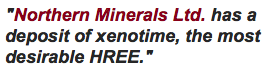
In Australia, Northern Minerals Ltd. (NTU:ASX) has a deposit of xenotime, the most desirable HREE. 

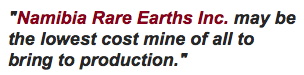
In Africa, Namibia Rare Earths Inc. (NRE:TSX, NMREF:OTCQX) may be the lowest cost mine of all to bring to production. 

The problem with all of these projects is that developing the mine is just step one. Once you do the metallurgy and extract the values you want, you end up with a mixed concentrate. At this point, the only thing you can do with an HREE mixed concentrate is sell it to China or line up to try and get tolling at an acceptable cost from Solvay SA (SOLB:NYSE; SOLB:BRU) or, perhaps, Shin-Etsu Chemical Co. Ltd. (4063: TYO). 

With today’s general commodity price decline, we’re seeing unusual declines in the prices of the HREEs, in China at least. The price a Chinese producer gets from a Chinese customer has stayed artificially low. Even though the production of REE permanent magnets has gone up significantly, the price of dysprosium has gone down. For the first time in my adult life I’ve begun to wonder if the conspiracy theorists might not be on to something. 

Hitachi Metals Ltd. (5468:TKY; HMTLF:OTCPK) owns 600 patents—sort of a monopoly—for modern REE permanent magnets. Twenty percent of Chinese magnet companies are licensees of Hitachi. If General Motors is buying an REE permanent motor in China, it’s most likely made by a Chinese company using a Hitachi license. This is starting to decline as Hitachi’s patents expire. 

The Chinese are coming out roaring in this business. They want direct business all over the world. 

TMR: Is there any hope for extra-Chinese companies if they can utilize shared processing at lower costs?

JL: If these materials are critical for our military and our lifestyle, somebody will have to capitalize security and independence. Geography is destiny in geology. The Chinese have these materials. They don’t have to pay to develop mines or develop new ways to separate the material. 

The only thing that’s impeding China is its own internal inflation, its cost of labor and chemicals, its skilled labor. These are going up all of the time. Now, China is looking for REE sources elsewhere in the world. 

Isn’t this the ideal situation in a capitalist system? We have somebody who wants something we’ve got. Why aren’t we developing it?

TMR: Australia is in China’s backyard. Northern Minerals conducted a bench scale test in 2013, using both high-gradient magnetic separation and whole ore floatation circuitry. Could that company take advantage of new techniques to supply demand? 

JL: Northern Minerals has a very large Chinese investor who offered to put in enough money to complete the development, if he could take over the company. Management turned him down. CEO George Bauk told me he thinks he can raise the money in Australia without selling out and becoming a foreign-owned company. He’s very optimistic. 

TMR: Are there other companies in Australia that you are watching?

JL: Alkane Resources Ltd. (ANLKY:OTCQX; ALK:ASX) is producing and selling gold. It has an offtake for its REEs. Alkane is moving along, going into production. 

TMR: Any closing thoughts?

JL: In the West, our cowboy capitalism is looking for new ways to apply existing technology to REE separation. A genuine change in how REEs are processed may be the salvation of the non-Chinese industry. It costs a bundle to build a mine and processing plant—amounts of money the market cannot support because there isn’t enough profit to be made to repay the debt. It’s way too late to raise that amount of equity. 

Lynas and Molycorp did raise those amounts of equity. They built REE separation plants and developed their mines and neither one of them is making any money, because they chose to focus on light rare earth separation.

I’m advising the industry to look at processing together because even if all the names I mentioned in this interview were to reach their target production, there still wouldn’t be enough material to meet existing demand. If you built a central processing plant in North America and that cost were taken off the business model, that might help convince investors to fund one or all of them. We need all of them.

TMR: Thanks for your time and your insights. 

Jack LiftonJack Lifton is an independent consultant and commentator, focusing on market fundamentals and future end-use trends of the rare metals. He specializes in sourcing nonferrous strategic metals and due diligence studies of businesses in that space. He has more than 50 years of experience in the global OEM automotive, heavy equipment, electrical and electronic, mining, smelting and refining industries. Lifton is also an author at InvestorIntel.

Want to read more Mining Report interviews like this? Sign up for our free e-newsletter, and you’ll learn when new articles have been published. To see recent interviews with industry analysts and commentators, visit The Mining Report homepage.

Related Articles


DISCLOSURE: 
1) JT Long conducted this interview for Streetwise Reports LLC, publisher of The Gold Report, The Energy Report, The Life Sciences Report and The Mining Report, and provides services to Streetwise Reports as an employee. She owns, or her family owns, shares of the following companies mentioned in this interview: None.
2) Jack Lifton: I own, or my family owns, shares of the following companies mentioned in this interview: None. I personally am, or my family is, paid as business operations consultant by the following companies mentioned in this interview: Ucore Rare Metals Inc., Rare Element Resources Ltd., Texas Rare Earth Resources Corp. (where he is a non-executive Director) and Tasman Metals Ltd. My company has a financial relationship with the following companies mentioned in this interview: None. I was not paid by Streetwise Reports for participating in this interview. Comments and opinions expressed are my own comments and opinions. I determined and had final say over what companies would be included in the interview based on my research, understanding of the sector and interview theme. I had the opportunity to review the interview for accuracy as of the date of the interview and am responsible for the content of the interview. 
3) The following companies mentioned in the interview are sponsors of Streetwise Reports: Northern Minerals Ltd., Namibia Rare Earths Inc and Alkane Resources Ltd. The companies mentioned in this interview were not involved in any aspect of the interview preparation or post-interview editing so the expert could speak independently about the sector. Streetwise Reports does not accept stock in exchange for its services.
4) Interviews are edited for clarity. Streetwise Reports does not make editorial comments or change experts’ statements without their consent.
5) The interview does not constitute investment advice. Each reader is encouraged to consult with his or her individual financial professional and any action a reader takes as a result of information presented here is his or her own responsibility. By opening this page, each reader accepts and agrees to Streetwise Reports’ terms of use and full legal disclaimer.
6) From time to time, Streetwise Reports LLC and its directors, officers, employees or members of their families, as well as persons interviewed for articles and interviews on the site, may have a long or short position in securities mentioned. Directors, officers, employees or members of their families are prohibited from making purchases and/or sales of those securities in the open market or otherwise during the up-to-four-week interval from the time of the interview until after it publishes.


 

test-php-789