
Asset protection
Signs Of The Times
We have been hoping to see anecdotes about diminishing speculation.
“Russia boosted gold reserves by the most since defaulting on local debt in 1998, driving its bullion holdings to the highest in at least two decades.”
– Bloomberg, October 29.
It is worth noting that this policy is likely more due to sound banking than to speculation.
“The credit quality of U.S. Commercial mortgages being packaged into bonds slipped further as borrowers piled into more debt.”
– Bloomberg, October 30.
“Wall Street banks are either absorbing losses or getting stuck holding some of the riskiest corporate loans they agreed to underwrite [just] before the biggest rout in more than two years.”
– Bloomberg, October 30.
“Goldman: The Risk Of A Stock Market Crash Is Low.”
– Business Insider, November 4.
The article included that the model was based upon “Historical price data from 20 advanced economies.” It did not mention how long the data base was. Five years, or three hundred years?
“The Republican wave that swept the states left Democrats at their weakest point since the 1920s.”
– National Conference of State Legislatures, November 5.
*****
Perspective
We will stay with our theme of 1-Exuberance, 2-Negative Divergence, 3-Volatility and 4- Resolution.
Condition #1 prevailed from July until September. Highlights were bearish sentiment dropping to 13.3%, the lowest since 1987; and the S&P registering Monthly Upside Exhaustions – not seen on this
proprietary model since 2000.
Condition #2 had the Small Caps and the STOXX setting highs in the summer and then taking out key moving averages.
Condition #3 had the VIX turning up in August.
Condition #4 “Resolution” clocked a 10% correction but has not recorded a setback proportionate to the degree and duration of financial speculation. The Fed, BoJ and the ECB are still in a highly speculative mode. Well, they did use reserves to buy equities. Modern central banking please meet modern portfolio theory.
The S&P rebound out of the Springboard Buy of September 17th has become somewhat overbought. How far can this rebound go?
We should look at “What is in the market?’.
Other than everyone, “news” about the ECB1 buying is in and so is the remarkable push by the Bank of Japan. And the news about one of the most profound election wins in US history is “in” as well. It will take many years to repair the damage done by the Obama administration. What’s more, he will impose a “scorched earth” policy before leaving.
Recall that his objective has been to trash the economy and the middle class by overwhelming the welfare system. All according to Saul Alinsky. Although more of the media are now describing Obama as incompetent, this is not the case. He has been remarkably successful in imposing his personal vision of the “new” America.
Other than a voluntary and sudden retirement of the president, we can’t think of any other sensational policy moves. However, the Republican “wave” could temper the ambition of the Federal Reserve System. Perhaps from Reckless 2.0 to Reckless 1.0.
Currencies
Earlier today, the DX made it to 87.91, a new high for the move. Quite likely the rally from the breakout at 81 in July to 86 in early October was tied to the “correction” in the financial markets. The rally from 85 in mid-October was due to the rebound when the “world” was buying US stocks and bonds.
This week it is tied to the remarkable change in US politics and the crashing ruble.
For those who are obliged to service debt with US dollars into New York the burden is increasing. In the volatile times of the 1550s, Gresham was Elizabeth’s advisor and agent in the money market of Antwerp. In a number of letters he explained the problem of servicing debt from a weak currency to a strong one.
This has been the best explanation of why the senior currency is chronically firm in a post-bubble contraction.
The Canadian dollar has slumped with crude oil, which has forced the Weekly RSI down to 32. A little closer to 30 would be oversold enough to limit the decline.
We have been looking for crude and copper to decline on seasonal forces into December.
Commodities
The highlight is the plunge in crude oil and the momentum is down to a Weekly RSI of 21.57. This is approaching the level that could limit the decline. That would be under “normal” market conditions going into a seasonal low.
However, in this year’s discovery of volatility has seen failures from an oversold condition. For the DX it has been extensions in the rally from overbought conditions. Also there is the attractive possibility of Russia suffering a sharp decline of petroleum income. It happened when crude crashed from late 1985 to spring 1986.
The chart of the crashing ruble follows.
Last year’s “cold weather” rally in natural gas essentially began from a dip into November to 3.38. The rally made it to 6.49 in February. We have been looking for a similar trade this year. The low was 3.55 two weeks ago and has jumped to 4.40 yesterday. If a financial storm develops the action could become volatile.
Copper has been expected to set a tradable low sometime in November. The high on last winter’s “Rotation” was 3.11 and the price has declined to 2.95 in mid-October. The relief rally took it to 3.11 and the low needs to be tested.
Grains (GKX) have had the best indications of stability and then a rally. The low was 290 at the first of October and has been 323 a couple of weeks ago. It is in a modest uptrend, tempered by the firm dollar.
Precious Metals
Wednesday’s Special Report on gold updated our big perspective on precious metals. The point to be made is that it does not endorse the “gold and silver bug” culture that grew out the 1960s and seems to have reached its ultimate passion in 2011. This has always rested upon the utterly immoral theories and practices of interventionist central banking.
The action since the peak in 2011 is likely a transition from the old school of research to the “new” paradigm of gold’s behaviour in a long post-bubble contraction. In which case, investment in gold shares will be the key to good returns. With a chronically firmer dollar the old paradigm of making the gains from dollar depreciation relative gold may be limited to brief trades.
Precious metals markets over the next few weeks will be interesting. Traditionally, gold stocks lead the change in bullion prices. So what we are looking for now is for the HUI to outperform gold. With this, gold would follow with a rise in dollar terms.
HUI/Gold was down to 22 yesterday on the Weekly RSI, which is very oversold. The ratio of HUI/GLD set a new low of 1.33 at yesterday’s close. It is up around 4% today, which seems to be a good start. However, it will need some technical work before we can call a new bull market for the sector.
Gold’s real price rising since June is likely the start of a cyclical bull market which is very constructive on the longer term outlook for the precious metals sector.
Link to November 7th Bob Hoye interview on TalkDigitalNetwork.com:
http://talkdigitalnetwork.com/2014/11/whats-behind-positive-loonie-gold-bump/

 “It’s called a “credit cycle” for a reason. Rising rates come around sooner or later – often ferociously – after a long period of apparent stability, over-optimism, overpriced equities and artificially suppressed yields.”
We’ve been meaning to write about what hasn’t happened yet.
Not that we claim any knowledge of tomorrow or the day after. But we can look at the present. And here’s a guess about where it might lead.
The middle classes – aka “the voters” – expressed themselves last week. They have been sorely used and they know it.
The biggest money-fabricating program of all time – the Fed’s QE – has done nothing for them. Instead, it has made their lot worse.
Investment in new business output has gone down. Their meager savings produce no revenue. And “breadwinning jobs” are scarce.
For all the talk of an “improving labor market,” there is no sign of it in wages. The typical household has $5,000 less income than it had when the 21st century began.
Cold, Dark and Desperate
Meanwhile, Europe and Japan grow cold, dark and desperate. Last week, ECB chief Mario Draghi announced the central bank would buy another €1 trillion of bonds to try to light a fire under the euro-zone economy.
And Bank of Japan governor Haruhiko Kuroda got out his matches the week before, claiming potentially unlimited tinder.
Can the US resist the worldwide slump?
Our view is it’s just a matter of time before either the US economy or US stock market begins to wobble.
We could see the Dow fall 1,000 points or more… or we could hear GDP growth has gone negative… or both.
Then what?
It’s a good bet that the Yellen Fed would intervene again – hoping to keep a small problem from becoming a bigger one.
Ever since the 1930s, central bankers have learned that they will scarcely ever be criticized for overreacting. But if they sit on their hands, they will be damned to hell.
And ever since Alan Greenspan’s 1987 “put,” the Fed has backed up the stock market with whatever policy it deemed appropriate.
Lower rates? QE? It’ll do “whatever it takes.”
Janet Yellen is aware that the two previous Fed chairmen were hailed for having saved the economy from destruction. She won’t want to be the first to let it fail.
While we are guessing, we’ll suppose each rescue effort will be more costly and less effective than the one that preceded it.
That’s the way “stimulus” works. Like looking at naughty pictures, the first are exciting and titillating. Later, they are just boring and sordid.
Still, a vigorous new response from the Fed would probably produce another rise in financial asset prices. But then what?
Coaxing Stocks Higher
Central bank activism – stimulating credit creation with artificially low interest rates – only works when people see little risk of default or rising rates. But that risk cannot be ignored forever.
It’s called a “credit cycle” for a reason. Rising rates come around sooner or later – often ferociously – after a long period of apparent stability, over-optimism, overpriced equities and artificially suppressed yields.
When that happens, the central banks lose their ability to coax stocks higher with lower rates.
The Fed has been interfering with the credit cycle for the last 20 years. But when it believes it can overturn the cycle for good… that is when it becomes a big loser.
At that point, and it could be months – or years – ahead, we are likely to see central banks become more creative.
What else can they do?
They will still be fully committed to “saving” the economy. When their policy tools fail, they will have to come up with something different.
What? We see three things:
1) Central banks will buy stocks. Japan, as usual, is ahead of the curve.
2) Governments will bring out large fiscal stimulus packages aimed at infrastructure “investments” that are supposed to pay for themselves.
3) Some form of Direct Monetary Funding from central banks will finance these stimulus packages. Central banks will simply “print” the needed funds.
All of these measures are either already in service or much discussed in the leading financial journals.
What will they mean to stocks? Bonds? The dollar?
Stay tuned…
Regards,
Bill Bonner

Whatever about the future effects of monetary stimulus, it cannot be said that past efforts have been good for inflation-sensitive commodities.
In fact, the opposite is true.
As Bill alludes to, commodities are plunging as the exchange value of the dollar rises versus foreign currencies.
As you can see below, the iShares S&P GSCI Commodity-Indexed Trust (GSG) – which tracks a broad basket of commonly traded commodities – is down 32% from its 2011 peak. And it recently took out the low it set in June 2012.
This decline happened under the Fed’s QE.

And gold – the finite yardstick against which infinite currencies are supposed to be measured – has also come under huge selling pressure.
The chart below, going back two years, shows that not only has gold been in a downtrend, but also it has taken out its June and December 2013 lows at around $1,200 an ounce.

Again, most of this decline happened under the Fed’s QE.
This does not mean you should rush out and sell your gold. Gold is not a speculation. It is an insurance policy against monetary disaster. And if Bill’s thesis is right, owning some gold is prudent.
But judging from the charts above, there could be a lot more price falls to come before that policy pays out.
1) Crescent Point Energy Corp (TSE:CPG.CA) — 7.6% YIELD
Crescent Point Energy is an oil and gas exploration, development and production company with assets focused in properties comprised of crude oil and natural gas reserves located in Canada and the United States. Co. is engaged in acquiring, developing and holding interests in petroleum and natural gas properties and assets related thereto through a general partnership and wholly owned subsidiaries.



What is the world’s most valuable cash crop?
As with most things, it can be complicated and more nuanced to answer. However, ultimately it boils down to a few key factors: total amount planted, the rate of yield, and the revenue per unit sold. It also depends on whether we are looking at the absolute value, or the most value per acre.
The most planted crops throughout the world are wheat and maize (corn). Rice and soybeans are other key staples. However, these are all relatively low yielding and do not make enough revenue per tonne of product produced.
The highest yielding crops are sugar cane, sugar beet, and tomatoes. Sugar cane accounts for about 80% of the world’s sugar production, while sugar beet the remaining 20%.
Not surprisingly, the most lucrative cash crops from a value per acre perspective are illegal in many parts of the world. With a higher risk to grow these, there is a higher reward for the farmers. Cannabis has a value of $47.7 million per square kilometre, while coca weighs in at $37.7 million and opium poppies $6 million per sq. km.
The most lucrative legal crops include tomatoes ($1.4 million per sq. km) and grapes ($625,000 per sq. km). Interestingly, tobacco comes in the middle of the pack with a value of $277,000 per sq. km. Rapeseed (also known as canola) comes in at $60,000 per sq. km.
From an absolute value perspective, the world’s most valuable cash crop is cannabis as well. It is followed by rice, maize, and then wheat.
Original graphic from: Information is Beautiful
Click Image for Larger Graphic


Tweak Open Trades to Maximize Profit and Minimize Loss
Good news: We’ve extended your free “Insider’s Look” at Black Swan Forex (BSFX) through Friday.
That means you’ll get two more days of trade alerts, updates and analysis. It also means you’ll get to see how Wednesday’s activity plays out.
To that point, here is a summary of open positions:

You added a new EUR/USD position, which is working higher this morning.
You were stopped out of a GBP/USD trade with a 50-pip loss yesterday.
Fortunately, though, that loss is more than covered with the profit I recommended locking in by adjusting stop-loss levels on open AUD/USD and USD/CAD trades on Wednesday. And in fact, during a volatile session for the Aussie overnight, we were stopped out with a 50-pip profit.
And that brings me to the subject of today’s missive:
Optimize Success by Adjusting Trades on the Fly
I always recommend you use a simple stop-loss to manage risk in every trade. I cannot stress it enough – it is easily the difference between success and failure, at least for me.
Moreover, it is vitally important to determine your stop-loss before you enter a trade. Two reasons:
- You are most objective about the trade before you have actually made the trade. Your objectivity tends to disappear after you enter a trade. Your mind tends to block, or rationalize away, negative information that may suggest it’s time to exit the position.
- Your risk tolerance should determine whether you place a trade in the first place. Look for a new trade I if your expected risk does not make sense relative to your expected reward.
Place that stop and place it first. Don’t rationalize and don’t risk too much to make too little.
Furthermore, adjust your stop-losses as needed.
Adjusting your stop-loss can be the difference between a little success and a lotta success.
Here’s what I mean:
Imagine you purchased a firearm for home defense. If you learn how to handle that firearm properly, you’ll be far better at protecting your home than if you just left the gun sitting untouched in its case on your nightstand with its receipt.
Just like a firearm, a stop-loss is a tool that will protect you better if you know how to use it.
There come times when you’re in a trade and need to make decisions on the fly. Chart set-ups change, the market mood changes, volatility increases or decreases.
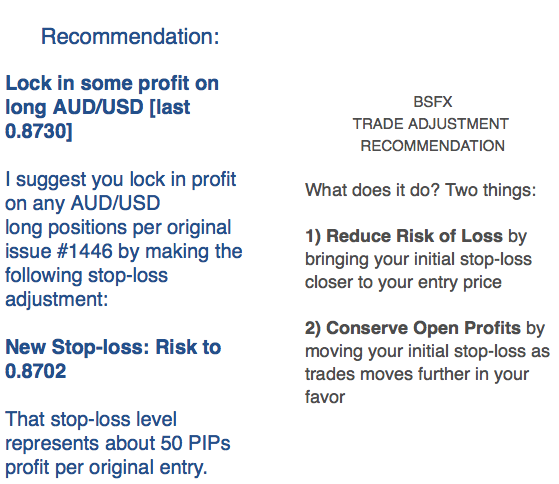
Protect yourself from these things with stop-loss adjustments. I provide updates and adjustments, as needed, throughout every trade. Here’s an example from yesterday:
Here’s my point:
Making adjustments on the fly helps you conserve profits and reduce risk of loss.
Remember: trading is about stacking the odds of success in your favor to help you win over time. This comes with a focus on process, not profits. A stop-loss is perhaps the most important part of the process.
But make no mistake: the stop-loss can be frustrating.
Stop-losses are not perfect, and they can knock you out of a trade that otherwise would have validated your bet and made you money.
But the moment you jettison your stop-loss tactic is the moment you find trouble. It’s a sign your ego is getting in the way of process, as I discussed yesterday.
Your ego always remembers missed opportunities, but tends to forget when your stop-loss saved your bacon from a huge loss or blown account.
Black Swan Forex provides stop-losses for subscribers in every trading idea. And it provides stop-loss adjustments to reduce risk or lock in open profit.
I truly believe this is why its winning trades are 170 percent larger than its losing trades – because of the initial focus on risk and subsequent adjustments.
We provide the tools you need for success.
Protect yourself and win with Black Swan Forex.
Best,
Jack
P.S. If you missed yesterday’s letter on “Knowing When to Jump Ship” — How to Manage Risk Easily and Effectively — click here to learn about 1 simple tactic that eludes most traders.

-
I know Mike is a very solid investor and respect his opinions very much. So if he says pay attention to this or that - I will.
~ Dale G.
-
I've started managing my own investments so view Michael's site as a one-stop shop from which to get information and perspectives.
~ Dave E.
-
Michael offers easy reading, honest, common sense information that anyone can use in a practical manner.
~ der_al.
-
A sane voice in a scrambled investment world.
~ Ed R.
Inside Edge Pro Contributors

Greg Weldon

Josef Schachter

Tyler Bollhorn

Ryan Irvine

Paul Beattie

Martin Straith

Patrick Ceresna

Mark Leibovit

James Thorne

Victor Adair