Energy & Commodities

Five Juniors that Insulate Investors from Today’s Low Oil Prices

blueoildriller580Angelos Damaskos, principal adviser of the Junior Oils Trust, admits that he finds the recent collapse in oil price a mystery. Nonetheless, he has no doubt that demand will compel higher prices in the medium and long term. In this interview with The Energy Report, Damaskos argues that current prices are dismal news for the majors, shale oil producers and the oil sands but underline the advantage of investment in juniors with solid, long-term projects, of which he presents five.

The Energy Report: The price of crude oil has fallen 30% over the last four months. Are you surprised?

Angelos Damaskos: It’s astonishing, considering that the price had been stable for over three years, trading between $100 per barrel ($100/bbl) and $120/bbl for Brent crude. 

TER: Why has this happened? 

AD: It’s unlikely that demand has collapsed so dramatically over the last four months. All indicators point to a fairly stable global economy, and the American economy in particular is enjoying healthier growth than previously. 

TER: So has the price drop been orchestrated?

AD: Nothing can be substantiated, given the opacity of the oil market, but there are three theories. The first is that Saudi Arabia is overproducing to hurt the American shale oil industry. Many shale oil deposits are probably marginal at around $75–80/bbl. 

The second theory is that Saudi Arabia may be overproducing to starve ISIS of funds. This is a more credible theory than the first, because this result would please the United States, as the oil price fall also hurts Russia, Iran and Venezuela. 

The third theory is that China, which has significant control over marginal oil demand, has deliberately curtailed its imports of foreign commodities over the last four to six months, as industrial users are drawing down their inventories. The Chinese are trying desperately to control domestic debt and protect their banks. Chinese institutions have used commodities as collateral to leverage operations, leading to, among other problems, a dangerously overheated property market. This third theory would also explain the dramatic fall in the prices of base metals such as copper, aluminum, zinc and especially iron ore, which is now near an all-time low.

TER: Wouldn’t Saudi Arabia cutting the price of oil be a case of cutting off its nose to spite its face? Saudi billionaire Prince Al-Waleed bin Talal pointed out, in an open letter to Saudi Arabia’s oil minister, that 90% of that country’s revenue comes from oil sales, so that to underestimate the consequences of a drastically lower oil price would be a “disaster which cannot pass unnoticed.”

AD: The Prince certainly has a point. However, if we accept the theory that Saudi Arabia has a politically motivated interest to oversupply to harm America’s shale oil industry, a significant reduction in new American supply would likely lead to more stable long-term oil prices, and this might actually benefit Saudi Arabia.
Screen Shot 2014-11-20 at 3.29.05 PMTER: Vladimir Putin has said that the global economy will suffer if the price of oil stays at $80/bbl. Putin obviously has a vested interested in higher oil prices, but is there anything to his argument?

AD: His argument simply doesn’t make sense. Cheaper oil helps economic growth. 

TER: How long will low oil prices last?

AD: Our belief is that the super cycle for oil is still intact. China now accounts for 11% of global oil consumption, versus 21% for the U.S. However, China has 1.3 billion people versus 360 million (360M) for the U.S. Furthermore, China represents 19% of global population. China’s GDP per capita has risen by 350% from 2000 to 2013, versus a U.S. rise of only 7.5%. It is evident that China’s energy consumption has risen significantly more than any other country’s. This is the primary reason for the rising oil and energy prices in the last decade. 

As China develops a middle class demanding a higher standard of living, this will require more energy consumption. Energy demand from China is likely to continue to grow at very rapid rates. Shale oil has added 2–2.5 million barrels (2–2.5 MMbbl) per day incremental supply to the U.S. over the last five years. However, conventional oil-source production from the U.S., the North Sea, Mexico, North Africa and the Middle East has fallen, so overall global supply has been more or less stable. The oil price drop is clearly temporary. 

TER: When I spoke to you earlier this year, you noted the risky economics of the Alberta oil sands and fracking. Now that oil prices have fallen 30%, and the price of natural gas has fallen from above $4.20/million BTU in September to $3.87 at the end of October, are these industries in peril?

AD: There are certainly question marks about the viability of shale oil developments. Oil shale wells decline 50–70% in their first year of production. Companies need to keep on drilling to maintain production. Oil prices at current levels mean that shale companies will find it much more difficult to finance their capital programs. Management teams will lack the confidence to embark on ambitious, high capital expenditure (capex) programs.

The same considerations apply to Alberta’s tar sands, which have marginal costs of $70–80/bbl, and to the deep sea fields in offshore Brazil that have not yet come into production, but are probably even more expensive.

TER: Do you stand by your May prediction that in 10–20 years oil should be well above the 2008 high of $147/bbl?

AD: Yes, based on our assumptions regarding Chinese growth and development stated above. 

TER: When will we see a recovery in oil and gas prices?

AD: Oil will likely stay in a very tight trading range for the next three to six months, but oil prices of $70–80/bbl are not sustainable. In the medium term, prices should hit $100/bbl. 

TER: You are the principal adviser of the Junior Oils Trust (JOT). Its value rose 18.3% from Jan. 1 to Sept. 30, making it the top-performing fund among the 20 energy funds monitored by Morningstar. Which factors explain the trust’s success?

AD: We have three fundamental investment criteria. The first is to invest at relatively low prices in companies controlling large Proven and Probable reserves. This requires expertise in assessing the geology and nature of the deposits and their likely economic value. 

The second criterion is avoiding pure exploration risk, meaning that there should be strong evidence of growing production in our investment holdings from well-understood geological settings. We invest in exceptional circumstances in early movers: companies that have secured licensed areas in new prospective territories. These companies are frequently funded by larger players that follow in their steps. Such juniors obtain exposure to high-impact exploration with limited monetary risk. 

The third criterion is the consistent avoidance of political risk in operations in areas where the rule of law cannot protect title of ownership. 

TER: How has the oil price fall affected how you evaluate the merits of particular junior oil companies?

AD: The price of oil is extremely important in our evaluation of current and future holdings. The lower oil price is extremely damaging to heavy oil companies and unconventional operators, such as the North American shales. Such companies with fixed obligations can get into trouble very quickly.

TER: What are your favorite junior oil companies in Asia?

AD: I would suggest two of our larger holdings, which are relatively insulated from the current price environment. The first is Carnarvon Petroleum Ltd. (ASX:CVN). It has benefited recently from a major discovery by its partner Apache Corp. (APA:NYSE) on the Phoenix project in Australia’s North West Shelf. Apache has exercised its option to drill further wells and appraise what it has found, which means that Carnarvon’s capex is fairly limited. 

“Relatively smaller companies not widely covered by the investment community can often provide exceptional value.”

This is a very long-term program. Positive cash flow is 10–15 years away, and it is most likely that Carnarvon will be out of this development by then. It is typical for small early-stage developers to divest once their projects have reached the field development program state. If they don’t sell to Apache, it is very likely that they will find another large oil company to sell to. Carnarvon is a hedged bet against current weak oil prices.

TER: What can you tell us about Carnarvon’s production in Thailand?

AD: Thailand has been a significant factor in Carnarvon’s valuation. It provides cash flow and stability and makes its operations viable and sustainable. Since the Phoenix discovery, however, Thailand has become a rather small part of the company’s valuation. I understand that Carnarvon is trying to divest part or all of its operation there. 

TER: What’s your second Asian junior favorite?

AD: Salamander Energy Plc (SMDR:LSE). It has very solid production from Indonesia and an existing deal with another company to sell part of its assets for a significant consideration. Recently, Salamander has received an indication of a potential takeover by Ophir Energy Plc (OPHR:LSE). Even though Ophir hasn’t tabled its offer and hasn’t revealed a specific price or valuation, we believe that it is likely to be significantly higher than the current share price. Salamander trades at about £1 on the London market. Our assessment of its net asset value suggests a true value of 140–150 pence, 40% to 50% higher. 

To the investor, Salamander represents an arbitrage situation. Better still, Salamander had previously rejected an approach by another consortium, so we could end up with a bidding war. 

TER: Does the Ebola epidemic give West Africa a significantly higher jurisdictional risk?

AD: Yes, to the countries that have been most severely affected: Liberia, Guinea, Sierra Leone and perhaps Nigeria. We have long avoided investments in onshore Africa and focused instead on offshore developments that are mostly insulated from epidemic risks because their platforms are far out to sea. Offshore platforms are much easier to control for health purposes. In addition, they have traditionally been immune from political problems. 

African governments are very dependent on oil revenues and thus dependent on the international oil companies that operate in their territories. So they have been unwilling to expropriate or otherwise interfere with offshore developments. 

TER: What’s your favorite junior oil company in West Africa?

AD: FAR Ltd. (FAR:ASX), which is an example of the “early mover” I mentioned above. It has secured properties in the jurisdictions of Kenya, Guinea Bissau and Senegal that have been farmed out to larger operators. In August, FAR announced that one of these farm-outs had made an enormous discovery off the coast of Senegal and then followed on with a second discovery on Oct. 7. These discoveries demonstrate the merits of FAR’s business model: acquiring licenses, learning the geology through seismic surveys and then inviting bigger companies to examine what it has found. FAR owns 15% of the Senegal block, with Cairn Energy Plc (LON:LSE) owning 40%, ConocoPhillips (COP:NYSE) 35% and Petrosen, Senegal’s national oil company 10%. The initial drilling budget was $80M, and this has risen to $180M, but the money has been mostly spent by Cairn and ConocoPhillips. 

Some would say that the Senegal discoveries have already been factored into the share price, which has risen over three times in the last year or so. So, what now? The consortium is appraising the drilling results, and it is very likely we shall see further good news about the size of the deposits and their economic viability as they get derisked. Furthermore, FAR has some very attractive licensed areas offshore and onshore Kenya. If FAR is successful in farming out these potentially high-impact targets, we could see further discoveries. This is another example of a far-forward discounted investment that is largely insulated from today’s oil prices. 

TER: Cairn’s initial estimate of the first Senegal discovery is 250 million barrels (250 MMbbl) to 2.5 billion barrels, with a “most likely” total of 950 MMbbl. If the proven amount is significantly higher than the most likely estimate, how would this affect FAR’s valuation?

AD: It could be hugely transformational. It is just impossible, at this stage, to try to evaluate the impact of such a finding. The initial estimate is probably conservative, because engineers like to err on the side of caution. In any event, we think FAR is a fairly attractive investment opportunity, given the risk/reward ratio.

TER: What’s your favorite oil junior in Africa north of the Sahara?

AD: We don’t have many holdings in North Africa because this region has been fairly unstable and risky since the Arab Spring, but we have held Circle Oil Plc (COP:AIM) for a long time, from before the turmoil began. Circle’s primary operations are in Egypt, but it has suffered no disruptions. The company had no problems sourcing supplies or equipment, and none of its employees fled or left the company. Its only difficulty has been that because it sells oil to the Egyptian General Petroleum Corp. (EGPC), Egypt’s national oil company, its receivables increased dramatically. EGPC wasn’t paying its bills on time, but this has changed dramatically in the last year.

Circle also has growing production in Morocco and an almost 100% drilling success rate, with a large number of low-risk prospects there. Most recently, it has had an attractive discovery off the shore of Tunisia. It’s early days, but the company has estimated an initial find of up to 100 MMbbl. This could be the most significant discovery from offshore Tunisia in recent years. For a junior, it is a phenomenal result. 

TER: Is Circle undervalued?

AD: Its current market cap is $152M, and it produces about 6,700 bbl per day. This equates to approximately 6 pence per share of cash flow per annum, but its share price is only 17 pence. Circle trades barely above 2x cash flow from its Egyptian and Moroccan production alone. This is a viable, growing company with significant cash flow and profits that account for most of the share price with a potentially huge bonus from Tunisia, which is currently ignored by the market. Should the Tunisian discovery require a large investment to take it to production, Circle could easily farm it out to another company or do a joint venture with a larger company.

TER: What is your favorite junior in North America? 

AD: Caza Oil & Gas Inc. (CAZ:TSX; CAZA:LSE) is our favorite play there. This is a company that goes from strength to strength. It has a very successful drilling record and has continually added to its production rate over the last two years. It is now almost at 2,000 bbl per day, which could potentially change its valuation and make it a very attractive takeover target by a larger oil company. Plus, it has a very large inventory of potential targets in its territories with substantial seismic data that point to a very large number of drillable prospects.

Major expansion would require a significant capex, so Caza is mobilizing at a slow rate. If a major were to take it over, however, it could employ a significant capex plan in a low-risk exploration and development strategy. We think that this company is a potentially attractive prospect for another company to either joint venture or take it over outright. 

TER: Caza announced results from the initial well at its Broadcaster property in New Mexico Sept. 18. How accretive is this to the company’s value?

AD: It’s extremely attractive because Broadcaster is in the Bone Spring formation. This has become one of the fastest growing oil regions in North America based on improved technology. Horizontal drilling has enabled local operators to multiply production rates several times. Bone Spring underpins Caza’s future production growth. Broadcaster is a low-risk operation with the potential to greatly increase production.

TER: You mentioned earlier your bias against pure exploration plays. Doesn’t the recent fall in oil prices improve the viability for those companies that are already in the game?

AD: The problem we face is that we cannot readily assess the impact the oil price fall will have on the profitability of mature producers. Juniors with longer-term prospects, such as the five we’ve discussed, do not have this problem. Obviously, companies with more mature production have better balance sheets, but until we fully understand the implications of recent price changes on profitability, we cannot estimate how their guidance will change in the next quarter. 

At this stage, one must be extremely careful in buying mature producers. I would prefer to focus on light oil producers with high netback margins where the impact of the fall in the oil price is proportionally smaller than heavier oil or shale oil producers, which have a much higher marginal cost and much lower netback margins. Such companies face the risk that the oil price fall could potentially destroy their profitability.

TER: The share prices of all the juniors we’ve discussed are quite cheap. The most expensive is £1. So the potential returns to those who invest in these companies would be much greater than potential returns from mature companies, correct?

AD: Absolutely correct. That is the essence of our investment thesis and the fundamental reason for the superior performance of the Junior Oils Trust. Relatively smaller companies not widely covered by the investment community can often provide exceptional value.

TER: Thank you for your time, Angelos.

Angelos Damaskos is the founder and CEO of Sector Investment Managers Ltd. of London, a regulated investment advisory company. He is the Principal Adviser of the Junior Oils Trust and the Junior Gold Fund. The Junior Oils Trust focuses its investments in smaller oil and gas exploration and production companies. An investment banker, Damaskos worked a decade for the European Bank for Reconstruction and Development. He holds a Bachelor of Science in mechanical engineering from the University of Glasgow and a Master of Business Administration from the University of Sheffield.

Want to read more Energy Report interviews like this? Sign up for our free e-newsletter, and you’ll learn when new articles have been published. To see a list of recent interviews with industry analysts and commentators, visit our Streetwise Interviews page.

Related Articles


DISCLOSURE: 
1) Kevin Michael Grace conducted this interview for Streetwise Reports LLC, publisher of The Gold Report, The Energy Report, The Life Sciences Report and The Mining Report, and provides services to Streetwise Reports as an independent contractor. He owns, or his family owns, shares of the following companies mentioned in this interview: None.
2) The following companies mentioned in the interview are sponsors of Streetwise Reports: Caza Oil & Gas Inc. The companies mentioned in this interview were not involved in any aspect of the interview preparation or post-interview editing so the expert could speak independently about the sector. Streetwise Reports does not accept stock in exchange for its services.
3) Angelos Damaskos: I own, or my family owns, shares of the following companies mentioned in this interview: None. I personally am, or my family is, paid by the following companies mentioned in this interview: None. My company has a financial relationship with the following companies mentioned in this interview: Carnarvon Petroleum Ltd., Caza Oil & Gas Inc., FAR Ltd., Circle Oil Plc and Salamander Energy Plc. I was not paid by Streetwise Reports for participating in this interview. Comments and opinions expressed are my own comments and opinions. I determined and had final say over which companies would be included in the interview based on my research, understanding of the sector and interview theme. I had the opportunity to review the interview for accuracy as of the date of the interview and am responsible for the content of the interview. 
4) Interviews are edited for clarity. Streetwise Reports does not make editorial comments or change experts’ statements without their consent. 
5) The interview does not constitute investment advice. Each reader is encouraged to consult with his or her individual financial professional and any action a reader takes as a result of information presented here is his or her own responsibility. By opening this page, each reader accepts and agrees to Streetwise Reports’ terms of use and full legal disclaimer.
6) From time to time, Streetwise Reports LLC and its directors, officers, employees or members of their families, as well as persons interviewed for articles and interviews on the site, may have a long or short position in securities mentioned. Directors, officers, employees or members of their families are prohibited from making purchases and/or sales of those securities in the open market or otherwise during the up-to-four-week interval from the time of the interview until after it publishes.


 

The Risks of Alternative Investments

craigburrowsIf you’re a keen follower of Michael Campbell’s Money Talks, than you probably understand the missed opportunity by solely investing in public markets like stocks, bonds and funds. Last week’s article explained the basics of alternative investments and the three main areas that retail investors can likely invest in: real estate, private companies and commodities. Before investing one should know the risks as salespeople will always show you the reward – but a real advisor takes the time to explain the risk. I can tell you that at TriView we’ve reviewed hundreds of Business Plans and my partners probably thousands, and to this date we’ve never seen a pro forma that doesn’t make money! So why do so many fail?

Alternative investments can improve your portfolio diversification, can be profitable in any economic environment, can improve long-term risk adjusted returns and can preserve capital in volatile markets. So based on the above factors, why wouldn’t you invest all of your wealth into alternative investments? The above is only one side of the sword, the other side that should concern you is less liquidity than public markets, valuation based on book value than market value, less regulation that can lead to fraud and longer capital lockout periods that can extend your investment more than anticipated.

Simply put, alternative investments should be a piece of your portfolio pie and the size of that piece depends on your own risk tolerance and timeframe.

What are five risks that a retail investor should consider before making an investment:

–  Management risk

–  Financial risk

–  Transparency risk

–   Liquidity risk

–   Less Regulatory risk

Management risk is probably the biggest with alternative investments as you’re investing in a private company that is generally controlled by one or a few people. Hundreds of millions of dollars have been raised and lost due to the lack of experience, knowledge and integrity of management in alternative investments. Many of these failures tend to be gifted sales or marketers that are very good at selling an idea but have no experience to execute their idea. They tend to see a trend and take advantage of investor greed to pry money out of their hands. The old saying is “even turkeys can fly in hurricanes”. But once the wind stops, there’s a giant thud when your investment hits insolvency. Before investing in any company, try and get a background check on the management team (google them). Another thing to look for is “investor alignment”. Investor alignment is comparing how management get compensated (front is bad, back is good), and how do you get paid (front is good, back is bad). Also find out what penalties management face if they don’t hit targets on time and on budget?

Financial risk is an important factor when investing in a private company that can’t raise money on the public markets. Many deals have failed due to lack of capital. For example, what happens if a company needs to raise $10 million to complete their business plan and only raise $7 million? Sometimes they can get some bridge money (borrowed money at high interest) or need to dilute shares to vulture capitalist that reduce the original investors significantly. The worst case scenario – the business fails and the investors’ money disappears entirely to insolvency or bankruptcy. How confident are you in the company completing their capital raise in order to execute their business plan? Some companies like to raise the price of their stock / units in order to reward earlier investors but also allow more conservative investors to invest at the end of the capital raise at a higher premium.

Transparency risk relates to how well you can vet the deal prior to investing as well as tools to continue vetting the business to ensure your investment is safe. Many private companies refuse to provide audits as they believe, as a private company, it’s confidential. That may be an OK attitude when it’s your own business but once you ask people to invest in your company, it’s no longer fully “private”. Stay away from anyone that gives you the “Trust Me” line. If they are not prepared to provide you audited financials on a yearly basis, you should not be prepared to invest.

Liquidity risk describes how and when you can get your money back. Many alternative investments have clauses that don’t allow you to transfer your stocks / units without management approval. They also generally have provisions that can postpone the liquidity event if the company does not have the money, or a return of capital could expose the company to financial risk. Invest money in alternative investments that you can afford to have tied up for an extended period of time (years).

Less regulatory risk is becoming less of a risk as most of the regulators across the country are improving their monitoring of alternative investments. Over the last two years, more money has been raised in the alternative / private markets than the public markets. While most of this money is institutional investors, knowledge slowly trickles down to accredited investors than to retail investors. Investors need to understand the difference between prospectus, Offering Memorandums (OM) and Confidential Information Memorandum (CIM).

The alternative markets are an incredible opportunity to provide additional yield and diversity to your portfolio but probably the most forgotten risk is trying to invest on your own. In some cases, there might not be a big difference from using a broker to conduct public trades to e-trading. In fact, I would argue that with the internet and basic knowledge of valuation of public companies, many sophisticated investors are more knowledgeable than their stock brokers. For example, I was looking to buy Alibaba prior to their IPO but when I spoke to my broker about the largest IPO in history, he knew very little while I’ve been following this company for two years. In fact, I shut down my account the very next day!

I’d be very cautious on buying alternative investments without an advisor as it’s can be very complicated and there is little information on the internet to help you understand if the investment is valued properly. You should obviously investigate your advisor as there are good and bad ones.

Hopefully this has helped you look at the risks of investing in alternative investments. At TriView, we tend to focus on private real estate opportunities as it’s less complicated than hedge funds or some of the morecomplex investment strategies. We feel real estate is something that people can relate to as we’ve all either owned or rented a property. The more educated and comfortable our clients are about an investment sector, the better the investor.

Happy Investing!

Craig

Stock Trading Alert: Stocks Extend Fluctuations As Investors Remain Uncertain – Which Direction Is Next?

Briefly: In our opinion, speculative short positions are favored (with stop-loss at 2,085 and profit target at 1,950, S&P 500 index).

Our intraday outlook is bearish, and our short-term outlook is bearish:

Intraday (next 24 hours) outlook: bearish
Short-term (next 1-2 weeks) outlook: bearish
Medium-term (next 1-3 months) outlook: neutral
Long-term outlook (next year): bullish

Stock Trading Alert originally published on November 20, 2014, 6:27 AM:

The U.S. stock market indexes were mixed between -0.5% and 0.0% on Wednesday, extending their recent fluctuations as investors reacted to the release of FOMC Minutes, among others. The S&P 500 index remains relatively close to its Tuesday’s all-time high of 2,056.08. The nearest important resistance level is at around 2,050-2,060. On the other hand, level of support is at 2,040, marked by previous resistance level, and the next support level is at 2,020-2,025. There have been no confirmed negative signals so far, however we still can see some overbought conditions accompanied by negative divergences:

35863 a

Larger Image

Expectations before the opening of today’s trading session are negative, with index futures currently down 0.4-0.5%. The main European stock market indexes have lost 0.7-1.4% so far. Investors will wait for some economic data announcements: Initial Claims, Consumer Price Index at 8:30 a.m., Existing Home Sales, Philadelphia Fed, Leading Indicators at 10:00 a.m. The S&P 500 futures contract (CFD) continues to trade along the level of 2,040. The nearest important level of resistance is at around 2,050, marked by recent highs. On the other hand, support level remains at 2,025-2,030, as the 15-minute chart shows:

35863 b

Larger Image

The technology Nasdaq 100 futures contract (CFD) retraced Tuesday’s move up, as it bounced off resistance level at around 4,250. The nearest important level of support is at 4,190-4,200. There have been no confirmed negative signals so far, however, we may see a topping pattern here:

35863 c

Larger Image

Concluding, the broad stock market continues to fluctuate relatively close to its long-term highs. There have been no confirmed negative signals so far. However, we expect a downward correction or an uptrend reversal. Therefore, we continue to maintain our speculative short position. Stop-loss is at 2,085 and potential profit target is at 1,950 (S&P 500 index). It is always important to set some exit price level in case some events cause the price to move in the unlikely direction. Having safety measures in place helps limit potential losses while letting the gains grow.

Thank you.

Much Higher Dow Simple to Understand …

Ever since the March 2009 crash low in the U.S. equity markets, I’ve maintained my view that the Dow Industrials and other broad market indices were entering a new bull market. That forecast has been spot on.

One of the tools I used to come to that conclusion in 2009 was the ratio of the Dow Industrials to the price of gold.

I wrote extensively about it in several issues of my Real Wealth Report. I also reported on it several times in other pieces I wrote. Today I want to update the analysis for you.

First, a refresher. At the peak of the Dow/gold ratio in 1999, the Dow Industrials would have purchased just over 50 ounces of gold. That’s because the Dow was at a high in real, inflation-adjusted terms, while gold was at its bottom at the $255 to $275 level.

During the financial crisis of 2007-09, as equities plunged and gold rallied (since its bottom in 1999), the ratio collapsed all the way down to the 6 to 7 level.

In other words, in terms of gold — what I like to call “honest money” — at its March 9 low the Dow Industrials had lost more than 87 percent of the entire equity bull market from 1980 to 1999.

Since then, stocks have vastly outperformed gold, as stocks have moved higher, and gold lower.

As a result, the ratio of the Dow Industrials to gold has widened back out, to about a level of 15 today.

Put another way, had you bought the Dow Industrials in 2009 at the bottom and sold gold, you would have made 300 percent on your money as the Dow soared and gold plunged (after 2011).

So what does this all mean? And what does it hold for the future for the Dow?

Screen Shot 2014-11-20 at 6.54.35 AMI’ll answer those questions now. But I urge you to put your thinking cap on, because the analysis of the Dow/gold ratio is not easy to grasp, yet it’s critically important to understanding the future.
FIRST, the collapse in the Dow-to-gold ratio was not caused simply by a crash in equity prices. It was also due to a crash in the value of the dollar, as reflected in the soaring value of gold from the year 2000 to 2011.

SECOND, the Dow is now beginning to adjust — to reflect how much value the dollar lost between 2000 and 2011.

This adjusting of equities is perfectly normal. All asset classes eventually recalibrate their price levels to the new reality of the purchasing power of the underlying currency, which in this case, is the dollar, which in turn, is nowhere near what it was worth back in the year 2000.

A simple theoretical exercise here will show you how the Dow will adjust.

For the Dow/gold ratio to climb back to the 50 level — where it was when stocks peaked in 2000 and gold bottomed …

The Dow would have to explode higher to the 59,350 level, assuming gold’s current price of roughly $1,187.

Naturally, the price of gold is not going to remain at $1,187. It will probably fall back to as low as $900 before it bottoms, one of my targets for the end of gold’s bear market.

So let’s say gold does indeed fall to $900. Then a 50-to-1 ratio for Dow/gold, with gold at $900, would still imply the Dow eventually hitting the 45,000 level.

Naturally, projections like that assume all else remains equal. In other words, the underlying economy, unemployment, international relations, the global economy and a host of other variables.

So those projections are not realistic.

But what is realistic is this: It would not be unusual at all, in fact, it would be perfectly normal if the Dow/gold ratio were to regain half of what it lost since the year 2000 …

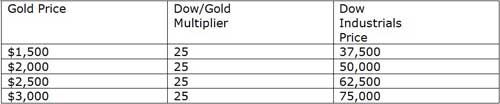
And move back to the 25 level.

Then, all we need to do is pop in various prices for gold to get various measurement of how high the Dow can go. Assuming gold does bottom at $900 and then begins its next bull market, we can then come up with a grid that looks something like this:

chart1s

Put any number in the first column for gold, and you can come up with any slew of other numbers for the Dow.

And on the flip side, at a Dow/gold ratio of 25 — a perfectly real world and normal retracement of 50 percent of what it lost since 2000 …

  • The Dow could only fall back to 12,500 if gold were to fall back to $500.
  • The Dow could only fall back to 10,000 if gold were to fall back to $400.
  • The Dow could only fall back to the March 2009 low of roughly 6,500 if gold fell to $260!

And given the high probability that gold won’t move any lower than $900 and will then enter a new bull market …

It’s certainly not hard to see why the Dow also has huge upside potential going forward, and that its downside is limited to mere technical corrections!

Factor in the war cycles and other geo-political forces that are driving capital to the U.S. stock markets …

And you can easily see why I remain very bullish long term on the U.S. stock markets and why my long-term target of Dow 31,000 may actually end up conservative.

Lastly, an important point: As you can tell from this exercise, the monetary system has changed dramatically.

So much so that it’s also inevitable that at some point in the not-too-distant future, the dollar reserve based system will have to change.

Even as the dollar now rallies, the system is so broken and so out of date with the rest of the world and emerging economies and Asia, we will eventually need a new reserve system with a globally neutral reserve currency.

Best wishes,

Larry


Central Bankers Are Invisible

Signs of The Times

“U.S. Companies are turning more to the bond market to fund expansion than at any time since 2008.”

                                                                       – Bloomberg, November 4.

“Crashing Oil Prices Won’t Kill The US Economy”

                                                                      – Business Insider, November 4.

“Mr. Kuroda promised to ‘drastically convert the deflationary mindset’.”

                                                                      – Financial Times, November 5.

“If the ECB tries to press ahead with QE, Germany’s central bank chief will resign.”

                                                                    – Telegraph, November 5.

“The Republican wave that swept over the state left Democrats at their weakest point since the 1920s.”

                                                                   – National Conference of State Legislatures, November 5.

“Global Warming Community in Panic Over Republican Takeover of Senate”

                                                                   – Examiner, November 7.

One can’t help but wonder how all of the apparatchiks, functionaries, intelligentsia and central planners who were dining at the public trough in Soviet Russia felt when the Berlin Wall came down in November 9, 1989.

Perspective

The US election indicates a profound change in political direction and we have frequently described Obama’s policy moves as being the regulatory equivalent of building the Berlin Wall. This was being accomplished through a mainstream media that abandoned its critical faculties and started cheerleading massive intrusions upon basic freedoms.

The towering intellects of Nancy Pelosi, Harry Reid and Obama’s teleprompter have been bypassed by the commonsense of many voters. What’s left of Obama’s term is being described as a “Lame Duck Presidency”. Yeah, a duck with the teeth and tenacity of a piranha.

Political dissatisfaction during periods of rampant inflation can turn into murderous revolutions. The two greatest examples are the French Revolution that in the 1790s turned into the Reign of Terror. And then there was the Russian Revolution and another reign of terror that began in 1917. The fall of the Berlin Wall can be described as a great reformation. Putin’s attempts to restore the Soviet can be described as a counterreformation.

Obama has no specific ideology other than the lust for power and control with the Rules For Radials being equivalent to Mao’s Little Red Book.

In just the last one hundred years there has been some dramatic setbacks to the long experiment in authoritarian government. These have turned with the end of a boom. One of the most outstanding commodity booms blew out in 1920 and collapsed. Soviet Russia turned from pure communism to sort of a socialism. In the US, John Moody explained the wonders of the 1929 boom as due to America’s turn from socialism and nationalized railroads.

The boom radiating out of Tokyo in the late 1980s fostered outstanding speculation in commodities and global real estate (remember “Trophy” items such as Pebble Beach Golf Course). As recorded by the Nikkei, the peak was at the end of December 1989 and the Wall came down in November.

The “Glorious Revolution” of 1688 occurred during a deflationary period as did the American Revolution. Both were essentially conducted by the middle classes who avoided neurotic intellectuals that prevailed during the nasty revolutions.

The White House has been overrun by anxious intellectuals and it is time for another reformation conducted by the middle classes.

Stock Markets

As we have been noting, the “oversold” of mid-October determined that the setback was a “correction”. With huge amounts of central bank promises (Japan’s was remarkable) and a very refreshing election the rebound set new highs for the senior indexes.

Last week, we listed a number of the key “plusses” that were in the market. Forgot to include that over the past few weeks financial news programs have been talking up the favourable October to May seasonal tendency.

We will stay with our list of accomplished stages:

Exuberance, Divergence and Volatility got us to the big swings into and out of October.

Resolution to excessive speculation has yet to be discovered.

We thought that Small Caps (RUT) and the STOXX were leading on the way to the “correction”. RUT set its high at 1213 in July with the Daily RSI at 70. The October low was 1040 and down to 30 on the RSI. The rebound has made it to 1186. This is at a resistance level and has reached an RSI of 70.

Recording the action in Europe, the STOXX set its high at 3325 in June with a Daily RSI at 72. The October low was 2789 with the Daily RSI down to 26. The rebound high was 3142 last week and is not overbought.

The NY Composite (NYA) set its momentum high at 11106 in July and declined to 10557 in August. The September high was 11108 and the October low was 9886 and oversold at the RSI of 28. So far the high has been 10911 and at the RSI that ended the September rally.

As noted above, inspired by a number of really good stories the stock market has enjoyed a vigorous rebound. Our work in mid-October had Springboard Buys on the S&P and JNK. It is uncertain how long this rally may last.

It is worth checking commodities and credit markets for some guidance.

Credit Markets

Lower-grade bonds have been volatile. JNK slumped into a Springboard Buy on October 14th and the rebound was sufficient to register the opposite on the following week. JNK (without the interest payment) reached the 50-Day ma and has been following it down. At 40 now, taking out the October low of 38.93 would extend the downtrend.

Out of the October hit, spreads briefly narrowed and the widening trend has resumed. The chart showing new “wides” follows.

It is worth keeping in mind that as commodities decline so does the ability to maintain prices at the retail level. This reduces general earnings power and the ability to service debt (chart follows). Then credit-rating agencies get busy with downgrades and eventually junk issues live up to the worst descriptions in their prospectuses.

Last week we thought that on the next slide in the stock market the bond future would rally. The loss of liquidity in the world’s most liquid market on October 15 was without precedent. That drove the future up five points at the opening to a price of almost 148.

The low was 140.5 on Friday and it has firmed to 141.25. The high needs to be tested and that becomes our target.

The Russian note needed to rise above 10.22% to exend the trend. It did it at 10.24% today.

Central bank recklessness reminds of hanging out with a Martini-drinking crowd some years ago. The cocktail was referred to as “Martins” or “Electric Waters”. There were certain levels of intoxication, but I can only remember the last one. You had become invisible. The reasoning was that you were doing such stupid things that it would be best to be invisible.

They called for transparency in central banking, but invisibility is too much.

Currencies

In 1980 we recall that as Reagan won some important primaries the dollar would firm up the next day. Upon taking office the DX rallied from 97 to 164. It was helped by commodities blowing out in the grandest fashion since 1920. Paul Volker had nothing to do with either event.

Reagan was one of the leaders that inspired the reform of excessive government that swept the world in the 1980s. Margaret Thatcher had a parliamentary majority and made huge advances. The equivalent by Reagan was denied by a Democratic Congress.

This time around, political change will be led by a reform-minded Congress and opposed by the Obama faction. Republicans will likely win the White House in 2016, when a massive reform can really get underway.

The dollar was expected to rally as the financial boom ran out of momentum. The DX broke out at 81 in July. After 85 was reached in September the jump to 88 was largely driven by offshore buying of US stocks and bonds. The DX has yet to have a strong rally based upon financial asset deflation.

On the near term, the DX rally reached a lofty 85 on the Weekly RSI and the index reached 88 last week. Perhaps this is the best on foreigners buying US paper.

Perhaps DX could correct some more. The next rally would likely be due to weakening asset prices and a minor start to political reform.

Precious Metals

In early September we thought that a buying opportunity would appear in the latter part of October. In the middle of that month we decided to wait for the “buy”. Our November 4th Special (Caveat Venditor) outlined how gold and silver really work during a credit cycle.

The key was that gold’s real price has been rising since what seems to be a cyclical low in June. This could be the early stages of a cyclical bull market for the real price. Improving profit margins will follow.

The November 7th ChartWorks noted that silver’s plunge had become severe enough to register a Downside Capitulation. A significant rally is pending.

The November 4th Chartworks “Gold Miners Bounce” called for that.

This and last week’s Pivot have been looking for gold stocks to begin outperforming the bullion price.

The HUI/GOLD ratio plunged from .44 in 2011 to .13 on November 4th. It has recovered a little and we would like to see some stability over a few weeks. The bear since 2011 has

been brutal and stability would provide the base for the start of a new bull market for the Precious Metals sector.

On the bigger picture, the recent collapse of HUI/GOLD seems similar to when the ratio plunged to .13 in late-November 2001. That cyclical bottom drove the Weekly RSI down to the low 20s, similar to now.

In the last two weeks of October, the HUI dropped from 185 to 146 on November 4th.

The bounce made it to 164 yesterday and the low needs a test.

Crude Oil and Recessions: Ten Years

35856 a

  • Note the “Peak Oil” peak in 2008.
  • The current failure is becoming serious.
  • Is it indicating technological revolution?
  • Is it indicating global recession?
  • Perhaps both.

Crude Oil and Recessions: 1970 to 2010

35856 b


  • Crude’s plot is rate of change.
  • From 1970 until the mid-1990s there was great belief in the powers of OPEC, the erstwhile oil cartel.
  • When OPEC was headed by Sheikh Yamani, it was said that he commanded all of the attention that is focused upon a cross-eyed javelin thrower at the Olympics.

Producer Price Index and Recessions: 1913 to Date

35856 c

Larger Image 

  • The cyclical low was 168 in March 2009.
  • The high for the move was set in April at 208.3.
  • A double top was set at 208.3 in June.
  • The latest posting is September’s at 206.5.

S&P Earnings and Commodities

35856 d

Larger Image – Source: Yardeni.com

  • This year’s high for the CRB was set in June at 313.
  • The low for the year was set last week at 266.
  • According to the chart, earnings should follow.

Credit Spreads: Now Worse Than On October 17th

35856 e

Larger Image

  • On the near-term, rising above 171 bps set on October 17th would extend the trend.
  • This was accomplished on November 7th.
  • It is now at 173 bps and stair-stepping up.
  • Widening has taken out resistance at the March “high”.

The above is part of Pivotal Events that was published for our subscribers November 13, 2014.

test-php-789