
Asset protection
 Everyone always says, I want to buy low and I want to sell high. So I think for me, of course I own a lot of gold, and I need to buy more to keep asset allocation between 25% in Real Estate, 25% in equities, 25% cash and bonds, and 25% gold. I need to buy more. So for me this is a very happy event. I don’t like to buy gold at $1,900 like in 2011. I like to buy it here or lower.
Gold Broker: Do you think it will break under $1,000 like some people say?
Marc Faber: Look. The forecasting record of people is horrible, in particular, the forecasting record of the Federal Reserve. So, I don’t know, maybe it will go below $1,000 but my sense is that it will not stay below $1,000. …. I would use the current weakness as a buying opportunity. … I’m telling everybody, you as an investor, and me as an investor, we cannot trust the government. … I am my own central banker. I keep my own physical gold. I do not trust anyone of these (unprintable word).
…the above posted on Marc’s website Dec 4th. The following on Dec 3rd & Dec 2nd.
In Europe we have a flat inaudible Economy
Fed Monetary Policy Will Destroy World

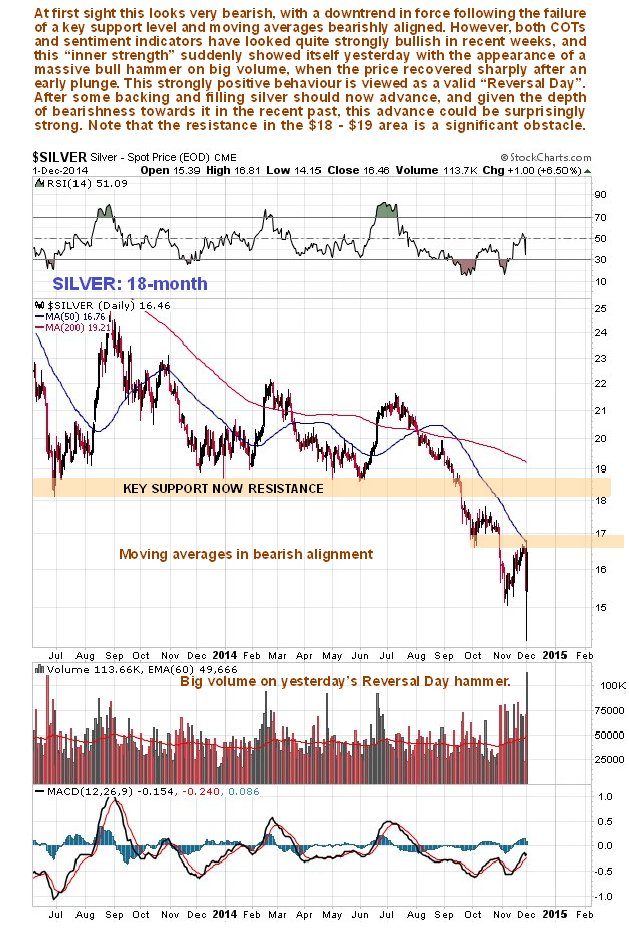
While silver’s 18-month chart admittedly looks awful at first sight, we can see (monday’s) spectacular hammer on it, which is viewed as calling the final low – even if the price does break below this low, it is unlikely to drop back much more. This chart makes plain that the strong resistance at the failed former support level in the $18 – $19 area will be a “tough nut to crack”, but silver could get back above this level surprisingly fast once the tide turns – and it is thought to have yesterday, especially if the dollar goes into a tailspin.

1) Baytex Energy Corp (TSE:BTE.CA) — 13.0% YIELD
Baytex Energy is a conventional oil and gas company engaged in the acquisition, development and production of petroleum and natural gas in the Western Canadian Sedimentary Basin and the United States. As of Dec 31 2010, total proved reserves for light and medium oil consisting of 18,416 thousand barrels gross (15,335 thousand barrels net), heavy oil consisting of 104,978 thousand barrels gross (87,384 thousand barrels net), natural gas liquids consisting of 2,825 thousand barrels gross (2,015 thousand barrels net) and natural gas consisting of 83,800 million cubic feet gross (70,300 million cubic feet net).



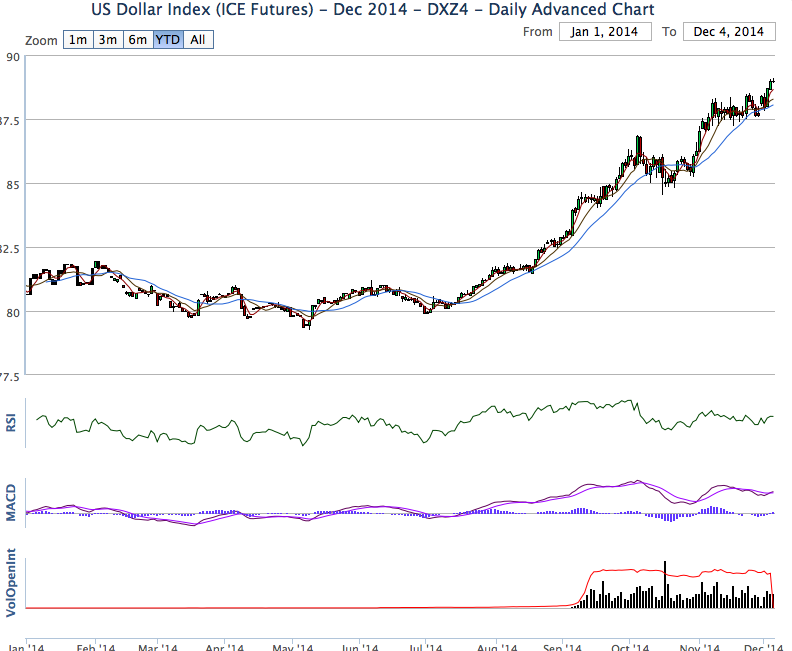
The U.S. dollar is extending its advance as the divergence theme moves into overdrive. The dollar has drawn close to JPY119.50. The euro has fallen to new lows near $1.2320, having been turned back from $1.25 on Monday. The Australian dollar has been pushed briefly below $0.8390.
The main exception is sterling, which is holding its own after a stronger than expected service PMI. Although it slipped below yesterday’s low, Monday’s low near $1.5585 remains intact, and sterling is trading around 3/4 a cent above there near midday in London.
The divergence theme has been underscored by the comments by Fischer and Dudley reaffirming the signal by Fed leadership that the mid-2015 rate hike is still “reasonable”. The disinflationary impulse from the drop in energy prices is temporary. Instead, they emphasized the growth implications.
[Read: End of U.S. Dollar Hegemony – Not]
There has been a backing up of U.S. interest rates too. The 2-year yield is near 55 bp, which is the upper end of the range seen in recent weeks, and represents a 10 bp increase since Monday’s lows. There is increased speculation that the “considerable period” phrase in the Fed’s statement is likely to be diluted or dropped as early as this month. Meanwhile, the 10-year yield is near 2.30%, which is a 15 bp increase since Monday’s lows.
In Europe, the service PMI was slightly disappointing at 51.1 from 51.3 of the flash and 52.3 in October. Germany was unchanged from the flash (52.1) but France’s downward revision wipes out the improvement that the flash suggested. France’s service PMI slipped to 47.9 from 48.8 of the flash and 48.3 in October.
The pleasant surprise came from Italy. The November service PMI rose to 51.8 from 50.8. The consensus was for 50.2. It was Spain that disappointed. The service PMI fell to 52.7 from 55.9. The market had expected a smaller decline to 55.2.
In addition, the euro area October retail sales in October rose 0.4%, slightly less than expected, and managed to retrace only a small part of the 1.2% decline in September (was initially -1.3%). This week’s data provides a poor backdrop for tomorrow’s ECB meeting. Everyone agrees that the ECB staff is going to cut its forecasts again and that Draghi will be dovish. This goes practically without saying. The key issue is whether the ECB expands the assets it is purchasing (to include supra-nationals, like EU, EIB, EFSF, ESM bonds – the “low hanging fruit), or does it announce its intentions to buy sovereign bonds, as some expected.
[Listen to: Michael Pettis on Why We Need a New Global Monetary System]
The market took the Australian dollar lower in response to the poor Q3 GDP figures. The economy expanded by 0.3% on the quarter, less than half the pace the consensus expected. The RBA statement earlier this week had spurred a reassessment of a rate cut the market was pricing in for next year. However, today’s weak growth figures have seen such pressure renew. However, ahead of tomorrow retail sales and trade balance reports, the interest rate adjustment is modest. The 2-year yield is off 5 bp today to 2.38%. It had reached 2.45% earlier in the session. The low before the RBA meeting was near 2.36%. This level should be taken out as a cut is further discounted.
China reported service PMIs. The official one ticked up to 53.9 from 53.8. The HSBC measure also ticked up, from 52.9 to 53.0. It does not impact expectations that the PBOC is likely to cut the reserve requirements in the next week or so. The dollar has quietly firmed against the yuan and reached almost CNY 6.1550 today, its highest since late September. Because the yuan shadows the dollar, despite the flexibility the PBOC claims it has introduced, the yuan has appreciated on a trade-weighted basis. It will continue to do so, even if it edges lower against the dollar.
The North American session will be busy. The Bank of Canada meets. It is expected to leave rates on hold. We look for the Bank of Canada’s statement to emphasize that it is looking through the pick up in price pressures as transitory. There are three U.S. reports to note: ADP, ISM services and the Beige Book. Note too that UK’s Osborne will make the Autumn Statement (budget). Separately, it has already been announced that the Funding for Lending Scheme, which aims at increasing credit to small and medium-sized businesses has been extended for another year.
Do you have forebodings about the future? I do, which is why I’ve been looking closer at the transformations technology promises to bring us. Note: be sure to read through to 3D Printing — a hint of the APM future – Money Talks Editor
First, a brief review. I’ve previously written about the rapid pace of technological development (here and here) and Ray Kurzweil’s point that though technology is growing exponentially, we experience it linearly, and we tend to base our expectations on our linear experience. (See his essay “The Law of Accelerating Returns” for details.)
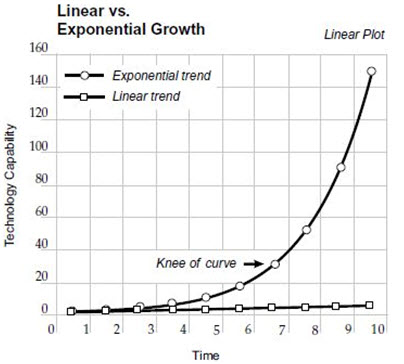
Here’s an example. When the Human Genome Project began in 1990 he predicted the project would be completed in 15 years. Almost no one believed him. After a year of work, biochemists had succeeded it transcribing one ten-thousandth of the genome. Seven years later a mere one percent had been finished. One imagines the laughing was well underway. But the project actually finished ahead of schedule, in 2003.
In The Singularity is Near Kurzweil explains how this happened:
Scientists are trained to be skeptical, to speak cautiously of current research goals, and to rarely speculate beyond the current generation of scientific pursuit. This may have been a satisfactory approach when a generation of science and technology lasted longer than a human generation, but it does not serve society’s interests now that a generation of scientific and technological progress comprises only a few years.
He has been amazingly accurate in his predictions, and over the years he’s turned those predictions into a fortune inventing and marketing products based on his expectations of the technologies that will be available in years ahead. “Invention is a lot like surfing,” he says, “you have to catch the wave at the right time.”
Kurzweil sees three overlapping areas where growth is increasing exponentially and which will transport us to a world formerly associated with science fiction and fantasy: genetics, nanotechnology, and robotics.
Our atomically-precise future
In this article I want to discuss nanotechnology — a term popularized by K. Eric Drexler in his 1986 book Engines of Creation: The Coming Era of Nanotechnology (online here) — and its implications for our economic lives.
By “nanotechnology” Drexler means “technology based on the manipulation of individual atoms and molecules to build structures to complex, atomic specifications.” To distinguish his meaning from other, more inclusive definitions he uses the term atomically-precise manufacturing (APM). APM will build things by rearranging atoms and using those nano-structures as building blocks for larger products.
What kinds of products? Everything being built today by conventional means and other products that can’t be built today.
Materials are characterized by their arrangement of atoms — if we rearrange the atoms in coal a certain way we can produce a diamond. Atomically-precise control of materials can produce patterns of atoms that are out of reach of today’s technologies.
In his 2013 book Radical Abundance: How a Revolution in Nanotechnology Will Change Civilization, Drexler tells us that
Atomic precision starts with small-molecule feedstocks, atomically precise by nature and often available at a low cost per kilogram. A sequence of atomically precise processing steps then enables precise control of the structure of materials and components, yielding products with performance improved by factors that can range from ten to over one million. [my emphasis]
APM will change industrial production beyond recognition or replace it outright.
Traditional manufacturing builds in a “top down” fashion, taking a chunk of material and removing chunks of it – for example, by grinding, or by dissolving with acids – until the final product part is achieved. The goal of nanotechnology is to instead build in a “bottom-up” fashion, starting with individual molecules and bringing them together to form product parts in which every atom is in a precise, designed location. [Foresight Institute]
APM-based technologies will [from Drexler, Radical Abundance]:
- Slash resource consumption and toxic emissions
- Provide the infrastructure for low-cost solar energy and a carbon-neutral economy
- Produce better products at far lower cost than today
- Collapse long specialized supply chains to a few steps of local production
- Transform daily life, labor, and the structure of society on Earth, just as the agricultural, industrial, and information revolutions have done
Drexler likens APM to digital technology transferred to the material world, in which microblocks are combined much like ink droplets to form endless, intricate patterns.
A better analogy than ink droplets, however, would be blocks of the sort found in high-end Lego sets, which include not only blocks in different shapes and colors, but also blocks that provide intricate, functional parts such as motors, gear trains, sensors, and computers.
When advanced APM arrives within the next decade you’ll have a box on your desk that will allow you to do with atoms what you presently do with bits and pixels. At roughly the same price. But without worrying about atoms, just as you don’t concern yourself with bits and pixels. On a larger scale, advanced APM will mean, for example,
replacing an enormous automobile factory and all of its multi-million dollar equipment with a garage-sized facility that can assemble cars from inexpensive, microscopic parts, with production times measured in minutes.
The technologies that can make these visions real are emerging—under many names, behind the scenes, with a long road still ahead, yet moving surprisingly fast.
The need for engineering
As with the stunning nature of Kurzweil’s predictions for the decades ahead (which you really ought to check out), it’s difficult to imagine the economic world as we know it being turned upside down because we’re slipping past the knee of an exponential curve. Yet APM is not waiting for some scientific breakthrough to make it a real possibility. The road ahead “has no gaps, no chasms to cross,” Drexler says.
What is missing from APM research? Better engineering; specifically, “AP molecular systems engineering.”
No matter how research-intensive a project may be, work coordinated around concrete engineering objectives will eventually be required to produce concrete engineering results. . . .
The semiconductor industry provides a model for coordinating research to advance the technology of an entire field. What’s more, the achievements of semiconductor engineers give us a sense of the potential scale of results, for it was their work that brought us nanoscale digital information systems and today’s Information Revolution.
Roadmapping has been the key to the success of the semiconductor industry.
In 2007, under the auspices of the Waitt Family Foundation, researchers in nanotechnology finally produced a guiding document for their field: Productive Nanosystems: A Technology Roadmap. The Executive Summary tells us that:
It is uncontroversial that expanding the scope of atomic precision will dramatically improve high-performance technologies of all kinds, from medicine, sensors, and displays to materials and solar power. Holding to Moore’s law demands it, probably in the next 15 years or less. [My emphasis]
Assuming the document is up-to-date, APM should be here by or before 2022. Mark your calendars.
3D Printing — a hint of the APM future
The nascent technology of 3D printing is a stepping stone between traditional manufacturing methods and APM. Drexler contrasts 3D with traditional processes:
Some traditional methods make a shape all at once using a costly, specialized tool, like a mold to shape plastic, a die to stamp steel, or an optical mask in semiconductor lithography. Other traditional methods carve shapes by removing small bits of material using general-purpose equipment like lathes, drills, and milling machines.
3D printing, by contrast, makes shapes by adding small bits of material using general-purpose machines guided by digital data files. 3D printing can make shapes beyond the reach of casting or carving.
One 3D printer is a kit you assemble yourself called the RepRap. With a RepRap 3D printer, you can “print” the parts that make up a RepRap and assemble them yourself. According to the video at the RepRap website, the RepRap project aims to put a factory in every home — a factory that can make more factories. RepRap has a slogan, “wealth without money.”
RepRap and other 3D printer user communities stir memories of the Homebrew Computer Club that launched the PC revolution in the mid-Seventies. The Club spawned many pioneers in the microcomputer industry, including the two Steves. The MITS Altair 8800 was one of the first kit computers, comparable to the RepRap today. Unlike Altair, RepRap can self-replicate.
Conclusion
There are downsides to every technology. As with clubs and axes once used to obtain food and shelter, APM technologies can be weaponized. The good news is that APM, like information technologies, has a strong decentralizing and price deflationary component. In this sense it works in favor of individuals and free markets, and against the Keynesian states we live under. The APM revolution has the potential to dramatically empower people, as we’re seeing with the information revolution today.
Though there are many questions one could raise about APM, I have one in particular that I invite any APM researcher to address: If APM continues to develop into a Kurzweil future, will someone someday be able to “print” gold and other precious metals?
And further: The whole of economics is based on scarcity. APM won’t eliminate scarcity, but it could surely relegate it to a position of less importance since common feedstocks will replace scarce resources. What does a world with scant scarcity look like?
We are encouraged by psychologists to live in the present, in the here-and-now. The here-and-now has many dimensions, one of which is the legacy of innumerable statists. I look forward to a “present” when their legacy is found only in history books. Technology will help get us there.


-
I know Mike is a very solid investor and respect his opinions very much. So if he says pay attention to this or that - I will.
~ Dale G.
-
I've started managing my own investments so view Michael's site as a one-stop shop from which to get information and perspectives.
~ Dave E.
-
Michael offers easy reading, honest, common sense information that anyone can use in a practical manner.
~ der_al.
-
A sane voice in a scrambled investment world.
~ Ed R.
Inside Edge Pro Contributors

Greg Weldon

Josef Schachter

Tyler Bollhorn

Ryan Irvine

Paul Beattie

Martin Straith

Patrick Ceresna

Mark Leibovit

James Thorne

Victor Adair