
Currency
 Of all the problems with fiat currency, the most basic is that it empowers the dark side of human nature. We’re potentially good but infinitely corruptible, and giving an unlimited monetary printing press to a government or group of banks is guaranteed to produce a dystopia of ever-greater debt and more centralized control, until the only remaining choice is between deflationary collapse or runaway inflation. The people in charge at that point are in a box with no painless exit.
Prudent Bear’s Doug Noland describes the shape of today’s box in his latest Credit Bubble Bulletin:
Right here we can identify a key systemic weak link: Market pricing and bullish perceptions have diverged profoundly both from underlying risk (i.e. Credit, liquidity, market pricing, policymaking, etc.) and diminishing Real Economy prospects. And now, with a full-fledged securities market mania inflating the Financial Sphere, it has become impossible for central banks to narrow the gap between the financial Bubbles and (disinflationary) real economies. More stimulus measures only feed the Bubble and prolong parabolic (“Terminal Phase”) increases in systemic risk. In short, central bankers these days are trapped in policies that primarily inflate risk. The old reflation game no longer works.
In other words, most real economies (jobs, production of physical goods, government budgets) around the world are back in (or have never left) recession, for which the traditional response is monetary and fiscal stimulus — that is, lower interest rates and bigger government deficits. Meanwhile, the financial markets are roaring, which normally calls for tighter money and reduced deficits to keep the bubbles from becoming destabilizing.
Both problems are emerging simultaneously and the traditional response to one will make the other much, much worse. Some more specifics from Noland:
Let’s begin with a brief update on the worsening travails at the Periphery. The Russian ruble sank another 6.5% this week, increasing y-t-d losses to 37.9%. Russian (ruble) 10-year yields jumped another 146 bps this week to 12.07%…
Increasingly, emerging market contagion is enveloping Latin America. The Mexican peso was hit for 1.6% Friday, boosting this EM darling’s loss for the week to a notable 3.0%. This week saw the Colombian peso hit for 4.3%, the Peruvian new sol 1.1%, the Brazilian real 0.9% and the Chilean peso 0.6%. Venezuela CDS (Credit default swaps) surged 425 bps to a record 2,717 bps. Brazilian stocks were slammed for 5% this week and Mexican equities fell 2.2%…
Declining 1.3%, the Goldman Sachs Commodities Index fell to the low since June 2010. Crude traded to a new five-year low. Sugar fell to a five-year low, with coffee, hogs and cattle prices all hit this week.
And a quick look at the bubbling Core: The Dow 18,000 party hats were ready, although they will have to wait until next week. The S&P500 traded Friday to another all-time record. Semiconductor (SOX) and Biotech (BTK) year-to-date gains increased to 31.4% and 48.1%, respectively. The week also saw $4.0 Trillion of year-to-date global corporate debt issuance, an all-time record. Italian (1.98%), Spanish (1.83%) and Portuguese (2.75%) yields traded to all-time record lows again this week.
What differentiates today’s reflation from those that “worked” in the past? The current reflation has overwhelmingly manifested within the Financial Sphere. And that’s the essence of why I believe the Bubble is now running on borrowed time. It’s a critical issue that goes completely unrecognized these days: In the end, Financial Sphere inflations are unsustainable…. The entire world believes central bankers will support stock, bond and asset prices. Everyone believes central bankers will ensure liquid markets. Most believe global policymakers will forestall financial and economic crisis for years to come. And it is these beliefs that account for record securities prices in the face of a disconcerting world.
We are, in short, down to the final myth that animates the blow-off phase of most bubbles: that of the omnipotent government/central bank which likes the status quo and has the power to maintain it. They don’t have that power, of course, or else financial bubbles would never burst and we’d still be living in the golden age of junk bonds, dot-coms and subprime mortgages.
What’s different about this iteration is that instead of being confined to a single asset class, the bubble is in financial assets generally, including fiat currencies, government debt, corporate bonds and equities, along with all their related derivatives. Where previous bubbles accounted for hundreds of billions or at most one or two trillion dollars, this one is denominated in hundreds of trillions spread from emerging market bonds to money center bank interest rate derivatives. The number of moving parts and the magnitude of the hidden risks guarantee that when it comes, the dissolution of today’s myth structure will be like nothing any of us have ever seen.

Friday’s news that the US economy added 321,000 nonfarm jobs in November sent the US dollar to new heights.
The US Dollar Index – which measures the exchange value of the dollar versus a basket of six trading-partner currencies – rose 1.2% for the week.
That leaves the index at its highest level since all the way back in April 2006 – close to the peak of the US credit bubble.

Friday’s jobs report was the tenth in a row that saw the US economy add more than 200,000 jobs.
That leaves the official unemployment rate at 5.8% – or about half the European Union rate of 11.7%.
And it’s just 10 basis points higher than the 5.7% unemployment rate the Congressional Budget Office (CBO) reckons is the “natural” unemployment rate.
Some rate of unemployment is inevitable in an economy. Right now, the CBO reckons about 6 out of every 100 Americans looking for jobs will remain out of work for underlying structural reasons (i.e., reasons outside the Fed’s control).
That means the current 5.8% jobless rate is also close to the point at which wage pressure will start to build… and with it inflation pressures from rising wages.
This is already starting to happen. Hourly earnings rose 0.4% in November – nearly twice the rise Wall Street economists were expecting.
Wage growth is one of the indicators the Yellen Fed is watching closely. So this – plus a jobless rate butting up against the natural unemployment rate – will up the odds of a rate hike sometime in early 2015.
If rates rise, it will be bad news for bondholders.
As interest rates rise, new bonds carry a coupon rate – the interest rate stated on a bond when it’s first issued – that reflects higher interest rates. This pushes down the prices of bonds that carry a lower coupon rate.
After all, who wants to buy an old bond with a coupon rate of, say, 2% when they can spend the same money on a new bond with a coupon rate of 2.5%?
Only by discounting the price can sellers of lower-coupon bonds compete.
Higher wage costs will also put pressure on US corporations’ profit margins, as they will have to use a bigger percentage of their revenues to pay for labor costs.
If profit margins start to fall, it’s a good bet that overvalued US stocks will follow suit.
We’ll continue to watch this story closely… But don’t be surprised if US stocks and bonds come under pressure in a world where the dollar is king.

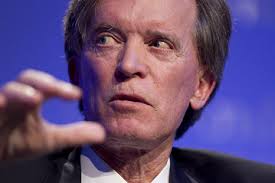 Bill Gross, who left Pacific Investment Management Co. in September to join Janus Capital Group Inc., recommended that investors reduce risk and prepare for asset prices to stop increasing.
“Markets are reaching the point of low return and diminishing liquidity,” Gross wrote in his investment outlook for December.
“Investors may want to begin to take some chips off the table: raise asset quality, reduce duration, and prepare for at least a halt of asset appreciation engineered upon a false central bank premise of artificial yields, QE and the trickling down of faux wealth to the working class.”
Gross, 70, known for his colorful investment commentaries, suggested that the creation of more debt by policy makers worldwide to solve the credit crisis will be judged by future generations much like smoking in public or discrimination against gays is viewed by people today. The investment outlook, titled “How Could They,” also referenced Punch and Judy nursery rhymes to analyze central bank policies.
“Can a debt crisis be cured with more debt?,” Gross wrote. “I suspect future generations will be asking current policy makers the same thing that many of us now ask about public smoking, or discrimination against gays, or any other wrong turn in the process of being righted.”
‘Bye-Bye’
Gross in October started managing The Janus Global Unconstrained Bond Fund after his surprise exit from Pimco, the bond firm he had co-founded in 1971. In an investment commentary in October, Gross said that investors should bid “bye-bye” to double-digit returns as growth worldwide is slowing down, in a scenario that he and Pimco first expressed in 2009, called “new normal.”
He wrote that there are “structural headwinds” that make it difficult for central bankers worldwide to solve the debt crisis with quantitative easing.
“How could they?,” Gross wrote. “How could policymakers have allowed so much debt to be created in the first place, and then failed to regulate their own system accordingly? How could they have thought that money printing and debt creation could create wealth instead of just more and more debt?”
via Bloomberg
 Despite falling oil prices, the Organization of Petroleum Exporting Countries (OPEC) voted on November 27th not to cut production in order to boost prices. The key to this decision appears to have been the attitude of Saudi Arabia, which has long been the first among equals in the coalition. Not surprisingly, the decision led to further oil price declines, and led many observers to conclude that OPEC has largely lost the ability to upwardly influence the price of petroleum. But this determination ignores the wider geopolitical considerations that may be convincing Saudi Arabia to be perfectly content, for now, with lower prices.
With about 20 percent of the world’s proven oil reserves and producing between 10 and 13 percent of the global oil usage, Saudi Arabia is the world’s leading oil producer ahead of the U.S., China, Iran and Canada. Perhaps more importantly, with its developed and easily accessible oil fields, Saudi Arabia has some of the lowest “lifting costs” in the world. Some estimate that it only costs the Saudis less than $5 to extract a barrel of oil from its fields. This is stark contrast to the much higher costs in rival countries and offshore and of shale producers. This permits the Saudis to withstand a protracted price slump far easier than other countries. The Saudis can use this ability as a weapon to achieve its strategic ends.
Modern U.S./Saudi relations were shaped towards the end of WWII by negotiations between President Franklin D. Roosevelt and the Saudi King Ibn Saud. In return for Saudi cooperation over oil, the United States guaranteed Saudi Arabia military protection. Despite the clear ideological differences between a conservative Wahabbi Sunni Kingdom and a Western democracy, this policy has largely held for some 68 years. Saudi Arabia exercised moderation and consistency over oil supplies from the Arab Gulf. In return, the United States led an impressive Allied military defeat of an Iraqi threat to Saudi Arabia in Gulf War I.
While the current dip in energy prices clearly does hurt Saudi Arabia, it hurts her enemies far more, particularly Iran and Russia, which has been a key enabler of Iranian power and an international pariah on its own. Putting pressure on Russia has also become a key strategic interest of Washington.
For many oil exporting nations, the tax revenues generated from petroleum constitute a major portion of government budgets and have become essential to the maintenance of long-term solvency. Nations like Russia, with oil generating 50 percent of tax revenues in 2013, according to the Ministry of Finance, are assumed to have a ‘Budget Break Even Cost’ (BBEC) of around $105 per barrel based on Citi Research’s data. Obviously the current price, less than $70 per barrel, is placing a great deal of strain on President Putin’s finances. Iran has a BBEC of some $131 oil. Recovering from recent sanctions, Iran has few currency reserves. Therefore, oil at $70 will necessitate an early cut in government spending, risking civil discontent and possible regime change.
Saudi Arabia is assumed to have a lower BBEC of some $98 per barrel. And although current prices are lower than that, over decades Saudi Arabia has accumulated vast foreign exchange reserves. As a result, many observers believe she can sustain her economic budget for a considerable time with oil selling at below $93 a barrel. Meanwhile, countries such as Russia, Iran and, particularly, Venezuela, which already is nearing default on its debt, must start cutting government spending to reflect depleted oil revenues. These outcomes are firmly in the interests of both Saudi Arabia and her longtime strategic partner, the United States.
And although U.S. consumers are now enjoying the benefits of lower fuel costs, which will help spark consumer demand, the threat to the U.S. energy industry should not be overlooked. U.S. oil companies have invested heavily in horizontal oil drilling and so-called fracking to increase well yields. U.S. domestic oil production has risen significantly over the past five years and now approaches 8 million barrels per day based on data from the U.S. Energy Information Administration (EIA). However, much of this investment was made on the basis of $100 oil. If the price stays below $70 for long, the continued viability of some smaller U.S. oil companies might be threatened, particularly in Texas and South Dakota. Citigroup Inc.’s recent forecast that the U.S. would pump 14.2 million barrels per day by 2020 could prove illusive and result in job losses.
However, there are more serious strategic concerns currently in play. The Obama Administration’s recent engagement with Iran may be of great concern to the Saudis, who consider Iran to be a mortal threat. Currently, the U.S. and Iran are in protracted negotiations over Iranian nuclear capabilities. The U.S. appears to be willing to acquiesce to Iranian desires in exchange for more cooperation against ISIS.
These concerns may have escalated this week when it was announced that Iran had recently conducted air strikes against ISIS insurgents within Iraqi territory. U.S. Secretary of State John Kerry reacted to these revelations as a “welcome development.” Although ISIS should be considered an enemy to both the U.S. and Iran, American acceptance of Iranian military intervention in Iraq can be seen as a clear shift in Washington’s policy towards Tehran.
If such is the case, the Saudis may begin to feel ‘dumped’ by Obama, and may be tempted to turn more forcefully towards China, the world’s largest oil importer, offering cheap oil in return for strategic protection against a new American-backed Iranian regional threat.
The effects of international recession and the U.S. ‘oil boom’ were slow to create a production glut because, until recently, production from Iran, Russia, Iraq and Libya was curtailed by sanctions and war. Cheap oil likely will protect and increase Saudi Arabia’s oil market share.
The real costs of Obama’s dropping the U.S.’s 68-year friendship with Saudi Arabia in favor of Iran are becoming increasingly apparent. If Saudi Arabia is forced closer to China, taking with her other Arab Gulf States (OAPEC), the long-range implications could be extremely serious for America and Europe.
John Browne is a Senior Economic Consultant to Euro Pacific Capital. Opinions expressed are those of the writer, and may or may not reflect those held by Euro Pacific Capital, or its CEO, Peter Schiff.
Subscribe to Euro Pacific’s Weekly Digest: Receive all commentaries by Peter Schiff, John Browne, and other Euro Pacific commentators delivered to your inbox every Monday!

 Why Nuclear Energy Stocks Will Soar in 2015
You don’t have to be a rocket scientist to have seen some upward trends in the nuclear industry lately.
There are several key indicators that point in a bullish direction on nuclear stocks, and all are worth examining before adding any uranium-themed investments to your portfolio.
No doubt the global nuclear energy market is growing. So-called “green” alternatives like wind and solar haven’t made much of a dent in the world’s energy bourses, and that’s where nuclear enters the picture.
According to Statista.com, the value of the global nuclear energy market stands at $133 billion right now but is expected to grow to $300 billion in 2015.
Additionally, the worldwide radiation management market is worth $69 billion right now and will grow to $267 billion by 2030. Construction and services show similar growth trends (expected to hit $53 billion and $22 billion in value over the next 16 years).
But in the past few years, growth has been muted by another high-profile industry event: the Fukushima nuclear disaster in April 2011 that led Japan to close all 48 of its nuclear power plants.
These plants provided 40% of the nation’s electricity needs, and for a short time, the talk was that Japan could make do with non-nuclear fuels to provide energy for the highly populated country — a move other countries (like Germany, Italy, and Sweden) said they would emulate.
That tamped down nuclear stocks, as investors took to the sidelines to see how alternative energy solutions would pan out for nuclear-shy nations. But that scenario is changing, too.
“Nuclear power has been in use for over 50 years,” notes the Emirates Center for Strategic Studies and Research, which published a recent report on the nuclear industry. “Nevertheless, the majority of the world’s nuclear power plants are concentrated in industrialized countries with large economies.”
Several new countries are now considering using nuclear energy, the report adds. “The challenges of maintaining nuclear safety have yet again become the focus of arguments against nuclear power among its opponents. These arguments are not new, having been used after the nuclear incidents at Three Mile Island in the USA and Chernobyl in Ukraine.”
Boosting Nuclear Stocks
The move toward alternatives lost steam, and now nuclear is once again at the top of the list for energy options for a burgeoning number of countries — Japan among them.
Consider these recent developments in the nuclear sector, all of which should add to demand for uranium and boost nuclear stocks:
- Japan has reopened many of its nuclear power plants after demand for alternatives and fossil fuel-based energy sources weakened.
- The U.S. has announced plans to roll out 13 new nuclear power plants.
- The U.K., France, and Canada have also announced plans to beef up their nuclear energy industries.
With renewed interest in nuclear energy, the stocks to watch right now have a uranium bent. One of the earth’s most valuable resources, uranium is the path to profits for investors in one key way: 435 nuclear power plants across the globe rely on uranium to fuel energy development.
All of those plants use about 86,000 tons of uranium annually, but the uranium industry doesn’t really produce that much volume on a yearly basis. Actually, it produces about 75,000 tons of uranium each year.
That’s manna from heaven for uranium stocks and funds, as the price for valuable uranium goes up as demand spikes. Uranium prices are up by 28% so far in 2014 and heading higher as they outpace all five energy benchmarks in the Bloomberg Commodity Index.
“There are a few key factors that are making traders believe that prices should be going up, this includes the good news of Japanese reactor restarts,” said Jonathan Hinze, a senior vice president at Roswell, GA-based Ux. “Expectations that demand will grow even stronger due to China” should also drive uranium prices upward.
70 Nuclear Power Plants
Further pushing uranium prices upward are “shovel in the ground” projects for 70 new nuclear power plants coming on line globally in the next two or three years. Some analysts predict uranium prices will rising from $40 today to $70 in 2015.
Which companies offer the best opportunities for atomic energy-minded investors?
For starters, look to Uranium Participation Corp (TSX: U), which owns a stockpile of several million pounds of uranium. UPC’s performance is strictly tied to the ebb and flow of uranium prices, making it a no-frills but potentially ample upside investment given the current trend of uranium prices.
Another option is Cameco (NYSE: CCJ), which is currently trading at $18 per share with an upside, analysts estimate, of $23 per share. Cameco is expected to benefit substantially from Japan’s decision to re-ignite its nuclear power industry.
According to Morningstar, Cameco is the world’s largest publicly traded uranium miner with high growth prospects. “We expect annual output, which was 23.6 million pounds in 2013, to rise roughly 50% through 2019,” the firm says in a recent research note. “Cameco’s new volume will be low cost, with the majority coming from one of the highest-grade deposits in the world.”
Morningstar also notes that uranium consumption is “set to grow at the highest pace in decades as emerging economies turn to nuclear as a carbon-light source of base-load power. Meanwhile, as decades-old existing stockpiles of uranium are whittled down, we expect to see increased pressure on mined supply to meet that growing demand.”
Another option is the Global X Uranium ETF (NYSE: URA), which tracks 23 worldwide uranium mining companies, most of them in Canada. This ETF has a small-cap flavor (aside from a 23% position in Cameco), with a 32% weight toward small-cap energy firms and a 31% weight on uranium microcap firms.
After struggling all year, URA is up 7% in the past three months and shows signs of growing stronger as demand for uranium picks up.
The takeaway? Adding nuclear power to your portfolio is no longer a luxury. With industry growth on the front burner, going nuclear in 2015 — especially with uranium mining companies — is a necessity.
Until next time,
Brian O’Connell for Wealth Daily


-
I know Mike is a very solid investor and respect his opinions very much. So if he says pay attention to this or that - I will.
~ Dale G.
-
I've started managing my own investments so view Michael's site as a one-stop shop from which to get information and perspectives.
~ Dave E.
-
Michael offers easy reading, honest, common sense information that anyone can use in a practical manner.
~ der_al.
-
A sane voice in a scrambled investment world.
~ Ed R.
Inside Edge Pro Contributors

Greg Weldon

Josef Schachter

Tyler Bollhorn

Ryan Irvine

Paul Beattie

Martin Straith

Patrick Ceresna

Mark Leibovit

James Thorne

Victor Adair