
Asset protection
Oil prices plunged to their lowest prices in five years last week after the International Energy Agency (IEA) downgraded its forecast for global oil demand for the fifth time in six months.
The IEA report told markets that global growth will remain weak in 2015, triggering an across-the-board sell-off in stocks and junk bonds on Friday that left the major indices with some of their worst percentage losses in three years.
Unfortunately, stocks are still trading within a few percentage points of record highs reached only a week ago and remain severely overvalued in the context of seriously deteriorating economic fundamentals.

Investors that were complacently expecting stocks to melt up to “Dow 18,000” and “S&P 2,100” by year-end are now facing a the much grimmer reality of a correction and even the potential of a bear market in 2015.
By the Numbers
On the week, the Dow Jones Industrial Average plunged by 678 points or 3.8% to close at 17,280.82, its largest point and percentage drop since 2011. Only a week ago on December 5, the Dow hit a record closing high of 17,958.79.
The S&P 500 collapsed by 73 points or 3.5% to end the week at 2002.53 after closing a week earlier in December 5 at a record closing high of 2,075.37. The Nasdaq Composite Index fell by 127 points or 2.7% to end at 4653.6 and the small cap Russell 2000 dropped 29.99 points or 2.5% to end the week at 1,152.45. European stocks also got hammered and saw their biggest losses since 2011.
Falling Oil Prices are Taking Stocks With Them
Stocks followed oil lower. Crude futures fell $8.03 per barrel or 12.2% to $57.81, their lowest level since the depths of the financial crisis in 2009, down 46% from crude’s 52-week closing high of $102.26 per barrel in June. More alarmingly, the price has completely fallen out of bed in the last three weeks, plunging by 24%. For the uninformed, which appears to include the entire financial media and most of the so-called experts who appear on their television shows, prices do not collapse that quickly due to oversupply; demand is melting away like a glacier in the summer sun because the global economy is deteriorating under the weight of too much debt and geopolitical problems. The question now is how quickly stocks will catch up to this inexorable reality and how widespread the damage will be.
Why This Flattening Yield Curve Signals a Gaining Bear
Anyone who questions the burgeoning economic weakness rearing its ugly head in the oil patch but about to spread far beyond North Dakota and South Texas and OPEC should pay careful attention to what is happening in the bond market. The U.S. Treasury curve flattened significantly this week, a phenomenon that has been occurring all year but is accelerating.
While moves in the yield curve are somewhat technical, they are extremely important for investors to understand because they establish the price of money in the economy. A flattening yield curve means that the difference in the price between short-term money and long-term money is diminishing which is a sign that lenders expect the economy to slow. On the shorter end, the 2/10 curve flattened by 21 basis points from 175 to 154 basis points last week and is down sharply from 261 basis points at the beginning of 2014. On the longer end, the 2/30 curve flattened by 13 basis points last week to 219 basis points and is down from 353 basis points at the beginning of the year.
Equally important, absolute yields are now moving down to levels that suggest that economic growth is slowing with the yield on the benchmark 10-year Treasury falling 21 basis points on the week to close at 2.1% and the yield the 30-year falling 22 basis points to close at 2.75%. Despite the fact that the U.S. economy has seen real growth (i.e. growth ex-inflation) of better than 3% during five of the last six quarters, these yields are signaling a coming slowdown.
We are taught that a bear market cannot begin until the yield curve inverts, but we are about to learn whether this rule-of-thumb still applies when interest rates have been pushed to the zero boundary by Federal Reserve policies that have distorted the value of all financial assets. Low interest rates are a sign of a weak economy. The fact that interest rates are so low suggests that something is amiss and should be flashing a warning sign to investors in stocks.
This month marks the sixth anniversary of the Fed’s decision to drop the Federal Funds rate to 0-25% and keep it there long past the ostensible end of the financial crisis. What markets are going to find out – and what some of us have been warning all along – is that the crisis never ended but instead morphed from a fast-moving study in chaos theory and contagion to a slow moving event in which the Fed was praying for fiscal policy makers to come to their rescue with pro-growth policies.
Such policies are desperately needed to create sufficient productive capacity in the economy to generate enough income to service and repay the more than $100 trillion of debt that now exists in the world. Alas, no such miracle has occurred and the world is now left to figure out how to deal with this unsustainable debt burden. The options are both obvious and distressing (literally and psychologically). Fiat currencies will have to be further debauched and financial assets that have been inflated in value will now have the air let out of them. The only question is how quickly these adjustments will occur.
This Subtle Change in the Junk Bond Market Will Signal Real Distress
The drop in oil prices is just the first wave of deflation that will hit markets over the coming years. In addition to the deflationary signals being emitted by commodity prices led by oil, Japan and Europe are also exporting deflation through their central banks’ easing policies. The world is experiencing a massive currency war and one of the currencies now in play is oil. Geopolitical pressures have added to world’s tolerance for low oil prices or, phrased more bluntly, the Saudis are willing to bear the pain of lower oil prices to hurt Iran, ISIS and Russia and have the full backing of the U.S. and other Western nations to do so.
When $1 trillion and counting of money is removed from the global economy, which is what is happening with the price of oil effectively being cut in half, economic activity drops sharply and inflation morphs into deflation. Commodity prices and the yield curve are telling us that the U.S. is heading for both a growth scare and a recession. The question is whether an economy as leveraged as the United States is still capable of experiencing a mere recession or whether something much worse is in store.
The bloodbath that is unfolding in the energy sector of the high yield bond market could easily spread to the rest of that market, which has been trading at grossly overvalued levels for the last three years as investors have been duped into believing that five and six percent yields are sufficient compensation for owning what remain hybrid debt/equity instruments that pose a real risk of principal loss. The average yield on energy bonds has jumped to 9.42% from a record low 4.87% just six months ago (a level that should have told holders of these bonds to be selling). The average energy sector bond now trades at 87.7 cents on the dollar, a level that could easily move 10 or 20 points lower if contagion spreads.
Energy bonds approximately 15% of the junk bond market but oil itself has an impact on a much broader array of industries. The option-adjusted spread on the Barclays High Yield Index has widened out to 504 basis points but the average yield on the index is still only 6.83%, far below distressed levels. If current trends continue, spreads and yields could easily widen by another 300 basis points which would still leave them far shy of distressed levels.
Absolute yields will continue to be suppressed by lower benchmark Treasury rates so the telling sign that investors should look for is whether junk bond investors stop basing their valuations on spreads and start looking for absolute returns that accurately represent the risks they are taking.
When that happens, the market will truly be in crisis mode. Today’s junk bond market is characterized by thin dealer inventories, a buyer’s strike among distressed and event-driven sellers, and concentrated ownership among ETFs and large institutions which has led to a truly horrible liquidity picture. Despite the bold talk from Wall Street and some large investors like Blackstone and Oaktree, it won’t take much more pain to send the market into a full-throated selling panic.
What Investors Should Do Now
What investors should be doing to prepare for them depends on their individual situations but at the very least they should be either significantly reducing or hedging their stock and junk bond exposures.
More aggressive and sophisticated investors can take steps to profit from the coming correction through options strategies and short selling strategies.
And everyone should be buying physical gold. What is happening is entirely a consequence of a failing monetary policy regime.
This may not be the end of that regime, but this is what the death rattles sound like.


Last week we became bearish the US stock market when the indexes lost the support parameters originally laid out in an update on Tuesday. Then, on the sharp rebound NFTRH+ noted a short trade on SPY. That is still in progress. So what is next for a market that is taking a much deserved correction of its excesses?
We should not feel the need to predict because NFTRH’s approach is intuitive in reading charts by daily, weekly and monthly views, checking macro data that matter (i.e. look forward) like the upcoming Semiconductor Book-to-Bill ratio for November, and to lay out possibilities and refine probabilities.
Despite global news items, last week’s drop in the US stock market was a probability owing to the deplorably over bullish sentiment we noted in #320 and its over bought proximity above important moving averages that we also talked about recently.
The Dow, S&P 500 and Nasdaq 100 (i.e. US market headliners) are on plan for a corrective hit in the first half of December (recall also the typical December seasonal we reviewed on page 33 of NFTRH 319) and we need to finish managing that before any thoughts of bounces, rebounds or bull continuation via a Santa rally.
If Santa does come on schedule, we will only call it a bounce until it proves otherwise.
On Friday, in the midst of bearish markets far and wide, I wrote an article speculating about a potential counter-trend bounce in the beaten down ‘inflation trade’ http://nftrh.com/2014/12/12/is-inflation-oversold/ and this theme could mesh with a ‘Santa Rally’ and/or ‘January Effect’ rally that could begin to get itself together over the next several weeks.
Things are actually getting interesting because we have downside movement in the major US markets, ‘tax loss’ season in full swing, commodities and the global ‘inflation trade’ (incl. certain global markets like Canada, Australia and Emerging) approaching support levels (ref. the Canada and Aussie dollar targets/support in the article linked above) and silver and gold, however uninspiring they seem at the moment, providing a hint as silver leads the recent relative strength in the precious metals vs. commodities and stocks.
As is always the case, any year-end speculations are taken against the unchanged big picture view of a global economic contraction and the slow erosion (some would say deflation*) of previously inflated asset bubbles.
I don’t care what kind of upside Dow targets come out of Martin Armstrong’s computer. Our simple charts have shown again and again the precarious nature of the US stock market as an inflated thing with no backing fundamentals outside of policy making. So that is the caveat as always. The chart shows Monetary Base and Debt-to-GDP fading and flat lining, respectively.

Please take a moment to really look at that chart. Let it tell its story. Frankly, seeing something like that makes me feel a little uncomfortable even writing a segment about a would-be Santa Rally because nothing has changed for people who want to look beneath the surface (admittedly a distinct minority in the gambling casino filled with wild eyed players) and consider what is really in play.
Total Public Debt to GDP has leveled off and the post-QE3 money supply is dropping. In response, the S&P 500 has only just begun to respond. You and I are not the only ones who see this. The average stock bull does not see nor care to see it, but our big brained friends at the Federal Reserve certainly do. Depending upon what transpires the first couple of days next week, this paints the upcoming FOMC meeting as a notable one.
The market’s interest rate price fixers issue their statement at 2:00 (ET), followed by a Yellen PC at 2:00 on Wednesday, December 17.
If Santa is coming, he may take his cue from whatever comes out of the orifice of this multi-headed group of autocrats. Again, they see clearly what we see in the chart above.
Bottom Line on Santa
So with a typically dour NFTRH caveat fest behind us, we can move on with the understanding that we are dealing in what is (a mocked up bull market, but a bull market nonetheless), not what I personally would like it to be (a more honest environment… ha ha ha, he sounds like a financial flower child, a hippie… an idealist!).
The market has lived by the policy and it will either continue to live by the policy or die by the policy unless our big picture macro view is wrong (always a possibility folks) and a sustainable bullish environment – sans QE – engages. Again, we will watch the likes of the Semiconductor b2b and also consider whether the plunge in energy and other important commodities is like a beneficial QE, to the US at least.
So with that, let’s play it straight and move on to the jolly rotund man in red.
*Note: the above is followed by 15 pages of different market sector analysis, charts and recommendations, all up to date, that can be read in full HERE – Money Talks Editor

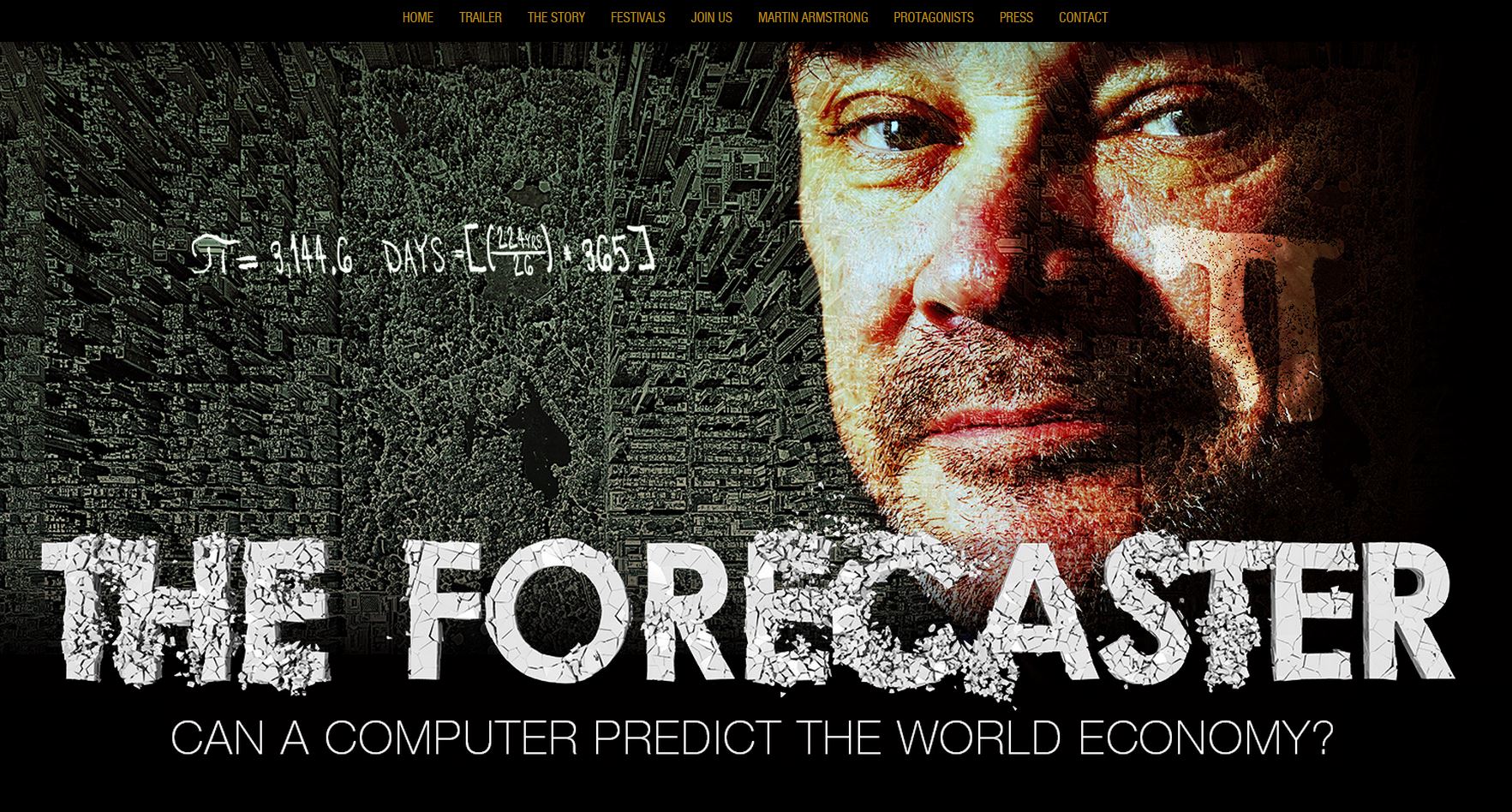
The long awaited Martin Armstrong documentary had it’s world premier in Europe last month at the Amsterdam Film Festival. We’ve always said that Martin’s life and experiences with the US Justice system read like a film script – and we look froward to the North American premier early in 2015.
In the meantime, enjoy the excellent trailer for the film on the movie website – http://forecaster-movie.com/en/the-forecaster/
And don’t forget! Marty will once again be presenting both days of the 2015 World Outlook Financial Conference.
– Ed.

Why Mark Twain thinks a major Euro bottom may be near
The inimatable American author Mark Twain once counseled, “Whenever you find yourself on the side of the majority, it is time to pause and reflect.” This is, of course, great advice for life on the whole, but it has very specific application to trading in particular.
Flash back to six months ago: EUR/USD was the king of the forex world. Rates had just rallied to a 3-year high at 1.40 and the consensus trade was that the rally would stretch into the end of the year. As any experienced trader will tell you, these are precisely the times when a market is most vulnerable to a reversal. Sure enough, the pair reversed sharply off a multi-year bearish trend line and dropped through its rising wedge pattern in May, starting a six-month cascade of lower highs and lower lows down to the low-1.22s.
Now, as we head into the end of the year, the exact opposite situation is developing: the consensus 2015 trade in the forex market is to be short EUR/USD. At first glance, this is a very logical view: the US economy is accelerating, prompting speculation that the Federal Reserve will hike rates in the first six months of 2015, while the Eurozone is struggling with lackluster growth and fears of outright deflation, with most traders pricing in the start of sovereign quantitative easing (QE) program from the European Central Bank (ECB) in Q1.

*A Piercing Candle is formed when a candle trades below the previous candle’s low, but buyers step in and push rates up to close in the upper half of the previous candle’s range. It suggests a potential bullish trend reversal.
….continue reading page 2 HERE

-
I know Mike is a very solid investor and respect his opinions very much. So if he says pay attention to this or that - I will.
~ Dale G.
-
I've started managing my own investments so view Michael's site as a one-stop shop from which to get information and perspectives.
~ Dave E.
-
Michael offers easy reading, honest, common sense information that anyone can use in a practical manner.
~ der_al.
-
A sane voice in a scrambled investment world.
~ Ed R.
Inside Edge Pro Contributors

Greg Weldon

Josef Schachter

Tyler Bollhorn

Ryan Irvine

Paul Beattie

Martin Straith

Patrick Ceresna

Mark Leibovit

James Thorne

Victor Adair