
Timing & trends
 Congratulations to Janice D. of Alberta, this week’s winner of two (2) VIP tickets to the 2015 World Outlook Financial Conference + one (1) night accommodation at the Westin Bayshore Hotel in Vancouver on Friday, January 30th courtesy of Solara Club and MoneyTalks.
Tune in every Saturday in January for your chance to win!
*N.B. The prize has no cash value but is fully transferrable.


 Imagine a self-learning robot that can enrich its knowledge about fine-grained manipulation actions (such as preparing food)simply by “watching” demo videos. That’s the idea behind a new robot-training system based on recent developments of “deep neural networks” in computer vision, developed by researchers at the University of Maryland and NICTA in Australia.
The objective of the system is to improve performance, improving on previous automated robot-training systems such as Robobrain, discussed on KurzweilAI last August. Robobrain, which has been downloading and processing about 1 billion images, 120,000 YouTube videos, and 100 million how-to documents and appliance manuals, is designed to deduce where and how to grasp grasp an object from its appearance.
The with it and other system: there’s a large variation in exactly where (which frames) the action appears in the videos, and without 3D information, its hard for the robot to infer what part of the image to model and how to associate a specific action such as a hand movement (cracking on egg on a dish, for example) with a specific object (“hmm, did the human just crack the egg on the dish, or did it break open magically from an arm movement, or do spheroid objects spontaneously implode?”).

The researchers took a crack, if you will, at this problem by developing a deep-learning system that uses object recognition (it’s an egg) and grasping-type recognition (it’s using a “precision large diameter” grasping type) and can also learn what tool to use and how to grasp it.
Their system handles all of that with recognition modules based on a “convolutional neural network” (CNN), which also predicts the most likely action to take using language derived by mining a large database. The robot also needs to understand the hierarchical and recursive structure of an action. For that, the researchers used a parsing module based on a manipulation action grammar.

The system will be presented Jan. 29 at the AAAI conference in Austin (open-access paper is available online).
Hat tip: “Spikosauropod”
Abstract of Robot Learning Manipulation Action Plans by “Watching” Unconstrained Videos
from the World Wide Web
In order to advance action generation and creation in robots
beyond simple learned schemas we need computational tools
that allow us to automatically interpret and represent human
actions. This paper presents a system that learns manipulation
action plans by processing unconstrained videos from
the World Wide Web. Its goal is to robustly generate the sequence
of atomic actions of seen longer actions in video in
order to acquire knowledge for robots. The lower level of the
system consists of two convolutional neural network (CNN)
based recognition modules, one for classifying the hand grasp
type and the other for object recognition. The higher level
is a probabilistic manipulation action grammar based parsing
module that aims at generating visual sentences for robot
manipulation. Experiments conducted on a publicly available
unconstrained video dataset show that the system is able
to learn manipulation actions by “watching” unconstrained
videos with high accuracy

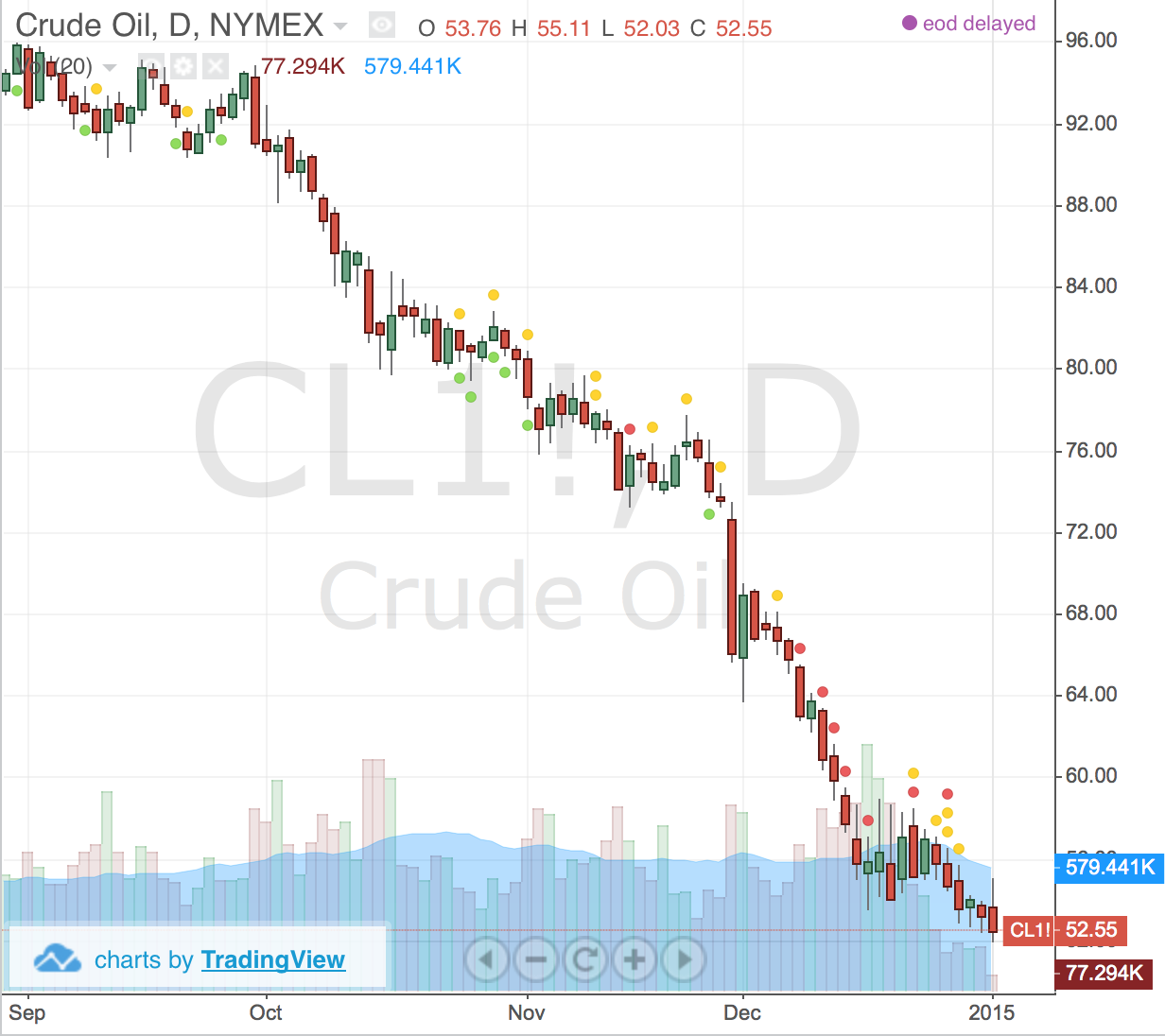
Iran is feeling the pain of lower crude oil prices and is calling on Saudi Arabia to do something about it.
Reuters News reported that Iran Deputy Foreign Minister Hossein Amir Abdollahian said “If Saudi does not help prevent the decrease in oil price…this is a serious mistake that will have a negative result on all countries in the region” whose economies rely heavily on oil.
That is an understatement and a lot more mild than the comment from Iranian President Hasan Rouhani who told the Associated Press last month that Saudi Arabia’s refusal to scale back oil production was tantamount to a “conspiracy against the interests of the region” and the Muslim people. “Iran and people of the region will not forget such conspiracies, or in other words, treachery against the interest of the Muslim world,” he said. Of course, while Iran wants the Saudi’s to cut production, it is unlikely that will happen.
Today it seems that the words of European Central Bank president Mario Draghi are having more of an effect on oil. Draghi said that the risks to the ECB’s ability to fulfill its price-stability mandate have increased over the past six months. He warned that medium-term inflation expectations have fallen since June raising expectations that the ECB will start moving on its bond buying program sooner rather than later.
That sent the March Euro to a new contract low and the lowest price since June of 2010 and the March dollar to a new contract high, which is pressuring oil. It seems oil cares more about over supply and the value of the dollar then Iran and their complaints to Saudis.
…continue reading page 2 HERE
Scenes From a (Suddenly) Nude Beach
Warren Buffett’s classic aphorism “You only see who’s swimming naked when the tide goes out” is being tossed around more frequently these days, as the world gets yet another deflation scare. Zero Hedge just published a great piece on this topic, which should be read in its entirety. In the meantime here’s a summary of the story with a few added bits.
Let’s begin with the common sense premise that overly-easy money sends a false-positive signal to market participants, leading them to buy and build things that maybe shouldn’t be bought or built. Then, when money goes back to a more reasonable price, the bad decisions (malinvestment in economist-speak) are revealed and financial turmoil ensues.
Today’s situation has its roots in the 1980s, when the developed world got too lazy to live within its means and started borrowing way too much money. It then tried to inflate away its debts by creating a tidal wave of new currency and pushing interest rates down to unnaturally low levels. Flush with extra cash and cheap credit, consumers (especially in the US) bought huge amounts of imported junk. This in turn led China — the main producer of said junk — to go on an infrastructure/factory building spree of epic proportions, which shifted into hyper-drive after the 2008 crash. Chinese demand for industrial materials like copper, iron ore, and oil soared, pushing their prices far above historical averages.
This in turn led miners and drillers to mine and drill on an unprecedented scale, which caused the supply of industrial materials to surge. The flashiest case in point is the US shale oil boom, which sent domestic oil production back to levels not seen since Texas’ blockbuster oil fields were young.
But it was all a money illusion, and every part of this process has recently hit a wall. Consumers refuse to go more deeply into debt to buy non-necessities, even when money is nearly free. Faced with lower demand and poor cash flow from the past decade’s overbuilding, China has tapped the brakes on its infrastructure build-out. The US is trying to stop monetizing its debt, which has sent the dollar through the roof on foreign exchange markets, thus making life even harder for about half the world’s population.
As a result of the above, demand for basic materials is returning to normal levels, which, in the face of inflated supply, is tanking prices across the commodity complex.
In other words the tide has gone out, leaving a whole beach full of naked (and unfortunately not very attractive) bodies. Specifically:
Shale oil junk bonds. Back when oil was over $100 a barrel, everybody wanted to lend to drillers, especially in the exotic (and as it turns out fatally-flawed) shale oil sector. $170 billion of energy-related junk bonds are now outstanding, and they are tanking along with the price of oil.

Emerging market economies. These countries and their major companies have accumulated about $6 trillion of dollar-denominated debt, and with the dollar up more than 10% in the past year, the aggregate losses on those loans could exceed half a trillion dollars. Suddenly, the emerging market miracle looks disturbingly like the Asian Contagion that nearly brought down the 1990s global economy.
Mining/drilling firms. These guys ramped up in response to soaring oil, copper, iron ore, gold, and silver prices. Now many of them are earning less per unit of product than it costs to mine/drill it. Massive bankruptcies and consolidations are coming. One dot-comish sign of things to come is Civeo, which provides living quarters for workers pouring into oil fields and mines in Canada, Australia, and the US. With people pouring out instead of into these suddenly non-viable fields, the company’s services are no longer required.

The Texas economy. Texans are cool. But a big source of their cockiness vis-a-vis the rest of the country was due to the fact that the price of their main export — oil — was at historically high levels. Now that it’s not anymore, the Texas economy — like those of Brazil and Russia, is falling back to earth. JP Morgan Chase predicts a recession in 2015.
The US economy. It turns out that most of the full-time jobs gained in the past five years have come from the energy sector. Otherwise, it’s been part-time secretarial/fast food/temp work that no one actually wants and in any event can’t support a family. Reverse out the oil patch jobs and the $10 or so trillion it took to engineer the “recovery” will look like just another piece of money-illusion malinvestment.
Anyhow, that’s just a sampling of the badly-maintained bods suddenly on display. Most are now running for cover, which is an amusing sight for anyone not directly affected by their problems. Trouble is, it’s hard not to be affected by energy, debt and deflation.

 “With just two trading days left in 2014, it’s mathematically assured that the S&P 500 will finish the year without ever having four consecutive down days. That’s never happened before in the 90 or so years since Standard & Poor’s launched its first stock index in the 1920s. (The S&P 500 in its current form dates to 1957.)
What’s more, there were barely any instances of three-day slides for much of the year. Before Labor Day, there were just four such three-day streaks, a startling testament to the lack of market volatility for large swaths of 2014.
But in the last few months, that’s changed. Since Labor Day, there have been six three-day slides, including twice earlier this month. But every time, day four was an up session.
In contrast, 2014 has brought us 11 winning streaks of at least four days, including the five-session run which ended with a 0.29-point decline on Christmas Eve.
The last four-day drop for the index was capped on Dec. 13, 2013. Even then, the S&P 500 barely notched a four-session skid, as the index that day logged a mere 0.18-point decline.“. – by Kevin Kingsbury of Morning Money Beat
….read: We Just Got A Major Warning Signal That Preceded Stock Market Crashes In 1987 & 2007


-
I know Mike is a very solid investor and respect his opinions very much. So if he says pay attention to this or that - I will.
~ Dale G.
-
I've started managing my own investments so view Michael's site as a one-stop shop from which to get information and perspectives.
~ Dave E.
-
Michael offers easy reading, honest, common sense information that anyone can use in a practical manner.
~ der_al.
-
A sane voice in a scrambled investment world.
~ Ed R.
Inside Edge Pro Contributors

Greg Weldon

Josef Schachter

Tyler Bollhorn

Ryan Irvine

Paul Beattie

Martin Straith

Patrick Ceresna

Mark Leibovit

James Thorne

Victor Adair