
Personal Finance
 Yesterday, the IRS announced the International Data Exchange Service.
If you’ve not heard of it, it’s is an outgrowth of the Foreign Account Tax Compliance Act (FATCA), which requires every single bank in the world to get in bed with IRS to share information about customers.
We’ve said this over and over, FATCA is probably the dumbest law in the history of the United States. And I don’t say that lightly, because there’s definitely stiff competition.
Like any other bankrupt government, the US government has taken to intimidating its own citizens and the entire world in an attempt to make ends meet.
Their hope was that the minority of people committing tax evasion would come clean and that it would result in some huge boost in tax revenue.
But the fact is that tax revenues actually haven’t improved at all.
Looking at tax revenue as a percentage of GDP, the numbers haven’t budged at all from their long-term average. Not a single bit.
So in actuality, FATCA has done nothing positive for America.
That said, FATCA has managed to destroy what little remaining credibility the United States government still had.
Bear in mind these people have spied on their allies, dropped bombs by remote control, and force fed people negative real interest rates and $18 trillion in debt.
But if that weren’t enough, FATCA goes after foreigners with absurd logistical challenges, commanding every single bank on the planet to comply.
Here’s the ultimate irony: there are nations in this world that are not recognized by the United States. The Turkish Republic of Northern Cyprus. Abkhazia. Etc. Yet banks in these regions still have to sign up with the IRS.
It’s like— you don’t exist. But you must still comply.
The IRS tells us that so far more than 145,000 financial institutions have already signed information-sharing agreements.
Now with yesterday’s launch of IDES they have an online platform to invade customer privacy at every one of those banks. This is a terrible trend.
I was talking to Jim Rickards the other day, author of both Currency Wars and The Death of Money (both excellent books).
He was telling me how decades ago he could ring up a bank and open an account over the phone in just a matter of minutes.
Now, because all these governments are bankrupt, banks have become unpaid financial spies required to treat customers as if we’re criminal terrorists.
The lifeblood of capitalism is capital, and banks are supposed to be the responsible stewards of our capital.
So by obstructing the ability of banks to engage in commerce, the US government is grinding down the pitiful remains of global capitalism down to the mere punch line.
This has consequences.
Perhaps more importantly, and the reason we think FATCA is the dumbest or at least the most destructive law in US history, is that it provides an enormous incentive for the rest of the world to simply avoid dealing with the United States.
There’s no bank on the planet that likes FATCA.
The only reason they comply is because the US has a nuclear option: sign up for FATCA or else we’ll withhold 30% of all transfers that go through the United States.
This is a big deal for banks.
Since the US dollar is the world’s dominant reserve currency, the majority of global transactions are denominated in US dollars and cleared through the US banking system.
This makes the US banking system critical to global finance. And it has long been a major advantage to the United States.
You would think that a government entrusted with such an awesome responsibility, from which it has benefitted for decades, would treat this advantage with dignity and care.
But no. Instead, the US government has turned its banking system into a weapon with which it threatens the entire world.
It doesn’t take a rocket scientist to realize that the rest of the world is one day going to create its own alternative system. One that would no longer rely on the US dollar.
Oh wait— they’re already doing that.
With FATCA, the US has shot itself in the proverbial foot. They’re practically begging the world to please take away its last remaining financial advantage.
And the rest of the world is listening.


With all the hype and noise built in to daily and weekly market management, sometimes it is worthwhile to dial out, calm things down and touch base with markets on the big picture. Here are views on various markets (with limited commentary) by way of some NFTRH monthly charts.
Let’s start with currencies, since they are a reflection upon global policy making, which has been unprecedented in its direct market interference over the last few years.
Nominal Charts – Currency
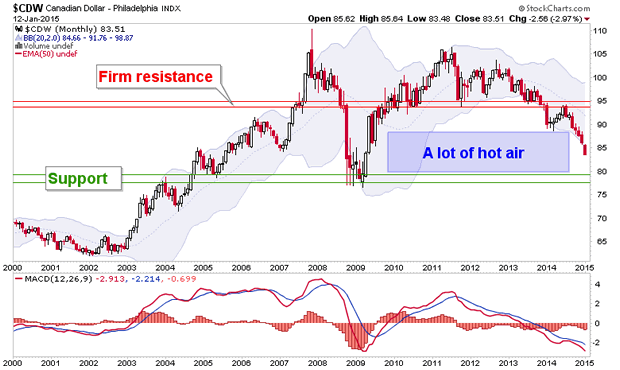
We noted the hot air patch in the Canada dollar last year. I had thought CDW might stop and find support at 85, which is a measurement from the topping pattern; but so far, no dice.
Larger Image
…continue reading & viewing another 36 charts with Larger views HERE

A few years ago (when the world was very different) veteran mining analyst Jay Taylor told me something that seemed counterintuitive: Deflation can actually be a good thing for the gold and silver mining business — if the prices of mining inputs like oil fall faster than the price of precious metals.
In other words, it’s not inflation or deflation per se that matter, but the distribution of price trends. “With quantitative easing,” said Taylor, “the liquidity being pumped into the system has caused energy and labor costs to rise, which has more than offset higher precious metals prices. Historically, the miners have actually done better in a deflationary environment in which gold and silver are seen as monetary metals and the cost of getting them out of the ground declines due to lower energy and labor.”
So the relationship of gold to the rest of the commodities complex is a good indicator of the mining environment. Gold might be down, but if it’s relatively strong, the mining equation is favorable. How is it today? Improving:

This implies that the cost of mining gold is falling while the price received for each ounce of gold is rising slightly. So margins, which have been squeezed to the point of evaporation for even high-quality miners, might be less horrendous than the markets now expect and (assuming current trends continue) earnings in the second quarter and beyond might exceed expectations. With mining stocks beaten down to historically-low levels, even stable earnings might be enough for a nice rally.
About DollarCollapse.com:
DollarCollapse.com is managed by John Rubino, co-author, with GoldMoney’s James Turk, of The Money Bubble (DollarCollapse Press, 2014) and The Collapse of the Dollar and How to Profit From It (Doubleday, 2007), and author of Clean Money: Picking Winners in the Green-Tech Boom (Wiley, 2008), How to Profit from the Coming Real Estate Bust (Rodale, 2003) and Main Street, Not Wall Street (Morrow, 1998). After earning a Finance MBA from New York University, he spent the 1980s on Wall Street, as a Eurodollar trader, equity analyst and junk bond analyst. During the 1990s he was a featured columnist with TheStreet.com and a frequent contributor to Individual Investor, Online Investor, and Consumers Digest, among many other publications. He currently writes for CFA Magazine.
 Just take a moment and read this list – it’s full of cool stuff and essential information.
– By the end of this year Amazon will have put 10,000 robots in their warehouses. The robots are integrated into the delivery system and are estimated to save them between $400 million and $900 million annually as well as decrease customer delivery time.
– In November Arizona’s Local Motors built the first fully-functional 3D-printed electric car. It only took two days to construct. The car is made up of 49 parts, which pales in comparisons to all the nuts and bolts that make up your metallic car. The company aims to sell it for about $17,000.
– Last spring, a software algorithm wrote a breaking news article about an earthquake that The Los Angeles Times published.
– Morgan Stanley predicts that widespread adoption of self driving vehicles will contribute $1.3 trillion to the U.S. economy through cost savings from reduced fuel consumption and accidents, including $507 billion in productivity gains because people could work while commuting instead of driving.
– Robots now deliver fresh towels at the Aloft Hotel in Cupertino, California while an automated anesthesiologist, called Sedasys is increasingly employed in hospitals. Microsoft’s Kinect can recognize a person’s movements and correct them while doing exercise or physical therapy thereby aiding (or replacing?) physiotherapists.
You Can’t Ignore The Financial Opportunities
– Smartwatches are expected to ship 10.8 million units in 2015, up 400% plus from 2014 according to Shawn DuBravac, chief economist of the Consumer Electronics Association.
– 1.3 million units of ultra high definition 4K TVs sold in the US last year, up from 77,000 in 2013. The number is expected to grow over 300% this year to 4 million units and then jump another 250% in 2016 to 10 million units.
– Revenues for drones were up 50 percent in 2014. Global revenue for drone sales in 2015 is expected to be $130 million.
No matter what I say it will not do justice to the revolutionary changes and the massive opportunities in technology that are taking place. This is THE good news story of next generation but it’s surprising how many people don’t appreciate it – including virtually every current affairs commentator in the media.
The tech revolution has the potential to overcome the litany of bad news stories that threaten to overwhelm us like sovereign debt, geopolitical unrest, unfunded entitlement promises and financially incompetent governments.
For example, tech innovation has already resulted in significant improvements in fuel efficiency. As Bloomberg News reports, the amount of oil consumed per day in the US, for every $1 billion of economic activity, is down 33% from 20 years ago. The University of Michigan’s Transportation Research Institute reports that since 2007 the average car gets 28% better mileage.
Tech is the #1 driver of economic and investment growth
Most of us now understand the importance of 3D printers. Granted, on the investment side, I recommended taking profits in 3D stocks over a year ago – but that wasn’t because I doubt about the massive growth potential. It was because I saw more immediate downside risk than upside potential.
I still feel it’s too early to re-enter the 3D arena but I’m on the look-out for a bottom. In the meantime, new applications and new materials as well as a rapid expansion of the market are making the best 3D stocks even more interesting. There are going to be some monster winners in this area – Hewlitt Packard, Stratasys, 3D Printing and others are vying for leadership.
But 3D printers are just one example. Picking the winning robotics companies will make investors a heck of a lot of money. At the Consumer Electronics Show a week ago in Las Vegas, personal robots were the rage.
Maybe Intel is poised to be a big winner with its RealSense Technology, which offers the ability for electronic devices to understand and interact with the world in three dimensions. Intel is teaming up with iRobot to create a robot butler or maid, which will have a high level of dexterity and be able to navigate difficult environments. The technology is complicated but the end result is not. Real freaking robots in the home doing my chores!
I am very interested in the suppliers for the smart phone industry. Apple introduces its first smart watch this year and its suppliers are going to see their revenues explode.
The incredible opportunities in tech – and the societal change it is fostering is why I read everything I can get detailing the advancements in nanotechnology, biotech, telecommunications and artificial intelligence, all driven by the explosion in information technology.
And some of the stock moves are incredible in tech related companies. Three years ago in Keystone’s World Outlook portfolio, Ryan Irvin recommended Enghouse Systems at the $8.00 level. The company’s software services a variety of segments in a number of industries including traditional call centres and online help desks. Today it trades just above $41 – a 414% capital gain not including a good dividend.
There’s also real action in small tech companies like Canadian based Firan Technology Group, which supplies aerospace and defense electronic products, specializing in quick turn around production runs for some large corporate clients. The stock was up 120% between Jan 1, 2014 and the first week of December.
Big names like Go Pro are still up over 170% from their IPO while Truecar is up about 160%.
And as I mentioned above with the high flying 3D stocks – there are definitely some companies that have become over hyped and over priced. King Digital, maker of Candy Crush is off about 40% since it first traded in March.
Choosing the right tech is essential
There are literally hundreds of examples of innovative companies changing our future and making major moves in the market but that’s the point. The next 10 years will witness more technological change than the last 100 years combined. Investors are going to have a huge array of opportunities. Forgive the cliché but this is where the action is if you’re looking for growth.
Big Change At The World Outlook Conference
This year we are going to feature a specific program for all things tech – called InvesTech. In a nutshell, this will be fun. Not only are we going to demonstrate some of the latest tech gadgets, I will be joined by three well known industry experts to share their expertise. Eamonn Percy, President of The Percy Group joins Brent Holliday, CEO of Garibaldi Capital Advisors and Patrick Cox, John Mauldin’s top tech analyst to talk about the most important investment opportunities.
As I said, whatever I write won’t do justice to the importance of the tech revolution but luckily these experts will go a long way to rectify that. Better still, you get a chance to meet both Brent, Eamonn and other tech experts and ask them your personal investment questions.
Finally
I am unequivocal in stating that each one of us needs to get familiar with the tech revolution. The World Outlook Financial Conference is your chance to not only hear renowned analysts like Martin Armstrong, Lance Roberts (just confirmed), Don Coxe, Greg Weldon and to see Ryan Irvine’s World Outlook Small Cap Portfolio 2015. It’s also an opportunity to get familiar with the most important investment opportunities of the next generation.
I hope to see you there.
Sincerely,
Mike,
Host of Money Talks
Conference Details
Where: Westin Bayshore, Downtown Vancouver
When: Friday, Jan 30th 1pm – 8pm and Saturday, Jan 31st 8:30m – 4pm
To book Your Ticket: go to http://moneytalks.net/events/world-outlook-financial-conference.html
Cost: $129 for a General Admission two day pass




-
I know Mike is a very solid investor and respect his opinions very much. So if he says pay attention to this or that - I will.
~ Dale G.
-
I've started managing my own investments so view Michael's site as a one-stop shop from which to get information and perspectives.
~ Dave E.
-
Michael offers easy reading, honest, common sense information that anyone can use in a practical manner.
~ der_al.
-
A sane voice in a scrambled investment world.
~ Ed R.
Inside Edge Pro Contributors

Greg Weldon

Josef Schachter

Tyler Bollhorn

Ryan Irvine

Paul Beattie

Martin Straith

Patrick Ceresna

Mark Leibovit

James Thorne

Victor Adair