Michael Waring Has Seen the Energy Downturn Movie Before, and He’s Not Worried
The Energy Report: Michael, you said in November that the Organization of the Petroleum Exporting Countries (OPEC) expected the U.S. to share in reducing production growth to help stabilize the oil market. Have events justified that expectation?
Michael Waring: Events have not. But I think we need to address that statement. I don’t believe that the Saudis are out to hurt Iran, to punish the Russians or to take down shale oil production in the U.S. I don’t think this is some Machiavellian scheme. I think it is simply a question of market share. The Saudis are say they have the lowest operating costs in the world, so why should they be the first guys to cut? It makes more sense that the more expensive guys cut production first. When you say it that way, you can actually understand the point the Saudis are trying to make here. It wouldn’t be logical to assume that Russia or the U.S. would voluntarily take production down, but it’s going to be forced on them by lower prices.
And the Saudis have really talked the price down. When you look at the rhetoric of the last two months, they’ve gone out of their way to drive it down. I think the basic attitude has been that if the high-cost guys don’t want to voluntarily reduce production, we’ll make them reduce it by lowering the price to the point where it hurts.
TER: Will those low prices do permanent damage to the North American industry?
MW: I wouldn’t use the word permanent, but damage is being done that will take probably more than a couple of years to recover from.
I think that the smaller oil and gas companies on the shale oil and gas treadmill—and I refer to it as a treadmill because they have to keep drilling aggressively if they want to keep their production flat or growing—have a real problem now because the banks won’t lend to them, the bond markets are closed to them and they can’t issue equity because the stocks have collapsed. You’ll see consolidation. And it’s going to shake a lot of the marginal guys out of the business.
 This happens every 10 years in the oil and gas industry. It is a commodity business after all, and what’s happened to the price isn’t way out of line with what’s happened in the past. This is actually a good thing about the industry: It tends to be self-correcting and cleansing. What happens at a moment like this is that the good guys, with really good plays, are solid and secure. It’s the marginal guys that get squeezed out, and the marginal guys tend to drive the cost up over time because everybody is outbidding for services. If you clean all those guys out, then you have a reset back to a lower cost base, and a focus on oil and gas plays that make sense and generate a good economic return through full-cycle pricing.
TER: What should investors do in this market?
MW: In our own portfolio, if we have two or three names in the energy sector that we were interested in, or that we owned but didn’t have a high degree of conviction in, we would use this as an opportunity to sell those names and double down on the two or three stocks that we have a high degree of conviction in—that we know will dramatically outperform coming out the other side. That’s a key. Investors probably want to use this as an opportunity to clean house on the energy portion of their portfolios and go high grade into the companies that will give good torque on the way up.
TER: Is there a silver lining for oil and gas investors in this dark cloud of falling prices?
MW: In every previous cycle, prices 6–12 months after the bottom are up quite sharply. I don’t know the exact timing this time around, but I do know that the harder and faster prices come down, the harder and faster they’re going to go up. That’s typically been the case, unless you want to utter those very dangerous words: “This time is different.”
The point I would make is that we have an opportunity to buy shares in companies where the stock price is down 50–60%, but the business models are not impaired and the companies have a solid asset base. We are actually being given a gift. If you can look out one year, it will be a gift to own these stocks at fabulous, attractive valuations.
TER: The Energy Information Administration (EIA) is forecasting Brent crude averaging $58/barrel ($58/bbl) in 2015 and $75/bbl in 2016. What’s your forecast?
MW: We wouldn’t be too far off that. I just had to send an estimate out to a client, and we’re thinking $70–75/bbl oil in 2016, and we’re depending on natural gas at $2.75–3.25 per thousand cubic feet ($2.75–3.25.Mcf).
TER: Is that oil price Brent or West Texas Intermediate (WTI)?
MW: That’s WTI. I wouldn’t say they’re trading at parity, but the gap between Brent and WTI has narrowed dramatically.
TER: Do you expect that to remain the case? They’ve been running $3–4/bbl apart.
MW: On a go-forward basis, I’m expecting it to remain narrower than it’s been historically, or for the last two years, let’s say.
TER: The EIA’s forecast seems to point to an extended period for lower prices. What oil and gas investments are safe in such a market?
MW: We have to remain focused on the fundamentals behind the business. It’s a moment where psychology has taken hold, and people have forgotten, overlooked or can’t be bothered with the fundamentals. The fundamentals of each company on its own will tell us what we need to know. If you look at the supermajors and large-cap oil companies, from Suncor Energy Inc. (SU:TSX; SU:NYSE) to Canadian Natural Resources Ltd. (CNQ:TSX; CNQ:NYSE)—we don’t own those names and those aren’t part of our universe—any company of that stature is going to be just fine. Likewise, a company like PrairieSky Royalty Ltd. (PSK:TSX) on the royalty side is going to be fine. It’s debt free with a lot of cash. There are ways to play this sector at the moment, looking at companies with very attractive valuations, solid balance sheets, and secure assets and cash flow going forward. Something like PrairieSky, in my mind, would certainly fit the bill.
TER: Are you expecting mergers and acquisitions (M&A)?
MW: I think there will be consolidation in the business. I think that’s inevitable. Having weak players without a lot of choices in terms of flexibility going forward will lead to mergers and consolidations. But good companies with good asset bases won’t have to be in the M&A game. All they need to do is focus on those assets.
TER: You have a diverse portfolio of companies. Are the companies you’re referring to in that portfolio?
MW: Yes, they are. We have a concentrated list of holdings in oil and gas. Oil and gas currently makes up about 20% of our mutual fund holdings. We have a fairly concentrated list of four or five names that we like a lot.
TER: Can you talk a little about some of those?
MW: Sure. The first one would be Paramount Resources Ltd. (POU:TSX). I think at one point late last summer, this was a $65/share stock. It cut down to $22/share. It’s currently $29/share. This is a natural gas and liquids producer. It has exposure to a play in Western Canada, along with a company called Seven Generations Energy Ltd. (VII:TSX). These two companies together probably have the most attractive rock in the Western Canadian sedimentary basin. The returns from this play are the highest we can identify out there, because of the high level of liquids and condensate produced alongside the natural gas.
 Paramount has decided to build its own infrastructure and its own gas processing plant, as opposed to using a midstream company like a Keyera Corp. (KEY:TSX) or Pembina Pipeline Corp. (PPA:TSX; PBA:NYSE). What that means is that on a go-forward basis, Paramount will capture more margin and have lower operating costs and greater control over its operations than a company using a third-party midstreamer.
We’re very excited about this company. It is currently producing 37,000 barrels a day (37 Mbbl/d) from a gas plant that it brought on last June. It is adding a piece of equipment in the plant that will allow it to deal with all the condensate and liquids coming out of these wells. When that is complete in March, corporate production will increase to 70–75 Mbbl/d in 2015. The company will have a dramatic increase in production and a dramatic increase in cash flow.
The knock against the company is that it borrowed a lot of money to build up this plant. It was a $250 million ($250M) capital expenditure, so the debt numbers look high. But we would argue that once it is up and running at 75 Mbbl/d, on an annualized basis, the cash flow is going to be $700M at $65/bbl oil. We think the debt/cash flow numbers are going to dramatically improve. In this environment, how many companies can double production in the next four to six months? Understand, the money is all spent. The company has 45 wells standing behind pipe to support this plant once the stabilizer comes onstream. There’s nothing that Paramount has to do at the margins. It’s a slam dunk.
The risk is that we want to see this stabilizer come onstream smoothly. It’s going to have a startup period, but the main plant itself was started up last spring, and Paramount has been able to bring that on pretty steadily, without any problems or interruptions. This is a name we like a lot. We think when prices finally bottom, this stock will recover very quickly.
TER: What other companies do you like?
MW: One is Secure Energy Services Inc. (SES:TSX). This company deals in oil field waste and water disposal. This is a razor blade-type story, because Secure Energy provides a service to the industry, and whether prices are up or down, the industry needs to deal with waste and water. As wells mature in Western Canada, they tend to have higher water production over time, so the older a well gets, the more water it produces. This is probably the most solid of all the service businesses that we know of.
Management at Secure Energy is great. I’ve known the guys for 15 years, maybe longer, and they’ve done an excellent job to date, since the company has come public. Secure has been beaten up along with other oil service names, but it stands apart. This company will stay busy—maybe not at the same level, but it’s going to stay busy.
 Then I’d mention Canadian Energy Services and Technology Corp. (CEU:TSX). It provides drilling fluids to the oil and gas industry. Part of the business is tied to oil well drilling, because the company makes specialized fluids needed to drill complex horizontal wells. But it also produces chemicals used by the industry to stimulate production from existing wells. This is a consumable-chemistry company, not a true oil and gas service company. Again, it doesn’t have to go out and invest in all kinds of steel and iron. What it invests in is research and development in a chemistry laboratory.
We like this company. It has tremendous free cash flow because it doesn’t have to buy and sit on equipment. We think, again, this is a name that will come rocketing back when the time is right. EOG Resources Inc. (EOG:NYSE), in the States, is the biggest operator in the Eagle Ford Basin—one of the best at what it does. It uses Canadian Energy Services for all of its drilling fluids, so that should tell you something about the quality of the product.
The last company—a straight oil company—is Whitecap Resources Inc. (WCP:TSX.V). It has top management and light oil. It has a dividend yield of something like 7.25%. The all-in payout ratio is about 100% at current prices, but that compares very favorably to most other dividend-paying companies in the space. Whitecap has maintained a very steady payout ratio. It is very good on the operating cost side. Again, this one will come bouncing back when the psychology finally turns in the oil market.
TER: A lot of energy service companies are suffering because of lower demand from their customers. Are Canadian Energy Services and Secure Energy Services having that problem?
MW: To date, no, they are not. It’s not to say that at some point. . .Come spring breakup, will activity fall off? Yes, it probably will. These companies will not be completely immune to a slowdown in the industry, but they’ll be a whole lot more immune than, let’s say, contract drillers and other service companies. And they’ll provide really good torque on the upside. Again, when the psychology turns and people decide it’s not the end of the world for the energy industry, names like this will be the first out of the box to bounce back.
TER: What is going to give them a leg up?
MW: I think it’s the high-quality nature of what they do. Both companies provide something very specialized, as opposed to a fleet of generic drilling rigs. They are not commodity-type businesses. In the case of Canadian Energy Services, when it gets involved with a company like EOG Resources, it tailors its drilling fluids to suit the needs of EOG in that particular field. Once it gets engaged with a customer, it’s very hard for that customer to go somewhere else just because somebody can shave 10% off the price. This is very specialized stuff. Once you get that relationship going, you have to really screw up to lose that relationship.
TER: What are Paramount Resources and Whitecap Resources doing to ensure they can survive in this low-price market?
MW: Both are watching their capex very carefully. Paramount does not pay a dividend; Whitecap does. It has a history of raising that dividend, and has done so every couple of quarters consecutively since it became public. Just before Christmas, Whitecap said it was expecting to raise the dividend in January this year, but it has decided to defer that increase until it sees how things shake out.
 In both cases, it’s a function of how quickly these companies want to grow, or whether they want to slow down the growth rate. They have the luxury of deciding their fates, of determining how quickly the business grows or whether they’re going to throttle back on capital expenditures and slow it down.
TER: What qualities in a company catch your attention and keep you interested?
MW: I think in oil and gas, first and foremost, it has to be the management team. I don’t know any other business where companies end up reinvesting so much capital in the business. If you’re not good at what you do—if you’re not good on the cost side—you can blow your brains out and destroy capital very quickly. Investors should get a read on management—look at the track record, the pedigree, etc. Operating costs and netbacks tell you a lot about the caliber and diligence of management. Those are very important metrics to look at.
Second, investors need to assess the geology of the company’s holdings. Asset quality can vary greatly between companies. To use Paramount as an example, you can’t own better rock in Western Canada. Maybe somebody will find something else in the future, but at the moment, this company has some of the best acreage in the business. Understanding something about the geology is helpful.
It’s never easy going through the down times. I’ve been to this movie before, and quite frankly I’m tired of seeing it. Each movie plays out a little differently, but it always ends up the same. At the moment it feels like it’s the end of the world, it will never come back, etc., etc. But it always feels this way. Every cycle, it always feels this way.
TER: Thank you for your insights.
Before forming Galileo Global Equity Advisors Inc. in 2000, Michael Waringserved from 1985 to 1999 as a vice president, director and portfolio manager at KBSH Capital Management Inc., a private investment management firm with over $10B under management. Waring obtained his master’s degree in business administration from the University of Western Ontario, is a CFA charter holder and a member of the Toronto CFA Society.
Want to read more Energy Report interviews like this? Sign up for our free e-newsletter, and you’ll learn when new articles have been published. To see recent interviews with industry analysts and commentators, visit our Streetwise Interviews page.
Related Articles
- Jason Wangler Throws a Lifeline to Oil and Gas Investors
- Revolutionary Oil Prospector Richard Masterson Shares Fracking Investment Opportunities Gov. Cuomo Can’t Touch
DISCLOSURE:
1) Tom Armistead conducted this interview for Streetwise Reports LLC, publisher of The Gold Report, The Energy Report, The Life Sciences Report and The Mining Report, and provides services to Streetwise Reports as an independent contractor. He owns, or his family owns, shares of the following companies mentioned in this interview: None.
2) The following companies mentioned in the interview are sponsors of Streetwise Reports: None. The companies mentioned in this interview were not involved in any aspect of the interview preparation or post-interview editing so the expert could speak independently about the sector. Streetwise Reports does not accept stock in exchange for its services.
3) Michael Waring: I own, or my family owns, shares of the following companies mentioned in this interview: None. I personally am, or my family is, paid by the following companies mentioned in this interview: None. My company has a financial relationship with the following companies mentioned in this interview: Paramount Resources Ltd., PrairieSky Royalty Ltd., Secure Energy Services Inc., Keyera Corp., Canadian Energy Services and Technology Corp., Whitecap Resources Inc. I was not paid by Streetwise Reports for participating in this interview. Comments and opinions expressed are my own comments and opinions. I determined and had final say over which companies would be included in the interview based on my research, understanding of the sector and interview theme. I had the opportunity to review the interview for accuracy as of the date of the interview and am responsible for the content of the interview.
4) Interviews are edited for clarity. Streetwise Reports does not make editorial comments or change experts’ statements without their consent.
5) The interview does not constitute investment advice. Each reader is encouraged to consult with his or her individual financial professional and any action a reader takes as a result of information presented here is his or her own responsibility. By opening this page, each reader accepts and agrees to Streetwise Reports’ terms of use and full legal disclaimer.
6) From time to time, Streetwise Reports LLC and its directors, officers, employees or members of their families, as well as persons interviewed for articles and interviews on the site, may have a long or short position in securities mentioned. Directors, officers, employees or members of their families are prohibited from making purchases and/or sales of those securities in the open market or otherwise during the up-to-four-week interval from the time of the interview until after it publishes.


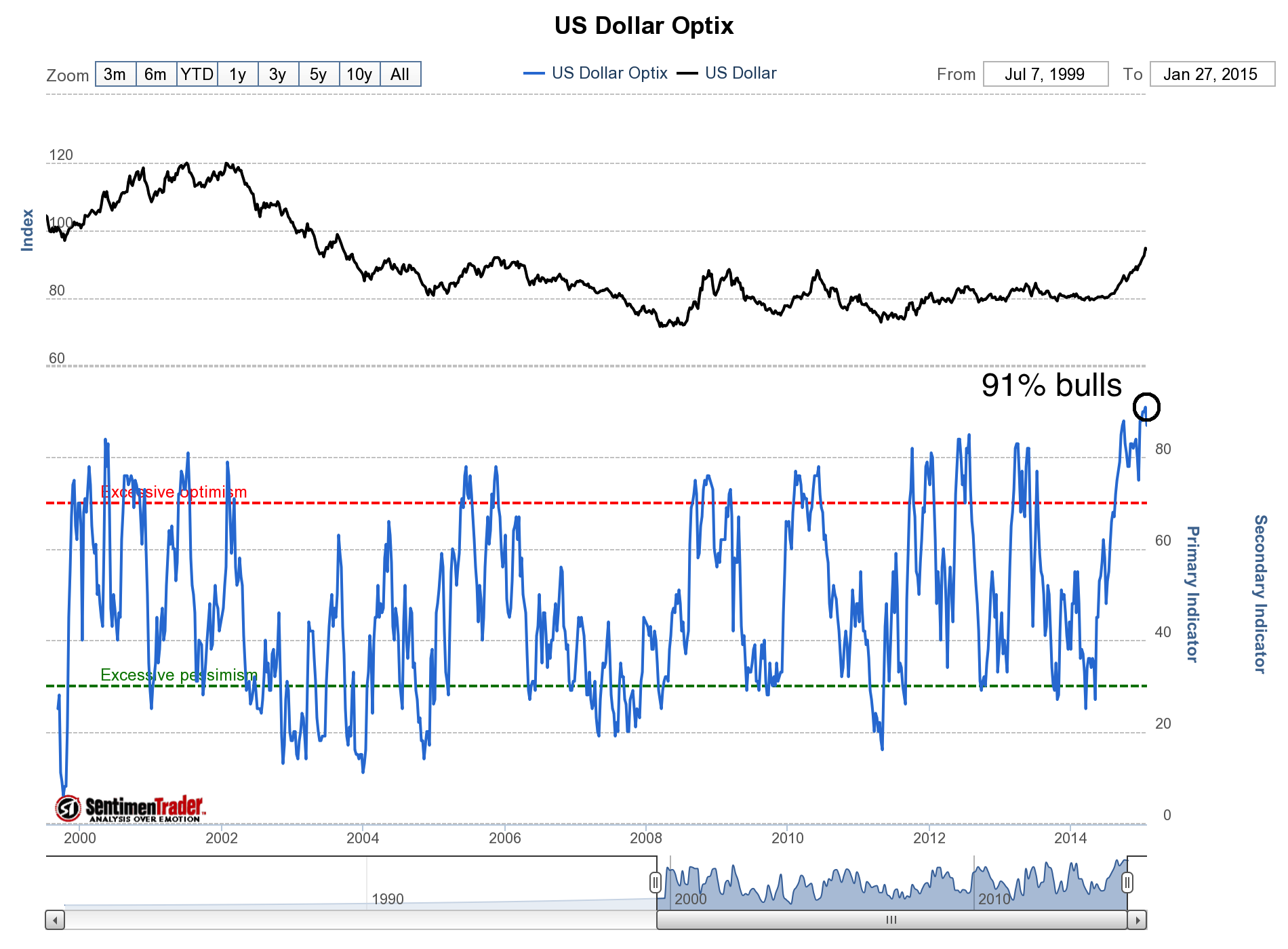

 Heading into the last trading day of January with the futures marked down 1% and I think it is safe to say that we will have a down month, with the potential for a 3% loss.
 The US on the brink of being unable to borrow or create money.