
Stocks & Equities


In This Week’s Issue:
In This Week’s Issue:
– Stockscores’ Market Minutes Video – Understanding Corrections
– Stockscores Trader Training – The Best Trades Are Not Hard to Find
– Stock Features of the Week – Abnormal Activity
Stockscores Market Minutes Video –
It is important to understand why market corrections happen and some of the early signs that one is imminent. This week, I explain how to spot a correction plus do my regular weekly market analysis.Click here to watch
Trader Training – The Best Trades Are Not Hard to Find
Traders, particularly those who need to make money rather than those who would like to make money, tend to have a fear of missing out. They hear about a trading idea or find an opportunity with their own effort and make the trade with less thought than they might put into buying a microwave. They can invest thousands of dollars on an impulse, much like the drunken gambler who throws down $1000 on Five Red.
One reason for this sort of reckless approach to trading is the belief that trading ideas are like gifts. They only come along from time to time and you should feel grateful for the opportunity. If you spend 10 hours researching a company or receive the occasional bit of insight from someone who should know more than the rest of us, it’s easy to understand why you wouldn’t want to let a seemingly promising trade slip through your fingers. The problem is that this gratitude for trading ideas leads you to lower your standards and place trades that are not much more than a gamble.
Have you ever made a trade and then, just a few minutes or days later, asked yourself what the heck you were thinking? If you are normal, then it’s likely that you have because it is easy to focus on the dream of making a profit. You should focus your attention on the trading situation as it has been presented to you by the market rather than the words of an expert. Some trading opportunities are so well marketed that it’s hard to see the truth because you fixate on the profit potential that has been dangled before you as the prize.
It is critical to only take trades that meet the criteria of a strategy that you have found to have a positive expected value. Rather than look for a reason to take the trade, which is easy, look for a reason not to. Ask yourself, “If I buy this stock, who will be selling to me, and what does she know that I don’t know?” Looking at the other side of the argument will often highlight considerations that you have missed.
Being fussy is a lot easier when you recognize that the market-even a slow market-will give you opportunities. The markets have been pretty quiet this year but there are still stocks outperforming the market every day.
And if you can’t find a trade today, tomorrow or in the next week, eventually you will. There is always another bus coming down the road. If you miss one, just wait for the next.
I have found that you will actually make more money by trading less. If you maintain a very high standard for what trades you make, you will always pass on some trades that end up doing very well. By being selective, however, you will also avoid many marginal trades that would tie up your capital and then incur a loss. By being fussy and trading less, you end up taking only the very best trades and your results will be better overall.
It is easy to be fussy when the market is strong and there are lots of opportunities. It’s like fishing when every time you cast your line you get a bite. With that kind of success, you will quickly throw back any fish that is too small because you know there’s going to be something better coming along soon. You only take the best of the best.
When the fish stop biting and you spend hours with no bounty, you take the first fish that grabs your hook. It could be a tiny fish that you would never keep on even an average day, but with your desire to catch something, you keep it anyway. It would be better to have just not gone fishing at all.
You’ll do the same thing when trading a slow market. Eager to make a profit, you will take trades that show some potential even if they don’t meet all of your requirements. You will work hard to uncover a trade rather than wait for the obvious no-brainer trades that you take when the market is in a giving mood.
I like to say that in trading, when the going gets tough, the tough get lazy. You can’t control the market, so if the market is not giving you opportunities, it’s better to do nothing. Your hard work will not change what the market does.
This is hard for many people who have been programmed to relate hard work to success. If you try harder than the next person in a sport, you should get a better result. If you study harder for an exam, you should get a better mark. If you work longer hours at your job, you should make more money. In the stock market, if you work harder to find good trades, you will probably lose money.
The best trades are easy to find. Working hard to uncover something leads you to find questionable trades that you have to talk yourself into. It’s better to walk away when you have doubts.
This is not to say that hard work is not rewarded in trading. Traders who work hard at practicing their analytical skills or developing new strategies will be rewarded. People who devote their time and effort to improving their emotional control will be better traders. These are things that you can control and affect with hard work, but hard work won’t change what the stock market does.

Where there is smoke, there is fire. Stocks that make an abnormal price gain with abnormal volume after a period of generally complacent trading are often set to start a new trend. This week, I scanned the market for stocks trading abnormally using the Stockscores Market Scan and found the following stocks that have good potential.

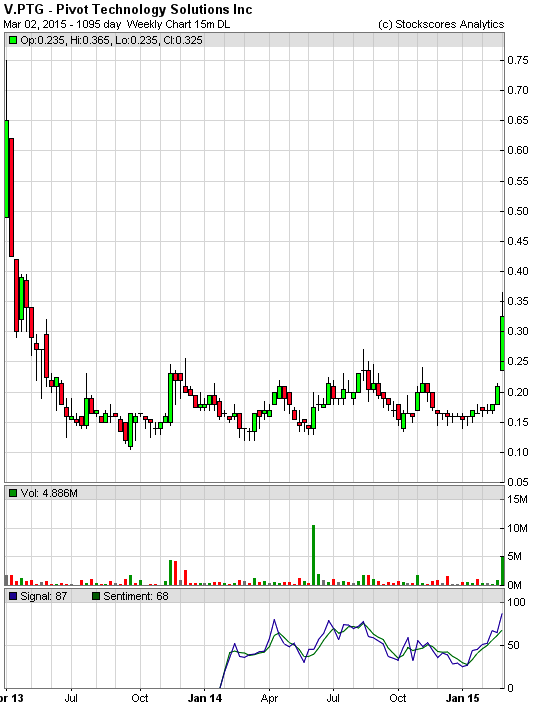
1. V.PTG
V.PTG has been trending sideways for two years but came alive with very strong volume and price action today indicating the market has found something to be excited about. Support at $0.19.
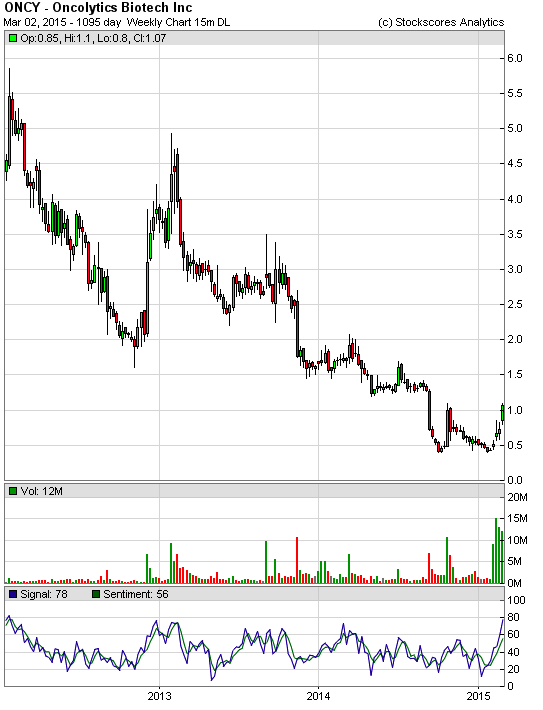
2. ONCY
ONCY (T.ONC) made a big break higher today that broke the long term downward trend line. This is a good sign that the downward trend is over but it could take time for the stock to build upward momentum. The abnormal activity today is a sign that the buyers have taken an interest in the stock again. Support at $0.57.
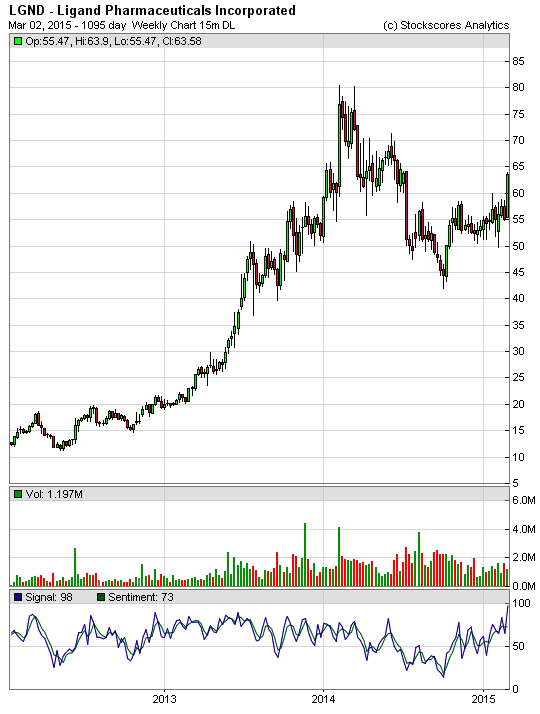
3. LGND
LGND went quiet for the last year after being very strong in 2013. This week, it is breaking higher from a decent pattern and appears to be starting the resumption of a long term upward trend. Support at $55.
References
- Get the Stockscore on any of over 20,000 North American stocks.
- Background on the theories used by Stockscores.
- Strategies that can help you find new opportunities.
- Scan the market using extensive filter criteria.
- Build a portfolio of stocks and view a slide show of their charts.
- See which sectors are leading the market, and their components.
Disclaimer
This is not an investment advisory, and should not be used to make investment decisions. Information in Stockscores Perspectives is often opinionated and should be considered for information purposes only. No stock exchange anywhere has approved or disapproved of the information contained herein. There is no express or implied solicitation to buy or sell securities. The writers and editors of Perspectives may have positions in the stocks discussed above and may trade in the stocks mentioned. Don’t consider buying or selling any stock without conducting your own due diligenc

Over the last year, the US Dollar has had an incredible surge in value of 11%. It appreciated against all main currencies in the world in 2014.
Meanwhile, gold also actually increased in value when valued against the vast majority of world currencies but the dollar was the only currency that it could not conquer.
What is behind this surge in value for the dollar?
In our opinion, it is a very easy explanation: as investors abandon all other options, they continue to look for safe havens. With central banks such as the Swiss National Bank and the Bank of Canada making surprising interest rate or pegging decisions, everyone is looking for safety and predictability. The ECB and Bank of Japan are piling onto the problem by fighting deflation with massive quantitative easing programs.
These are also the reasons why gold has also seen a recent bounce back as well.
The question is: how long can the USD remain the safe haven of choice? With moderate economic growth still happening, investors still seem to have confidence in the United States. However, if that at all falters and economic growth slows, there will be nowhere to hide. Remember that it only takes one event to cause a ripple effect and the US Dollar bull run could be over.
To quote Mr. Warren Buffett: “Only when the tide goes out do you discover who’s been swimming naked.”


 Today King World News is pleased to share a fantastic piece that warns a major danger signal is now flashing RED after one of the largest increases in history! This piece also includes a key illustration that all KWN readers around the world must see.
By Jason Goepfert Founder & CEO Of SentimenTrader
March 1 (King World News) – We’ve discussed in previous reports over the past two years how traders in volatility products have tended to be the smart money, at least to the best of our limited knowledge in how they are using the products.
The three main exchange-traded funds based on the VIX “fear gauge” (VXX, UVXY and TVIX) have seen their shares outstanding ebb and flow over the past three years based on demand from traders.
….read more HERE

 After a brief respite during December and January, the bull market has now reconfirmed its bullish trend. Buy signals are back in place and my recent moves to fully increase exposure in the portfolio model in advance of the recent breakout are performing well.This week I am going to review the current technical status of the market to provide a better understanding of the risk/reward that currently exists in the markets.
Importantly, just because I am discussing the resumption of the “bullish” trend in the market, it does NOT mean there is NO RISK of a meaningful and crippling mean reverting event in the near future.
You should remember that when you are investing there is NO SUCH THING as LONG TERM. All you have as an investor is the capital that you are speculating with today and the time you have until you need it. Investors have lost almost 6-years of their investment time horizon simply “getting back to even” following the last market decline. While the capital has been recovered, the time lost can never be. This is why so many retirees are now unprepared to retire which explains why the number of individuals over the age of 64 is at the highest level on record.
When you are told “you are a long term investor” and you should just “hold” investments for an indefinite period it suggests one of two things: 1) It is due to laziness; or 2) there is no real understanding of how to invest or control risk.
“Buy survival gear”
Economics Compacted
“This column contains everything there is to know about economics. Hereafter it will be possible to shut down university deprtments and stop talking about Keynes and the Austrian School, to the great relief of mankind. In gratitude you can send me your childrens’college funds.
In 1850 people all lived on farms and grew food, which they ate. Eating was really important to them. They liked eating. There was in 1850 tremendous demand for refrigerators and cars, but people didn’t know they wanted these things because they hadn’t been invented. Anyway, they didn’t have any money to buy them with.
Yet the demand was there, crouched to spring. Much demand for almost everything, but little supply.
Then farming automated and people all went to cities to work in factories to make refrigerators and cars, which had been invented. These weren’t as important as food, but they were pretty important. People had a little money now, and bought them. You don’t need advertising to sell what people actually want.
There was lots of demand and getting to be pretty good supply.
Soon the factories were spitting out more than anyone could use of everything that anyone could reasonably want. A family needs only so many refrigerators. Here we encounter the first crucial problem of the modern economy: too much supply and not enough demand.
Yet the factories had to make stuff so people would have jobs, and the people had to buy the stuff so they could keep having factories. Economics is thus the study of the squirrel wheel.
To keep people working and buying, the economy began making things that nobody really needed or would think to want, such as nail salons, electronic gadgets, and designer jeans. To get people to buy these things, the supply of demand had to increase. Advertising came about to manufacture demand for things that, without advertising, no one would buy. Consequently society now depends for existence on pop-ups, singing commercials at twenty minutes to the hour on television, billboards, and Google ads. Advertising thus became more important to the economy than anything it advertised.
Labor
Labor followed a similar pattern. When factories came, they needed lots of people to make the refrigerators and cars. Most work involved digging holes or lifting heavy objects, so the workers didn’t have to be smart or know much.
Automation
Then came the rolling disaster that economists don’t seem to have anticipated: automation. As factories produced the increasingly trivial goods that supported the economy, they needed fewer and fewer workers to make the trivial goods. This raised two questions: Who was going to buy the $450 running shoes that nobody needed except that advertising told them they did, and how were the workers who didn’t have work making them any longer going to get money to buy them? Or to eat?
It became obvious, except to economists, that automation could do just about everything people were paid to do. Just now, someone has invented a burger-maker machine that will presumably replace hundreds of thousands of burger-flippers who aren’t needed anywhere else. Self-driving vehicles approach practicality, and will first replace long-haul truckers and then cabbies and delivery truck drivers. Much worse is in the offing. Here is the second crucial problem of modern economics: Where to put unnecessry people?
 The Theory of Increasing Uselessness
A search continues, long quietly underway but now intensified, for ways to keep off the work force people for whom there is no work, or no real work. These are not necessarily lazy, shiftless, or parasitic. They just don’t have anything to do.
Child-labor laws and requirements that people finish high school helped diminish the labor force. Then society told the young that they all needed to go to college, when most of them didn’t, and since the universities served chiefly as holding pens, the quality of education dropped. Universities did however employ professors and administrators. Here was another example of selling at high price something that no one really needed, namely the appearance of education.
Swollen bureaucracies popped up to provide the appearance of work while the purported workers did little that would not better have been left undone. Military enterprise soaked up more people doing nothing that should be done. Exotic fighter planes that would never do anything to justify their existence but bomb remote goat-herds absorbed thousands of engineers and hundreds of billions of dollars. The engineers could as well have been paid for digging holes and filling them in, but this was judged unduly candid.
Finally even these measures ceased to be enough. College graduates began living with their parents and lining up for jobs a Starbucks because there was no need for them anywhere else. Resort was had to outright charity. Thus food stamps, Section Eight housing, free lunches at school, AFDC, and all the other disbursements of free money. Those receiving the free money no longer had any incentive to work even if the opportunity offered. In the cities generation after generation now lived on charity, largely illiterate and in what is never called custodial care. They are simply unnecessary. There is nothing for them to do. So they don’t do anything.
Poverty
In America this is usually a state of mind rather than an economic condition. The allegedly poor have all their time free, a luxury not available to the indentured drones who pay for this leisure. The poor have enough to eat—gobbling Cheetos instead of real food is their choice—and they have access to libraries and parks and museums. Graduate students at the same economic level used to live a life of books, music, illicit substances, and good conversation. The recipients of charity are not economically poor, but mentally empty.
Cognitive Stratification
Meanwhile an elaborate and highly effective system developed for sucking the very bright young from every cranny in the country and sending them to the remaining good universities: SATs, GREs, National Merit, ACT, and suchlike. Here the top two percent in intelligence partied, married, and made babies, not always in that order, and went into brain-intensive trades like Silicon Valley, i-banking, and medicine. As the middle class sank into the lower-middle, the brain babies increasingly formed a thin layer of dominant if not always morally impressive intellects at the top of society.
Increasingly aware of each other thanks to list-serves and web sites for the very smart, they foregathered internationally with their own kind, eschewing contact with the surrounding sea of slugs. (I will bet you are not reading this on a site where the comments are misspelled.) They prospered. Nobody else did. The battle lines were being drawn. Which brings us to:
The Minimum Wage
Conservatives harbor the curious notion that people will work if they don’t have to. This is because to them work, real actual work, is an abstraction with which they have no familiarity. Real work is usually unpleasant or boring. But to economic theorists, work means being a cardiac surgeon, talking head, columnist, or CEO. Thus they say that if we eliminate the minimum wage, black youth (these are always given as examples) will rush to labor for a dollar an hour, learn the trade, rise, and become CEOs. Horatio Alger and all that.
This implies two things: First, that anyone in his right mind would spend eight hours a day flipping burgers for a pittance when he could live on charity in leisure at the same standard, and second, that any employer in his right mind would want to hire semi-literates with bad work habits when, given our current endemic unemployment, he has a choice of much more educated and dependable workers.
In short, if the minimum wage were abolished, the bottom rungs of society would remain unemployed because their labor isn’t worth enough for them to live on, or worth anything at all. The bottom rungs creep upward. When almost everybody is unemployed, we will have to institute communism manque: “To each according to his needs and, from each, nothing much. I will then write The Theory of the Leisure Classes: A Study in Urban Chaos.”
There you have it, all of economics in a small package. Buy survival gear.
Philip Francis Stanley and Grotesque Ophthalmological Malpractice


-
I know Mike is a very solid investor and respect his opinions very much. So if he says pay attention to this or that - I will.
~ Dale G.
-
I've started managing my own investments so view Michael's site as a one-stop shop from which to get information and perspectives.
~ Dave E.
-
Michael offers easy reading, honest, common sense information that anyone can use in a practical manner.
~ der_al.
-
A sane voice in a scrambled investment world.
~ Ed R.
Inside Edge Pro Contributors

Greg Weldon

Josef Schachter

Tyler Bollhorn

Ryan Irvine

Paul Beattie

Martin Straith

Patrick Ceresna

Mark Leibovit

James Thorne

Victor Adair