Energy & Commodities

How to Make Money in the Chaos of Oil and Gas

moneyrolled580Operating in difficult conditions—whether political, logistical or technical—comes with the oil and gas territory, but the collapse in oil and gas prices has added further complexity and risk to the space. Though many companies have lost half or more of their share price in the debacle, Stephane Foucaud of FirstEnergy Capital tells The Energy Report how to find value in small-cap exploration and production names, and provides several examples of companies poised to rebound on the upturn.

The Energy Report: Stephane, do you think the oil price has hit bottom and is now recovering?

Stephane Foucaud: When the Brent oil price was close to $50/barrel ($50/bbl), I think it was the bottom. It has recovered quite a bit. There is a risk that it might dip again, but I don’t think we will reach the low $50s for quite some time. The reason I think there is a risk that the oil price could dip is that there has been an overreaction to the North American rig fleet reports, and particularly to what appears to be a large number of rigs being taken out of the market. Those rigs are, however, associated with lower-producing areas. Therefore, I think it’s more sentiment than reality in terms of impact on the supply. The recovery has been too steep. 

TER: What prices are you forecasting for 2015 and 2016?

SF: For 2015, we are anticipating $59/bbl Brent. For Q1/15, we have $54/bbl; Q2/15 at $58/bbl; we expect to end up at $63/bbl. For next year, we have $72/bbl. The trend on the one-year view is upward, but with some fluctuation.

TER: The Islamic State of Iraq and Syria (ISIS) is growing in Libya, and is threatening the oil industry there. How would capture of the oil fields by ISIS affect commodity prices?

SF: Though it is part of the equation, and Libya is a problem, production in Libya has already dropped a lot, and is arguably already factored into the oil price. I think the situation in Iraq and Kurdistan with regard to ISIS is equally, if not more, important. If you have deterioration of the situation in Kurdistan and Iraq, that will have a positive impact on the oil price. Now, that has to be considered in the context of Venezuela potentially blowing up, which would be very serious, or Russia disappointing. And Russia is currently a black box.

TER: What do you mean by black box?

SF: There are currently sanctions on Russia. But I think most of the market does not really expect much decline in supply this year from Russia. Very few oil forecasting agencies have a detailed model as it applies to Russia, because there is very little visibility. So analysis is often focused on the U.S., and to the north in Canada, where there is a free flow of information and a lot of granularity. We don’t have that level of detail on Russia.

“There is a risk that the oil price could dip because there has been an overreaction to the North American rig fleet reports.”

Russia is one of the largest producers in the world. Any deviation from the broad assumption of production not dropping this year in Russia could be very meaningful. 

TER: You have a four-tier strategy for investment, and you’ve slotted some of your companies into one tier or another. How do you evaluate where they should go?

SF: First, I look at whether a company remains fairly defensive, even in the current oil price environment, on the strip curve for Brent. I am cautious about companies with overall asset value being marginal on the strip curve for Brent, or with funding issues on the strip. Second, I look at whether a company is operating in an area where the risk profile is not too high, so there is not something that could suddenly blow up. Taking too much political risk in the current market needs to offer really material upside. Third, I look at the share price and see where I find value on the house view for Brent. 

TER: How has the collapse in commodity prices affected the oil and gas companies you cover?

SF: First, their share prices have been hit extremely hard. Most companies have seen their share prices halved—and sometimes more than halved—but not all of them. The ones that are very well funded have been more defensive. Second, the fundamental values of the assets have gone down. Third, given the reduced cash flow, companies face issues with their balance sheets and the repayment of any debt. 

So today it’s about looking at companies that are able to survive in the current environment, and are still offering value on the strip. The companies we like in the current environment are those whose share prices have dropped much more than the underlying value of their assets, and those that are still funded. 

“If you have deterioration of the situation in Kurdistan and Iraq, that will have a positive impact on the oil price.”

Companies we like at the moment include Premier Oil Plc (PMO:LSE) and TransGlobe Energy Corp. (TGL:TSX; TGA:NASDAQ). Premier is a North Sea story, and the market is somewhat concerned with its debt. The company is embarking on a relatively low-risk exploration program in the Falklands. A success could attract a farm-in partner, which would be a rerating event as investors do not seem to ascribe much value to this group of assets. TransGlobe Energy is cheap, and arguably offers the benefit of being in an area where the politics are getting a bit better.

TER: How will TransGlobe Energy’s writedown of its Yemeni assets affect the company?

SF: I think the writedown was broadly expected. The situation in Yemen is difficult and pretty complex. We are not fundamentally surprised that the company decided to write down its assets. The contribution to the company value compared to shareholder expectation is absolutely minimal.

TER: How has Premier Oil responded to the collapse in oil prices?

SF: Premier has kept its net debt almost at the same level. The net debt level has been higher than the current market cap for some time. 

The fact that Premier explores in the North Sea means it is, by definition, quite sensitive to the oil price. At one point, the share price was half what it was before the oil price collapse. That’s quite significant given that Premier is one of the blue-chip exploration and production companies listed in London, with good hedge in place on its production. The shares are also very liquid. 

So it has been difficult. The value of the company has gone down because the oil price is lower and it has fairly high-cost assets. But, again, that’s what you’d expect in a world where the oil price drops.

TER: Premier has described its hedging policy as “conservative.” What does that mean in practice?

SF: It means that the oil price at which the company is hedged is quite high, and that a fairly important component of its production is being hedged. Particularly when you look at the lower oil price environment, the overall cash flow of the firm is enough—or close to being enough—for the company to operate with confidence. 

“Any deviation from the broad assumption of production not dropping this year in Russia could be very meaningful.”

For instance, if the indebtedness of a company is quite low, and if the costs associated with its assets are also quite low, one would argue that such a company would need less hedging than a company that needs a high oil price to make its assets work and to repay debt. By “conservative,” Premier means it is quite resilient to a low oil price, and can deal with fairly high-cost assets and a high level of debt. 

TER: Is there a last company you would like to mention?

SF: Our argument for Tethys Petroleum Ltd. (TPL:TSX; TPL:LSE) is based on growing production to China, increasing gas export price, and exploration upside in Tajikistan. But more than anything, it’s all about the completion of the deal with a Chinese private equity firm that would be buying 50% of Tethys’ Kazakh asset. The value of this deal is more than Tethys’ current market cap. At the time that this deal closes, the company gets over US$80 million (US$80M), which compares with a market cap at the moment of less than £30M (about US$45M). You can see the investment logic. This is almost 50% upside on the transaction with the Chinese private equity firm. Beyond that, there is production growth and exploration upside in Tajikistan. The upside is quite significant.

TER: How are you advising investors to proceed in the oil and gas space now, given current prices?

SF: Look for names that offer liquidity. Look at the value of a firm based on the future curve for the oil price, and look for companies that have value at that level. If the oil price gets better then great, there will be some upside. Our approach is quite cautious—liquidity, value on the strip, upside beyond the strip, and the relative assurance that there won’t be a serious debt issue in the near term.

TER: Thank you very much for your time, Stephane.

Stephane Foucaud is managing director, institutional research, of FirstEnergy Capital LLP. Before joining FirstEnergy, he was head of oil and gas research at Fox Davies Capital and senior oil and gas analyst at Société Générale in London, covering Royal Dutch Shell, BP, BG Group, Statoil and Cairn Energy. Foucaud also worked for Schlumberger for seven years in various technical, operational management and corporate strategy roles. He holds a master’s degree in engineering from the National School of Electrical and Mechanical Engineering of Nancy, France, a master’s degree in exploration production from the French Petroleum Institute, and a master’s degree in business administration from INSEAD in France.

Want to read more Energy Report interviews like this? Sign up for our free e-newsletter, and you’ll learn when new articles have been published. To see recent interviews with industry analysts and commentators, visit our Streetwise Interviews page.

Related Articles


DISCLOSURE: 
1) Tom Armistead conducted this interview for Streetwise Reports LLC, publisher of The Gold Report, The Energy Report, The Life Sciences Report and The Mining Report, and provides services to Streetwise Reports as an independent contractor. He owns, or his family owns, shares of the following companies mentioned in this interview: None.
2) The following companies mentioned in the interview are sponsors of Streetwise Reports: None. The companies mentioned in this interview were not involved in any aspect of the interview preparation or post-interview editing so the expert could speak independently about the sector. Streetwise Reports does not accept stock in exchange for its services. 
3) Stephane Foucaud: I own, or my family owns, shares of the following companies mentioned in this interview: None. I personally am, or my family is, paid by the following companies mentioned in this interview: None. My company has a financial relationship with the following companies mentioned in this interview: Tethys Petroleum. I was not paid by Streetwise Reports for participating in this interview. Comments and opinions expressed are my own comments and opinions. I determined and had final say over which companies would be included in the interview based on my research, understanding of the sector and interview theme. I had the opportunity to review the interview for accuracy as of the date of the interview and am responsible for the content of the interview. 
4) Interviews are edited for clarity. Streetwise Reports does not make editorial comments or change experts’ statements without their consent.
5) The interview does not constitute investment advice. Each reader is encouraged to consult with his or her individual financial professional and any action a reader takes as a result of information presented here is his or her own responsibility. By opening this page, each reader accepts and agrees to Streetwise Reports’ terms of use and full legal disclaimer.
6) From time to time, Streetwise Reports LLC and its directors, officers, employees or members of their families, as well as persons interviewed for articles and interviews on the site, may have a long or short position in securities mentioned. Directors, officers, employees or members of their families are prohibited from making purchases and/or sales of those securities in the open market or otherwise during the up-to-four-week interval from the time of the interview until after it publishes.

 

Silver Projection, Dollar Correction

Take the S&P Index and multiply by the US dollar index.  This removes most of the currency variation.  Do the same with silver.  The chart of silver times the dollar looks very much like silver priced in euros.

T-SP


T-SI1

Note the following:

  • The S&P times the $ has been rising since 2002, is now at all-time highs, and is above the top of the trend channel as I have drawn it. The massive increase in debt since 9-11 has created liquidity which has levitated the S&P.
  • Silver times the $ has risen since 2002, is well below its 2011 high (markets correct) and has dropped almost to the support trend line as I have drawn it. The massive increase in debt since 9-11 created liquidity that helped silver spike higher in 2011, but it has since corrected. 

Facts and Speculation:

  • Debt is increasing rapidly. Global debt is approximately $200 Trillion and US debt exceeds $18 Trillion.  Unfunded liabilities are much higher.  Deflationary forces threaten central banks, hence they pump dollars, euros, and yen into the system to levitate the bond and stock markets.  Interest rates have been crushed to multi-generational lows to further levitate the bond market and increase bank profitability.  Currently the squeeze on the dollar has pushed it into a parabolic rally, and such rallies always correct.  When the dollar corrects (crashes), silver and gold prices will benefit from the ensuing financial chaos.

Examine the silver times $ graph again with speculation regarding possible values after prices compensate for currencies printed to excess.

T-SI2

Current:

Silver                             $15.60

Dollar Index                      0.99

Silver times $                  15.47

Zone 1 (perhaps 2017):

          Silver                             $55.00                    or     $62.00

          Dollar Index                      0.90                                0.80

          Silver times $                  50.00                              50.00 

Zone 2 (perhaps 2019-20):

          Silver                           $125.00                    or   $155.00

          Dollar Index                      0.80                                0.65

          Silver times $                100.00                             100.00

The above are speculations regarding prices for silver and the dollar index.  What is not speculation are the following: 

  • Markets always correct.
  • Parabolic rises usually crash and burn.
  • Unbacked paper currencies are being printed to excess and they will devalue in purchasing power.
  • Silver and gold have been real money and valuable for thousands of years, in contrast to hundreds of paper currencies that have been inflated into nothingness.
  • I don’t know what will happen to the S&P, but we can be relatively certain the prices for gold and silver will rally substantially as all paper currencies inevitably weaken.

Sadly, most people will continue playing on the Titanic financial system and believe it is unsinkable.

 Gary Christenson

The Deviant Investor

The One Chart You Need to Predict the Future

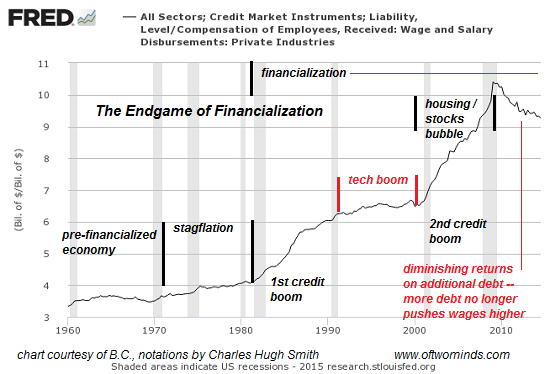
We are witnessing a profound secular sea-change: the failure of expanding debt and leverage to lift the real economy of wages and household income. 

When push comes to shove, you only need one chart to predict the future: debt and wages ( credit and compensation). This chart displays debt and wages as a ratio: debt/wages. What it reveals is the endgame of financialization: creating more debt no longer pushes wages higher.

credit-compensation3-15a


I have broken the past five decades into easily recognizable economic periods.….continue reading HERE


“Debt Bomb!”

Screen Shot 2015-03-12 at 5.43.14 AM

Perspective

The observation that European savers are being punished is not new, but the form is unique. That borrowers are being favoured is also not new, and the form is also unique.

Why?


Policymakers are still in the thrall of theories that have always been impractical. Credit expansion and currency depreciation remain the remedies for anything. Sheer audacity has carried them this far, but at some point, their fanaticism will fail. The curiosity is when do they realize their methods are unsupportable.

There are at least four items that will be alerts.

  • The resumption of credit spread widening.
  • The reversal in the Treasury curve to steepening.
  • Resumption of weakening commodities.
  • Resumption of a firming dollar.

Of these, the latter is underway.

This as well as the general heaviness out there reminds of the “Debt Bomb”. This was a satirical video written and performed by our London buddy – Dominic Frisby. The link to YouTube is: https://www.youtube.com/watch?v=GXcLVDhS8fM

The full realization interventionist policymaking has been a fantasy of generations of undisciplined intellectuals. It will take some time and not-impossible forces to wake them up. Reducing their monopoly on “Monopoly Money” will take a little longer.

The irony is that history provides reliable instruction on what works and what doesn’t. Since the inception of modern central banking in 1694, there are 300 years of specific instruction, and that is that throwing credit at a credit contraction won’t make it go away.

Stock Markets

With new stock issues soaring and exploding like rockets, we have been plodding along the path of a Rounding Top. During the Third Quarter history recorded Exuberance, Volatility and Divergence. This was repeated to last week’s high in the senior indexes. This has added an Up Thrust to our Rounding Top pattern on the NYSE comp.

The key high on the NYA was 11,108 set in September. After a correction to Springboard Buy in October the next high was 11,068 in November. Then there was the intense excitement in February that drove the big index up to 11,142 last Wednesday. This was a pop to a new high and the slump is indicating a Failed Up-Thrust”, which is likely to be followed by a correction. At least equivalent to the one that completed in October.

Somewhat more than a 10 percent correction would turn the Rounding Top pattern into a Rounded Top.

This would be the Resolution to the excesses of a cyclical bull market.

But let’s outline the steps on the way.

Taking out the 50-Day ma which is at 10,852 would be step one. Oddly enough, this is close to the level of the 40-Week ma, which provided magnificent support on all of the bull moves since 2009.

In the meantime, the old Dow Theory has been a guide that has been building a classic “Sell” signal. As the ChartWorks updated it on February 14th, the longer the non-confirmation of the DJIA high – the more significant the correction.

If the correction occurs within six weeks it is moderate. The Dow and the Transports both set highs on December 29 and Monday’s high for the Dow ran unconfirmed for ten (10) weeks.

The other count we had going was the stock rally that follows a collapse in crude oil prices. And this has been looking for a high in the March 6th to 13th window.

In the Sector Opportunities Department, the outstanding rally in the REITS (IYR) registered an Upside Exhaustion in early February. The high was 83.54 and by steps the decline took out the 50-Day a couple of weeks ago. That was at 80 and this week the moving average is providing overhead resistance.

The last time this was crossed was on the October correction when support was found at the 40-Week ma. It is now at 74, which is also support provided by the December correction level.

On the S&P, the Failed Up-Thrust, or False Breakout would be realised in taking out the base line. The index is at 2098 and taking this out would confirm the False Breakout.

Is this week’s decline a correction or the start of the Resolution to the excesses of a cyclical bull market?

Unprecedented speculation by central bankers makes this bubble more than just cyclically interesting.

Credit Markets

Do negative interest rates require the bond holder to restore coupons and then some to the certificate, rather than clipping them?

Just asking.

Where the stock market has been working on a False Breakout, credit spreads have had a significant correction in the widening trend. We were looking for a reversal to widening at around June and this was accomplished at 143 bps in June. The “wide” was 213 bps in January. So far the narrowing has made it to 177 bps.

In 2007 the reversal to widening was accomplished at 126 bps in June and initial move took the spread to 186 bps on September 15th. The correction was to 167 bps on Monday, October 15th. With this “joy” the S&P clocked its best percentage gain in a day. Up 11.7% on Friday the 12th.

That was a profound False Breakout.

The resumption of widening in the middle of October effectively ended the 2007 stock bull market.

This time around, spreads reversed to widening at 143 bps in June and the worse was 213 bps in January. Narrowing has made it to 177 bps yesterday.

Further widening would make us wonder if this week’s False Breakout is as profound as the one in 2007.

Using the Junk side of recent narrowing, the rally in JNK was impetuous enough to register a Daily Springboard Sell as well as a Weekly Upside Exhaustion. As noted last week, the latter has occurred only 7 times on a series back to 2008. Each was followed by a significant setback.

JNK has been a good guide to the action. Its plunge with crude into December registered a Springboard Buy.

We appreciate technical measures when they register at each end of a strong move.

Spreads are setting up for the next phase of widening. Since the cyclical turn was made in June, it has been on the path to distressed conditions.

We’ve been bullish on long-dated Treasuries since January 2014 and got out twelve months later. Our January 20th Special reviewed the whole bull market from 1981 and concluded that it was close to “Ending Action”. The February 2nd ChartWorks noted the rare Upside Exhaustion as the high was set at 152. The projected target is the 84-Week ma, at around 132.

European bonds have been interesting. Greek and Russian yields have declined a little. Perhaps just a correction on the road to ruin.

British and German yields seem to be trying to base.

Germany set a low of .30% at the end of January and increased to .39% on February 22nd. The next low was at .29% on February 25th. Now at .38%, rising above .39% would set a modest uptrend.

The action in UK bonds has made the turn to rising yields. The low was 1.33% at the end of January. This week’s rise to 1.88% has taken out the last high at 1.84% and sets a modest uptrend in interest rates.

In anticipation of the actual start of the ECB buying program, yields have declined today. Will UK bonds trade with Europe or with the US?

Since last summer we have been calling the action in all classes of bonds as being the biggest bubble in history. Being the biggest, its demise will not go unnoticed.

Currencies

The Dollar Index traded in a range at the 94 to 95 level from January until Tuesday. This was on either side of the 50-Day and in rising to 96.37 today it is breaking out. The last such breakout occurred in July. The resumption of the “sound money” trend may be perplexing to the establishment.

Let’s review our stance. In a post-bubble contraction the senior currency becomes chronically strong. Last June we advised that while the DX was overbought it could become superoverbought. That was reached on the zoom into January.

Has the sideways motion eased the overbought condition?

No, it is still relatively high, but that was the case following the commodity blow-off of 1980. The DX rallied from 95 to 164 (not seasonally adjusted). The rallies generated superoverbought conditions many times and corrections were modest.

The main uptrend can continue.

Commodities

Crude hit our timing target for the plunge to end in January. Then the bottoming process would last for many months. “V” bottoms have not followed oil crashes. Last week our concern was that this process could dither around into the start of the next recession.

Generally weakening commodities, as well as the crash in the Baltic shipping rate, are telling us that the global economy is slowing. Over the past few months many US business and economic numbers have turned from very positive to soft or down. There was a lengthy list of them, but in not immediately grabbing the story; it is gone.

However, history records that in a “New Financial Era” the stock market no longer leads the business cycle. We used this in 2007 to advise that the recession would start virtually with the bear market. And it did. Then it was used to note that once the panic ended in 2009, the recover would soon follow. The crash ended in March and the recession ended in that June.

A turn to disappointing numbers should accompany a resumption in weakening commodities – and – a weakening stock market.

Crude enjoyed a sharp jump from 43.50 in January to 54 in early February. It has been in a trading range. This week it has worked its way to above the 50-Day ma. So long as it stays above it is constructive.

Longer term, we have our doubts as relative to real measures such as gold or the PPI, there is further to go on crude’s full bear market.

In the meantime, gasoline became more oversold than it did in its post-2008 crash. And now it has exploded, setting a huge swing on the Daily RSI to very overbought. Also there is a significant gap in the chart. Gasoline needs a correction.

GKX (grains) joined the bounce in crude and made it from 295 to 316, just below the 50-Day. So far, the slide has been to 296. Taking out 295 will test support at the September low of 290, which was the low for the bear that started in 2011.

Over in base metals, the GYX set its low with the crude problems at 299 and bounced to 318 in early February. The next low was 305 a couple of weeks ago. The last rally attempt was turned back by the 50-Day ma. At 310 now, base metals remain in a trading range.

Base metal miners (SPTMN) declined from 1599 in 2011 to 513 in January. The rebound made it to 739 last week. At the recent low it was not cyclically oversold. Miners are drifting down to test support at the 50-Day. We are not bullish on the longer term.

Lumber fell out of its wedge pattern and took the hot forestry stocks with it. WY set an Upside Exhaustion at 36.73 in early January. The initial slide was to 34.46 and the rebound made it to the 50-Day at 35.50. It is now at 34.16 and not oversold. Tree stocks are on an intermediate decline.

Earnings Heading South: Fast

36940 a

  • Note the reversal in EPS (red line) in 2007 and in 2000.
  • Breaking below the zero line is critical.

Real Interest Rates: China

36940 b

Link to March 6 Bob Hoye interview on TalkDigitalNetwork.com: http://talkdigitalnetwork.com/2015/03/dow-theory-working-and-its-not-pleasant


Reflexivity in the Currency Market: Cause and effect are two horses from the same stable

BlackSwanQuotable 
There is no important idea that stupidity does not know how to make use of, for it can move in all directions and is able to wear all the garments of truth.  Truth, on the other hand, has only one garment and one road and is always at a disadvantage.
 

                              Taken from Robert Musil’s book, The man without qualities

Commentary & Analysis

Reflexivity in the Currency Market: Cause and effect are two horses from the same stable
 
From George Soros the brilliant macro trader (not the less than brilliant leftist activist) circa 1985:
 
While reflexive interactions are intermittent in the stock market, they are continuous in the market for currencies.
 
“Changes in one [fundamentals versus exchange rate] may precede changes in the other, but it does not make sense to describe one as the cause and the other as the effect because they mutually reinforce each other.  It is more appropriate to speak of a vicious circle in which the currency depreciates and inflation accelerates or of a benign circle where the opposite happens.”
 
Vicious and benign circles are a far cry from equilibrium. Nevertheless, they could produce a state of affairs akin to equilibrium if the reflexive, mutually self-reinforcing relationship could be sustained indefinitely.  But that is not the case. The self-reinforcing process tends to become more vulnerable the longer it lasts and eventually is bound to reverse itself, setting in motion a self-reinforcing process in the opposite direction.”
 
Not long ago, people who write books and talk about currencies, where damning the US for creating a “currency war” by weakening the dollar.  

Please click here to view the issue

test-php-789