
Bonds & Interest Rates
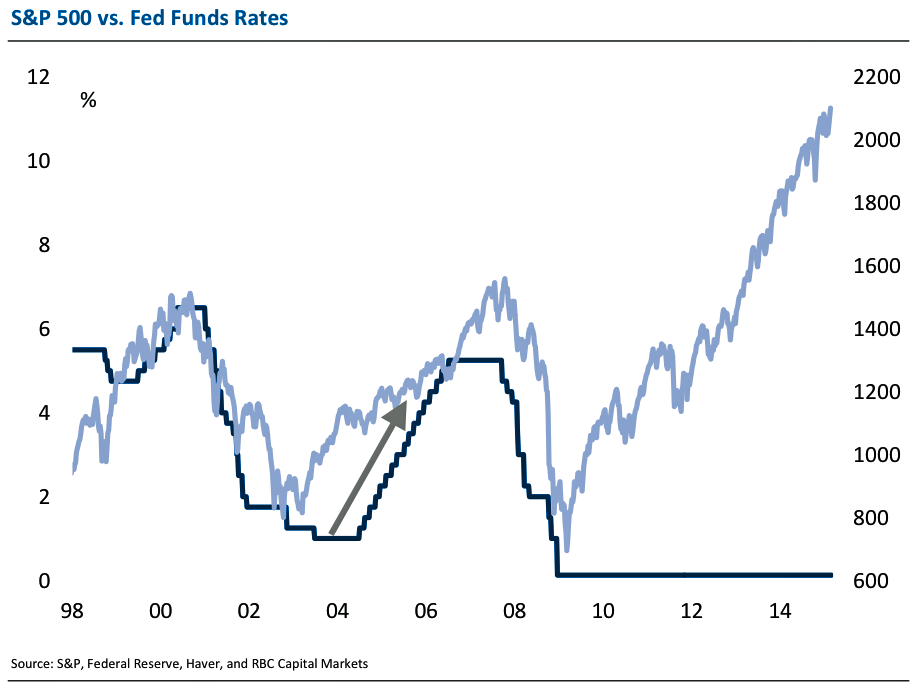
 The Federal Reserve has kept its benchmark interest rate near zero for years in its effort to stimulate job growth and stoke inflation in the post-financial crisis world.
But with job growth looking healthy and some signs that inflation could soon heat up, Fed Chair Janet Yellen and her colleagues have been preparing the markets and its participants for tighter monetary policy via an initial rate hike.
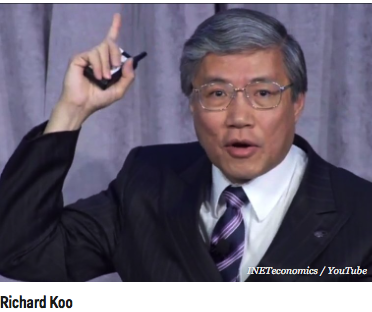
“Given the importance of getting the timing right, the FOMC needs to be absolutely sure that tightening is the right thing to do,” Nomura’s Richard Koo writes. “On this point, three of the members on the rate-setting committee have already argued that the Fed should tighten, while Chair Yellen and the rest of the members believe the start of this long 375bp journey is similar to a rocket launch in that all conditions need to be favorable.”
Koo thinks that it’s noteworthy the way Fed members are characterizing.
 RBCCM
RBCCM
“Interestingly, these people are referring to the first rate hike as “lift-off,” which is the term used to describe the moment the rocket leaves its launching pad,” Koo wrote. “This is an indication of how careful the Fed will have to be when pushing the button on a rate increase.”
Koo argues it’s important that this path to monetary policy normalization be steady as she goes, or we could see trouble.
“Once the Fed begins its mechanical tightening process, stopping before the goal is reached could upset the markets,” he wrote.
Currently, most economists believe the first rate hike will come June of this year. But there are plenty of economists who would argue that the Fed should put this first move off until later this year or even early 2016.
….more from BusinessInsider:

 I’m now in the 1,300-year-old Tibetan Town, in Dukezong in Yunnan province, southwest China. A mix of mostly Tibetan Buddhists and Muslims, the area, with its dramatic scenery inspired the fictional paradise of Shangri-La described in the 1933 novel “Lost Horizon” by British author James Hilton.
To say the surroundings of mountains, streams, sheep, yack, Tibetan Monks and Imams is a sight to behold is an understatement. I have never seen such peaceful surroundings and beauty!
Tibetan Town is also along the old Silk Road. A trading route that will also be modernized by the build out of China’s Silk Road 2.0, the 21st century version of a trading network that will open Western China  and trade to Europe, to Middle Asia, to Southeast Asia and even all the way to Germany on the Western portion of the route.
In a few weeks, I’ll tell you all about it, including a travelogue I’ll put together. Not to mention how you can get set to profit from the build out of Western China and Silk Road 2.0.
But right now, let me turn your attention to the markets. More specifically, DEFLATION. It’s here, with a vengeance.
The massive losses last week in nearly all commodity markets are beginning to take their toll with devastating blows in everything from precious metals and energy, to foods, soft commodities such as coffee, cocoa and sugar, and more, including slumping meat prices.
What’s causing it all? Some think it’s the soaring dollar. And in part, it is strength in the dollar that is causing import prices to decline. But it’s much more than that. It’s what the strength in the dollar signals, for the dollar itself is rising due to …
 First, the absolute total mess that Europe is in. I have been warning about this for some time now, and Europe’s meltdown is now in process. The euro currency has plummeted more than 25 percent in the past few months, a shocking collapse.
The euro may bounce in the short-term, but its decline is far from over. The euro, currently trading at roughly 1.0540 to the dollar, will ultimately fall to 0.80 to the dollar, then cease to exist.
Second, European leaders’ insane policies of austerity measures and piling on more debt at the same time. It’s crushing the economies of Greece, Spain, Portugal and more, where debt to GDP ratios are rising, strangling growth, causing unemployment to remain high, and the youth to start to rebel.
Savvy Europeans, anyone with half a brain, is moving money out of Europe and into the dollar.
Third, U.S. leaders aren’t all that much better. Still up against an $18 trillion Federal debt limit, hunting down every penny of wealth Washington can get its hands on domestically and overseas, killing our tech leading spot in the world with its planting of spying devices on hard drives and computers, spying on each and every one of us …
Is all leading to a risk-off, hoarding money type of effect, causing the velocity or turnover of money and credit to slump — outright deflationary.
Bottom line: There will be more deflation ahead. Much more. For Europe, for Japan, and for the U.S.
Keep your eye on gold. It has now tested support at the $1,140 level. A bounce is overdue, but once gold closes below $1,140, DEFLATION will accelerate even more, leading to another round of crushing blows in all commodities.
And don’t let anyone fool you about the price of oil. It too has not yet bottomed. Before deflation comes to a head, oil will be trading near the low $30 level.
If you own the inverse ETFs on gold and silver, recommended Oct. 15 and the bullish ETF on the dollar, recommended Oct. 29, HOLD!
They’ve racked up gains of as much as 10.9 percent (GLL), 10.9 percent (DZZ),13.5 percent (ZSL) and 15.9 percent (UUP), respectively.
Best wishes, as always …
Larry
P.S. I’m so concerned about the massive new threats to your income, savings, investments and retirement that I am ready, willing and able to give you everything you need to help protect and multiply your wealth in 2015 — absolutely FREE.

 Commentary & Analysis
Yellen wolf? And betting on Bligh?
I read an interesting article on Bloomberg.com concerning the performance at PIMCO now that Bill “Captain Bligh” Gross has left the ship. According to the author, the new team now at the wheel has outperformed their old leader by concentrating its bets on the middle of the yield curve, under the expectation the Fed will indeed do the dirty deed—hike rates in June. But the old captain, now at the helm at Janus (not yet rearranging the deck chairs), has positioned into longer term maturities expecting the Fed to stand pat for longer than now expected…
Please click here to view the issue
——-
Free Three-Week Trial to Black Swan Capital currency services:

We’ve maintained our bullish US Dollar bets with CAD short positions (we “coulda/shoulda” been more aggressive given the US Dollar upside breakout) and we’ve maintained our bearish bets on WTI Crude. Three weeks ago we took an initial short position in US stocks.
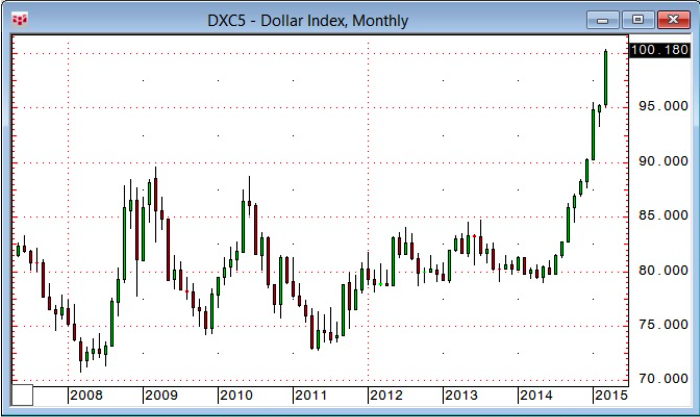
The US Dollar Index has surged higher the past 3 weeks…up 25% since July 2014 at fresh 12 year highs. It has recovered about half of what it lost during its 2002 to 2008 bear market…we think it has a lot more upside…
…..continue reading commentary & view 5 more charts HERE


In This Week’s Issue:
In This Week’s Issue:
– Stockscores Free Webinar – Trading Styles
– Stockscores’ Market Minutes Video – Raise Your Standards
– Stockscores Trader Training – The Economics of Trading
– Stock Features of the Week – Small Cap Revival
Stockscores Market Minutes Video – Raise Your Standards
The fear of missing out causes over trading. Raise your standards, trade less and make more. That plus my complete analysis of the markets with thoughts on equities, the US Dollar, Gold, Oil and Fear.Click here to watch
Trader Training – The Economics of Trading
I am often asked, “How much money can you make day trading the stock market?” I understand why people ask the question but it is a question that is hard to answer because there are so many variables. It is like asking, “How much money can you make playing hockey?” For some, it is millions, for others, it only costs them money.
Of course, trading skill is the most important factor. Trading is not complicated, in fact, it is the simple things that work the best. This is not to say that trading is easy; it is actually quite hard but not because it is intellectually demanding. It is just hard for most people to disconnect themselves from their emotional attachment to money.
The rules for most of my trading strategies could be written down on the back of a napkin – they are simple. Executing them properly takes practice and emotional control. For some, that is not too hard. For others, it can be close to impossible.
You do not have to be exceptionally smart to be a good stock trader; I think most people are smart enough. It does take more determination and hard work than a lot of people are willing to invest but the great thing about both of those things is that neither is exclusive. No matter what your age, gender, looks, intelligence, nationality or social status, hard work and determination are achievable.
Before I go in to the economics of trading, let me first explain a few important concepts. The first is risk, the difference between the price you buy a stock and the stop loss point. If you buy a stock at $20 and have a stop loss at $19, you are risking $1 a share.
The reward is the difference between the entry price and the profitable exit price, assuming you are not stopped out with a loss. That stock you bought at $20 has a reward of $5 if you sell it at $25.
The reward for risk is the reward divided by the risk. In this example, the reward for risk is 5 since the profit was $5 for a risk of $1. How much you actually make depends on what your risk tolerance is.
If you are willing to lose $500 on a trade then you would have bought 500 shares in this example. $500 of risk tolerance divided by $1 of risk demands you buy 500 shares. With an exit at $25, you earn $2500 or five times your risk.
How much money did it take to make the $2500? 500 shares of a $20 stock costs you $10,000, assuming you only use your capital. If you use leverage, which most brokerages will give you at 2 to 1 and some brokers will give you at 3 to 1, you lower the capital requirement. With 2 to 1 leverage, you need $5000 to make the $2500 profit. With 3 to 1, you only need $3333. With more leverage, the percentage return goes up but so too does the potential percentage loss.
Now, what can you expect to make in terms of reward for risk? This is where there are variables outside your control that have a big effect on performance. If the market is hot, it is much easier to find winning stocks and the size of those winners will be greater than if the stock is dead. No matter how hard you work or how skilled you are as a trader, you cannot control how many opportunities the stock market is going to give you.
As a general guideline, I think that a skilled trader in a reasonable market can earn an average of 10 times risk in a week. So, if you risk $500 on each trade, you should be able to make $5000. I want to stress, however, that your skill and the state of the market are two very important variables in this calculation.
The final question is how much capital do you need to risk $500 on each trade? Again, the state of the market is an important part of this equation. There are times when the hot sector of the market is the low priced stocks. The size of your position in these stocks tends to be smaller because these stocks are more volatile. You may be able to take $500 or risk with a $5000 position (which with leverage may require less than $2000 of your capital).
In a market where the large cap stocks are the hot area you could need 10 times as much capital to achieve the same amount of risk.
As a general rule, take your risk tolerance and multiply it by 100 to get the required capital, before leverage. So, if you risk $500 you will need $50,000 of capital to take the trades that come to you. If the stocks you trade are smaller, more volatile names, that amount could be a lot less.
Above all else, none of this works if you are a person who approaches the market with a gamblers mentality. Losses are part of trading and you have to be prepared to take the small loss when the market leads you astray. When you get a winner you have to be willing to let the profit run so that the winners can pay for the losers and still leave you some overall profit.

Over the past couple of weeks, the Russell 2000 Small Cap index has outperformed the S&P 500 index of large cap stocks. Although price does not define a company’s market cap, generally lower priced stocks have smaller valuations. This week, I ran the Stockscores Simple Market Scan on the US and Canadian markets but with an upper price threshold of $15. I then inspected the charts in search of stocks showing breaks from positive chart patterns, here are two that I like:

1. SIGM
SIGM is breaking out from a cup and handle pattern with good volume support to three year highs. Support at $7.20.

2. MTG
MTG has been stuck under resistance at $9.50 for over a year but today broke through that threshold and looks like it could be in the early stage of an upward trend. Support at $9.15.

Stockscores Free Webinar – Trading Styles
There are many ways to trade the market, the choice you make depends on your time, capital, personality and skill. This webinar will consider the different choices, demonstrate the process for each and answer your questions on whether you should be a long term investor, a short term active trader or something in the middle.
References
- Get the Stockscore on any of over 20,000 North American stocks.
- Background on the theories used by Stockscores.
- Strategies that can help you find new opportunities.
- Scan the market using extensive filter criteria.
- Build a portfolio of stocks and view a slide show of their charts.
- See which sectors are leading the market, and their components.
Disclaimer
This is not an investment advisory, and should not be used to make investment decisions. Information in Stockscores Perspectives is often opinionated and should be considered for information purposes only. No stock exchange anywhere has approved or disapproved of the information contained herein. There is no express or implied solicitation to buy or sell securities. The writers and editors of Perspectives may have positions in the stocks discussed above and may trade in the stocks mentioned. Don’t consider buying or selling any stock without conducting your own due diligenc

-
I know Mike is a very solid investor and respect his opinions very much. So if he says pay attention to this or that - I will.
~ Dale G.
-
I've started managing my own investments so view Michael's site as a one-stop shop from which to get information and perspectives.
~ Dave E.
-
Michael offers easy reading, honest, common sense information that anyone can use in a practical manner.
~ der_al.
-
A sane voice in a scrambled investment world.
~ Ed R.
Inside Edge Pro Contributors

Greg Weldon

Josef Schachter

Tyler Bollhorn

Ryan Irvine

Paul Beattie

Martin Straith

Patrick Ceresna

Mark Leibovit

James Thorne

Victor Adair