
Stocks & Equities
 In her speech from Providence, Rhode Island this Friday, Federal Reserve Chair Janet Yellen said the central bank is on track to raise interest rates this year but will likely proceed cautiously because the job market hasn’t fully healed, inflation is low and growth has again disappointed.
U.S. job growth did rebound in May and the unemployment rate dropped to a near seven-year low of 5.4 percent, suggesting modest but continued positive underlying strength in the economy at the start of the second quarter and helping to keep alive prospects for a Federal Reserve rate hike later this year.
Nonfarm payrolls increased 223,000 as gains in services sector and construction jobs offset weakness in mining, the Labor Department said on Friday. The one-tenth of a percentage point decline in the unemployment rate to its lowest level since May 2008 came even as more people piled into the labor market. However, wage growth was tepid and March payrolls were revised downward.
The Fed expects economic growth to pick up in the months ahead. Her speech came a few hours after the Labor Department reported signs inflation is stabilizing, which should give the central bank more confidence about the economy’s strength.
With many suggesting the market strength of late has been driven by the ultra low rate environment, the more real the prospect for a hike becomes the better a chance the party could be over. But how real is the prospect of a hike in 2015? Or more importantly, in the grand scheme of the markets, how truly impactful would a quarter point increase be?
From a fundamental perspective, a quarter point hike really should have little impact on the markets. However, from a market psychology perspective, it could signal a shift from easing and a hold at ultra low levels to a tightening bias. This may actually be a good thing for the health of the markets in general as it can serve to keep the “froth” in check.
Fed officials have held the rate near zero for more than six years in a financial experiment that investors were originally told would be short-term and temporary in nature. Six years and counting is by no means short term. Now, the Fed sees the rate someday getting to 3.75% or what it considers to be normal in the long run. Their March forecasts showed that even at the end of 2017, they expected the rate to still be below that level.
In fact, on Friday, Yellen stated it could be “several years” before the Fed’s benchmark short-term rate is back to that range. Some believe several years could stretch into a decade. Again, given the unprecedented nature of the financial experiment the North American economy is currently participating in, even the most educated on these matters would just be guessing to provide any realistic timeframe or the eventual outcome.
In the U.S., the consumer-price index rose for the third consecutive month in April, reversing a three-month slide largely associated with falling energy prices. Consumer prices were still lower than they were a year ago after the earlier declines, but underlying inflation outside of the volatile food and energy sectors has stabilized. That could be a sign that broader consumer-price declines have run their course and that the economy, even after a weak first quarter, is not in a deepening slump.
U.S. consumers are spending, but more selectively, which in our minds is not a bad thing. Sectors such as the auto, restaurant and home have been the benefactors. We have seen shares in our top Small-Cap auto-parts manufacturer benefit greatly from this trend over the past 3 years and continue to see strength for the next 12-18 months.


|
Concern about Canadian household debt levels overblown when assets, other measures taken into account |
|
Fraser Institute ranks academic performance of 289 B.C. secondary schools, spotlights the province’s top schools boards |
|
Screening foreign acquisitions may discourage Canadian entrepreneurship, economic growth |
| Books |
|
What America’s Decline in Economic Freedom Means for Entrepreneurship and Prosperity |
| Commentaries |
|
The provinces are lousy at controlling spending (Calgary Herald, May 16) by Mark Milke |
|
National drug plan for Canada? Look before you leap! (Windsor Star, May 15) by Bacchus Barua |
|
Safer rail transport still can’t compete with pipeline safety (National Post, May 14) by Kenneth P. Green and Taylor Jackson |
|
Why do we have more firefighters fighting fewer fires? (Vancouver Province, May 11) by Charles Lammam and Milagros Palacios |
|
Which path will Alberta’s NDP government take? (Calgary Herald, May 8) by Charles Lammam and Jason Clemens |
| Videos and infographics |
| Video – What America’s Decline in Economic Freedom Means for Entrepreneurship and Prosperity. America’s decline in economic freedom is eroding entrepreneurship. |
| Perspective on Canada’s Household Debt This infographic shows stories about household debt levels are incomplete when assets aren’t accounted for. |
| News and upcoming events |
|
• Join us this fall as we honour a number of great Canadians with the Fraser Institute Founders’ Award. This year’s honourees are Keith and Ryan Beedie (Vancouver – September 24th), Jack Cockwell (Toronto, October 15th), Fred and Ron Mannix(Calgary, October 29th), Emanuele “Lino” and Lino A. Saputo, Jr. (Montreal, November 5th). For more information or to purchase tickets please contactevents@fraserinstitute.org or call 1-800-665-3558, ext. 529. |


Weakness In Transports In 2015
If you follow the markets, you have probably heard about the “non-confirmation” warning being flashed by the fact the Dow Transportation Average has failed to post a new high simultaneously with the Dow Jones Industrial Average.
Dow Theory Is Useful
We have written about Dow Theory many times in the past; a July 2014 article explains the economic rationale behind the theory. We believe Dow Theory is useful, but it is one of many sources of information.
Is It A Showstopper?
We will answer the question above with a few historical charts. Charts allow us to reference facts rather than
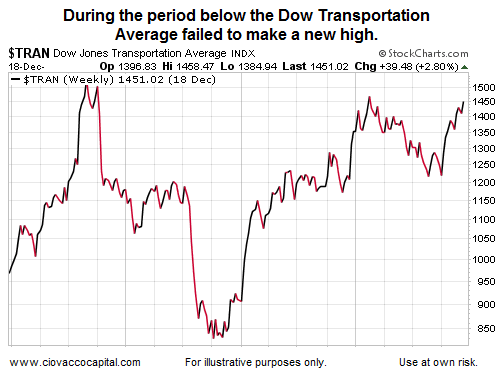
human bias or emotions. If I showed you the chart below, it would represent a “non-confirmation” period since the Dow Transportation Average has failed to push to a new high. We have removed the dates from the chart below to minimize historical bias.
How Did The S&P 500 Do Over The Same Period?
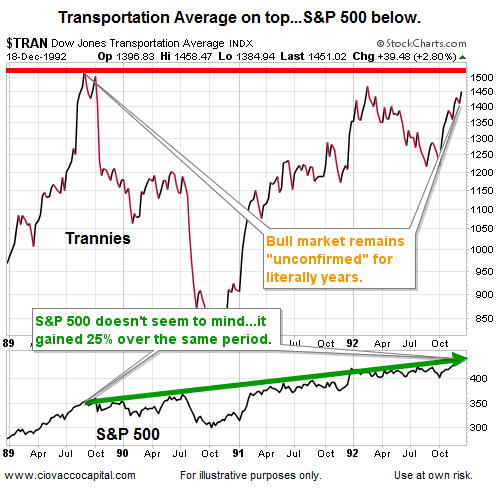
The chart below shows the exact same period as the Transportation chart above. Did a new bear market start during the period of non-confirmation? Would it have made sense to sell all our stocks because the Dow Transports failed to make a new high? Answers: No and No. In fact, the non-confirmation was not particularly insightful or helpful at all since the S&P 500 gained 25% over the same period.

Bringing The Charts Together
The chart below allows you to see both indexes together. Dow Theory is relevant, but the fact that the Transports have not made a new high in 2015, taken in isolation, is not a reason to sprint for the equity exits.
You Can Always Find Bearish Data
If you are bearish, you can always find a chart that supports your personal outlook. The same can be said for the bullish side of the ledger. It is prudent to look at any information (bullish or bearish) in the context of a broader array of useful inputs. Our concerns about the Transports in 2015 would be greater if more inputs were singing off the same hymnal. That may happen, but we need to see that data, rather than anticipate it.
Some Other Takes On Trannies
This is a hot topic on Wall Street. You may want to see what others have been saying:
- Dow Theory signaling market doom? Nah
- Dow Divergences Part 1: Transports
- Why Dow Theory isn’t a red flag for the market
The Weight Of The Evidence Takes Precedence
We can learn something about the market and economy via the recent weakness in the Transportation Average, but it is not prudent to make decisions in any field based on one input viewed in isolation. The links below allow you to look at the 2015 stock market through a broader lens:
- 2015 And Historical Bear Market Triggers
- Is The Smart Money Running For Cover?
- Stock Correction Odds Increasing?


 ….as its chief economist Stephen King warns global economy on the cusp of a major collapse.
It’s no longer the lunatic fringe of forecasters who are warning about a coming apocalypse for the global economy. Perhaps it is time to sit up and pay attention rather than wait to be overcome by doom and gloom.
HSBC’s Chief Economist calls explains why the world could be on the cusp of a major collapse. Not surprisingly perhaps the bank has finally joined the gold bulls…

-
I know Mike is a very solid investor and respect his opinions very much. So if he says pay attention to this or that - I will.
~ Dale G.
-
I've started managing my own investments so view Michael's site as a one-stop shop from which to get information and perspectives.
~ Dave E.
-
Michael offers easy reading, honest, common sense information that anyone can use in a practical manner.
~ der_al.
-
A sane voice in a scrambled investment world.
~ Ed R.
Inside Edge Pro Contributors

Greg Weldon

Josef Schachter

Tyler Bollhorn

Ryan Irvine

Paul Beattie

Martin Straith

Patrick Ceresna

Mark Leibovit

James Thorne

Victor Adair