
Personal Finance
“If this were a marriage, the lawyers would be circling.”
The Economist, My Big Fat Greek Divorce, 6/20/2015
If you’re like me, you are suffering terminal Greece fatigue. You just want Greece and its creditors to “do something already” rather than continually coming to the end of every week with no resolution, amid finger-pointing and dire warnings from all sides about the End of All Things Europe – maybe even the world.
That frustration is a common human emotion. Perhaps the best and funniest illustration (trust me, it is worth a few minutes’ digression) is the story about one of my first investment mentors, Gary North, who was working in his early days for Howard Ruff in Howard’s phone call center before Gary began writing his newsletters and books. (Yes, I know I am dating myself, as this was the late ’70s and early ’80s, just as I was getting introduced to the investment publishing business. And for the record, I knew almost everyone in the publishing business in the ’80s. It was a very small group, and we got together regularly.)
Howard set up a phone bank where his subscribers could call in and ask questions about their investments and personal lives. One little lady had the misfortune to get Dr. Gary North on the line. (Gary was the economist for Congressman Ron Paul and went on to write it some 61-odd books, 13,000 articles, and more – all typed with one finger. He is a human word-processing machine.)
This sweet lady lived way out in the country and was getting older. She asked Gary if he thought it would be a wise idea for her to move into the city (I believe it was San Francisco) to live with her daughter. Not knowing the answer, Gary helped her work out the pros and cons over the phone, and she decided to move. A few days later she called back and said that she couldn’t bring her dog with her because of the rules at her daughter’s apartment. It turns out she couldn’t live without her dog, so Gary helped her come to the conclusion that she could stay in the country.
A few days later she called him back asking whether she should change her mind, and Gary once again help her to come to a conclusion. This went on for several weeks, back and forth, move or not move, dog or no dog. Finally she called one last time. Gary, in utter exasperation and not being infinitely tolerant of indecisive people, said, “Look lady, just shoot the dog and sell the farm.” (For the record, I hope she didn’t really shoot the dog. I like dogs.)
That is where most of us are with the Europeans and Greeks. I have devoted a great deal of space in this letter to Greece over the past five years and have visited the country and corresponded with many analysts and citizens about the situation. And while I want to briefly outline the Greek situation again today, as there are some subtle nuances to consider, I think this juncture is a teaching moment about the larger picture in Europe. In fact, watching this process, I have come to change my mind about the timing of what I see is the endgame for Europe and European sovereign debt. I think exploring that issue will make for an interesting letter.
Economic crises go through cycles. Here’s a chart from the clever folks at Valuewalk.com (via my friend Jonathan Tepper on Twitter).

https://twitter.com/valuewalk/status/612948290267688960
The Greek situation is presently caught in those two bubbles on the bottom. European leaders held summit meetings this week to consider new breakthrough concessions offered by Greek Prime Minister Alexis Tsipras. Let the champagne flow. Except those concessions were rejected, and the Greeks rejected the counteroffer as of this afternoon. But it’s not quite midnight yet.
Unfortunately, the wheel of debt never stops turning. If this solution is like countless others floated in the last five years, we will soon learn that it has no substance or simply won’t work. We will then reenter the crisis phase.
Every cycle breaks eventually. If you forget everything that’s happened to this point and re-imagine the crisis as an economic standoff between Greece and Germany, you have to say Germany will win. It outweighs tiny Greece in every possible category. The real question is why Germany let the fight go on this long. We will deal with that in a minute.
Note that this observation isn’t about which country should win; it is about who will win. Greece has some legitimate grievances. Unfortunately, these grievances aren’t going to matter in the end.
Poster Children for European Profligacy
My friend David Zervos of Jefferies & Co. has no doubt who will win. He sent me this note on June 17.
The bell is tolling for Alexis [Tsipras]. European leaders from all sides have abandoned him as he burns through every last bridge that was once in place. His only meeting of importance during this crucial week of negotiation is with Putin – which clearly does not inspire any confidence for a near-term resolution.
It is actually amazing that we have not seen any of the left-leaning party leaders from the rest of Europe running to Tsipras’ side as he truculently engages his paymasters. Where are all these European anti-austarians? Of course they are hiding from the Germans, hoping not to receive the same fate as Alexis. So there he sits, alone and under his last Soviet-held bridge, just like Hemingway’s Robert Jordan. He is waiting to cause just a little more damage before his time is up.
In the end, there is no question that the Germans have executed a near flawless plan to humiliate and vilify Greece. The Greeks now stand as poster children for European profligacy. And they are being paraded through every town square in the EU, in shackles, as the bell tolls near the gallows for their leader. And to be sure, making an example of Greece is a probably the greatest achievement for the fiscal disciplinarians of Europe. Maastricht never had any teeth. But this exercise is impressive. It shows that fiscal excess will be squashed in Europe. The Portuguese, Spanish, and Italians are surely taking notice. And in the days that lead up to a Greek default on 30 June, and then more importantly on 20 July, these disciplinarians will surely display their power for all to see.
Oddly enough, I actually think this has been the German plan all along. With no real way to ensure fiscal discipline through the treaty, they resorted to killing one of their own in order to keep the masses in line. It explains why Merkel took out Samaras when she knew a more hostile government would surely emerge in Greece. This was masterful political manipulation.
The 1992 Maastrict Treaty created the European Union and led a few years later to the euro currency. Which I said at the time would be a disaster. And it has been. Leaders have been wrestling with its fundamental flaw almost from the beginning. The EU has no way to enforce fiscal standards on its member nations. The member nations likewise have no way to devalue the currency in their own favor. This can’t go on forever – and it won’t.
Germany, by virtue of its sheer size and its favored position in the bureaucratic scheme of things, grew wealthy partly by exporting to the European periphery: Greece, Italy, Spain, Portugal, and Ireland. (The rest of their 40–50% of exports of GDP come from exporting to the rest of Europe and the world. They have benefited massively from a currency that has been and continues to be weaker than it would be if it were just a German currency.)
The peripheral countries essentially exported all their cash to Germany (and to some extent northern Europe) in exchange for German goods. When they ran out of cash, not just because of their purchase of export goods but because of the uncompetitive nature of their bureaucratic and labor systems and the rather large unfunded government expenditures, they wanted yet more cash to continue to spend on government services. Germany and the rest of Europe offered vendor financing. German and the rest of European banks loaned money to Greeks so the Greeks could buy German goods and perpetuate their government spending habits. In the early part of the last decade, tt was a deal that was seemingly made in heaven as Greece got to borrow money at German rates and Germany got to sell products in a currency driven by the valuation of the peripheral countries.
This arrangement left Greece and the other PIIGS deep in debt. Much like the American homeowners who lived beyond their means, Greece found itself overleveraged and undercapitalized. And here we are.
To continue reading this article from Thoughts from the Frontline – a free weekly publication by John Mauldin, renowned financial expert, best-selling author, and Chairman of Mauldin Economics – please click here.

What was predicted for China has started to happen with the dramatic failure of its parabolic uptrend just over a week ago leading to a plunge. The update China Crash was posted when all indicators were at “nosebleed” levels late in April, right after which the third steepest fanline shown on our 1-year chart for the Shanghai Composite Index below was breached. Somewhat amazingly, that overbought peak late in April was not the final top – it rose even higher into early-mid June, but after that, just over a week ago, it finally broke below the parabola and started to cave in.
While low grade Chinese speculators who are leveraged to the hilt and up to their eyeballs in margin debt may have been unnerved by what has just transpired and are probably starting to break out in a sweat, it is considered unlikely that they appreciate the full gravity of the situation – many of them think that this is just a correction, albeit a larger fiercer one. So they are likely to buy this dip, some of them appreciative of the opportunity to get more stock at better prices. They have no idea what is really going on, but we do.

Here is what is going on – the market has just dropped back from the peak of the Head of a Head-and-Shoulders top shown on our chart
and if this interpretation is correct it should now rally from the vicinity of the low of the Left Shoulder trough of the pattern, that occurred early in May, where there is support. The expected Right Shoulder, projected to form as shown on the chart in red, will be the final trap. Once it descends from the peak of the expected Right Shoulder, after a little hesitation at support at the “neckline” of the pattern, where we might see a minor bounce, it should breach this support and then crash – not drop – crash – because the low grade highly leveraged speculators who currently populate this market will be forced to flee in panic.
Recent action is shown in more detail on the 6-month chart below with expected pattern development shown in red…

Action in the Chinese action has some implications for other Western markets, since a crash in the Chinese market is likely to have a knock-on effect on bloated markets elsewhere. If the Head-and-Shoulders top in the Chinese market completes in a symmetrical manner, then we have about 3 weeks until neckline failure and a crash, and, perhaps, 3 weeks to prepare for Western markets to follow suit.
End of update.

Greece intends to default tomorrow. Ryan Irvine notes that “the last time the market ran for cover in the face of Greek default was actually an excellent time to buy some quality companies. Ryan suggest 5 quality companies below – Money Talks Ed.
 Greece Back in the Spotlight as Debt Default Looms Once Again
by Ryan Irvine
For being a relatively small country (population of less than 11 million), Greece has taken its share of the spotlight in the global financial crisis. In Europe, it has been at the epicenter. News centers were firmly focused on the struggling nation back in 2010 and 2011 when the European Union (EU) and International Monetary Fund (IMF) negotiated two separate bailout packages for a total value of €240 billion. Since then, news of Greece’s financial woes has (at least in North American) fallen somewhat into the background…until now.
For anybody wondering why the TSX Composite index is down more than 300 points today (with similar declines throughout North America and globally), look no further than Greece’s return to the foreground. The country is expected to default on a €1.55 billion (about US$1.73 billion) loan to the IMF on Tuesday. Missing this payment to the IMF means that Greece will technically lose access to the flow of bailout money it has been receiving. If the situation is left unresolved then much larger defaults will occur from Greece later in July.
To provide a short history lesson on the subject…Greece is a member of the European Union (EU) and adopted the Euro in 2001. In October 2009, one year after the global financial crash, the Greek government fessed up that it had artificially understated its budget deficit in order to meet EU standards for adoption of the Euro. What was once officially quoted as a budget deficit of 6% of gross domestic product (GDP) was restated several times over the following year to over 15%.
How did this happen? New and complex financial products allowed the country (this was of course not limited to Greece) to increase indebtedness without technically having to report new debt. This reminds me of Warren Buffett’s quote, “everyone floats when the tide is in, but when the tide goes out you see who has been swimming naked.” It was easy for the world to play financial alchemy when the economy appears to be on solid footing and investors are bliss but it is when the outlook dims and investors want to access their capital that financial melting pots start to explode. As was the case with Greece and much of rest of the world.
At the time, Greece was so firmly woven in the EU financial system that many feared a full debt default would be catastrophic for Europe and would send ripple effects throughout the global economy. The result was that the EU and IMF agreed to bail Greece out…but this came with a price…AUSTERITY. Greece had to agree to pull itself up by its financial bootstraps, reining in government spending, clawing back social programs, and cracking down on what was some of the most rampant tax evasion known to the Western world.
The concept of “financial austerity” is extremely sound. You can’t (or shouldn’t) spend more money than you have. This is what Greece was doing. Of course, this is what essentially the entire Western world has been and continues to do. But in the case of Greece, the gap was much wider than average. The problem now is that the cut backs in spending mean that Greece’s economy is stuck in a rut with over 25% official unemployment. This is a depression, not a recession and it makes things difficult for a country that wants to get back into the “black.”
Tough times in Greece have led to a disenfranchised population, many of whom believe that the rest of the EU, particularly Germany, are actually benefitting from the misfortunes of their country. This led recently to the election of a left wing government on the promise that it would end austerity measures. A referendum on the subject is currently scheduled for July 5thwhereby the Greek people will accept or reject the terms of the country’s creditors. If Greece does not come to an arrangement with the rest of the EU and the IMF then all bailout money will cease to flow and Greece will default on its scheduled debt payments.
What this means for investors around the world is debatable. If Greece doesn’t eventually come to terms with its creditors then it is hard to imagine a scenario whereby they stay in the EU and continue to use the Euro. The general consensus is that the global impact of this would not be as extreme as it would have been a few years ago given that Europe has had more time to prepare for the ramifications. The US economy also appears to be on much better footing which should provide some extra support for the global economy.
We would certainly expect to see a stiff short-term kick to global financial markets if the situation deteriorates. However, we will also note that the last time the market ran for cover in the face of Greek default was actually an excellent time to buy some quality companies that were “thrown out with the bathwater.” In the short term, these kinds of events tend to result in waves of fear that impact companies which are not directly affected by the underlying issue. Such events should be considered opportunities. Recent history has demonstrated that it is the investors that made “knee jerk” and emotional reactions to these events that lost money. While the investors that haven taken a calm, rational, and long-term approach to the matter are the ones to have benefited.
KeyStone’s Latest Reports Section
5/29/2015
UNDERVALUED SPECIALTY PHARMA MAKES SOLID PRODUCT ACQUISITIONS, MORE-TO-FOLLOW? – MAINTAIN BUY
Greece has chosen the path to default!
Specifically, Greek officials called for a nationwide referendum on July 5 over the European bailout program rather than reach a direct agreement with creditors over the weekend.
Next, Greece itself said it will skip a 1.7 billion euro debt payment due tomorrow to the International Monetary Fund (IMF). That, in turn, is a default in everything but technical name only. It also means Greece’s current bailout program will expire with nothing to replace it.
The European Central Bank (ECB) responded to the referendum news by refusing to hike its emergency aid to the Greek banking system, currently around 89 billion euros after several recent increases. Since those funds were the only thing keeping Greek banks alive, the Greek government was forced to shut down all the nation’s banks through at least July 6.
Greek citizens can still take money out of an ATM, but only 60 euros per day. The Greek stock market was also shut.
Those moves temporarily halt the worst of the financial bleeding in Greece. But they also open up a whole host of other questions.
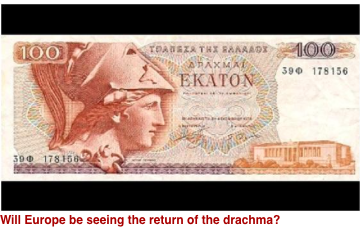 The most pressing one for depositors: What the heck will they get back the next time a teller window is open to them? Euros? New drachmas? IOUs? And the bigger question for investors around the world is: “Does this mean Greece is going to get kicked out of the euro currency union?
If Greek citizens vote “No” to Europe’s last and best offer on the table this coming Sunday, I believe Greece will get kicked out. If they vote “Yes,” there’s always a possibility the country hangs on by its fingernails for a while.
But without permanent debt relief that acknowledges it can never pay back all its bonds at face value, Greece might be forced to abandon the euro and introduce its own currency anyway. It sure seems like Germany, France, and other European nations – which hold all the financial cards here — are fed up and ready to cut the country loose.
Greek Prime Minister Alexis Tsipras tried to put a brave face on the situation. He tried to rally his political base behind a “No” vote, couching it in terms like this: “The dignity of the Greek people in the face of blackmail and injustice will send a message of hope and pride to all of Europe.”
But the initial reaction in global markets was swift and severe. Asian markets tanked, while stock markets around Europe plunged as much as 5%.
Bonds issued by peripheral European countries fell in value, while the euro currency dropped below 1.10 against the dollar, before bouncing a bit. Anyone unlucky or unwise enough to own the handful of direct Greek investments that trade here in the U.S., such as the Global X FTSE Greece 20 ETF (GREK) or National Bank of Greece (NBG), lost even more of their money. NBG plunged 24%, while GREK lost 20%.
Now, we’ll see where the rubber meets the road. I laid out my three possible scenarios for what would happen in Greece, and how that would impact investors like you, two weeks ago.
We clearly did not get Scenario #2 (a last-minute can kick deal). That leaves Scenario #1 (a quick and painful, but ultimately healthy move) and Scenario #3 (a long, drawn-out disaster scenario).
I suggested #1 was the most likely all along. But the truth is, the markets are going to determine the ultimate answer. My three “tells” to see which is getting the upper hand? The euro currency, the European bond market, and U.S. financial stocks.
 If the euro tanks and other peripheral European bond markets start following Greece’s into the abyss, that would be a huge red flag. And if U.S. financial stocks start plunging, that would be a sign that contagion fears were spreading beyond Greece’s (and Europe’s) borders.
So far, there’s pressure on all of them — with the Dow dropping by around 350 points today … but none of the out-of-control panic we saw during the credit crisis days back in 2007-09. That could easily change, though, and you can bet I’m watching closely. So stay tuned for more recommendations and commentaries about what to do next – right here at Money and Markets and in your other subscription services.

Briefly: In our opinion, speculative short positions are favored (with stop-loss at 2,140, and profit target at 1,980, S&P 500 index)
Our intraday outlook is bearish, and our short-term outlook is bearish:
Intraday outlook (next 24 hours): bearish
Short-term outlook (next 1-2 weeks): bearish
Medium-term outlook (next 1-3 months): neutral
Long-term outlook (next year): bullish
The main U.S. stock market indexes were mixed between -0.7% and +0.3% on Friday, as investors remained uncertain ahead of news concerning Greece debt crisis. The S&P 500 index trades within a short-term downtrend. The nearest important level of resistance is at around 2,115, marked by local highs. On the other hand, support level is at 2,070-2,080, among others. There have been no confirmed negative signals so far. However, we can see negative technical divergences:

Expectations before the opening of today’s trading session are negative, with index futures currently down 1.0-1.3%. The European stock market indexes have lost 1.6-3.5% so far. Investors will now wait for the Pending Home Sales number release at 10:00 a.m. The S&P 500 futures contract (CFD) is within an intraday uptrend, following gap-down opening. The nearest important level of support is at 2,050-2,060, and resistance level is at 2,080-2,090, marked by Friday’s local lows, as the 15-minute chart shows:

The technology Nasdaq 100 futures contract (CFD) followed a similar path, as it traded as low as 4,400 following weekend news concerning Greece debt crisis. The nearest important support level is at 4,400, and resistance level is at 4,440-4,460, marked by gap-down opening, as we can see on the 15-minute chart:

Concluding, the broad stock market slightly extended its short-term downtrend on Friday and it is bound to continue its decline today. We maintain our speculative short position (2,098.27, S&P 500 index), as we expect a downward correction or an uptrend reversal. Stop-loss is at 2,140, and potential profit target is at 1,980. You can trade S&P 500 index using futures contracts (S&P 500 futures contract – SP, E-mini S&P 500 futures contract – ES) or an ETF like the SPDR S&P 500 ETF – SPY. It is always important to set some exit price level in case some events cause the price to move in the unlikely direction. Having safety measures in place helps limit potential losses while letting the gains grow.
Thank you.


-
I know Mike is a very solid investor and respect his opinions very much. So if he says pay attention to this or that - I will.
~ Dale G.
-
I've started managing my own investments so view Michael's site as a one-stop shop from which to get information and perspectives.
~ Dave E.
-
Michael offers easy reading, honest, common sense information that anyone can use in a practical manner.
~ der_al.
-
A sane voice in a scrambled investment world.
~ Ed R.
Inside Edge Pro Contributors

Greg Weldon

Josef Schachter

Tyler Bollhorn

Ryan Irvine

Paul Beattie

Martin Straith

Patrick Ceresna

Mark Leibovit

James Thorne

Victor Adair