
Stocks & Equities
Briefly: In our opinion, speculative short positions are favored (with stop-loss at 2,140, and profit target at 1,980, S&P 500 index)
Our intraday outlook is bearish, and our short-term outlook is bearish:
Intraday outlook (next 24 hours): bearish
Short-term outlook (next 1-2 weeks): bearish
Medium-term outlook (next 1-3 months): neutral
Long-term outlook (next year): bullish
The main U.S. stock market indexes were mixed between -0.2% and +0.1% on Thursday, extending their short-term fluctuations, as investors hesitated following recent move down. The S&P 500 index remains below the level of 2,100. The nearest important level of support is at around 2,040-2,050, marked by March local lows. On the other hand, resistance level is at 2,090-2,100, among others:

Expectations before the opening of today’s trading session are negative, with index futures currently down 0.5%. The European stock market indexes have lost 0.5-1.2% so far. Investors will now wait for the ISM Service number release at 10:00 a.m. The S&P 500 futures contract (CFD) trades within an intraday uptrend, following lower opening. The nearest important level of support remains at 2,030-2,040, and resistance level is at 2,065-2,070, marked by Friday’s consolidation, as the 15-minute chart shows:

The technology Nasdaq 100 futures contract (CFD) follows a similar path, as it trades along the level of 4,400. The nearest important resistance level is at 4,400-4,420, and support level is at around 4,350, as we can see on the 15-minute chart:

Concluding, the broad stock market continued to fluctuate on Thursday, along its short-term local highs, as investors awaited Greece debt crisis news releases. For now, it looks like a correction within two-week-long downtrend. Therefore, we continue to maintain our already profitable speculative short position (2,098.27, S&P 500 index), as we expect a medium-term downward correction or an uptrend reversal. Stop-loss is at 2,140, and potential profit target is at 1,980. You can trade S&P 500 index using futures contracts (S&P 500 futures contract – SP, E-mini S&P 500 futures contract – ES) or an ETF like the SPDR S&P 500 ETF – SPY. It is always important to set some exit price level in case some events cause the price to move in the unlikely direction. Having safety measures in place helps limit potential losses while letting the gains grow.
Thank you.

Last week began with crosscurrents that made it hard to predict. See On Monday, It’s China Versus Greece.
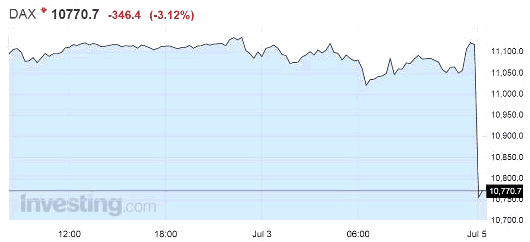
This week is starting with no such ambiguity. The Greeks had their vote and tossed a resounding “NO” at their European creditors. And the markets are not happy:
S&P 500 futures down 1.5% on Greek vote
U.S. stock futures opened sharply lower Sunday night after the Greek people voted resoundingly to reject proposals from their European creditors. S&P 500 futures fell 1.5 percent in early trading after 6 p.m. ET (2200 GMT).
Once the magnitude of the Greek vote became clear, the euro began falling against other major currencies, and European stock futures sank (led by a 4 percent decline for the benchmark German DAX).
Because it’s still early on Sunday, a lot of futures markets have yet to open. But when they do it will be with a bang. So expect, along with plunging European and US stocks, extreme currency swings, lower oil prices and surging equities volatility.
And then comes the real excitement. The Greek vote wasn’t legally binding but it does free the country’s leaders to stand up to its creditors, so expect some big threats to be tossed out on Monday. Here’s a typically evocative headline from Zero Hedge: Greece Contemplates Nuclear Options, May Print Euros, Implement Parellel Currency, Nationalize Banks.
This is a story with legs, of course, but as always it’s important to understand that Greece isn’t the issue. It is to the global financial system what who takes out the trash is to an unhappily married couple: Not the big issue but a perfectly acceptable start to a catastrophic conflict. The real problems are in the quadrillion dollar derivatives market, the debt/GDP trends of five or six major countries, income inequality in the US and elsewhere, and the Chinese shadow banking system. Greece might be where it starts but those other places are where it will end.

 Rule #1 is definitely unique! – MT Ed.
I managed to totally screw things up for myself at the ages of 20, 22, 24, 29, 33, 37, and 40, so I decided to write everything I know about so-called personal finance. The words personal finance are a total scam, but I’ll save that for another time. Let’s just say, this is about how to build wealth and preserve your wealth.
The things you need to know.
The first answer is: nothing. You need to know absolutely nothing about personal finance. Buying a cheap beer versus buying an expensive beer will not help you get rich.
But that seems cynical. So let me say congratulations first. You’re 20 years old! Yay!
I can’t even really remember being 20 years old. I started my first business then. And failed at it. But that’s another story.
When I was 22 I was thrown out of graduate school and then fired from three jobs in a row at higher and higher salaries from which I saved nothing.
When I was 24 I moved to New York City and began the first of about 10 career changes. The first rule of personal finance is that it’s not personal and it’s not financial. It’s about your ability to make 10 changes and not get too depressed over it.
During those career changes I made a lot of money. Then lost a lot. Then made a lot. Then lost a lot. Then made a lot more.
I did this so many times I made a study of what was working for me on the way up. And what wasn’t working on the way down.
So I’m not an expert on anything. I just know WHAT HAS WORKED FOR ME to create massive success. I’m admitting it right now. I’m not just a failure.
First off, don’t bother saving money. You get more money in the bank by making more money. That’s rule No. 1.
(Should you put your money in stocks?… Are we in a bubble?… How about mutual funds?… I answer all of these questions and more in my Ultimate Cheat Sheet for Investing.)
People might think this is flippant. What if they can’t make more money? Well, then, you’re going to run out of money. No personal finance rule will help.
Buying coffee on the street instead of in a Starbucks is the poor man’s way to get rich. In other words, you will never get rich by scratching out 10 cents from your dollar.
People save 10 cents on a coffee and then… overpay $100,000 for a house and then do reconstruction on it.
Or they save 10 cents on a book and then… buy a college degree for $200,000 that they never use.
Now your real education can begin:
A) Don’t save money. Make more. If you think this is not so easy then remember: Whatever direction you are walking in, eventually you get there.
B) That said, don’t spend money on the BIGGEST expenses in life. House and college (and kids and marriage, but, of course, there are exceptions there). Just saving on these two things alone is worth more than a million dollars in your bank account.
C) But doesn’t renting flush money down the toilet? No, it doesn’t. Do the math. You can argue all you want, but the math is very clear as long as you are not lying to yourself.
D) Haven’t studies shown that college graduates make more money 20 years later?
No, studies have not shown that. They show correlation but not causation, and they don’t take into account multi-collinearity (it could be that the children of middle-class families have higher paying jobs later and, oh by the way, these children also go to college).
E) Don’t invest in anything that you can’t directly control every aspect of. In other words… yourself.
In other words:
1. You can’t make or save money from a salary. And salaries have been going down versus inflation for 40 years. So don’t count on a salary. You’re 20; please take this advice alone if you take any advice at all.
2. Investing is a tax on the middle class. There are at least five levels of fees stripped out of your hard-earned cash before your money touches an investment.
F) If you want to make money, you have to learn the following skills. None of these skills are taught in college.
I’m not saying college is awful or about money, etc. I’m just saying that the only skills needed to make money will never be learned in college:
• how to sell (both in a presentation and via copywriting)
• how to negotiate (which means win-win, not war)
• creativity (take out a pad, write down a list of ideas, every day)
• leadership (give more to others than you expect back for yourself)
• networking (a corollary of leadership)
• how to live by themes instead of goals (goals will break your heart)
• reinvention (which will happen repeatedly throughout a life)
• idea sex (get good at coming up with ideas. Then combine them. Master the intersection.)
• the 1% rule (every week try to get better 1% physically, emotionally, mentally)
• “the Google rule” – always send people to the best resource, even if it’s a competitor. The benefit to you comes back tenfold.
• give constantly to the people in your network. The value of your network increases linearly if you get to know more people but EXPONENTIALLY if the people you know get to know and help each other.
• how to fail so that a failure turns into a beginning
• simple tools to increase productivity
• how to master a field. You can’t learn this in school with each “field” being regimented into equal 50-minute periods. Mastery begins when formal education ends. Find the topic that sets your heart on fire. Then combust.
• stopping the noise: news, advice books, fees upon fees in almost every area of life. Create your own noise instead of falling in love with the others.
If you do all this you will gradually make more and more money and help more and more people. At least, I’ve seen it happen for me and for others.
I hope this doesn’t sound arrogant. I’ve messed up too much by not following the above advice.
Don’t plagiarize the lives of your parents, your peers, your teachers, your colleagues, your bosses.
Create your own life.
Be the criminal of their rules.
I wish I were you because if you follow the above, then you will most likely end up doing what you love and getting massively rich and helping many others.
I didn’t do that when I was 20. But now, at 46, I’m really grateful I have the chance every day to wake up and improve 1%.
P.S. James Altucher has been a hedge fund manager, angel investor and trader. He has sold two companies for $10 million each and is on the boards of several large companies. He also hosts one of the highest ranked business podcasts in the world and has been a Wall Street Journal bestselling author twice.

 1 . All Hell Now Breaking Loose – This Crisis Will Rock The Global Financial System To Its Core
by James Turk
2. Richard Russell: The Smart Money Is Dumping Stocks
3. Quality Companies “thrown out with the bathwater.”
by Ryan Irvine of Keystone Financial


-
I know Mike is a very solid investor and respect his opinions very much. So if he says pay attention to this or that - I will.
~ Dale G.
-
I've started managing my own investments so view Michael's site as a one-stop shop from which to get information and perspectives.
~ Dave E.
-
Michael offers easy reading, honest, common sense information that anyone can use in a practical manner.
~ der_al.
-
A sane voice in a scrambled investment world.
~ Ed R.
Inside Edge Pro Contributors

Greg Weldon

Josef Schachter

Tyler Bollhorn

Ryan Irvine

Paul Beattie

Martin Straith

Patrick Ceresna

Mark Leibovit

James Thorne

Victor Adair