
Timing & trends
Say what you will about “green cred” — the social brownie points awarded in certain areas of the country for driving a battery-powered Nissan Leaf or Toyota Prius plug-in — but electric vehicles outside the Tesla Model S have a dowdy image. I mean, you can’t imagine James Bond pulling up to a casino in a Chevy Volt.
In an industry that is built on horsepower braggadocio and sexy sheet metal, that image has limited electric vehicles’ market penetration.
Last month, plug-in vehicle sales (less the Tesla) totaled just 7,565 nationwide. Compare that with the 55,171 Ford F-150 pickups that were sold or the 37,408 Toyota Camrys that found buyers. Overall, 676,627 cars and 800,048 light-duty trucks were sold last month.
Electric cars are just an ion in the bucket. For an industry that needs unit volume to lower battery costs, increase range, and widen their market penetration, these numbers need to get better. The good news is: There are signs another wave of excitement for battery EVs is coming.
 Did you see the wild battery-powered racecar Honda used to win the Exhibition class at the Pikes Peak Hill Climb race? The wining overall time was set by an all-electric prototype — a first for the event. The event marks a turnaround for Honda, which had been hesitant to develop battery-electric vehicles due to cost concerns. They’ve turned their opinion around; with company chief exec Takahiro Hachigo saying they will “evolve products that use electricity as a core technology.”
Honda has announced it is working on a new lineup of vehicles including an all-new battery-electric model and an all-new plug-in hybrid model by 2017.
New models of the iconic Nissan Leaf and Chevy Volt are coming — with extended ranges as battery technology improves pushing down cost-per-kilowatt — while General Motors is working on bringing the 200+ mile Bolt concept into production. Tesla’s been busy too, with the upcoming SUV Model X expected to double the company’s sales according to CEO Elon Musk, who with the help of the $35,000 Model 3 is hoping to move 500,000 cars by 2020.
A new study by Navigant Research predicts that overall plug-in EV car sales will hit a 1.1 million annual rate in 2024, up from 133,000 in 2014.
Not only will this be great news for Tesla, which has recently moved to test its record high from last summer near $290, but other companies in the EV ecosystem like Johnson Controls (JCI), which makes lithium battery packs; Kandi Technologies (KNDI), which makes mini EVs in the Chinese market; and Delphi (DLPH), which makes chargers, battery-pack systems and voltage-wiring systems. Put these stocks on your radar.
Best wishes,
Jon Markman

The intermediate-term trend for the stock market is lower…
Last week, the S&P 500 hit a low of 2,044. As I explained earlier this month, I think it is headed toward the 1,990 level between now and October.
But it’s not going to be a straight shot lower. And traders can still profit by betting on the upside when short-term conditions hit extremely oversold levels.
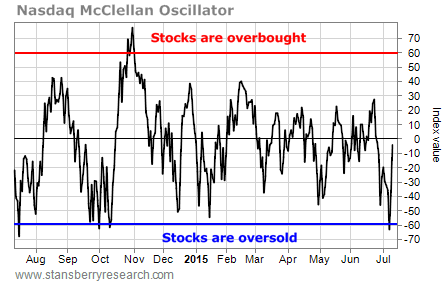
ollowing Wednesday’s sharp decline, many technical indicators hit oversold levels. For example, the McClellan Oscillator for the Nasdaq closed at -63. That’s the sort of reading that often occurs near short-term bottoms…
Also, the market’s fear gauge, the Volatility Index (the “VIX”), closed Wednesday at 19.66. That was above its upper Bollinger Band. And the current chart pattern looks similar to the market bottoms in October and December…

The VIX generated a broad stock market buy signal when it closed back inside its Bollinger Bands on Thursday. That also happened at the end of June. But I told my Stansberry Short Report subscribers at that time that, like we saw in October and December, we could get a second move back above the upper Bollinger Band before the market actually hits a short-term bottom and gives a sustainable buy signal.
As you can see from the chart, that’s exactly what happened last week.
Wednesday’s move in the VIX took the index above its upper Bollinger Band for the second time in less than a week.
We now have a much stronger buy signal.
The “double buy signal” in October led to a 10% rally in the S&P 500 in just six weeks. December’s double buy signal kicked off a 5% rally in two weeks.
Take a look at this updated chart of the S&P 500…
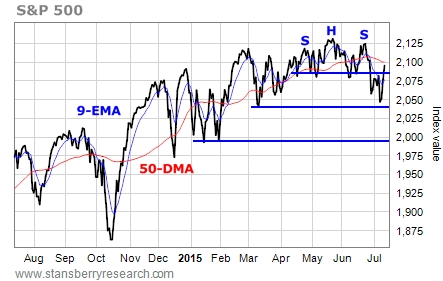
Its 2,044 low is darn close to the 2,038 target of the head-and-shoulders pattern I wrote about earlier this month. Now, with the double-buy signal from the VIX and the oversold conditions on the McClellan Oscillator, traders ought to be looking for a bounce.
The index has resistance at 2,080. That’s the neckline of the head-and-shoulders pattern. But a more likely target is the 50-day moving average line at about 2,100.
So now it’s time to start looking for ways to profit off a new short-term bounce in the market.
Don’t get me wrong… It is NOT time yet to go “all in” on the long side. I still think the broad market has lower to go between now and October. My downside target for the S&P 500 is in the area of 1,990.
But with conditions as oversold as they are right now, the stage is set for a decent one- or two-week oversold bounce.
Best regards and good trading,
Jeff Clark
Also….

Recent Chinese trade deals and the formation of the Asian Infrastructure Investment Bank have given the dollar a run for its money.
Today’s infographic shows countries that have bypassed the dollar in bilateral trade agreements.
View a larger version of the Dollar Slowly Losing its Status & more analysis HERE

 ATHENS, Greece – “It’s finished. The euro finished. Greece finished.”
With this apocalyptic shorthand, our taxi driver described the situation in Athens.
The banks here have been closed for two weeks. To try to prop up the crumbling banking system, the government has banned Greek citizens – but not tourists – from withdrawing more than €60 ($67) a day from the ATMs.
The breaking news this morning is that the government and its creditors have cobbled together a deal to keep Greece in the euro zone.
Prime minister Alexis Tsipras has caved in to creditors’ demands on economic reforms. Trouble is his countrymen voted to reject almost the same deal in last weekend’s referendum.
And Tsipras still has to push the reforms through the Greek parliament on Wednesday.
We Hopped on a Plane to Athens…
Like a storm chaser, on Saturday we hopped on a plane from London to Athens to study the tornado moving through downtown Athens.
It would be fun to see so many vanities and pretensions fly high, we thought. At the very least, it would be instructive – useful training for the storms coming elsewhere.
But nothing happened: No twister. No train wreck. No panic in the streets.
From our explorations in the historical Pláka neighborhood – on the slopes of the Acropolis – we found only tourists. And they seem to have no idea that there is a financial crisis going on.
Last night, we went over to the Syntagma Square – the city’s central square – to look for mayhem and chaos. All we found was a squad of police dozing in an armored bus.
ATMs were working; no lines in front of them. Restaurants were about half full.
Nor did we see signs of extravagant spending or reckless investment. In Athens there is no equivalent of the Arc de Triomphe. No Eiffel Tour. No Louvre. No fancy apartments. No gleaming offices.
At least, none that we saw…
Its main achievements were completed more than 2,000 years ago. You wonder how Ancient Greeks did it. The Parthenon – a temple on the Acropolis dedicated to the goddess Athena – required huge investment and meticulous organization.
It is breathtaking… an architectural masterpiece. There is no sign of such capability here today. Instead, Athens is a washed-out, slightly trashy Mediterranean burg.
“Hey, can I help you?”
A seedy-looking man approached. We didn’t know what he was offering, but we didn’t want any.
“No… thanks.”
We turned to walk in the other direction. He followed.
“Hey… what are you looking for? I can help you find it.”
“Well, I’m looking for signs of financial breakdown.”
“Oh, I can help you find drugs… women… gambling. But I don’t know anything about financial breakdowns.”
We gave the man another “thank you” and went off.
Makers and Takers
As you know, Greece is just another front in the Great Zombie War.
The real issue here is the same as all the other fronts: how to keep the credit flowing.
Honest people make. Zombies take.
They take what they can from earnings and savings. But it is not enough. It is credit that keeps them alive.
Zombie businesses borrow more and more to keep the lights on. They pay out big bonuses, and their stock goes up!
Cheap credit keeps the feds in business, too. Practically every government in the world is operating in the red. Take away the red, and zombie programs would have to be curtailed.
Cheap credit funds the layabouts, the chiselers, the lobbyists and lawyers, foolish wars and foolish investments, and all the many millions of people who live at the expense of others.
Want to know if you’re a zombie?
In theory, the test is simple: If no one were forced to support you, would you still have the same income?
If this answer is no, you have been zombified.
But in practice, it can be hard to tell a zombie from an honest living, breathing human being.
Often they don’t even know themselves. Some honest professions, for example, have been almost entirely zombified. So have entire countries.
Greece, for example, has been able to live beyond its means – on credit provided by Northern Europeans.
Many of its people – especially those who work for the government – have gotten used to earning more than they’re worth. (For more on this, scroll down to today’s Market Insight.)
There were few zombies in the world of Pericles, Aristotle, and Euclid. The economy could not support many parasites.
Now, the world is full of them.
Regards,
 |
Bill
original article HERE

It is time for the US stock bull market to end. That was per the cycle analysis by Peter Eliades we reviewed several weeks ago. Meanwhile, we could not even get a blip let alone a correction until Greece (with a side of China) got in the MSM.
Now we have a correction. The fact that it is underpinned by media hysterics is bullish, not bearish. At least that is how all such media events have been throughout the cyclical bull market that was concocted by policy designed to reward greed and speculation. Cue the chart…

Junk to Quality bond spreads indicate that greed continues to lurk beneath the surface of the US markets. So we are open to a final push higher. Not predicting it but sure as hell allowing for it.
Watch the Semiconductor sector, which has been a consistent (though sometimes volatile) leader since 2012.
Global markets are much more a mixed bag. Discretion is advised between countries and economic zones.
Commodities are not of interest in the least right now.
Precious Metals are of interest but only when the macro turns. Some indicators have been turning for a long while now, but others remain holdouts. Only when speculation starts to fail and safe havens and insurance start to be valued again will the sector be ready, macro fundamentally speaking.
In that event, quality gold stocks would one day leverage gold’s out performance to most other items. But first, a final washout is still a potential that is in play. It is also the preferred scenario in order to get the contrarian juices flowing.
…continue reading this premium report with 40 charts that support each summary above HERE
…

-
I know Mike is a very solid investor and respect his opinions very much. So if he says pay attention to this or that - I will.
~ Dale G.
-
I've started managing my own investments so view Michael's site as a one-stop shop from which to get information and perspectives.
~ Dave E.
-
Michael offers easy reading, honest, common sense information that anyone can use in a practical manner.
~ der_al.
-
A sane voice in a scrambled investment world.
~ Ed R.
Inside Edge Pro Contributors

Greg Weldon

Josef Schachter

Tyler Bollhorn

Ryan Irvine

Paul Beattie

Martin Straith

Patrick Ceresna

Mark Leibovit

James Thorne

Victor Adair