
Asset protection
Multi-Market Update (NFTRH Premium)
Following is a detailed update of the US dollar, precious metals, US and global stock markets and commodities, which was sent to premium subscribers this morning.
The update is passed along to eLetter readers to remind you that NFTRH premium is a well rounded service, with not only a detailed 25-35 page (pdf) report emailed each Sunday, but as many or as few interim updates (posted at NFTRH.com and emailed) as required to keep us on the right side of markets.
Today’s markets are not cut and dry and I simply think NFTRH is the best overall service of its kind, bar none, in its ability to keep its subscribers on the right side of global markets.
Multi-Market Update
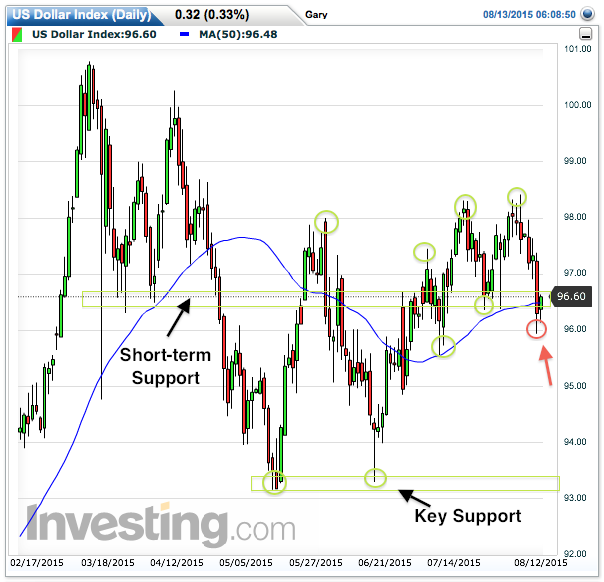
Add the US dollar to the list of items that are in question and on the move. The green circles show the higher highs and higher lows made by USD since the May low. In June it spiked down, tested that low and then shot higher.
Most recently we noted that the modest new high was enough to keep the uptrend going and that USD can correct, even all the way down to key support in the most extreme case, and still keep a bullish case going. In making a lower low to July, it is in danger of losing initial support but is clinging to the MA 50. The two most recent peaks would in that case be a double top of short-term significance only. Whether or not Uncle Buck holds support right here is very key to other markets and their bounce/rally potentials.

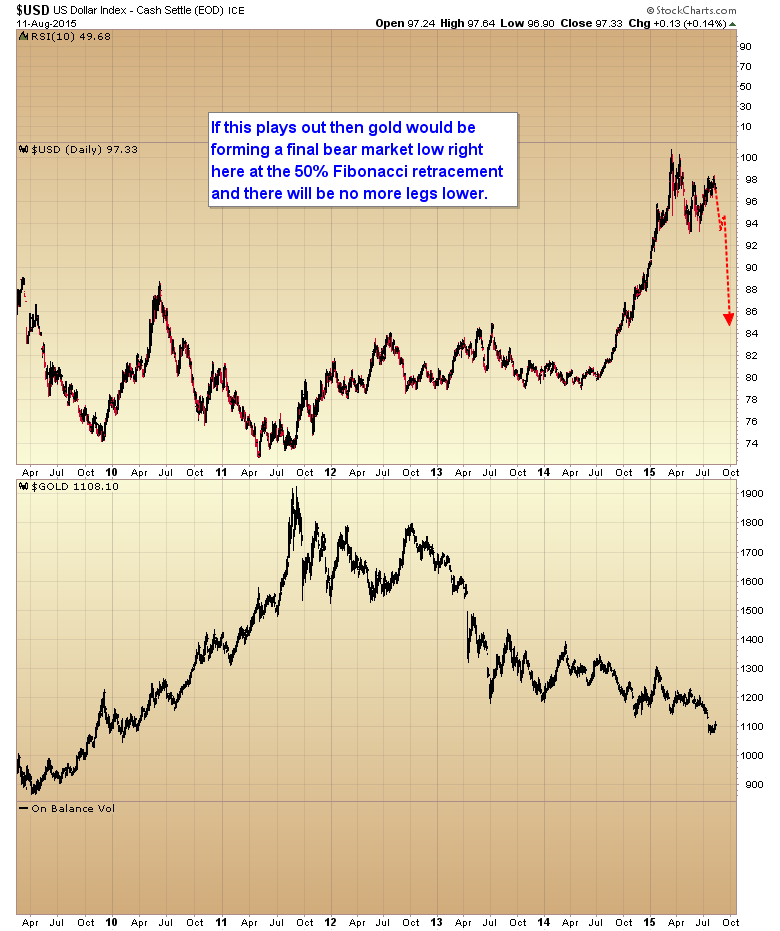
“the next cycle low will come due sometime between the first week of September and the FOMC meeting on September 17th”….read the whole analysis HERE

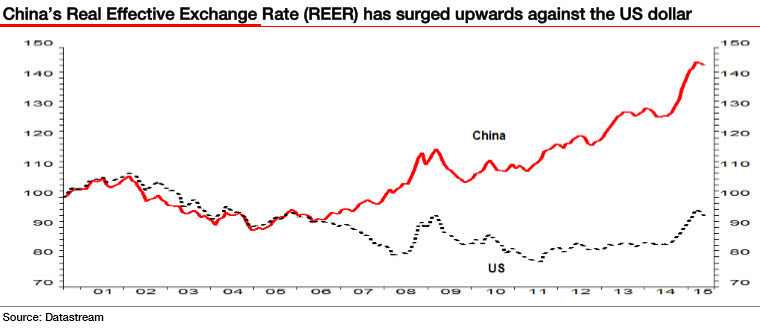
Make no mistake, warns SocGen’s Albert Edwards, this is the start of something big, something ugly. For while the west has been heaving a sigh of relief over the past few months that deflation pressures have abated somewhat – especially at the core level – we have been emphasising that deflation has only been intensifying in Asia and that like any puss-filled boil, this deflationary pressure would soon need to be lanced……continue reading HERE

On Tuesday, China shocked financial markets by suddenly devaluing its currency, the yuan, by nearly 2%, which may not sound like much, but it is the biggest downward currency move in two decades.
The move caught most analysts completely off-guard, and it seems like a desperate attempt to fight back against the forces of global deflation and jump start China’s sagging economic growth.
But China’s surprise move could trigger unexpected consequences in global markets. Why now? Let’s quickly recap China’s motivation for doing this, and the potential risks to markets worldwide.
What China did
The People’s Bank of China (PBOC) adjusted the yuan’s value downward by 1.9% Tuesday. What’s more, the PBOC also said it will allow the yuan’s value to reflect market prices from now on.
This is in keeping with Beijing’s long-term goal of opening up its financial markets and adopting a more flexible exchange rate. The U.S. and the IMF have insisted on this step as a prerequisite for the yuan to achieve parity with the dollar, euro, yen and other major currencies, which will pave the way for the yuan to be more widely used in global commerce.
But be careful what you wish for, because a flexible market-based exchange rate can’t be easily managed by the authorities in Beijing.
In fact, while the “official” adjustment by the PBOC was -1.9%, in offshore trading the currency tumbled even more, by -2.9% in value. That’s a strong sign the yuan could ultimately fall even further.
Sure enough, just one day after the official devaluation, the yuan sold off again Wednesday, forcing the PBOC to intervene and support the currency.
According to Bloomberg estimates, it will take a much larger depreciation in the yuan to significantly boost exports. Something more like a 10% drop in the currency’s value would be needed to restore China export growth to 10%. That’s a monster move.
The risk is that a sliding Chinese currency triggers massive money flows out of China, just as we’ve seen with capital flight from Europe as the euro declined. This could deal another blow to China’s struggling stock market.
Why they did what they did
The reasons why China made this move now are not really a surprise. They are two-fold:
#1: Deflation, and
#2: Currency competition
First, deflation still has the upper hand in the global economy, as my colleague Larry Edelson has frequently pointed out. China’s economy has been slowing for years, from double-digit GDP growth not so long ago, to Beijing’s current official growth target of just 7%.
But China’s economy will be lucky to expand even that much. After plenty of disappointing data recently, the current real-time estimate for China’s GDP this year is down to 6.6% and falling fast. Exports, China’s life-blood, plunged by 8.9% year over year in July.
China is desperately trying to grow its economy by any means possible: internally using fiscal and monetary stimulus, and now externally through currency depreciation.
Second, by explicitly devaluing its currency, China is taking a well-worn page out of the central bank playbook. The PBOC is simply pushing back against currency depreciation by the Fed, Bank of England, European Central Bank, Bank of Japan, etc. over the last several years.
In other words, the PBOC is just trying to keep up with the competition.
In fact, China’s currency has appreciated significantly in recent years compared to the dollar, euro and yen. The yuan’s real effective exchange rate has climbed 13% over the last 12 months alone.
And that’s not all. China’s emerging Asian neighbors and biggest trading partners — including Taiwan, South Korea, Malaysia, Singapore and more — have been busy depreciating their own currencies for years, at the expense of China. Now it’s payback time!
The potential risks …
Even if you argue China is somewhat justified by making this move, it could not have come at a worse time for global financial markets.
Now investors have another, in a growing list of risk factors to lose sleep over.
I see at least two major risks:
First, China’s devaluation could spark another battle in the ongoing global currency war. The South Korean won along with the Singapore and Taiwan dollar also tumbled this week in response to the weaker yuan.
So it’s clear that foreign-exchange markets are already pricing in more weakness to come.

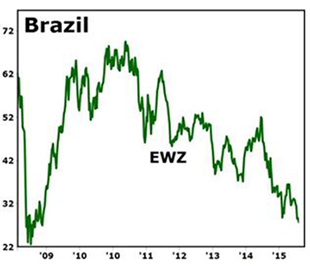
China’s move could trigger a vicious cycle of other countries trying to push their own currencies lower still. Former IMF economist and Morgan Stanley currency expert Steven Jen says “the emerging-market currency weakening trend is now going global.” He believes emerging market currencies from Brazil to Indonesia could be vulnerable to a decline of 30% to 50%.
So, the risk of another 1997-style Asian currency crisis playing out is clearly on the rise.
Second, China is also playing a very dangerous game with its own economy and still fragile financial markets.
The Bank for International Settlements estimates that dollar borrowing in China has expanded five-fold since 2008 to more than $1.1 trillion today.
According to Bloomberg, Chinese companies have $529 billion in dollar- and euro-denominated debt, which means their cost of servicing that debt just increased by $10 billion thanks to the PBOC.
And much of this dollar denominated debt may be unhedged, because up until Tuesday, the PBOC had kept the yuan in a narrow trading band against the buck. Bloomberg reports that: “Chinese property developers have lots of offshore debt outstanding — more than 20% of their total debt for some — and the majority of them have high leverage.”
In other words, China is walking a very fine line trying to boost its economy, while avoiding a major domestic credit crunch and market meltdown if the yuan falls too far too fast.
Bottom line: buckle your seatbelts because if financial markets weren’t turbulent enough for you already, China just upped the ante for investors.
Good investing,
Mike Burnick
 On the heels of the gold and silver surging along with the Dow, the Godfather of newsletter writers, 90-year-old Richard Russell, said the brutal bear phase in gold and silver is now coming to an end. The legend also discussed other key markets.
Richard Russell: “Everything that I read regarding the US economy is bullish. The only newspaper that dares to publish bearish comments on the US economy is Investor’s Business Daily. The mass of comments about the US economy is so lopsided, it makes one wonder if supply and demand has given way to Fed manipulation. I find myself wondering whether the stock market still retains any forecasting ability.
But let’s face it…..read more HERE

-
I know Mike is a very solid investor and respect his opinions very much. So if he says pay attention to this or that - I will.
~ Dale G.
-
I've started managing my own investments so view Michael's site as a one-stop shop from which to get information and perspectives.
~ Dave E.
-
Michael offers easy reading, honest, common sense information that anyone can use in a practical manner.
~ der_al.
-
A sane voice in a scrambled investment world.
~ Ed R.
Inside Edge Pro Contributors

Greg Weldon

Josef Schachter

Tyler Bollhorn

Ryan Irvine

Paul Beattie

Martin Straith

Patrick Ceresna

Mark Leibovit

James Thorne

Victor Adair