
Gold & Precious Metals
Gold companies engage in the exploration and production of gold from mines. Many times they also explore for other metals, such as silver, copper, and zinc. Gold companies are generally structured as corporations and have profits that are positively correlated with the price of gold. These companies generally offer average to below average dividend yields.


 Monday’s craziness aside, these tech stocks are deep values any way you slice it
Monday’s market carnage was the best thing to happen to investors all year. At long last, quality tech stocks went on sale — however briefly — and maybe even bottomed out, making names like Apple (AAPL), Facebook (FB) and Netflix (NFLX) the most appealing they’ve been in months.
Goodness knows investors needed this sale. It’s been a disappointing year in general for stocks, as the U.S. equity benchmark S&P 500 was up only about 2% for the year-to-date before China’s Black Monday tore through global markets.
If investors have any hope of outperforming during such circumstances, they need to overweight some of the biggest names in the market — and the cheaper they can get in, the better. Since the Nasdaq sold off harder than the other major indices over the past few days, tech stocks are standing out as buys on the dip.
After all, to get better prices on great tech stocks, you have to strike on days when the market is panicking. Besides, whether the selloff continues for a few sessions or turns into a bear market, odds are greatly in your favor that the best tech stocks will be much higher in, say, three years than they are today……
That goes double for some of the biggest, most-promising and most popular tech stocks.
From the most valuable company on the planet to the biggest social network to a momentum darling, Monday’s action proved that AAPL, FB and NFLX are stocks to buy when the going gets tough.
……read Next Page

I can’t tell you the complaints I’ve received over roughly the last 14 months, when I started warning everyone that a stock market correction was coming. Possibly a big one.
They said I was nuts. That I was a stopped clock. After all, the major indices such as the Dow Industrials and the Nasdaq were making one new high after another.
I even told investors who were interested in dividend income to stay out, they’d lose more than they could possibly earn in dividends or royalties when the principal of their investments would plunge.
But I stood my ground, backed my time-tested models. And the facts now are this …
A. Even before the stock market started to plunge last week, more than 67 percent of all publicly traded U.S. stocks were down at least 10 percent.
B. Now that the market is falling, those figures are even greater. 70 percent of publicly traded stocks in the S&P 500 are now down at least 10 percent.
C. And fully 31 percent are now down at least 20 percent!
D. Globally, more than $2.5 trillion has been wiped off of stock values in the past year!
Thing is, most investors who didn’t listen to me, won’t listen to me when I scream that the bottom is in and that the Dow Industrials are headed to well over 31,000 over the next few years.
And that Asian markets, as ugly as they seem right now, will do even better, with China probably quintupling.
Instead, they will be panicking near the lows, claiming it’s the end of the world. That the Dow is going to below 5,000 or some ridiculous number. That China and Asia are going to crash and burn. That the only safe place to be is in U.S. Treasuries.
And guess what? Those investors will …
A. Miss out on the biggest stock market gains, ever. And …
B. They will lose almost every penny they invest in U.S. or European sovereign bonds.
Let me give you perhaps the two most important insights you could ever have on how markets work. Insights that you only get from studying thousands of years of data every which way you can, and from being a professional trader yourself.
First, the majority of investors lose money. They are caught on the wrong side of the markets, especially at extreme highs and lows.
Second, pullbacks, crashes, mini-panics, bear market rallies in bear markets, etc. — all create the energy needed for the major underlying trend to finally reemerge.
In other words, it’s the crashes, like we are seeing now in stocks, that pave the way for the next bull run higher.
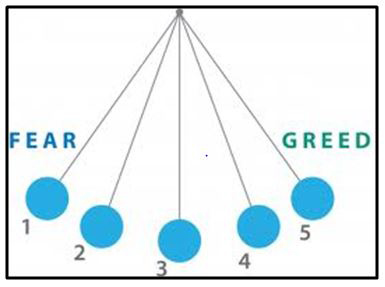 It’s the way the markets move, like a giant pendulum, swinging from one side to the other, from fear to greed and back again.
Let’s say, for instance, that the swing of the pendulum to the right is a bull market. How can it possibly swing to the right unless it first swings to the left?!
And on the flip side, let’s say the pendulum’s swing to the left is a bear market? Well, how can it possibly swing to the left if it hasn’t already swung to the right?
Get the picture? That is precisely how markets work. To get those swings, the majority of investors must, by definition, get trapped, bailing out precisely at the wrong time.
Shorts bail out at tops; longs bail out at bottoms.
And only the savvy know when to get out and back in at the right times!
That’s also why I couldn’t be happier about what’s happening in stocks now. Not only because I’ve been right of course, but far more importantly …
It’s setting up that inevitable swing back to fear, which will create the energy for the pendulum to swing back in the other direction, to the right, and help fulfill my long-term forecast, that the Dow is headed to 31,000+ over the next two years.
Problem is, as I said before, very few investors, except those who subscribe to my Real Wealth Report and my Supercycle Trader, will profit from it.
I’m not boasting mind you, I am just telling you like it is. Even if you’re not a member of my services and never become a member, please at least take the lessons I try to give you in these columns seriously; they will help you to both avoid losses and make more money to boot.
So what now for the stock market? Will it continue to crash? If so, where might it stop?
First, according to my models, the correction is not yet over. We should see a bounce back develop this week, if it hasn’t already done so by the time you read this column. But that’s all it will be, a bounce.
Second, major support for the Dow Industrials, the index most widely watched, comes in at the 15,672 level. If that gives way, the Dow will likely fall much further, to about 13,937.
Third, the correction, or crash, or whatever you want to call it, should be over by October, and may even come to an end this month, in a normal three-month correction.
I won’t be able to determine that until we see how the markets close out the month, on the last day of trading on Monday, Aug. 31.
At that time, I’ll be able to run my studies and update my forecasts. Month-end closings are more important than weekly closings, which in turn, are more important than daily closings.
As to gold; no it has not bottomed. All you are seeing is a bear market bounce. That too will end soon and give way to a renewed decline that will take gold below $1,000.
Best wishes and stay tuned …
Larry

Larry Edelson, one of the world’s foremost experts on gold and precious metals, is the editor of Real Wealth Report, Power Portfolio and Gold and Silver Trader.
Larry has called the ups and downs in the gold market time and again. As a result, he is often called upon by the media for his investing views. Larry has been featured on Bloomberg, Reuters and CNBC as well as The New York Times and New York Sun.
I want to take a special look at gold and the dollar this morning and see if we can’t alleviate some of the fears created yesterday by the big move down in mining stocks. As I’ve noted before it’s not uncommon for big money to try to run stops to enter at the cheapest price possible. We actually saw GDXJ run the stops last winter right before a second daily cycle tacked on some very big gains in the metals sector. We may see that again in the mining sector over the next few days, possibly as oil puts in its final three-year cycle low.

Gold has now rallied $70 since the downside Capitulation alerts in July and the two weeks of extremes in the COT data. It is also in the heart of the seasonally favourable period stretching into September.
The 20-week ema at $1155 remains the minimum upside target, while the 50-week ema is an outside possibility.
The initial rally to $1126 generated overbought readings on the daily chart. In weak markets these tend to be followed by two to four days of consolidation and then a move to a higher high. With this consolidation now behind us it becomes imperative that prices hold above $1120 to maintain the uptrend.

The correlation with the 1970’s suggests that a final low should be in place within six months. The primary resistance rests at $1250 and the bottom of the channel is around $1000.


The opinions in this report are solely those of the author. The information herein was obtained from various sources; however we do not guarantee its accuracy or completeness. This research report is prepared for general circulation and is circulated for general information only. It does not have regard to the specific investment objectives, financial situation and the particular needs regarding the appropriateness of investing in any securities or investment strategies discussed or recommended in this report and should understand that statements regarding future prospects may not be realized.
Investors should note that income from such securities, if any, may fluctuate and that each security’s price or value may rise or fall. Accordingly, investors may receive back less than originally invested. Past performance is not necessarily a guide to future performance. Neither the information nor any opinion expressed constitutes an offer to buy or sell any securities or futures contracts. Foreign currency rates of exchange may adversely affect the value, price or income of any security or related investment mentioned in this report. In addition, investors in securities such as ADRs, whose values are influenced by the currency of the underlying security, effectively assume currency risk. Moreover, from time to time, members of the Institutional Advisors team may be long or short positions discussed in our publications.
BOB HOYE, INSTITUTIONAL ADVISORS
EMAIL bobhoye@institutionaladvisors.com WEBSITE www.institutionaladvisors.com


-
I know Mike is a very solid investor and respect his opinions very much. So if he says pay attention to this or that - I will.
~ Dale G.
-
I've started managing my own investments so view Michael's site as a one-stop shop from which to get information and perspectives.
~ Dave E.
-
Michael offers easy reading, honest, common sense information that anyone can use in a practical manner.
~ der_al.
-
A sane voice in a scrambled investment world.
~ Ed R.
Inside Edge Pro Contributors

Greg Weldon

Josef Schachter

Tyler Bollhorn

Ryan Irvine

Paul Beattie

Martin Straith

Patrick Ceresna

Mark Leibovit

James Thorne

Victor Adair