
Asset protection
We are believed to be at an excellent juncture right now to short the broad stockmarket (or buy bear ETFs and Puts). As we know, we did just that before the dramatic plunge early last week, and are now “sitting pretty”. Now is the time to add to positions, or if you haven’t any and are looking for the right shorting opportunity, this is it.
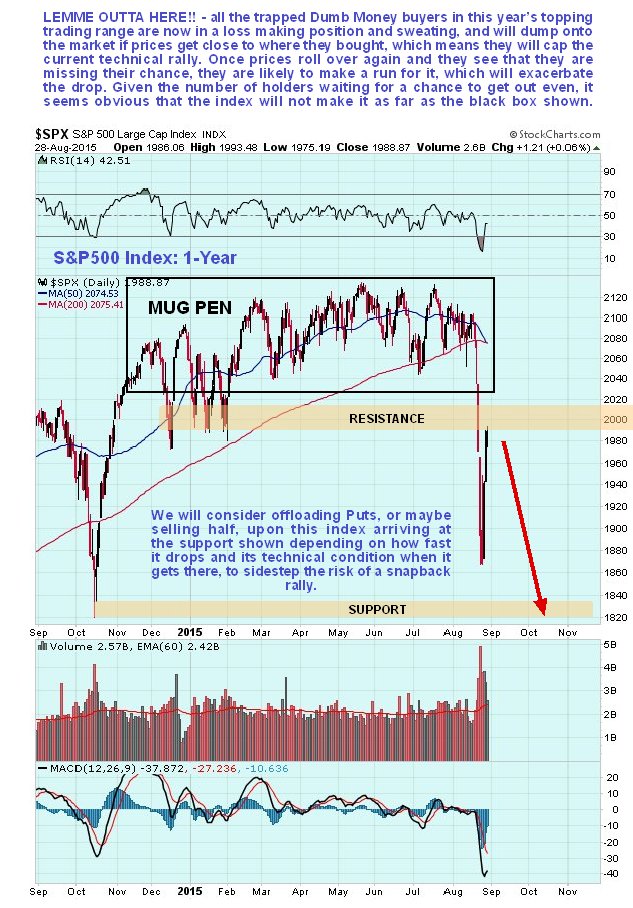
To see just why now is an excellent time to enter short positions or build on existing short positions (inverse ETFs / Puts) we will now look at the latest 1-year chart for the S&P500 index. All those who bought in the large rectangular pattern drawn on the chart, labeled the “Mug Pen” are like sheep huddled in a corral waiting to be fleeced. Even after the sharp rally late last week they are nursing significant losses, and if they get the chance to “get out even” or nearly so, they are going to take it. What is likely to happen is that they will almost get the chance, but not quite, because the market will turn down again soon, or immediately, and they will have to make a run for it if they want to avoid a severe fleecing. This means that as soon as the market starts to drop away again, they will stampede to unload stocks while they still can at reasonable prices, exacerbating the rate of decline. This is a big reason that another severe downleg is expected.
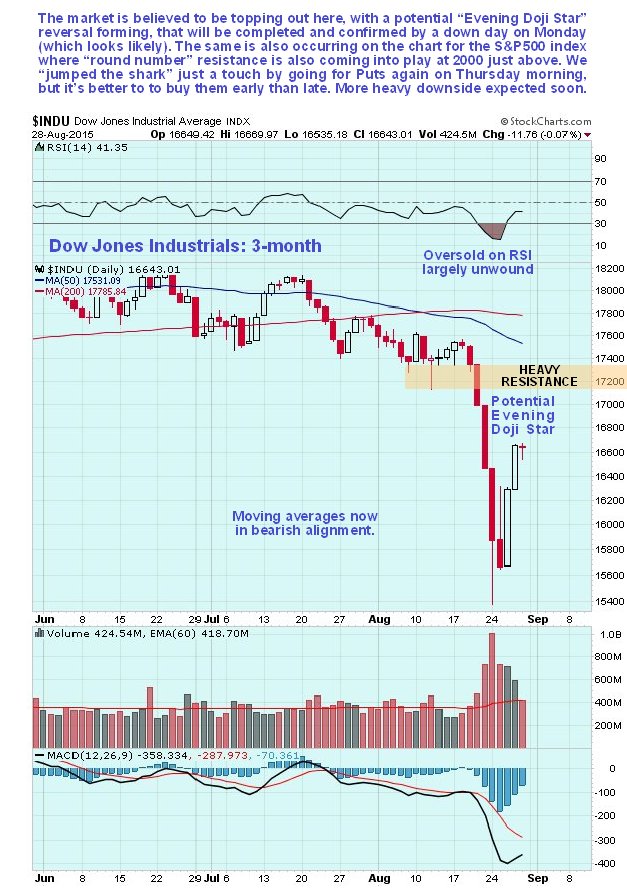
On the 3-month chart for the Dow Jones Industrials we can see recent action in detail, and how the market may right now be topping after the technical rebound last week, with a potential “Evening Doji Star” reversal forming on the chart, that will be confirmed by a drop tomorrow…
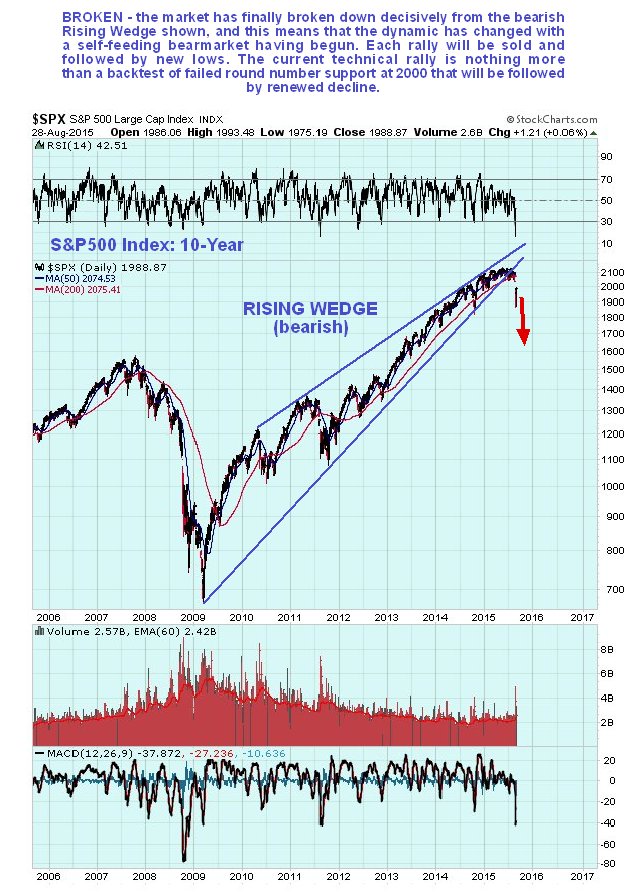
The seriousness of the situation is made clear by the long-term 10-year chart for the S&P500 index on which we can see that a long overdue cyclical bearmarket has been signaled by last week’s plunge, which involved a clear breakdown from a large bearish Rising Wedge. What we are seeing now is a final backtest of the “round number” resistance at 2000, formerly support that failed, before we enter a brutal self-feeding downtrend that is likely to be steep. This looks like the last opportunity to get out, or go short at good prices. Those who follow Wall St’s advice to “buy selectively” will learn to their dismay that the market doesn’t discriminate much when it comes to the damage it inflicts during a severe bearmarket phase – pretty much everything will be hit and hard.
For those who are experienced and comfortable with trading options, a wide range of suitable big stock Puts are detailed in two articles on the site, Big Stock Put Options for Market Crash – Round 2 and Big Stock Put Options for Market Crash – worthy additions.

In last week’s missive I specifically stated:
“The time has now come to start moving more heavily to cash. As I will discuss throughout this weekend’s missive, including the 401k-Plan Manager, it is now time to “OPPORTUNISTICALLY” REDUCE PORTFOLIO ALLOCATIONS.
As noted in the chart below, the markets are now once again extremely oversold. As I have often stated in the past:
“By the time a market signal is given in the market, the markets are very likely at a point of extreme oversold or bought conditions. Therefore, it is always better to use the subsequent relaxation of those extreme conditions to add or reduce portfolio exposure.”
This is why it is never a good idea to “panic” when something initially goes wrong.
With the markets now deeply oversold, it is VERY likely that the markets will bounce next week. The problem, for those with “buy and hold” bullishly biased strategies, is the “bull market” has now ended…at least for now.
As shown in the next chart, and confirmed by the above, is that a bounce from these oversold levels will run into a substantial amount of overhead resistance where the rally will very likely fail. THIS WILL BE THE POINT TO LIQUIDATE HOLDINGS.”
The chart below is updated through Thursday’s close.


 Faber says U.S. equity markets are currently “extremely oversold” and that a short-term rebound may be in the mix, but he argues more pain is likely to emerge. He also highlights precious metals as the one asset class that may offer a glimmer of hope for commodity-producing economies such as Canada and some safety for investors looking to shield their investments.
“There’s not much other good news for Canada at the present time,” he said.

Kim Jong Un Declares War as Armstrongs War Cycle Turns Up
First of all, this is not devaluation.The American government, IMF, me and others have said please let your market determine what happens to the currency. So finally the Chinese said okay and the Yuan went down 2% one day and 1% another day. But that is not devaluation.
 Making Sense Of The Sudden Market Plunge
Markets are quite possibly in crash mode right now, although events are unfolding so quickly – currency spikes, equity sell offs, emerging market routs and dislocations, and commodity declines – that it’s hard to tell for sure. However…..continue reading HERE
Summary
- Currency weakness is being driven by GDP issues, which are not tied to the health of the Canadian economy as directly as we think.
- Economic weakness stems from weak commodity prices, an improvement of which would drive the economy well past where it is today.
- Concerns about over-leveraged Canadian consumers and high price of Real Estate underestimate the ability of Canada’s Financial System to compensate.
- The main investment vehicles within Canada are being dumped along with energy and materials, despite the remaining companies’ value and lack of exposure to those assets.
- There are opportunities in Canada for those who are bullish and bearish on commodities, and the housing and debt factors are less influential to the thesis than many believe.
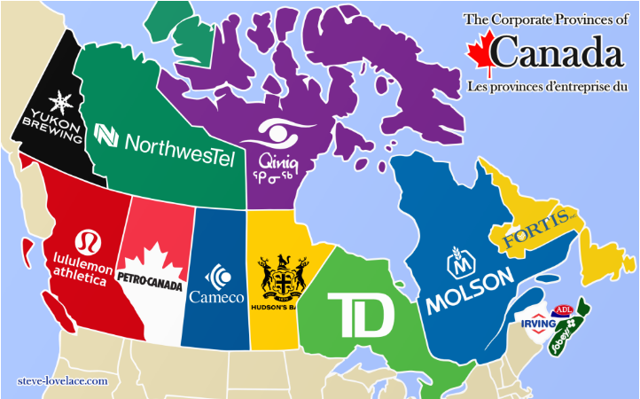
As a commercial banker, I have seen the issues I hear so many pundits speak about, and I have my own opinions about the very curious case of Canada.

-
I know Mike is a very solid investor and respect his opinions very much. So if he says pay attention to this or that - I will.
~ Dale G.
-
I've started managing my own investments so view Michael's site as a one-stop shop from which to get information and perspectives.
~ Dave E.
-
Michael offers easy reading, honest, common sense information that anyone can use in a practical manner.
~ der_al.
-
A sane voice in a scrambled investment world.
~ Ed R.
Inside Edge Pro Contributors

Greg Weldon

Josef Schachter

Tyler Bollhorn

Ryan Irvine

Paul Beattie

Martin Straith

Patrick Ceresna

Mark Leibovit

James Thorne

Victor Adair