
• Podcast
  • 5 Minutes with Mike
  • Inside Edge
    • Inside Edge
    • About Us
  • Events
    • 2026 World Outlook Financial Conference
    • Store
  • What we do
    • Our Full Services
    • Podcast
    • 5 Minutes With Mike
    • The Inside Edge
    • Store
    • Customer Support
  • Login
Select Page

Real Estate

Canada’s 6-City Housing Prices For August

Posted by Brian Ripley's Canadian Real Estate Chartss Canadian Real Estate Charts

on Saturday, 5 September 2015 13:58

4279401

Larger Chart 

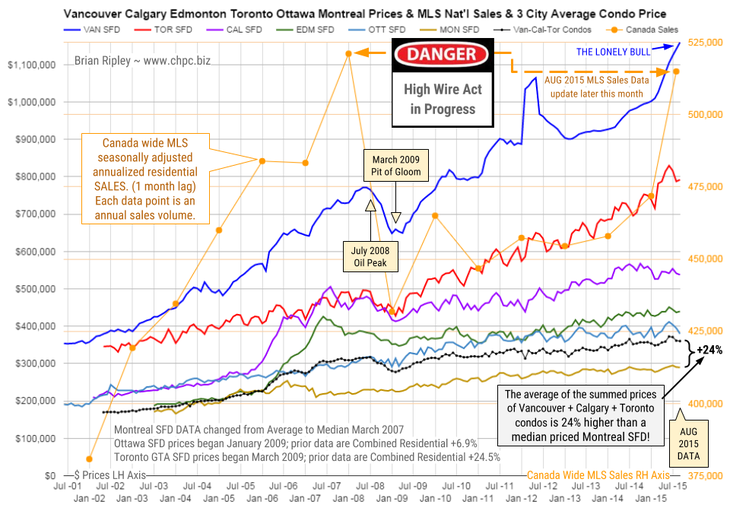
The chart above shows the average detached housing prices for Vancouver, Calgary, Edmonton, Toronto*, Ottawa* and Montréal* (the six Canadian cities with over a million people) as well as the average of the sum of Vancouver, Calgary and Toronto condo (apartment) prices on the left axis. On the right axis is the seasonally adjusted annualized rate (SAAR) of MLS® Residential Sales across Canada. The last data point is for July 2015, and will be updated probably in the second week of September.

In August 2015 Canada’s big city metro SFD prices folded under the weight of seasonality… except of course for the Vancouver bull that pushed buyers into hyperion skies. 

Apparently it’s the dirt that inflames big money’s desire to pay a premium for sitting on it, not the least of which is refugee money (The Province August 3, 2015).

It’s too late for the the Canadian national MLS residential annualized housing sales data to break out above the 2007 peak; the season has shifted into the third quarter and sales are heading for their annual nadir. 

High net worth trophy hunters have spent the last few years picking off well located SFD properties in hot markets while the hoi polloi settled for anything before being priced out. 

Are they going to enjoy being priced in? 

According to CMHC, August 13, 2015: “Low overall housing market risk is observed for Vancouver, as none of the individual risk factors are currently detected.”

…view the Plunge-O-Meter HERE (The Plunge-O-Meter tracks the dollar and percentage losses from the housing peaks)

Do crude fundamentals justify the rally?

Posted by Phil Flynn - The PRICE Futures Group

on Friday, 4 September 2015 15:34

Crude oil shorts are shocked as oil prices keep rallying. Massive capital spending cuts in the energy space as well as a refinery strike is giving oil and oil products a boost. While many continue to say that the fundamentals don’t justify the rally, the truth is these are the same folks who were shocked when oil went so low in the first place. The perception of what is a fair price for oil changes quickly as a futures market looks ahead from what is to what will probably be.

Oil products led the way as the first major refinery strike since the 1980’s caused market concerns. The strike by United Steel Workers union impacted about 10% of U.S. refining capacity. Even as many argued that output so far at the refineries not been impacted, wholesalers and jobbers bid up spot prices just in case. 

Genscape, the respected company that monitors energy industry and refining activity, reported yesterday that in the second day of strike by the United Steel Workers union at seven U.S. refineries and two other petrochemical and co-generation facilities has had little effect on operations. Genscape admitted that the strike pushed refined products prices higher today from concerns that production may be impacted. Genscape, which monitors approximately 58% of the refining capacity where strikes are taking place, said so far, no operational changes have been observed.

Screen Shot 2015-02-03 at 9.42.47 AM

Even so, oil products continue to rally as many are not certain if the refineries over the long run can maintain output. Some refineries are going to shut down for maintenance early as the strike is giving them the excuse they need. The other concern is that the strike may spread to other refineries and other industries as well. The strike is entering its third day with no end in sight.

We called a bottom at $44 on oil and it looks like it will hold up. With the technical looking strong and wounded shorts we still have the capacity to surprise on the upside. While the front end of the curve seems well supplied the demand to buy oil to put into storage has offered some support. With storage filling rapidly that could weigh on prices later but for now you can’t get in the way.

The International Energy Agency last week warned that supply would tighten later this year and we could see a 350,000 barrel drop in non-OPEC supply. That is a number that could grow if the rig and capital spending cuts keep coming, not to mention more shale bankruptcy possibilities.  


About the Author

Senior energy analyst at The PRICE Futures Group and a Fox Business Network contributor. He is one of the world’s leading market analysts, providing individual investors, professional traders, and institutions with up-to-the-minute investment and risk management insight into global petroleum, gasoline, and energy markets. His precise and timely forecasts have come to be in great demand by industry and media worldwide and his impressive career goes back almost three decades, gaining attention with his market calls and energetic personality as writer of The Energy Report. You can contact Phil by phone at (888) 264-5665 or by email at pflynn@pricegroup.com. Learn even more on our website at www.pricegroup.com.

Futures and options trading involves substantial risk of loss and may not be suitable for everyone. The information presented by The PRICE Futures Group is from sources believed to be reliable and all information reported is subject to change without notice.


RELATED ARTICLES
Further yuan depreciation expected

Fed’s Lacker reveal one yes vote on tightening

Japanese banks among bidders for GE’s local finance unit

We have a situation…

Jobs number mixed bag 

PREVIOUS
German yields drop below Japan in ominous sign for Eurozone
NEXT
Copper miner makes bet low is in
RELATED TERMS
Oil 3270Crude 1817OPEC 387


Chokin’ on the Splinters

Posted by The 10th Man - Mauldin Economics

on Friday, 4 September 2015 15:21

email-newsletter-thumb-jared-dillianIt’s been a tough couple of weeks.

I keep a mostly hedged book, long and short, so it’s rare that I get my head caved in on every position at the same time. But that’s pretty much what has happened. My shorts haven’t worked because they’re either rate-sensitive or Canadian banks. Meanwhile the longs, which include a lot of emerging markets—well, you know what has happened with those.

Nothing has changed with the long-term thesis. Nothing. But the mark-to-market is no fun, and any time you’re facing negative P&L, you have to do some soul searching and think about whether you still like these trades or they are permanently broken.

Anyway, you can read more about this discussion either in Bull’s Eye Investor or my newsletter for sophisticated investors, The Daily Dirtnap.

Fight or Flight?

What I really want to focus on today is the psychology of losing. I don’t care who you are, or how smart or confident you sound on Twitter, everyone in this business gets to feel pain at one time or another. You do your best to minimize it and mitigate it, but everyone will get hammered eventually. It happens to the best of us.

So what do you do about it?

This is where I get all Dicky Fox on you and start dispensing the motivational quotes. Like, it is human nature not to log on and look at the losses. Or the 1995 equivalent, throwing away the brokerage statement. People hide. They go into shutdown mode.

That is the worst thing you can do.

Hopefully the losses will motivate you to take some action. Most of the time, that means cutting the losses, but in rare, high-conviction cases, you may decide you want more risk. But sitting still and getting bludgeoned is not going to help. I assure you, it will get worse before it gets better. If it ever gets better. That is the nature of trends. And you are on the wrong side of one.

This is the reality of it: The financial markets are like a fight. You have to get up, ready to fight, every day. You don’t get to take a break from the fight, unless you just sell everything and take your ball and go home. Which is okay. You can run away, live to fight another day. Running is often preferable to fighting. I run all the time.

This time, I’m going to fight.

Endowment Effect

Here is thing number two. Have you ever heard of something called “endowment effect?” That’s the phenomenon where people get emotionally attached to things. Like the coffee mug you got in college. You wouldn’t sell it for $50, even though it’s only worth $5.

People get emotionally attached to stocks too. Which is weird because nobody has certificates anymore; it’s just a ticker in a web browser. But people are very protective of their ideas. It’s their idea, and nobody wants to admit that they are wrong and abandon this idea that could one day make them lots of money.

So you have two options. You can admit you’re wrong and sell it and go do something else, or you can try to wait out the market.

It can be very hard to wait out the market.

Inevitably, what happens to people who wait out the market is that they wait and wait and wait until they get to the point of maximum pain, and then puke the stock—on the lows.

That’s Wall Street.

If you have a number in your mind of how low something can go, your estimate is probably off. Like, if you’re long XYZ at $20, and it’s down from $25, and you think you can hang on until $15, it’s probably going to $5. People lack imagination about how bad the losses can get. They literally cannot conceive of things going horribly wrong. After doing this for 16 years, and seeing things go horribly wrong a bunch of times, I know.

All of my positions could easily get cut in half from here. Easily.

And then people start talking about the concept of “intrinsic value.” Like, this stock has $10 in cash on the balance sheet, there is no way that it can go to $10. And then it goes to $5. Seen it happen. Many times.

That goes for commodities, too. There is no reason why we can’t have $2 corn, or $20 oil, or $200 gold. All of these scenarios are unlikely, but there is no rule that corn or oil or gold can’t drop below a certain price.

If there is such a thing as fair value, the stock will go below it, for sure.

Loser

But more broadly, when people start getting hit, they get demoralized, which is bad because that’s the worst time to get demoralized. When the market is volatile, there are more opportunities (especially in options, where implied volatility is high).

I’ve written a lot of very stern comments here about not having discipline, but I should point out that the horrible bear markets of 2001 and 2008 gave rise to an entire generation of permabears. But the 2000s are not a good sample. For most of the history of the stock market, people are rewarded when they add to long positions on corrections of 10-20%.

You can find lots of reasons to buy stocks (valuation, strong USD, emerging markets, whatever), but there are always reasons not to buy stocks. There were reasons not to buy stocks in March of 2009. You can talk yourself out of a lot of opportunities if you only listen to the negative.

I don’t have perfect knowledge of how this is going to turn out. I don’t. But it doesn’t seem like a generational bear market to me. More likely than not, a year from now stocks will be higher. That’s as good of a prediction as I can offer.

Jared Dillian
Editor, The 10th Man
Mauldin Economics

Jared’s premium investment service, Bull’s Eye Investor, is available now. Click here for our introductory offer. For Jared, no asset class or type of investment is off limits. From an iconic sports outfitter to a particularly liquid frontier-market ETF—Jared picks the best vehicles for his subscribers to profit from tomorrow’s trends today. Put Jared’s ingenious mix of market analysis and trader’s intuition to work in your portfolio today. Follow Jared on Twitter at @dailydirtnap.

Gold, Dow, & Bonds: Inflation Is Coming

Posted by Morris Hubbartt - Super Force Signals

on Friday, 4 September 2015 15:14

dia bear

Here are today’s videos and charts (double click to enlarge):

Dow & Bonds Inflation Is Coming Video Analysis 

Gold & Silver Volume, RSI, & MACD Video Analysis

GDXJ Outperforms GDX Again Video Analysis

Key Precious Metal Stocks To Buy & Sell Now Video Analysis

Here is a look at some key charts that I use in my swing trading service, including “DUST” and “NUGT”.

Key Swing Trades Video Analysis

Also, here are some additional precious metal sector stocks, with important price and volume action:

More Key Precious Metals Stocks Video Analysis  

Thanks, 

Morris

Friday, Sep 4, 2015 Super Force Signals special offer for Money Talks Readers:
Send an email to trading@superforcesignals.com and I’ll send you 3 of my next Super Force Surge Signals free of charge, as I send them to paid subscribers. Thank you!

The SuperForce Proprietary SURGE index SIGNALS:

25 Surge Index Buy or 25 Surge Index Sell: Solid Power.
50 Surge Index Buy or 50 Surge Index Sell: Stronger Power.
75 Surge Index Buy or 75 Surge Index Sell: Maximum Power.
100 Surge Index Buy or 100 Surge Index Sell: “Over The Top” Power.

Stay alert for our surge signals, sent by email to subscribers, for both the daily charts on Super Force Signals at www.superforcesignals.com and for the 60 minute charts at www.superforce60.com

About Super Force Signals:
Our Surge Index Signals are created thru our proprietary blend of the highest quality technical analysis and many years of successful business building. We are two business owners with excellent synergy. We understand risk and reward. Our subscribers are generally successfully business owners, people like yourself with speculative funds, looking for serious management of your risk and reward in the market.

Frank Johnson: Executive Editor, Macro Risk Manager.
Morris Hubbartt: Chief Market Analyst, Trading Risk Specialist.

website: www.superforcesignals.com
email: trading@superforcesignals.com
email: trading@superforce60.com 

SFS Web Services
1170 Bay Street, Suite #143
Toronto, Ontario, M5S 2B4
Canada

Meet QT; QE’s Evil Twin

Posted by Peter Schiff - Euro Pacific Capital

on Friday, 4 September 2015 14:59

220px-Peter Schiff by Gage SkidmoreThere is a growing sense across the financial spectrum that the world is about to turn some type of economic page. Unfortunately no one in the mainstream is too sure what the last chapter was about, and fewer still have any clue as to what the next chapter will bring. There is some agreement however, that the age of ever easing monetary policy in the U.S. will be ending at the same time that the Chinese economy (that had powered the commodity and emerging market booms) will be finally running out of gas. While I believe this theory gets both scenarios wrong (the Fed will not be tightening and China will not be falling off the economic map), there is a growing concern that the new chapter will introduce a new character into the economic drama. As introduced by researchers at Deutsche Bank, meet “Quantitative Tightening,” the pesky, problematic, and much less disciplined kid brother of “Quantitative Easing.”  Now that QE is ready to move out…QT is prepared to take over.


For much of the past generation foreign central banks, led by China, have accumulated vast quantities of foreign reserves. In August of last year the amount topped out at more than $12 trillion, an increase of five times over levels seen just 10 years earlier. During that time central banks added on average $824 billion in reserves per year. The vast majority of these reserves have been accumulated by China, Japan, Saudi Arabia, and the emerging market economies in Asia (Shrinking Currency Reserves Threaten Emerging Asia, BloombergBusiness, 4/6/15). It is widely accepted, although hard to quantify, that approximately two-thirds of these reserves are held in U.S. dollar denominated instruments (COFER, Washington DC: Intl. Monetary Fund, 1/3/13), the most common being U.S. Treasury debt.

Initially this “Great Accumulation” (as it became known) was undertaken as a means to protect emerging economies from the types of shocks that they experienced during the 1997-98 Asian Currency Crisis, in which emerging market central banks lacked the ammunition to support their free falling currencies through market intervention. It was hoped that large stockpiles of reserves would allow these banks to buy sufficient amounts of their own currencies on the open market, thereby stemming any steep falls. The accumulation was also used as a primary means for EM central banks to manage their exchange rates and prevent unwanted appreciation against the dollar while the Greenback was being depreciated through the Federal Reserve’s QE and zero interest rate policies.

The steady accumulation of Treasury debt provided tremendous benefits to the U.S. Treasury, which had needed to issue trillions of dollars in debt as a result of exploding government deficits that occurred in the years following the Financial Crisis of 2008. Without this buying, which kept active bids under U.S. Treasuries, long-term interest rates in the U.S. could have been much higher, which would have made the road to recovery much steeper. In addition, absent the accumulation, the declines in the dollar in 2009 and 2010 could have been much more severe, which would have put significant upward pressure on U.S. consumer prices.

But in 2015 the tide started to slowly ebb. By March of 2015 global reserves had declined by about $400 billion in just about 8 months, according to data compiled by Bloomberg. Analysts at Citi estimate that global FX reserves have been depleted at an average pace of $59 billion a month in the past year or so, and closer to $100 billion per month over the last few months (Brace for QT…as China leads FX reserves purge, Reuters, 8/28/15). Some think that these declines stem largely by actions of emerging economies whose currencies have been falling rapidly against the U.S. dollar that had been lifted by the belief that a tightening cycle by the Fed was a near term inevitability.

It was speculated that China led the reversal, dumping more than $140 billion in Treasuries in just three months (through front transactions made through a Belgian intermediary – solving the so-called “Belgian Mystery”) (China Dumps Record $143 Billion in US Treasurys in Three Months via Belgium, Zero Hedge, 7/17/15). The steep decline in the Chinese stock market has also sparked a flight of assets out of the Chinese economy. China has used FX sales as a means to stabilize its currency in the wake of this capital flight.

The steep fall in the price of oil in late 2014 and 2015 also has led to diminished appetite for Treasuries by oil producing nations like Saudi Arabia, which no longer needed to recycle excess profits into dollars to prevent their currencies from rising on the back of strong oil. The same holds true for nations like Russia, Brazil, Norway and Australia, whose currencies had previously benefited from the rising prices of commodities. 

Analysts at Deutsche Bank see this liquidation trend holding for quite some time. However, new categories of buyers to replace these central bank sellers are unlikely to emerge. This changing dynamic between buyers and sellers will tend to lower bond prices, and increase bond yields (which move in the opposite direction as price). Citi estimates that every $500 billion in Emerging Markets FX drawdowns will result in 108 basis points of upward pressure placed on the yields of 10-year U.S. Treasurys (It’s Official: China Confirms It Has Begun Liquidating Treasuries, Warns Washington, Zero Hedge, 8/27/15). This means that if just China were to dump its $1.1 trillion in Treasury holdings, U.S. interest rates would be about 2% higher. Such an increase in rates would present the U.S. economy and U.S. Treasury with the most daunting headwinds that they have seen in years.  

The Federal Reserve sets overnight interest rates through its much-watched Fed Funds rate (that has been kept at zero since 2008). But to control rates on the “long end of the curve’ requires the Fed to purchase long-dated debt on the open market, a process known as Quantitative Easing. The buying helps push up bond prices and push down yields. It follows then that a process of large scale selling, by foreign central banks, or other large holders of bonds, should be known as Quantitative Tightening. 

Potentially making matters much worse, Janet Yellen has indicated the Fed’s desire to allow its current hoard of Treasurys to mature without rolling them over. The intention is to shrink the Fed’s $4.5 trillion dollar balance sheet back to its pre-crisis level of about $1 trillion. That means, in addition to finding buyers for all those Treasurys being dumped on the market by foreign central banks, the Treasury may also have to find buyers for $3.5 trillion in Treasurys that the Fed intends on not rolling over. The Fed has stated that it hopes to effectuate the drawdown by the end of the decade, which translates into about $700 billion in bonds per year. That’s just under $60 billion per month (or slightly smaller than the $85 billion per month that the Fed had been buying through QE). Given the enormity of central bank selling, and the incredibly low yields offered on U.S. Treasurys, I cannot imagine any private investor willing to step in front of that freight train.

So even as the Fed apparently is preparing to raise rates on the short end of the curve, forces beyond its control will be pushing rates up on the long end of the curve. This will seriously undermine the health of the U.S. economy even while many signs already point to near recession level weakness. Just this week, data was released that showed U.S. factory orders decreasing 14.7% year-over-year, which is the ninth month in a row that orders have declined year-over-year. Historically, this type of result has only occurred either during a recession, or in the lead up to a recession. 

The August jobs report issued today, which was supposed to be the most important such report in years, as it would be the final indication as to whether the Fed would finally move in September, provided no relief for the Fed’s quandaries. While the headline rate fell to a near generational low of 5.1%, the actual hiring figures came in at just 173,000 jobs, which was well below even the low end of the consensus forecast. Private sector hiring led the weakness, manufacturing jobs declined, and the labor participation rate remained at the lowest level since 1976. So even while the Fed is indicating that it is still on track for a rate hike, all the conditions that Janet Yellen wanted to see confirmed before an increase are not materializing. This is a recipe for more uncertainty, even while certainty increases overseas that U.S. Treasurys are troubled long term investments.

The arrival of Quantitative Tightening will provide years’ worth of monetary headwinds. Of course the only tool that the Fed will be able to use to combat international QT will be a fresh dose of domestic QE. That means the Fed will not only have to shelve its plan to allow its balance sheet to run down (a plan I never thought remotely feasible from the moment it was announced), but to launch QE4, and watch its balance sheet swell towards $10 trillion. Of course, these monetary crosscurrents should finally be enough to capsize the U.S. dollar.


Best Selling author Peter Schiff is the CEO and Chief Global Strategist of Euro Pacific Capital. His podcasts are available on The Peter Schiff Channel on Youtube

« Older Entries
Next Entries »
« Previous Page 1 … Page 1,230 Page 1,231 Page 1,232 Page 1,233 Page 1,234 … Page 2,671 Next »

Today's Best Money Making ideas

  • Asset protection
  • Bonds
  • Currency
  • Current Affairs
  • Economic Outlook
  • Energy & Commodities
  • Gold & Precious Metals
  • Personal Finance
  • Small Cap Investing
  • Stocks & Equities
  • Timing
  • Real Estate
  • Wealth Building Strategies
  • View all topics

Mike's Content

  • Michael’s Daily Comment
  • Michael Campbell’s MoneyTalks – Complete Saturday Show
  • Mike’s Saturday Editorial
  • Goofy Award Winner
  • Quote of the Week
  • Shocking Stat
  • Mike’s Big Fat Idea
  • View all of Mike's Content
  • I know Mike is a very solid investor and respect his opinions very much. So if he says pay attention to this or that - I will.

    ~ Dale G.

  • I've started managing my own investments so view Michael's site as a one-stop shop from which to get information and perspectives.

    ~ Dave E.

  • Michael offers easy reading, honest, common sense information that anyone can use in a practical manner.

    ~ der_al.

  • A sane voice in a scrambled investment world.

    ~ Ed R.


Inside Edge Pro Contributors

Greg Weldon

Josef Schachter

Tyler Bollhorn

Ryan Irvine

Paul Beattie

Martin Straith

Patrick Ceresna

Mark Leibovit

James Thorne

Victor Adair

Learn More about Inside Edge
© STAGING TEST SUCCESS! All rights reserved Privacy Policy1
test-php-789