Bonds & Interest Rates

Groundhog Day at the Fed

UnknownEvery dictator knows that a continuous state of emergency is the best means to justify tyrannical policies. The trick is to keep the fictitious emergency from breeding so much paranoia that routine activities come to a halt. Many have discovered that its best to make the threat external, intangible and ultimately, unverifiable. In Orwell’s 1984 the preferred mantra was “We’ve always been at war with Eurasia,” even though everyone knew it wasn’t true. In its rate decision this week the Federal Reserve, adopted a similar approach and conjured up an external threat to maintain a policy that is becoming increasingly absurd.  

 
In blaming its continued inaction on “uncertainties abroad” (an excuse never before invoked by the Fed in the current period of zero interest rates), the Fed was able to maintain the pretense of a strong domestic economy, and its desire to lift rates at the earliest appropriate moment while continuing the economic life support of zero percent rates. Unbelievably, the media swallowed the propaganda hook, line, and sinker.  
 
Over the summer it all seemed so certain. In mid-August the Wall Street Journal conducted a poll revealing that 95% of economists expected a rate hike by the end of 2015, with 82% expecting the first move to come in September. On July 29, Marketwatch reported that changes in Fed language were the “smoking gun” that made a September move a certainty. I was one of the few who publicly predicted that all the tough talk from the Fed was a bluff, and that there would be no hike in 2015. For taking that stance, I was largely ignored and ridiculed. In a July 16 interview on CNBC’s Futures Now (I am no longer invited to be on their television broadcasts), pundit Scott Nations took me to task for making the “outlandish” suggestion that the Fed would not raise in 2015, saying (to paraphrase):
 
“If price is truth and Fed funds futures are the collective wisdom of everybody in the world, and they are absolutely a lock for the Fed to raise rates by the end of the year, why is everybody else wrong and you are right?” 
 
But now, in mid-September, it has all changed, far fewer economists expect a hike this year. However, despite this dramatic reversal, few have downgraded their forecasts or weakened their belief that the Fed remains committed to tighten policy…eventually. In other words, the Fed has achieved a complete communications victory.
 
Just like it has in prior statements, the Fed painted a picture of a stable and growing economy that was ready for a hike. In fact, in her press conference, Janet Yellen said that the Fed was “impressed” by the strength of the domestic economy. Although such statements began to resemble the film Groundhog Day, no one seems to tire of it.
 
A cornucopia of metaphors should have come to mind: The Fed’s bite had failed to live up to its bark; its “open mouth” operations wrote a check that its Open Market Committee was unable to cash; the Fed has become Lucy of the comic strip Peanuts, always promising to hold the football for Charlie Brown to kick, but always taking it away before he kicks it. Instead, the dominant theme of the coverage was that the Fed’s understanding of the global economy was just better than the rest of us. It apparently understood that a 25 basis point increase in rates in the U.S. could ripple through to the world markets and could potentially push China’s tottering stock market into the abyss. That was a risk it believed was not worth taking.
 
To keep the story line going requires that the steady torrent of negative data be ignored (see manufacturing data in September Manufacturing Business Outlook Survey of Philly Fed]. Similar weakness is evident in business investment, productivity, and consumer confidence numbers. Based on those data sets, conventional Keynesian “wisdom” suggests the Fed should be preparing a fresh round of stimulus, not readying its first economic sedative in nine years.
 
The big news is the introduction of “international developments” as an ongoing input into the Fed’s rate deliberation process. This addition allows the Fed nearly limitless latitude to perpetually kick the can down the road. After all, it is a great big world, and it will always be possible to find a problem somewhere. A Reuters article issued after the decision describes the new reality (9/18/15, Howard Schneider):
 
“It is a situation that could leave the Fed stranded in its hunt for a rate liftoff until the entire global economy is growing in sync, and the horizon is clear of risks.”
 
So there you have it. The Fed is no longer just the central bank of the United States, but the central bank of the entire world. As such it will need to consider any possible negative impacts, anywhere, before it pulls the trigger. This isn’t just moving the goalposts; it is dismantling them completely, putting them in crates, and losing them in a government warehouse…much like the Ark of the Covenant at the end of the first Indiana Jones movie. 
 
The height of yesterday’s absurdity came during Janet Yellen’s press conference when Ann Saphir from Reuters asked her about the possibility that interest rates could stay at zero “forever.” While characterizing that likelihood as “extreme,” Yellen incredibly stated that she could not rule out the possibility. Of course the absurd suggestion that American civilization may never see rates above zero did not even raise eyebrows in the mainstream media. But the statement itself raises some interesting questions about Yellen’s actual thinking. First, how can she really be contemplating at 2015 rate hike, if she cannot even rule out the possibility of rates remaining at zero forever? Second, is she really that naïve and arrogant to believe that currency markets would allow the Fed to hold interest rates at zero indefinitely, without creating a dollar crisis, even if the Fed wanted to hold them there?
 
As I have maintained continuously, rate hike talk from the Fed is just a bluff to disguise its inability to tighten, as even small increases could be sufficient to prick the biggest bubble it has ever inflated. It is no coincidence that the stunning 170% increase in the Dow Jones, that occurred between March 2009 and the end of 2014, happened while the Fed was stimulating the economy almost continuously with QE, and that the rally came to an abrupt end when the QE stopped.
 
The recent 10% correction on Wall Street confirms to me just how sensitive the markets remain to the prospect of any rates higher than zero. In reality, that sell-off was a much greater factor than China in keeping the Fed quiet. That steep correction occurred at a time when most forecasters believed that a September hike was in the cards. For years, they had known that a rate hike was coming, but they always thought it would arrive when the economy was healthy. But when the big day became a clear and present danger, and the economy was still less than optimal, markets began to panic. It was only when Fed officials came out with publicly dovish statements that the sell-off ended. Despite this obvious connection, the markets are still blaming China, despite the fact that big sell-offs in China had been occurring for much of 2015 without sparking follow on panics in the U.S. 
 
As a result, it should be clear that ongoing Fed decision-making is not just “data dependent” (and now we are talking about international, not just domestic, data), but also “market dependent,” meaning the Fed won’t raise rates if markets sell off sharply on expectations that it will raise. Given these impossible conditions, perhaps a perpetual zero rates are not so outlandish. But the reality is Central banks can’t really control interest rates across the spectrum, just the short end of the curve…when markets really panic, they won’t be able to stop economically devastating interest rate spikes on the long end. 
 
In the meantime, I can only hope that the foreign exchange and commodity markets are finally getting the picture that the Fed appears impotent. The tremendous rally in the dollar over the past 18 months was predicated on the belief that interest rates would be rising in the U.S. just as they were falling everywhere else. Now that that premise is in tatters, the dollar should be giving back its undeserved gains. Recent moves in the foreign exchange market reveal that this is the case.    
 
When the year began, opinion was divided between those who thought the Fed would move in March, and those who thought it wouldn’t happen until June. When June came and went, September became the odds-on favorite. Now those same experts are once again divided between December and sometime in 2016. When will these “experts” finally connect the real dots and discover that the monetary medicine that the Fed has doused over the economy since 2008 has only created a weak and utterly dependent economy. A rate hike is supposed to be a signal that the economy has a clean bill of health. But as the patient fails to recover, another dose of QE will be just what the doctor orders.

 
Subscribe to Euro Pacific’s Weekly Digest: Receive all commentaries by Peter Schiff, John Browne, and other Euro Pacific commentators delivered to your inbox every Monday!

Martin Armstrong’s pivotal September 30, 2015 inflection point is fast approaching. Make sure you watch the powerful documentary The Forecaster – The Martin Armstrong Story beforehand. Use the MoneyTalks special code – MONEYTALKS to get 50% off the streaming video rental price at https://vimeo.com/ondemand/theforecaster

Fed Speakers talk hawkish

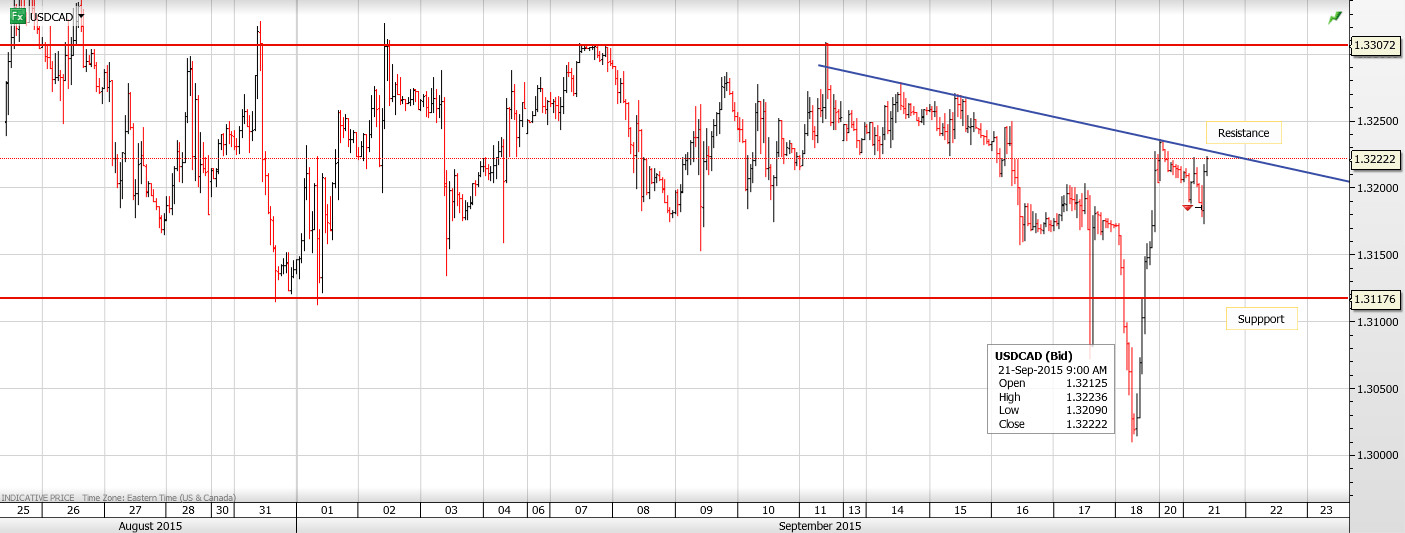
USDCAD Range 1.3015-1.3182        

A series of Fed speakers today and over the weekend made hawkish noises and since they were all from the hawkish camp, the noises shouldn’t be unexpected.  Nevertheless, they managed to give the US dollar a lift across the board with their suggestions that a 2015 rate hike remained a strong possibility.

USDCAD climbed off Friday’s roller-coaster ride and traded sideways throughout the Asia session before edging lower in Europe. Part of the Loonies modest gains can be attributed to a report that Opec is forecasting oil to be at $80.00/bbl by 2020, which is a grasping at straws type of move on a sketchy forecast. But that was Europe.  In North America, USDCAD has rallied, despite the WTI bump higher due to general US dollar strength vs. the majors.

Japan is closed until Thursday for various holidays sucking out a ton of liquidity during the Asian time zone. Since the FOMC members pointed to China growth concerns as a recent for standing pat, Chinese PMI data on Wednesday may be a bigger factor for FX

Bank of Canada governor, Stephen Poloz gives a speech in Calgary today which may provide clues as to how the BoC views the risks to the Canadian economy from a global economic slowdown. The text is available at 2:30 pm EDT

Technical Outlook

USDCAD continues to churn within the well-defined 1.3000-1.3350 range.  There is a minor intraday downtrend which remains intact while trading below 1.3250 that will extend losses to 1.3110 on a break of 1.3180. The post rate cut rally from July ended with a break below 1.3200 last week which should limit the top to 1.3250-70 this week.

Today’s Range 1.3180-1.3250

Chart: USDCAD hourly                                    Larger Chart
CAD-21-SEPT-1024x388

SP500 Index update – End Run Smash Looks Imminent…

Originally published September 19th, 2015.

The market didn’t waste any time “getting on with it” yesterday after the bearish action on the day of the Fed announcement. It fell, and hard. We are going to look at this carefully because what appears to be starting is a devastating “end run around the line” smash – if so a brutal plunge is just around the corner.

A few days back we were a little too accommodating in adjusting the upper boundary of the Pennant shown on the 3-month chart below when the index pushed out of the top of it. We shouldn’t have and on this chart we are going back to our original Pennant boundaries, which is important as it enables us to define where the support is at the apex of the Pennant. As you will recall the upside breakout from the Pennant, on the basis of its original boundaries, was regarded with deep suspicion, and it appears to have been the product of manipulation – Fed buying to “paint the tape”, especially as there was no such breakout in other markets like the London FTSE and Tokyo Nikkei, where a parallel Pennant had formed. If so then they may soon end up with egg on their faces.

38977 a

Other world market indices such as the Europe STOXX600 shown here, and the London FTSE and the Tokio Nikkei, which have similar bear Flags or Pennants completing, did not confirm the false upside breakout from the Pennant on the US S&P500 index before the Fed announcement…

38977 bMeanwhile, the Transports, which had a surprisingly big recovery rally after the August plunge, are perfectly positioned to drop away hard after failing at downtrend line resistance with a bearish “Shooting Star” and then breaking down from their recovery uptrend…

38977 c

The market is at a critical juncture because yesterday it dropped to the support at the apex of the Pennant. If this fails – and it is expected to perhaps after a minor bounce – then we will quickly find ourselves in an “end run” smash situation, which is what happens when a Pennant or Triangle breakout fails in this manner. The market should drop away fast, perhaps like a rock, and the downside target for this move is 1730, which it could easily exceed. However, if it doesn’t slice through the support at the August lows in the 1870 area and sticks there we may ditch half of our Puts there for a good profit, and let the rest ride. We’ll see how it looks when it gets there. With respect to nailing the get out point for Puts, the Transports chart shown above is helpful as it gives us a potential downside target at the lower boundary of its expanding downtrend channel.

With the gold and silver markets surging since the Fed’s decision to keep interest rates unchanged, today King World News is pleased to share a piece that illustrates commercial hedgers have become even more bullish on the price of gold.  This piece also includes a key illustrations that all KWN readers around the world must see.

Jason Goepfert at SentimenTrader:  “The latest Commitments of Traders report showed that large hedgers added the most aggressively to gold…

…continue reading HERE

test-php-789






