
Timing & trends
Ever since the March 2009 crash low, I’ve maintained my view that the Dow Industrials and broad U.S. equity markets were entering a new bull market — and that the Dow Industrials would eventually hit 31,000+.
One of the major tools I used to come to that conclusion back then was the ratio of the Dow Industrials to the price of gold.
I wrote extensively about it in my July 2008 issue of Real Wealth Report — even before the crash of 2009, which I also forecast — and several times since. Today I want to update that analysis for you.
First some background. At the peak of the ratio of the Dow Industrials to gold in the year 2000, the Dow Industrials would have purchased just over 51 ounces of gold.
During the financial crisis of 2007-09, as equities plunged and gold had rallied (since its bottom in 2000) the ratio collapsed all the way down to the 6 to 7 level.
In other words, in terms of gold — what I like to call “honest money” — the Dow Industrials had lost more than 87% of the entire equity bull market from 1980 to 1999.

In my Real Wealth Report issue of July 2008, I called for the bottom in the ratio to come in around the 5 to 6 level.
It bottomed slightly above that level, then retested it with a slightly lower low in September 2011.
Since then, stocks have vastly outperformed gold. Here’s the chart I published back then, but with updated comments and analysis.
As a result, the ratio of the Dow Industrials to gold started widening back out, and also broke out of a resistance level, which you can also see on the chart.
Now trading at about the 14.5 to 1 level, the Dow/gold ratio is set to widen much further.
So what does this all mean? And what does it hold for the future for the Dow? For gold?
I’ll answer those questions now. But I urge you to put your thinking cap on, because the analysis of the Dow/gold ratio is not easy to grasp, yet it’s critically important to understanding the future.
FIRST, the collapse in the Dow-to-gold ratio during the financial crisis was not caused simply by a crash in equity prices. It was also due to a crash in the value of the dollar during that time period, as reflected in the soaring value of gold from the year 2000 on.
SECOND, the breakout in the ratio means that the Dow is now beginning to adjust its value to its ratio to “honest money” — as measured by its value versus gold.
This adjusting of equities is perfectly normal and one of the main reasons I am very bullish equities over the next several years (after a normal but sharp pullback occurs).
A simple exercise here will show you why. For the Dow/gold ratio to climb back to the 18 to 20 level resistance level you see on my chart, the Dow would have to explode higher to the 23,480 level, assuming gold’s current price of roughly $1,174.
Naturally, the price of gold is not going to remain at $1,174. So let’s run a simple matrix of the price of gold and assume the Dow eventually gets back to a ratio of 20 to 1.
Let’s say, for instance, that gold eventually falls to $900. At 20 to 1, that would put the Dow around 18,000.
Or take a super-extreme, super bearish price for gold at say, $800. A 20:1 ratio puts the Dow at 16,000.
Clearly, there’s not a lot of downside to the Dow even if gold were to plunge all the way back to $800 (which is highly unlikely).
Now, let’s look at the flip side: What would happen to the Dow Industrials if gold were to move $1,500? Then to reach a 20 to 1 ratio, the Dow would have to explode to 30,000.
And at $2,000 gold, a 20:1 ratio would see the Dow eventually hit 40,000.
Do this exercise for any price level of gold you wish, and you will see that the downside risk in the Dow is minimal and the longer-term upside potential is enormous. Ditto for gold.
That’s not to say there won’t be pullbacks in the Dow. There will be. We are in the beginning throes of one now. One which should be avoided, owning as few stocks as possible.
But given the breakout from the bottom of the Dow/gold ratio in September 2011 … and the normal tendency for all markets, no matter what they are, to retrace good portions of what they have lost …
I believe it’s a very safe assumption to make that the Dow/gold ratio will continue to climb. And that means — longer-term — much higher prices to come for the Dow, and U.S. equity markets in general.
As for gold and silver right now, the bounce you’ve seen is nothing more than a dead cat bounce. The precious metals, and commodities in general, have NOT bottomed.
But the bottoming process should soon begin.
As for the Dow Industrials right now, here too, the bounce you’ve seen is nothing more than a dead cat bounce. Stocks will head lower in the shorter-term — before blasting off again to the upside.
But once the equity markets and gold do indeed bottom — both will be off to the races on the upside, in rip-roaring new bull markets where both equities and gold will soar, together.
This analysis also shows you why it’s so very important that you think out of the box. Most analysts will say I’m nuts to say gold and equities will eventually soar together.
But it’s not nuts. And in fact, it has happened before, many times, the most important of which was between 1932 and 1937, when gold and the Dow both soared, together, in the middle of the Great Depression.
Best wishes,
Larry

The paranoiac is the exact image of the ruler. The only difference is their position in the world. One might even think the paranoiac the more impressive of the two because he is sufficient unto himself and cannot be shaken by failure. ~ Elias Canetti
Feels like 2011 all over again. The Dow is tracing a pattern that bears an uncanny resemblance to the one set in 2011. History could be repeated again; the Dow could be ready to rumble instead of being taken down for the count. When the markets were plummeting in 2011, many experts were making the same dire predictions, while others were wondering if the bull had bashed its head into a brick wall. Turns out that the so-called crash was nothing but a hiccup in what turned out to be one of the most massive bull run’s of all time. Faced with the same paradigm again, the talking heads (many who actually have the impudence to call themselves experts) are marching to the same drumbeat and chanting the same hymn of doom.
As we live in an era of lies and deceit, where rampant manipulation is the order of the day; worse still, no one is contesting this manipulation. The masses have embraced that this is their destiny and surrendered to this new market norm. A norm that rewards speculators and punishes savers. As the laws of reality have been suspended (courtesy of the masters of deception, otherwise known as the friendly Fed), the markets will only crash if access to easy money is eliminated. This hot money is what’s fueling the markets and will continue to do so in the foreseeable future. Against this backdrop of deceit and corruption, normal market rules cease to apply.
Therefore, our contention has been that every major correction for the past several years is nothing but the market letting out a well deserved dose of steam and that a massive crash is not the makings; at least not yet. One day the markets will crash, but as this market is being propped up a by hot money, anything and everything will be done to prevent the markets from crashing. If there was any dose of freedom left in these markets, they would have crashed long ago. There is a stark difference between thinking you know what will happen and from knowing what is going to happen. Mass psychology clearly states that markets usually run into a brick wall when the Crowd is Euphoric and chanting “Kumbaya my love”. This is not the case yet and sentiment is far from the euphoric zone. This is one of the most hated bull markets in history.
Is this Deja Vu?
The predictions that Dow was destined for destruction during the correction of 2011 might have appeared erudite in nature. Those predictions, now in retrospect, sound more like the ravings of a lunatic. Be wary when the masses are joyous and Joyous when they are not, that in essence is the most basic tenet of mass psychology.
Dow Pattern in 2011

-
In 2011, the from high to low the Dow shed roughly 16.2% or 2,070 points. Now, depending on your entry point the experience could have ranged from being mild to crash like in nature. If you purchased right at the top, then the word crash was probably flashing through your mind. Just because you think it’s a crash does not necessarily signify that your perceptions, that are being overwhelmed by fear are correct.
-
All media outlets were busy flooding the waves with stories that extremely pessimistic in nature. Misery loves company and stupidity simply adores it. Consumer confidence was not strong, the U.S. credit rating was downgraded, manufacturing was slowing down, and the list goes on. . The 3rd quarter ended and the 4th quarter began and all those bogeyman stories well proved to be just that.
Markets climb a wall of worry and plunge down an abyss of joy; this is clearly demonstrated in the chart below

In 2011, the Dow ended the year on a positive note, defying all the predictions of disaster. Three months into the new year (20120, the Dow soared to a series of new highs. Like cockroaches, the naysayers vanished into the woodwork waiting for another day to sing the same old monotonous song, buoyant that time would make the masses forget the old proclamations and embrace the new ones; this falls dangerously close to the definition of insanity. Doing the same thing and expecting a different outcome. So far the outcome appears to be the same and if the pattern is repeated, then these chaps are going to get clobbered.
Dow outlook 2015

During the so-called market crash phase that started in August, the Dow from high to low shed approximately 16.3%….. Strikingly close to the 16.2% that the Dow gave up during the 3rd quarter of 2011. So far, in the 4th quarter, all the major market indices are faring much better as was the case back in 2011. In the 4th quarter, the Dow has tacked on almost 5%.
Market Sentiment during the so-called crash phase

The VIX, which is an index that measures fear blasted as it was being chased by the hounds of hell. ItX surged to a new 5 year high, pointedly illustrating that the masses were hysterical. Panic is the secret code name for opportunity. Mass psychology clearly indicates that when the crowds panic, the astute investor should be ready to jump in.
The bullish case for the Dow builds:
-
A host of technical indicators are still trading in the extremely oversold ranges.
-
Our trend indicator is dangerously close to triggering a new buy signal. The fact that it did not move into the sell zone validated that the correction was nothing but a market letting out some well-deserved steam.
-
Retailers like Costco (COST), L Brands (LB), Fred’s (FRED), etc., all surprised analysts by reporting stronger than projected same-store sales.
The Game plan going forward
Fear has to be avoided under any circumstance when it comes to investing. It is a detestable emotion that just sucks you dry. It takes and gives nothing back in return. When the crowd panics, one should resist the urge to become one with fear and the crowd. We are not in the jungle and fear is a useless emotion when it comes to making money in the markets. Get rid of it or it will get rid of you. Fear is a parasitic emotion; the only good parasite is a dead parasite. So shoot to kill when it comes to fear.
To break even for the year, the Dow only needs to trade approximately 600 points higher. If examines the entire journey (up and down) the Dow traversed from August to Oct, the count comes in at roughly 5000 points. Examined from this angle, 600 points does not amount to that much; the Dow still has roughly three months to achieve this objective.
The ride up is expected to be volatile as our V indicator is trading well above the danger zone; 1100 points higher to be precise. This means that extreme volatility is going to be the order of the day. One should not expect the ride up to be smooth. We have a fair amount of resistance in the 17300-17400 ranges. The ideal set up would be for the Dow would trade in these ranges, with a possible overshoot to 17,600 and then proceed to test 16,500-16,600 ranges. The Dow is then expected to put in a series of higher lows, ending the year on a positive note.
Bear in mind that the above targets should serve as rough guideposts. We never focus on trying to identify the exact bottom or top, a task we think is best left to fools with an inordinate appetite for pain. The game plan should be to view all strong pullback as buying opportunities.
Dow Dejavu? When one examines both the patterns (2011 and 2015); the answer appears to be “yes”
Action cures fear, inaction creates terror. ~ Doug Horton

Marc Faber comments on the outlook for stocks during this short video clip.
A look at the 1987 Stock Market Crash:
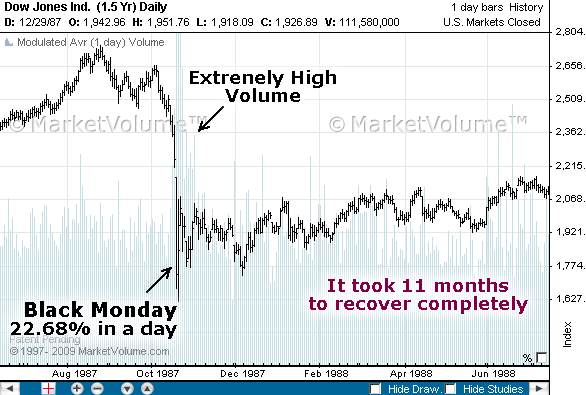
Chart via symonsez.wordpress.com
Faber interview with Bloomberg’s Joe Weisenthal, Scarlet Fu and Alix Steel on “What’d You Miss?” (Source: Bloomberg)

Peter Schiff on the Fed, also Elections No Big Deal for Canada’s Dollar is an article that was “curated by the editorial staff at Euro Pacific Capital to keep you up-to-date with the most vital market information.”
 About Peter Schiff
Peter Schiff, the Euro Pacific Capital’s President and CEO. He is known for his vocal and unpopular bearish views of the U.S. economy, voiced prior to the 2008 financial crisis, many of which were outlined in his 5 bestselling books, including “Crash Proof: How To Profit From The Coming Economic Collapse.” Mr. Schiff leads our experienced and diverse team of managers, researchers, consultants and support staff – a team that is literally scanning the globe for investment opportunities – by endeavoring to deliver the highest possible value for our clients

-
I know Mike is a very solid investor and respect his opinions very much. So if he says pay attention to this or that - I will.
~ Dale G.
-
I've started managing my own investments so view Michael's site as a one-stop shop from which to get information and perspectives.
~ Dave E.
-
Michael offers easy reading, honest, common sense information that anyone can use in a practical manner.
~ der_al.
-
A sane voice in a scrambled investment world.
~ Ed R.
Inside Edge Pro Contributors

Greg Weldon

Josef Schachter

Tyler Bollhorn

Ryan Irvine

Paul Beattie

Martin Straith

Patrick Ceresna

Mark Leibovit

James Thorne

Victor Adair