
Gold & Precious Metals
 With a 4.5% chance of rate hike priced into the markets at today’s FOMC meeting, it is unlikely that anything exciting will happen today. However, with China outflows, BoJ easing expectations, and Draghi still promising moar, it appears precious metals are once again bid. Both Gold & Silver have broken back above their 200-day moving-averages this morning…
related at ZeroHedge:

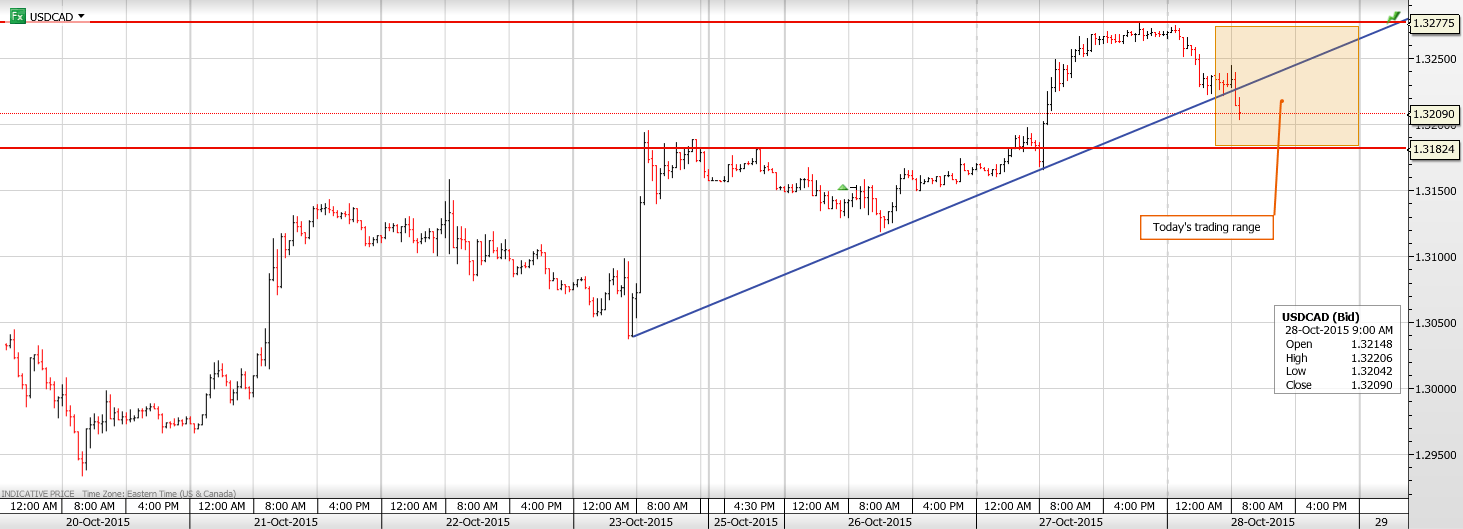
USDCAD Overnight Range 1.3220-1.3277
The Federal Open Market Committee will release their interest rate decision and statement at 2:00 pm. The prevailing wisdom is that the lack of a press conference makes it extremely unlikely that they will raise rates. Many are hoping that the statement omits references to recent “global economic and financial developments”. If so, the statement will be viewed as hawkish and as a signal that December is a go for lift-off. Other’s just hope for a degree of clarity in the statement. One thing is for sure and that is that someone will be disappointed with the statement.
The FOMC statement worries took a back seat to data in Asia. Sharply weaker than expected Australian CPI data knocked the Aussie for a loop and opened the door for a rate cut next week. Japanese Retail Sales data did not have the same effect on USDJPY. It was weaker than expected but no one cared and USDJPY hovered around the New York closing levels. The European session saw a quiet morning with EURUSD and GBPUSD fairly quiet within narrow ranges.
USDCAD hugged the 1.3260-70 level throughout the Asian session but drifted lower in Europe when oil prices moved higher. WTI rose from a low of $43.06 to $43.67 and that was all the Loonie needed. That trend has continued during so far, during the New York session as oil is back at its overnight highs. Unfortunately, today’s move is just noise until the FOMC statement.
USDCAD traders will be keeping their eye on the Energy Information Administration (EIA) crude Oil stocks change report which is out just before the FOMC statement.
USDCAD technical outlook
The intraday technicals are bearish following the rejection above resistance at 1.3280 and the break below 1.3230. The move below 1.3230 will target the 1.3160 uptrend from October 15. For today, support is at 1.3210, 1.3190 and 1.3160. Resistance is at 1.3270 and 1.3340.
Today’s forecast range is 1.3180-1.3270
Chart USDCAD 30 minute Larger Chart

Always do what you are afraid to do. ~ Ralph Waldo Emerson
We are listing excerpts from past market updates to illustrate how the mass mindset is always wrong. Even big shots like Bill Gross are not exempt from being sucked into this black hole, otherwise known as the mass mindset. Herd psychology clearly indicates that the only time a market is going to crash is when emotions have hit a boiling point. In other words, the crowd is foaming with joy. However, regarding bonds, there is one more factor that needs to be considered. The element of control and that element has a name; it is called the Fed. They are the ones that are going to determine when rates rise, as they are holding it down for an unusually long period. The simple question that comes to one’s mind is why? The answer is equally simple. The current economic recovery is nothing but smoke and mirrors; the Fed understands that the Crowd is aware of this phenomenon, but if the markets are driven up, then a glimmer of hope emerges. Hope springs eternal and even though the masses know that all is not well, this ray of hope that things will get better because the markets are soaring higher is what keeps them trudging along. Lost to them is the fact that the markets are trending higher only because rates are being artificially kept lower, so this hope sets off a chain reaction. More hot money is needed to fuel the illusion that all is well. The only way to pull this off is to keep rates down at extremely low levels. Low rates create an environment that fosters speculation. In this environment, speculators are rewarded, and savers are punished. Unfair. Damn right but that is life. So before you jump on the bandwagon of doom, understand that most of those naysayers are like broken clocks. Even a broken clock is right twice a day. What you should strive to understand is that every disaster is nothing but opportunity dying to plant a big fat kiss on your cheeks. Embrace the bugger, instead of kicking him to the curb as most do. See the world for what it is and not what others (so-called) experts force you to see. March to your drumbeat and not to the drumbeat of the talking heads, whose sole function is to add make a simple development appear to be scary and frightening. If you bought the nonsense the world was going to end; the markets were supposed to crash, blah, blah. You would have lost your shirt, your pant and your knickers in the process. Do not give credibility to people who only employ the tool of fear to sell you a bag of magic bones.
The excerpts listed below together with this chart will illustrate how dangerous it is to follow the doctors of doom.

Bill Gross has been predicting a collapse in the bond markets for quite some time and one day most likely he will get it right. Rates have to be allowed to move a little otherwise it will appear that the Feds are completely controlling everything; even though this is true, the masses do not believe this, so appearances must be maintained. Higher rates mean higher debt payments and higher costs to business and this must be avoided at all costs. Business are always given the best deal. America is bought and paid for by the corporate world. ~ Market Update May 17, 2015
Since we made these comments, bonds have rallied nicely, but we feel that they should (key word should) retest their lows before moving higher and testing their old highs. The trend has not turned negative and the reason bonds sold off is because too many fools had over-leveraged themselves in the futures markets. When there was talk from the Feds that rate hikes would be inevitable, markets pulled back and some of these long positions were so leveraged that some players were forced to liquidate their positions; this turned what would have been an orderly pullback into a short-term blood bath. This pullback allowed the Feds to give the impression that they are not manipulating the markets, some stupid fat greedy bulls were slaughtered, the bears were pushed into opening new shorts, so everything has been set up for a rebound. At this point of the game, bonds are still expected to reverse course and trade higher. ~ Market Update May 31, 2015
Bonds pulled back strongly and not only did they test their lows; they dropped to new lows, fulfilling the illusion the Feds wanted to create that the markets are free. What most have failed to note is that bonds have sold off several times during this bull market that started in 2008? In every instance, bonds recouped their losses. One day, this pattern will stop, and the trend indicator will inform us of this in advance. Until then, let the good Samaritans try to help everyone, and the naysayers sing their infamous song of impending doom. This up and down process will further cement the view that the Fed is impartial. It is the classic story: strong correction, then consolidation (lots of up and down movement) and then a new breakout that leads to new highs. ~ Market Update,June 19, 2015
As the trend has not turned negative, we have to view the current correction (regardless of how strong it might or might not be) as a normal cyclical move, in an otherwise healthy market. ~ Market Update June 30, 2015
After letting out some steam, bonds rallied as expected and by the middle of July, they had recouped almost losses that incurred, confirming that the naysayers were wrong once again. One day bonds will correct strongly and in our opinion bonds are more likely to experience a stronger correction than the Stock market. Stocks are far from overvalued, and the sentiment is not euphoric yet. As long as the trend indicator is bullish or neutral we will view all strong corrections as buying opportunities. Additionally, the Fed is not in a rush to raise rates, and they could play this game of cat and mouse forever. Ultimately as this economic recovery is nothing but illusory in nature, and the Fed will be forced to come out with another QE program.
So, while many well-educated, but not savvy market penguins stated that bonds were going to plunge even more, they recovered as expected. They traded past 152-153 ranges and are now on the way to test the 156 ranges. If they close above 156 on a weekly basis, then they will challenge the old highs or at the very least test them. The weekly trend is up; therefore, all pull-backs have to be viewed as buying opportunities.~ Market Update July 31, 2015
Bonds traded as high as 159-28 before pulling back, setting up the path for a possible test of the old highs. The weekly trend is still up, so all pullbacks have to be viewed as buying opportunities. We could recite more nonsense, but that would mean wasting good time on a senseless endeavor, so we will respectively decline the offer. Bonds will crash one day; however, we would rather not fixate on one day. We prefer to look at today, and today is not the day they are going to crash. The move by China to devalue its Currency last week could very well be the excuse the Fed needed to leave interest rates untouched, and then slowly build the notion that some sort of stimulus is needed. ~ Market update August 19, 2015
Bonds rallied but failed to trade to new highs yet, as the trend is still up, one can expect bonds to attempt to test their highs again. As equity markets and bonds are diverging, a move to new highs by bonds, would coincide with another corrective wave in the equity markets. ~ Market update Sept 1st, 2015
Even if the Fed raises rates, and at this point its a 50-50 shot a best, we expect the Feds to come out with some insane form of QE. Perhaps a QE for the people might be the next game plan; It sounds insane, well believe it or not Jeremy Corbun, Britain’s new labour party leader has proposed just this. You can read the full story hereNote that QE is still going on in the form of share buybacks. Based on the number of share buybacks authorized this year, the total dollar amount is set to exceed $1 trillion, setting yet another new all-time record. There is strong support in the 150-15 to 152 ranges, and the current consolidation should end there. ~ Market Update Sept 15, 2015
Try to recollect how you acted every time the markets sold off, whether it’s the bond market or stock market, it’s irrelevant. Did you give into fear, did you panic and Join herd as it stampeded towards the exit. A mind driven by panic cannot act rationally. Therefore, any action is bound to lead to a negative outcome. The best thing to do is to focus on what the crowd is doing and then use technical tools to help determine entry or exit points. It is the masses that produce the extreme moves in the market, and if you understand that fact, then you can use it to your advantage. We viewed every pullback as buying opportunity because the trend was still up.
So what’s next?
First and foremost make sure you never listen to the Doctors of Doom. They are not out there to help you; they will cloud the picture even more. If they knew when the markets were going to crash, then they would be sitting on the beaches of some tropical paradise, sipping Pina Coladas and raking in the millions. Instead, you find them screaming bloody nonsense and doing their best to scare individuals into believing what they very well know to be nonsense. Understanding the psychology of the masses is key to being a successful trader. When you couple technical analysis to the powerful concept of mass psychology, it becomes easy to understand what the masses will and will not do. One can then use the Technical indicators to fine tune one’s entry point.
Bonds
Overall the bond market is far more overvalued than the stock market, and we believe that for now, it would be best to sit on the sidelines regarding bonds. Ideally they will test the 149-150 ranges, with a possible overshoot to the 147 ranges, at that point one could take a closer look at them. The reason for this view is simple. Stocks are far from being overvalued, and the sentiment is not trading in the euphoric ranges. Therefore, every strong pullback has to be viewed as a buying opportunity. We expect the Dow to experience another pullback, the final strong pullback for the year. It is expected to test the 15800-16000 ranges, with a possible overshoot to the 15500 ranges. If this comes to pass we, will view it as a splendid buying opportunity as the Dow should end the year in the black. Next year, the Dow index is expected to trade to new highs; this was covered in a recent article titled; the Dow is getting ready to soar
Tactical Investor, where mass psychology and technical analysis converge seamlessly

 The Casey Research founder on:
• The implications of cheap oil…
• Specific steps you can take to protect your money from the next financial crisis …
• His thoughts on gold and other commodities…
• His thoughts on China…
• Who will win the U.S. election…
Editor’s Note: Doug Casey answered dozens of investment questions during the recent Casey Research Summit. We transcribed five of Doug’s best answers, and we’re sharing them with you below. What you’re about to read is Doug speaking to a live audience. His responses are unrehearsed.
• When asked about the implications of cheap oil…
Doug Casey: I always look on the bright side, and the bright side of low oil prices is that most of the countries that produce oil are just horrible places. Low oil prices will help to bankrupt the governments of these places, and that will, hopefully, set the stage for things to get better.
Look at the countries that produce a lot of oil: Russia, Saudi Arabia, Iran, Iraq, Venezuela, Nigeria…they’re all just horrible. It’s no accident. Easy wealth, owned by the state, is a formula for disaster.
Hopefully the oil price will bring on the collapse of the Saudi regime, one of the U.S.’s longtime puppets. It’s amazing how the U.S. has gone around and destroyed all kinds of regimes – most of which, frankly, were abusive and corrupt and needed killing – but the Saudis are one of the worst of them. Hopefully low oil prices and their ridiculous spending habits will bring down that terminally corrupt theocracy. Among others…
Another good thing about cheap oil is it should show anybody that’s got half a brain that Russia and Putin are non-entities. They’ve got a decent military, but all they can do is export oil. It’s like a primitive, third-world country with a first-world military. Well, kind of a first-world military.
So low oil prices are a very good thing. I don’t know how long they’ll stay low. But they’re going lower for the time being. Production is stable to up, but consumption is headed down with a slowing economy.
And I’m all for oil going even lower. I hope it goes down to $10 a barrel. At that point you can buy it reflexively and make a huge killing. But I’m still short oil at the moment.
• When asked who will win the U.S. election…
Doug Casey: I’ll put my money on Trump.
The reason for that is he’s an outsider. He’s not currently part of the Deep State. He speaks his mind. That’s refreshing. People like that, whether you like his opinions or not.
And here’s the most important reason. By this time next year we’re going to be in the midst of a gigantic crisis. The crisis could’ve happened anytime in the last few years. But I really believe it will happen within the next year.
The average chimpanzee will want somebody who has certainty and will tell them that he can solve things. And the Donald has lots of certainty.
It appears the Democrats will anoint Hillary, at least if she’s not jailed. She certainly knows how to push the “envy” button. But I’ll put money on the Donald as the Republican candidate. And very possibly the election itself.
• When asked for specific steps you can take to protect your money from the next financial crisis …
Doug Casey: Don’t keep too much money in a bank. What happened in Cyprus is likely to happen other places.
Have a lot of gold coins in your own possession, and some silver.
And you definitely want to diversify politically…which almost nobody does. Everybody says, “Yeah, it’s a good idea,” but hardly anyone does it.
It’s very hard to open up a foreign bank account today, but at least it’s still possible. You should also open up and use a foreign brokerage account. And you should have a crib outside of your home country.
Your biggest risk is not investment risk, although that’s very big. It’s political risk. So you’ve got to diversify politically.
(Editor’s Note: Going Global 2015 is our guide to diversifying politically. It will show you practical steps you can start taking today to protect your money from a crisis…like how to open a foreign bank account (page 11), how to open a foreign brokerage account (page 35), and what you need to know before buying foreign real estate (page 44). Click here to learn more.)
• When asked for his thoughts on gold and other commodities…
Doug Casey: I think the bear market in gold that started four years ago has turned around and is headed up. I think all the commodities are headed up at this point.
Some commodities, like coffee and sugar, are very low in both real terms and relative terms. So I’m selling naked puts against them.
(Editor’s note: selling naked puts is a strategy sophisticated investors can use to make bullish bets on a stock or commodity.)
I like selling options. The reason I like selling options is that time is on your side. I sell nearby in time and not so far away in price options. The nice thing about selling options is you don’t have to be very right to make money. You just have to not be very wrong, which is a lot easier…especially when you think you’ve got a major bull trend on your side. Which I do think in most commodities right now, certainly including gold and silver.
But take it easy with margins and leverage. Somebody without prudence and experience going into the commodities market is like handing a chainsaw to a six-year old. You’re just asking for trouble.
• When asked for his thoughts on China…
Doug Casey: On the one hand, the change in China over the last 30 years is unbelievable. I lived in Hong Kong 30 years ago and visited China. When I first flew into Beijing, the airport was about the size of the airport in Aspen, Colorado. And when I drove into Beijing from the airport there were still peasants – this is the truth – with oxcarts on the side of the road and oxen plowing the fields. And it was a two-lane highway from the airport to Beijing.
Now it’s totally and unrecognizably transformed…and this is true all over the country. So what’s happened in China is unbelievable. Nothing’s happened like that in all of world history anywhere.
That’s the good news. The bad news is that there are huge distortions and mistakes and misallocations of capital in China.
And all the banks are bankrupt…
The Chinese are famous for saving a third or half of their salaries. How do they save? Like everybody around the world saves. They take their country’s currency, yuan, and put it into banks.
So Mrs. Wu puts her yuan in the bank and she expects it back.
The problem is with the Chinese banks. They’ve financed all these goofy but spectacular projects that the Chinese government has pushed.
Two things could happen when hundreds of millions of Mrs. Wu’s go to the bank and try to get their yuan. Either she doesn’t get her yuan back, which will make her very unhappy. Or she will get it back…but it won’t be worth anything, which will make her equally unhappy.
China will have riots. It could break up into five or six little countries…because Shanghai is very different than Beijing, which is very different than Guangzhou.
So China’s ultimate future is unbelievably good. But its near-term future is probably pretty bad.
Money Talks Ed Note: for more from the summit and special offers from Casey Research Click here to learn more.

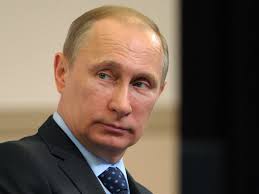 It is said that nature abhors a vacuum and that history is broadly the history of leaders. The vacuum that is the Middle East is now drawing in Vladimir Putin, one of the boldest characters on the world stage. By drastically raising its military presence in the region, Russia is taking advantage of political confusion and paralysis in the West to create a Middle East that may be more supportive of her interests. While the focus now is on Syria, highlighted by the surprise visit of Bashir al Assad to Moscow, the real target of Russia’s gambit may be Saudi Arabia, which is now incurring massive military expenditures as a result of fighting in Yemen and by proxy in Syria. Like Russia, Saudi Arabia is being hurt by low oil prices. Given both country’s dependency on the price of crude oil, they may have more in common than many may expect.

-
I know Mike is a very solid investor and respect his opinions very much. So if he says pay attention to this or that - I will.
~ Dale G.
-
I've started managing my own investments so view Michael's site as a one-stop shop from which to get information and perspectives.
~ Dave E.
-
Michael offers easy reading, honest, common sense information that anyone can use in a practical manner.
~ der_al.
-
A sane voice in a scrambled investment world.
~ Ed R.
Inside Edge Pro Contributors

Greg Weldon

Josef Schachter

Tyler Bollhorn

Ryan Irvine

Paul Beattie

Martin Straith

Patrick Ceresna

Mark Leibovit

James Thorne

Victor Adair