
Timing & trends
 As we head into the black Friday holiday shopping season, cash is king.
Cash will be the most popular payment method for shoppers buying holiday gifts, with 39% of Americans saying they plan to use it for most of their holiday purchases, in a recent survey of 1,000 shoppers personal finance website Bankrate conducted with Princeton Survey Research Associates International. This number was about the same as in 2014, when 38% of holiday shoppers said they planned to use cash.
Behind cash, the most popular choices for payment were debit cards, with 31% saying they would pay this way, followed by credit cards (22%) and checks (3%).
Younger shoppers were especially unlikely to use credit cards; 48% of millennials said they would do most of their holiday shopping with debit cards, and 36% said they preferred cash. Mobile payments are still unpopular; only 14% of U.S. adults with smartphones or similar devices plan to make even one mobile payment during the holiday season, according to Bankrate.
Millennials in general tend to avoid credit cards more than previous generations have done; 63% of millennials don’t own a single credit card, according to a separate Bankrate survey in 2014. “They grew up in the Great Recession and saw what happened with their parents,” Cetera said. “They don’t ever want to be in a situation where they’re in debt. They’re shying away from high-interest loans, essentially.”
Millennial Attitudes
That stat on credit card usage by millennials is precisely in tune with a statements I made in 2008 if not before.
- Kids will be competing with their parents and grandparents for jobs that do not pay a living wage.
- Children whose parents are being destroyed by debt now, will keep those memories for a long time.
Deflationary Trends
- Millennial attitudes
- Technology
- Demographics of aging boomers
- Student debt
- Millennials overpay for healthcare
- Low family formation rates
The Fed, the ECB, Bank of Japan, Bank of China, etc., are fighting major deflationary forces.
Attitudes are the key force actually. It took two generations for memories of the great depression to go away.
And it will take at least a generation for millennials who saw their parents lose their homes or get into huge fights over money for those memories to vanish.
To top it off, the Fed (central banks in general) has spawned another enormous asset bubble that will hugely add to deflationary woes when it pops.

 Dollar will likely continue to rise. We Are NOT In a CURRENCY WAR said Faber……

I remember how in 2003 the late legendary Barton Biggs, a strategist for Morgan Stanley, proclaimed in one of his Investment Perspectives that 10-year Japanese government bonds (JGBs) were “the short of the century.” Japan had just gone through 10 years of deflation and the 10-year JGB yields had gone from nearly 8% at the time of the all-time high in the Nikkei 225 benchmark index (at near 40,000 in December 1989) to a hair shy of 40 basis points (0.4%) in 2003.

Doctor copper, can no longer be viewed as a leading indicator, in fact, a name change might be in order. A change of name from Dr Copper to deadbeat copper might in order, given its dismal record over the years. After the financial crisis of 2008-2009, the economy, the stock markets and copper parted ways; while the markets and the economy trended higher, copper plunged into an abyss, and it is still trying to find its footing.
All Jokes aside, the reason copper is diverging from the markets is because the Feds destroyed the concept of a free market system long ago. Copper is indicating that this economic recovery is nothing but an illusion. However, several rounds of QE, plus interest rates being held down for a record-breaking period, have altered reality. The markets are moving higher because of hot money, and the economic miracle would end without the low-interest rate band aid. Against such a backdrop, copper ceased to work. In this environment, fundamentals and basic technical analysis can lead you astray; in such an environment Mass psychology works the best. The masses have accepted that Fed intervention is the new norm and that the Fed is the saviour. Hence, this is what investors need to pay attention too, as the psychology of the masses is what drives the markets. Given the old historical pattern between, copper and the markets, the stock market should have followed copper into the abyss, but instead we find that several indices are dangerously close from putting in new highs.
The chart below clearly illustrates how copper parted ways with the economy and the markets.
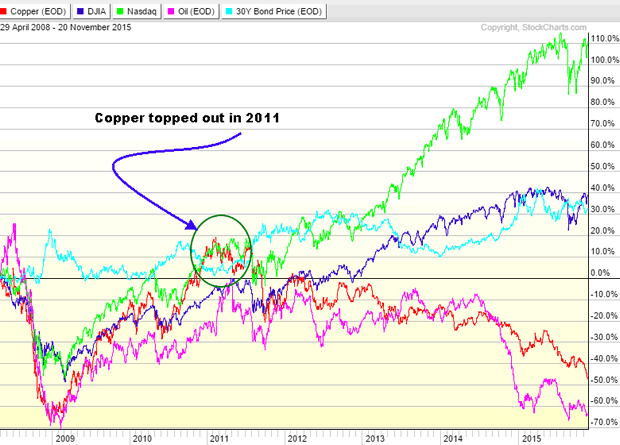
The Dow, the NASDAQ and even bonds have soared to new highs while copper crashed. Surprisingly the only sector that took a similar
path is Oil. However, we suspect that oil will diverge shortly too. Now if the Fed’s really wanted to cement this illusion, they would create the forces necessary to give copper prices a boost. Up until 2011, copper trended with the markets and given the proper environment, copper could trend in tandem with the markets. Until, the hot money factor is eliminated from these markets Dr Copper cannot be viewed as a leading indicator.
Why have the economy and the stock market refused to follow Coppers lead?
As we stated before, any shred of free market forces was totally eliminated after the Fed decided that propping up this market was more important than allowing free market forces to deal with the situation at hand. In fact, we came out with an article in June of this year clearly stating that Free markets no longer existed. First we had QE, this distorted the markets, but when it ended officially, the assumption was that everything would return to the norm. The ultra low rate environment favoured speculation, and the corporate world stepped in with massive share buyback programmes. Quantitative easing never stopped, only the players changed. This year the corporate world is on track to shatter yet another record. According to CNN Money, dividends and stock buybacks are set to hit $1 trillion dollars this year. This amount is larger than the GDP of many nations.
Almost seven years into one of the most hated bull markets in history and still 50% of the crowd is still not investing in the market. In fact, we will soon come out with a short article illustrating that more Americans drink coffee on a daily basis than invest in the markets. The markets never top on a negative note. The media is out with a plethora of negative factors, earnings slow down, energy sector collapse, Terrorism, a possible rate hike in December, and the list goes on.
For now Dr Copper has to hang up his credentials, for Copper is in a coma and in no position to give real guidance on market direction.
There is a lot of negativity in the air, a large percentage of the crowd is still not in the market, and the masses are not euphoric; end-result, this market will rise much further than anyone can currently imagine.


-
I know Mike is a very solid investor and respect his opinions very much. So if he says pay attention to this or that - I will.
~ Dale G.
-
I've started managing my own investments so view Michael's site as a one-stop shop from which to get information and perspectives.
~ Dave E.
-
Michael offers easy reading, honest, common sense information that anyone can use in a practical manner.
~ der_al.
-
A sane voice in a scrambled investment world.
~ Ed R.
Inside Edge Pro Contributors

Greg Weldon

Josef Schachter

Tyler Bollhorn

Ryan Irvine

Paul Beattie

Martin Straith

Patrick Ceresna

Mark Leibovit

James Thorne

Victor Adair