
Currency
Oil is plunging again, this time in the wake of OPEC’s inability to limit its members’ production. The US dollar, meanwhile, is up on the divergence between Fed tightening and ECB/BoJ/BoC easing.
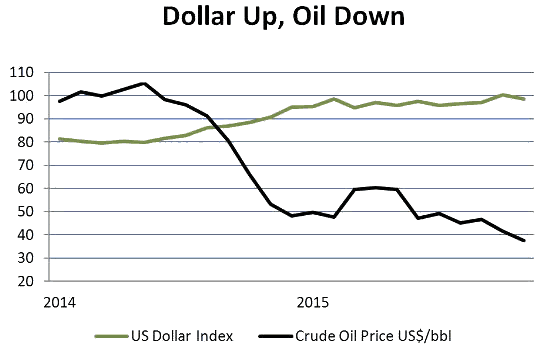
This widening gap is a perfect storm for the many, many entities that have borrowed dollars to speculate in foreign currencies or drill for oil. Some examples:
Emerging Market Debt Sales Are Down 98 Percent
(Bloomberg) – The commodity-price slump and the slowdown in China’s economy are crippling developing nations’ ability to borrow abroad, even as international debt sales from advanced nations remain at a five-year high.
Issuance by emerging-market borrowers slumped to a net $1.5 billion in the third quarter, a drop of 98 percent from the second quarter, according to the Bank for International Settlements. That was the biggest downtrend since the 2008 financial crisis and reduced global sales of securities by almost 80 percent, the BIS said in a report.
Emerging-market assets tumbled in the third quarter, led by the biggest plunge in commodity prices since 2008 and China’s surprise devaluation of the yuan. The average yield on developing-nation corporate bonds posted the biggest increase in four years, stocks lost a combined $4.2 trillion and a gauge of currencies slid 8.3 percent against the dollar. Sanctions on Russian entities and political turmoil in Brazil and Turkey also affected sales by companies in those countries.
Fears rise that junk bond investors are over their skis
(CNBC) – After years of safely reaching for yield through risky assets like stocks and speculative-grade bonds, Wall Street is heading into 2016 rethinking the strategy.
That trend of low defaults has begun to turn the other way, with the trailing 12-month rate rising to 2.8 percent in November, the highest level in three years, according to ratings agency S&P, which expects defaults to climb to 3.3 percent by Sept. 30, 2016.
Moreover, fellow ratings agency Moody’s reported its liquidity stress index in November hit its highest rate since February 2010. Still more troubling is that some of the damage has begun to spill outside the oil, gas and mining sectors, where most of the defaults had been contained.
Fully one-third of oil and gas and mining and metals companies in Moody’s coverage universe are on review for downgrade or have negative outlooks.
Brazil’s Unprecedented Torrent of Downgrades Is Set to Get Worse
(Bloomberg) – Amid Brazil’s economic and political tumult, the nation’s businesses have seen a record number of downgrades this year – and the total is about to get worse.
Fitch Ratings estimates it may slash the ratings of as many as 10 companies for every one it upgrades in 2016. Fitch said that grim scenario is most likely if it chops Brazil’s grade, an ever-growing possibility as the country’s woes deepen.
A top lawmaker initiated impeachment proceedings against President Dilma Rousseff last week, a move that may further undermine the nation’s finances and exacerbate the worst recession in a quarter century. That spells trouble for companies already finding it hard to obtain financing in the wake of an unprecedented corruption scandal at Brazil’s state oil company.
“You will see companies burning cash,” Fitch’s Carvalho said. “The cross-border market is closed for Brazilian companies, and the local market is selective.”
Saudi Arabia’s big welfare spending faces the oil abyss
(CNBC) – If Saudi Arabia maintains oil production at current levels amid the oil price crash, then it’s going to have to cut its budget – or it will likely be bankrupt by the end of the decade. The big issue is Saudi Arabia’s big spending ways, especially increased government spending on social welfare programs.
According to the IMF, government expenditures in Saudi Arabia are expected to reach 50.4 percent of GDP in 2015, up from 40.8 percent in 2014. That increase can be attributed to two things: falling oil prices (it’s bringing in less revenue) and an inflated budget (it’s spending more money).
It’s no secret that a large portion of Saudi Arabia’s roughly 30 million people rely on the government for economic support. In February, the newly crowned King Salman doled out a reported $32 billion to the Saudi people in bonuses and subsidies to celebrate his ascension to the throne.
“We are a welfare society, so the population depends a lot on government subsidies, directly and indirectly,” Abdullah Al-Alami, a Saudi writer and economist, recently told The New York Times. “But one day we are going to run out of oil, and I don’t believe it is wise to be pampered and subsidized.”
To summarize, the world is entering a classic credit crunch, in which lending dries up for marginal borrowers first before tightening for core entities like multinational corporations and developed world governments. And it’s just beginning.
Most of today’s crises evolved with oil considerably higher and the dollar somewhat lower, so current conditions are actually a lot worse than those that, for instance, caused emerging market debt issuance to evaporate and shoved Brazil into existential crisis.
And since oil overproduction will likely to continue while the differences in central bank policies are etched in stone for the next few months at least, it’s possible that the performance gap between oil and the dollar will widen going forward. This will turbo-charge today’s crises and add a few more, as oil producing US states hit financial walls and big chunks of the developing world follow Brazil down the drain.

Here is a list of common reasons I use to throw a stock out of consideration:
Also in This Week’s Issue:
– Stockscores’ Market Minutes Video – Overcoming Impatience
– Stockscores Trader Training – Say No to the Trade
– Stock Features of the Week – Downward Trend Reversals

 Many people confuse Index Funds with ETFs. They are not the same thing at all. And ETFs are definitely not a one size fits all solution. At the end of the day, ETFs can still be actively managed – which has inherent risks and costs associated… CLICK HERE to watch the complete video
The Evidence-Based Investor Video series is a service provided by Paul Philip and the team at Financial Wealth Builders Securities


I know I’m stretching North American history when I speak of the redcoats but the incoming Liberal government of PM Justin Trudeau is creating a regime of “taxation without representation” for a certain class of Canadians.
When I was in politics, I saw how easy it was to wind up a crowd and blame others for the audience’s woes. It’s become politically easy to use the majority to take away from the minority simply by asking them to give a little more for the greater good.
It reminds me of the story of how 10 drinking buddies ended up twisted by entitlement – “The tax system explained using a beer analogy”
The analogy would be funny but something has changed in Canada over the past year. Canadians seem to think it’s ok to go after the rich, that 1% of the population. Perhaps the rich 1% should pay more, but it’s the definition of who makes up the rich 1% that I have a problem with. Is it because Canadians are tired of austerity? Of living within their means? Judging by the provincial governments and the new federal one, you’d have to say “Yes”.
So what does Trudeau represent? He represents the rise of mediocrity, the public service and unions, political correctness and let no man (woman) get ahead of the pack. Ironically, all in an effort to give more to the wealthiest middle class in the world!
Take a look at his tax plan. He will roll back the TFSA investment and maybe even freeze it in the name of fairness. He will dramatically increase deficits over the coming years. Business and entrepreneurs will be taxed to pay for yesterday’s sins and tomorrow’s government pensions. He will increase personal tax of the 1% from 29% to 33%. What is disturbing that the 1% is classified as anyone who makes over $222,000 which is 264,000 tax filers.
If you live in Toronto, Calgary, Vancouver – is $222,000 per year the guy we need to target? Is that the new enemy of the middle class? I could bore you with numbers but there are people smarter than me that can explain that taxing 264,000 Canadians more will not benefit the middle class nor pay down the huge deficit spending about to begin.
I know rich bashing is a time honored tradition for “progressives” but I thought the rich were the people that make millions and have billions? The people with a team of tax lawyers to hide their money from stupid policies – after all, they didn’t get rich being stupid.
My concern is the guy who makes $250,000. You may feel, like my mother-in-law, that everyone should pay their fair share. What is fair share?
There are bureaucrats making over $100,000 year and police officers and teachers making close to $100,000. The difference is they have pensions while the $250,000 business person probably does not. The bureaucrats with their $60,000 pension per annum don’t realize that they are millionaires because the guy making $250,000 needs to have $1,200,000 to $1,800,000 saved to generate that kind of retirement.
Let’s say after taxes at the new 48% tax rate, they have $11,000 a month. If that small business owner is 50 years old and spent 10 years building his business, paying off loans, putting their homes up for collateral, they have the next 15 years to put away $100,000 a year to retire like a bureaucrat. With record low interest rates, that leaves less than $30,000 a year to live on (wait doesn’t that put them in the low income status and thus deserving of a tax break?). They also have to worry about stock volatility, poor investments and confidence men posing as financial advisers trying to steal their money.
If you live in Toronto, Calgary, Vancouver – is $222,000 per year the guy we need to target? Is that the new enemy of the middle class? I could bore you with numbers but there are people smarter than me that can explain that taxing 264,000 Canadians more will not benefit the middle class nor pay down the huge deficit spending about to begin.
I know rich bashing is a time honored tradition for “progressives” but I thought the rich were the people that make millions and have billions? The people with a team of tax lawyers to hide their money from stupid policies – after all, they didn’t get rich being stupid.
My concern is the guy who makes $250,000. You may feel, like my mother-in-law, that everyone should pay their fair share. What is fair share?
There are bureaucrats making over $100,000 year and police officers and teachers making close to $100,000. The difference is they have pensions while the $250,000 business person probably does not. The bureaucrats with their $60,000 pension per annum don’t realize that they are millionaires because the guy making $250,000 needs to have $1,200,000 to $1,800,000 saved to generate that kind of retirement.
Let’s say after taxes at the new 48% tax rate, they have $11,000 a month. If that small business owner is 50 years old and spent 10 years building his business, paying off loans, putting their homes up for collateral, they have the next 15 years to put away $100,000 a year to retire like a bureaucrat. With record low interest rates, that leaves less than $30,000 a year to live on (wait doesn’t that put them in the low income status and thus deserving of a tax break?). They also have to worry about stock volatility, poor investments and confidence men posing as financial advisers trying to steal their money.
If there is a need to pick on the rich 1%, perhaps we should look at those government millionaire pensioners by getting rid of pensions and leveling the playing field. After all, we’re just asking everyone to give a little more for the greater good.
Craig Burrows is the president of Triview Capital, a private equity and alternative investment dealer based in Calgary
Why losing buying power is a worthy goal for a nation’s money has never been fully explained. Nor has it been demonstrated – either in practice or in Ph.D. theses – that buying crummy debts from banks at above-market prices (aka QE) is an effective way to boost consumer prices.
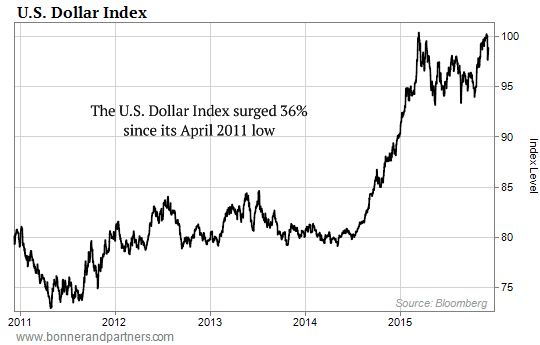
But investors – used to rising stock prices under the Fed’s QE – responded to Draghi’s words like a fat trout to a wiggly worm.
The Dow rose 370 points on Friday… a more than 2% gain.

-
I know Mike is a very solid investor and respect his opinions very much. So if he says pay attention to this or that - I will.
~ Dale G.
-
I've started managing my own investments so view Michael's site as a one-stop shop from which to get information and perspectives.
~ Dave E.
-
Michael offers easy reading, honest, common sense information that anyone can use in a practical manner.
~ der_al.
-
A sane voice in a scrambled investment world.
~ Ed R.
Inside Edge Pro Contributors

Greg Weldon

Josef Schachter

Tyler Bollhorn

Ryan Irvine

Paul Beattie

Martin Straith

Patrick Ceresna

Mark Leibovit

James Thorne

Victor Adair