
Personal Finance
So now that we know the Federal Reserve hiked interest rates, what does it mean to your finances?
The short answer is “a lot.” But different products will behave differently now … and how they behave down the road will depend on what the Fed does in 2016.
 For starters, you should understand exactly what the Fed did. When the Fed “raises rates,” it doesn’t single-handedly raise every single rate in the marketplace. It raises the federal funds rate, which is an overnight rate at which banks borrow money from each other. This time it also raised the discount rate, the rate at which banks borrow directly from the Fed on a short-term basis. Both moves were 25 basis points, or a quarter of a percentage point.
Since the funds rate is a very short-term rate, it has the most direct impact on very short-term Treasuries and very short-term yields. The so-called “prime rate” moves in lock step with Fed hikes. And the 2-year Treasury note (not to mention Treasury bills with maturities of one, three, or six months) are particularly sensitive to current and future Fed moves.
Case in point: Anticipation of a Fed move had already driven the yield on the 2-year note higher. It was at 0.2% a couple years ago, but surged to and through 1% this week for the first time since 2010.
The rates on many Home Equity Lines of Credit (HELOCs) and variable-rate credit cards are tied to the prime rate. The prime rate, in turn, tends to move in lockstep with the funds rate. So you can expect your interest rates on those products to rise by a quarter-point, and the cost of carrying revolving balances on them to rise slightly.
Rates on short-term Adjustable Rate Mortgages, such as 1-year ARMs, will likely rise slightly in response to the Fed move as well. The same is true for shorter-term auto loans, though it may not be an exact one-for-one increase of 25 basis points.
What about the bread-and-butter 30-year fixed-rate mortgage? That’s where things get a bit trickier. Rates on longer-term mortgages depend much more on how the longer-term portion of the bond market reacts to this Fed move, and expectations about whether it will be followed by a series of future moves.
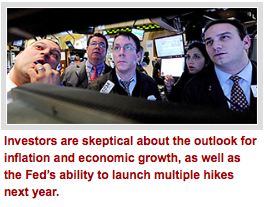
Investors are somewhat skeptical about the outlook for inflation and economic growth, as well as the Fed’s ability to launch multiple hikes next year. For evidence, just look at how 30-year Treasury Bond yields have behaved.
They fell from almost 4% in January 2014 to around 3% at the end of last year. Then after a brief trip all the way down to 2.25%, they’ve remained anchored around 3% for several months. As a matter of fact, on Fed day, the yield only rose one basis point. So it will clearly take increased optimism about the world economy to really get longer-term mortgage rates rising.
Want some good news? A rising funds rate puts upward pressure on the yields banks offer on Certificates of Deposit. Ditto for money market accounts and money market funds. So you can expect to earn a little more interest on your CDs and keep-safe funds.
Hopefully, this clarifies the outlook for your loans and deposit products in light of the Fed hike. When it comes to potential coping strategies, there are a handful of steps you can take:
* Consider transferring any balances you’re carrying from a variable-rate credit card to a fixed-rate one. Card companies often give you financial incentives to do so anyway.
* If you have a HELOC with a large balance on it, check to see if your bank offers a fixed-rate option. Many institutions allow you to fix the rate and payment on a portion of your balance, often at the cost of only a small fee. That move could protect you from a substantially higher interest bill if we end up getting a series of Fed rate hikes.
* Don’t lock in today’s low yields on long-term savings products like 3-, 4-, or 5-year CDs. Instead, wait to see if we’ll get more Fed hikes as that will boost the yields banks offer on them.
* Regardless of what the Fed does, consider using online-only banks for your term or money market deposits. They tend to pay higher yields because they don’t have physical infrastructure costs to cover by offering lower returns to deposit holders.
This is just a sampling of important pointers and strategies. I’ll have much more on additional post-Fed moves to consider in future columns.
I give more immediate guidance and precise “buy” and “sell” signals in my Interest Rate Speculator service. I’ve been sending out multiple recommendations in recent weeks to profit from increased turmoil in the interest-rate and equity markets, and I’d love to have you on board in light of the renewed Fed focus these days.
Until next time,
Mike Larson

 Speaking to CNBC just before the interest rate decision, Faber warned that it’s the wrong time because “the global economy has decelerated very badly, and many countries are already in recession, or going into recession.”
The rate hike separated the Fed from other major central banks – The ECB, Bank of England, PBOC, the Bank of Tokyo and elsewhere that are all battling deflation and desperately trying to stimulate some form of sustainable economic growth.
Yesterday’s hike still leaves U.S. monetary policy extremely loose, and Fed officials have signaled they will act cautiously from to nurture a very tenuous recovery indeed.
Faber said the outlook for American equities looks weak:
“I don’t think U.S. stocks are attractive by any measurement. They are expensive and earnings are going down, and if anything, eventually interest rates will be higher.”
Marc Faber is a strong advocate of owning physical gold and silver which he describes as being a way to become “your own central bank.” He believes an allocation and diversification into physical bullion will serve as vital financial insurance and that storing gold in Singapore is prudent as Singapore is the safest place to own bullion in the world today.

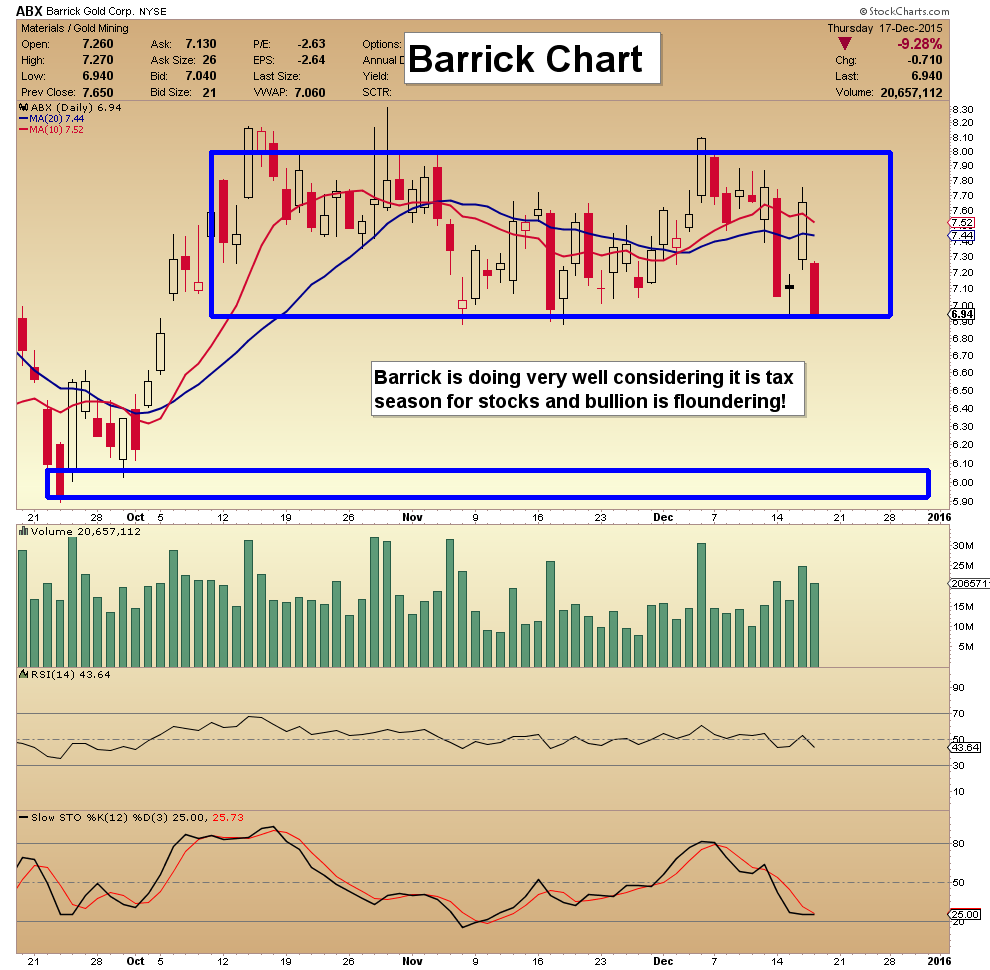
Today’s videos and charts (double click to enlarge):
Key Precious Metal ETFs Video Analysis
Bonds, Dollar, & US Stock Market Video Analysis
Trader Time Swing Trades Video Analysis
Key Individual Precious Metal Stocks Video Analysis
Thanks,
Morris

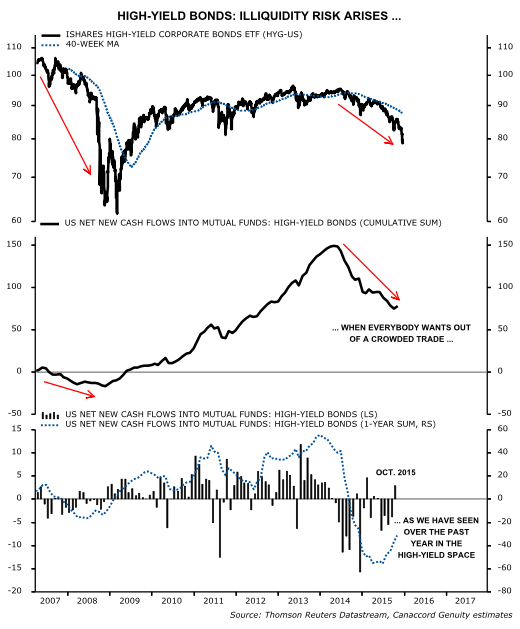
Canadian lifecos (OW) vs. banks (MW): After successfully favouring lifecos over banks in 2015, CG analyst Gabriel Dechaine recently inversed the trade. From a quant/macro viewpoint, we cannot make the switch just yet. A key driver between lifecos and banks is relative forward EPS strength. As Figure 2 shows, lifecos’ forward EPS still outpace those of banks and the rising trend in relative pricing power (i.e., insurance premiums/financial services & mortgage interest costs) suggests further strength. Also, market-based variables have been supportive for lifecos’ EPS in the fourth quarter with bond yields and global equities rising while the CDN$ has fallen to multi-year lows (Figure 3). Last, lifecos trade at a 7% premium to banks on a forward PE basis but this is reasonable given the superior EPS growth rate projected next year (11% vs. 4%).
….read more with larger charts HERE

The Fed hike interest rates with 25 basispoints. Stock markets rallied unanimously, currencies and commodities ended ‘status quo’. Is a “risk on” mood back, and is it time to become more aggressive?
We review our 5 “risk on” indicators which we closely monitor, according to our methodology, and where we stand in the “bigger picture”.
1. VOLATILITY INDEX
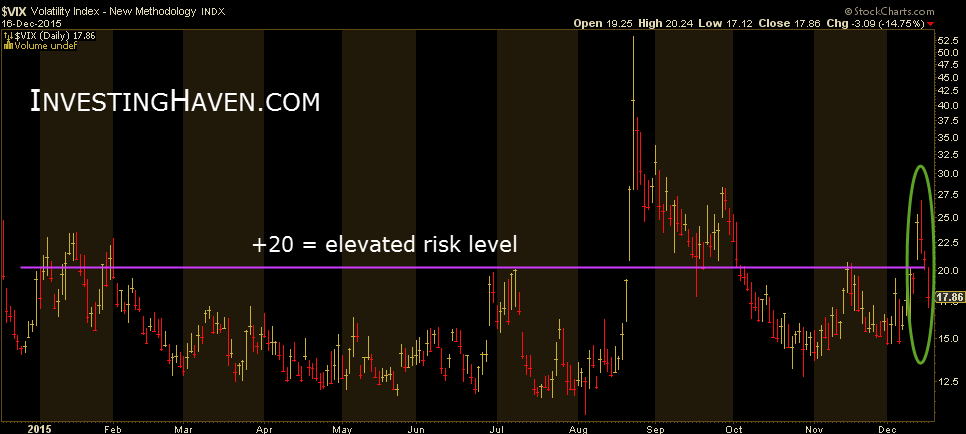
The VIX index spiked above the important 20 level earlier this week, but came down today to close the session at 17.8.
That is encouraging, definitely. But watch the higher lows pattern on the chart below since August this year. We are not there yet, and the next “low” will be an important level to watch!

-
I know Mike is a very solid investor and respect his opinions very much. So if he says pay attention to this or that - I will.
~ Dale G.
-
I've started managing my own investments so view Michael's site as a one-stop shop from which to get information and perspectives.
~ Dave E.
-
Michael offers easy reading, honest, common sense information that anyone can use in a practical manner.
~ der_al.
-
A sane voice in a scrambled investment world.
~ Ed R.
Inside Edge Pro Contributors

Greg Weldon

Josef Schachter

Tyler Bollhorn

Ryan Irvine

Paul Beattie

Martin Straith

Patrick Ceresna

Mark Leibovit

James Thorne

Victor Adair