
Currency
 People are grappling with market turmoil after Friday’s equity slide, but there was a good deal of action in another financial instrument: Bitcoin.
Bitcoin moved down some 10 percent on Friday after one of its significant developers, Mike Hearn, claimed in a startling blogpost that the cryptocurrency was now a failure.
Hearn used a publishing platform, Medium, to make his announcement, writing, “Despite knowing that bitcoin could fail all along, the now inescapable conclusion that it has failed still saddens me greatly.”
Hearn’s views are reportedly aligned with Gavin Andresen, another famous developer. The controversy pits Hearn and Andresen against other developers over the issue of whether – and how – processing speed for bitcoin “blocks” should be expanded.



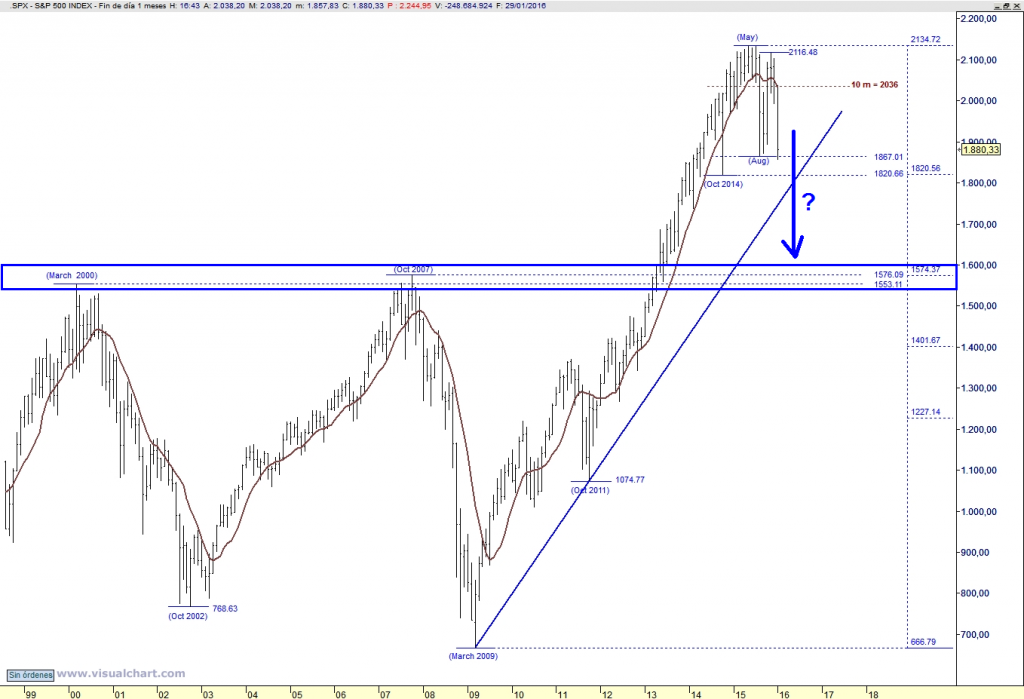
Monthly time frame:
- The 10 mma has a negative slope
- In addition we know have a lower high and a lower low
We should not rule out that SP 500 has begun a corrective phase that could open the door to a 0.382 retracement of the advance from the 2009 low which would coincide with a test of the Double Top break out (2000 and 2007 highs), I am talking about the range 1574-1553.
We’ve only really been in two weeks of trading in the new year, things are looking pretty bad to say the least, so predictably the press are asking -and often answering- questions about when the slump will be over. Rebound, recovery, the usual terminology. When will we get back to growth?
For me personally, but that’s just me, that last question sounds a bit more stupid every single time I hear and read it. Just a bit, but there’s been a lot of those bits, more than I care to remember. Luckily, the answer is easy. The slump will not be over for a very long time, there will be no rebound or recovery, and please stop talking about a return to growth unless you can explain what you want to grow into.….continue reading HERE


 [Editor’s note: This letter was penned by Tim Price, London-based wealth manager and editor of Price Value International.]
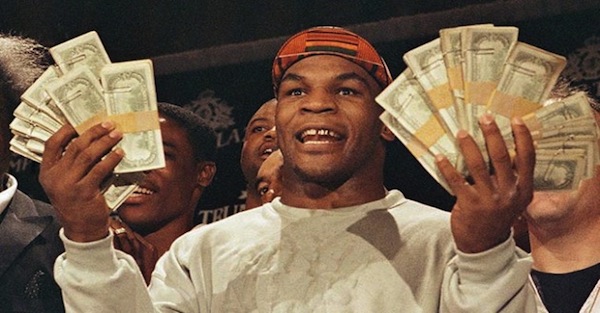
In a crisis, it helps to have good counsel. Consider the following sage advice from investment strategist Mike Tyson:
“Everyone has a plan ‘til they get punched in the mouth.”
Or as German military strategist Helmuth von Moltke the Elder put it, somewhat more formally:
“No battle plan ever survives contact with the enemy.”
The enemy has been quick to show himself this year, in the form of a bear market, at least for stocks.
This bear has so far been quick, and indiscriminate: the US; Europe; China; stock markets have fallen sharply, internationally.
Investors, being human, have scrambled in search of an explanatory narrative.
Some have blamed the Fed’s baby steps towards raising interest rates. Some blame the collapse in the oil price.
Last week’s movie night showed David Cronenberg’s 2012 thriller ‘Cosmopolis’, which has Robert Pattinson playing a 28-year-old hedge fund billionaire losing his entire fortune in a single day due to the unexpected rise of the Chinese renminbi.
Other than getting the direction of the renminbi wrong, the movie could have been shot yesterday.
But it has certainly been a good week for bears.
Last week RBS told us to “Sell everything except high quality bonds”. This is somewhat problematic since there aren’t actually any high quality bonds out there.
Tuesday brought us SocGen’s Global Strategy Conference, where guest speaker Russell Napier pointed out that growth in emerging market foreign exchange reserves from 2008 to 2014 amounted to the most rapid increase in emerging market money supply in history.
As this process goes into reverse, emerging market growth will clearly suffer.
And since many emerging market countries have over-borrowed in foreign currencies, the fighting in the global currency wars is set to get more intense this year.
As Napier warns, 2016 has also ushered in new rules requiring bond and deposit holders to be bailed in when banks blow up.
The EU (and many of its bank depositors) will come to regret not restructuring their banking system during the seven years post-Lehman when they had the opportunity.
The search for an easy narrative to explain the bear market is probably a waste of time. The financial market is a complex adaptive system and investors are prone to irrational behaviour and mood swings.
They are also prone to overpay. The great ‘value’ investor Benjamin Graham reminded us that,
“Operations for profit should be based not on optimism but on arithmetic.”
The optimists have had things their own way in an almost unbroken line since March 2009. January 2016 so far would suggest that the pragmatists are now in charge.
So the pragmatic response to this month’s volatility – if any is indeed required at all – is as follows:
1) Diversify by asset type.
2) Limit or eliminate exposure to emerging market debt. Raise cash rather than cling to a benchmark with no conviction (and no obvious value).
3) Concentrate any debt exposure to bonds issued by creditors, not debtors.
4) Limit equity exposure to high quality and inexpensive markets offering a ‘margin of safety’. (Most of the US market does not qualify in this regard.)
Russell Napier recommends Japanese equities, currency hedged, and so do we. And in a bear market, you don’t want to own expensive growth, you want to own defensive value.
5) Complement traditional investments with alternatives.
We would advocate systematic trend-following funds (which can profit in bear markets just as they did in 2008), and gold – the one form of currency that comes with no counterparty risk because it is the one asset that is no-one’s liability.
6) Limit your exposure to mainstream financial media, and especially to economists employed by commercial banks.


-
I know Mike is a very solid investor and respect his opinions very much. So if he says pay attention to this or that - I will.
~ Dale G.
-
I've started managing my own investments so view Michael's site as a one-stop shop from which to get information and perspectives.
~ Dave E.
-
Michael offers easy reading, honest, common sense information that anyone can use in a practical manner.
~ der_al.
-
A sane voice in a scrambled investment world.
~ Ed R.
Inside Edge Pro Contributors

Greg Weldon

Josef Schachter

Tyler Bollhorn

Ryan Irvine

Paul Beattie

Martin Straith

Patrick Ceresna

Mark Leibovit

James Thorne

Victor Adair