
Gold & Precious Metals

One by one the pillars of the recovery are toppling. Last year the Chinese infrastructure party ended and the shale oil boom went bust. More recently the FANG stocks went from pulling the market up to pushing it down. And today Apple — whose sales would always go up because everyone on Earth wants an iPhone and there were still some people in Africa and the Amazon Basin who don’t yet have one — reported that not only is its revenue no longer growing, but it might shrink in the year ahead.
Apple off 2.2% after hours on no-growth worry
(USA Today) – Apple investors had plenty of warning the high-flying stock was about to slow. They just got proof.
Apple’s revenue missed expectations in the just-reported fourth quarter, and the gadget maker is warning it could post the first drop in revenue since the 2009 recession in the current, first calendar quarter.
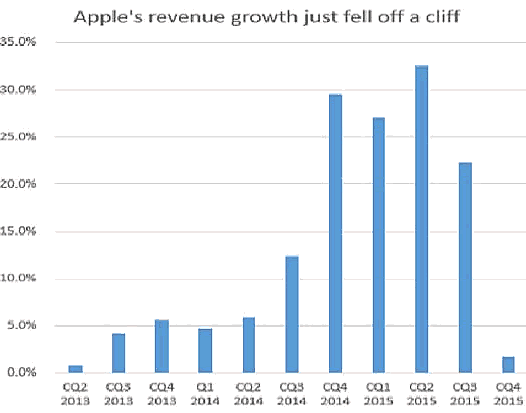
There are already signs of a slowdown. Apple reported quarterly revenue of $75.9 billion, which missed expectations, inching up just 1.7% from the same period a year ago. That was Apple’s lowest revenue growth since the June quarter of 2013, says S&P Capital IQ, when revenue rose 0.9%. Analysts were looking for revenue of $76.5 billion.
But here’s where it gets concerning for investors, who may need to readjust their expectations on what used to be the hottest stock going. Apple said revenue would be $50 billion to $53 billion in the current quarter. That falls short of the $55.3 billion that had been expected.
If Apple’s revenue is just $50 billion in the first quarter, it would be a 14% drop from the $58 billion in revenue reported in the same quarter a year ago. That would be Apple’s first quarterly drop in revenue since a 5.4% decrease in the September quarter of 2009, says S&P Capital IQ.
Seeing growth hit the skids is very unusual for this company that not long ago looked like it had a license to print money. It’s another sign of the growing saturation of the market for $650 smartphones. The stock market has been signaling for months that Apple’s overall growth, especially in the smartphone market, was about to slow dramatically. Analysts have been slashing estimates for the fourth quarter.
Shares of Apple closed Tuesday up 55 cents, or 0.6%, to $99.99 in regular trading, but still are down a crushing 25% from their high last year. Apple shares fell 2.2% afterhours following the earnings news.
All good things must come to an end, and cutting-edge smartphones are no exception. They are, in fact, a victim of their own technological success. Now that even low-end phones do things that were considered amazing three years ago, the rationale for paying up is becoming less compelling.
Personal anecdote: Each of our young-adult sons broke their high-end phones in the past year. One pulled out an old flip phone and is now using it quite happily, since it texts and that’s his main mode of communication. The other went to the local AT&T store and bought a $50 Windows phone that, he says, works just fine. Following in their tech footsteps (as I tend to do), when I dropped and broke my Samsung phablet, I dug out its predecessor, a three-year-old iPhone 4, and will use it until it dies. Then I’ll get the best available sub-$100 smartphone.
But tech cycles aren’t the point. What matters here is the growing realization that as the world leverages itself ever-more-precariously it takes ever-larger amounts of new leverage to generate growth. And the past year’s credit growth has been inadequate. The global economy is slowing and, in an inflate-or-die world, recession is now an existential threat.

 Inventories will continue to rise, but the momentum is slowing.
The following are some observations as to how we got here and how we’re gonna get out.
9 reasons why oil has taken so long to bottom:
1. OPEC increased production in 2015 to multiyear highs, principally in Saudi Arabia and Iraq where production between the two added 1.5 million barrels per day (mb/d) to inventories after the no cut stance was adopted.
2. Russian production increased in 2015 to post Soviet highs.
3. Long planned Gulf of Mexico production began coming on in late 2015.
4. An overhang of 3,000 or 4,000 shale wells that were drilled but uncompleted (“ducks”) entered a completion cycle in 2015.
5. Service companies and suppliers went to zero margin survival pricing (not to be confused with efficiency). The result has been an artificial boost to completions that cannot be sustained.
6. Resilience among a few operators in the Permian who felt the need to thump their chests, creating the rally that killed the rally last spring (disclosure: I own stock in Pioneer Resources but am going to dump it if they don’t cut it out!).
7. The dollar strengthened.
8. Iranian exports are coming.
9. And, finally, China.
5 Demand-Side Reasons Why We Need to Hang-On:
 If you think the recent bounce in the Dow and other world markets means an end to this year’s opening curtain of turbulence, think again and instead, fasten your seatbelts. The fact is you haven’t seen anything, yet.
In the weeks ahead, the Dow Industrials will fall as low as 13,938 … the S&P 500, as low as 1,353.00.
After some pullbacks, the dollar will stair-step higher this year to over 112 on the Dollar Index, roughly a 13% gain. The euro, conversely, will plunge to 0.91, or worse. The pound sterling will crash into the 1.30 level. And even the Chinese yuan will suffer one blow after another.

The Surge in U.S. Mansion Prices Is Now Over
-
Chinese stocks, falling oil prices denting high-end home sales
-
Expensive homes led U.S. housing market out of 2008 slump
The six-bedroom mansion in the shadow of Southern California’s Sierra Madre Mountains has lime trees and a swimming pool, tennis courts and a sauna — the kind of place that would have sold quickly just a year ago, according to real estate agent Kanney Zhang.
Not now.
Across the U.S., the story is much the same. The world’s economic woes — from China to Russia to South America — are damping sales in the high-end real estate market. Haywire overseas stock markets and dropping currency values caused in part by plummeting oil prices are dulling demand for mansions, penthouses and winter escapes.

-
I know Mike is a very solid investor and respect his opinions very much. So if he says pay attention to this or that - I will.
~ Dale G.
-
I've started managing my own investments so view Michael's site as a one-stop shop from which to get information and perspectives.
~ Dave E.
-
Michael offers easy reading, honest, common sense information that anyone can use in a practical manner.
~ der_al.
-
A sane voice in a scrambled investment world.
~ Ed R.
Inside Edge Pro Contributors

Greg Weldon

Josef Schachter

Tyler Bollhorn

Ryan Irvine

Paul Beattie

Martin Straith

Patrick Ceresna

Mark Leibovit

James Thorne

Victor Adair