
Gold & Precious Metals
Technical analyst Jack Chan has examined the charts and says the gold sector is on a new major buy signal, which could signal a new bull market, but he is patiently waiting for confirmation.
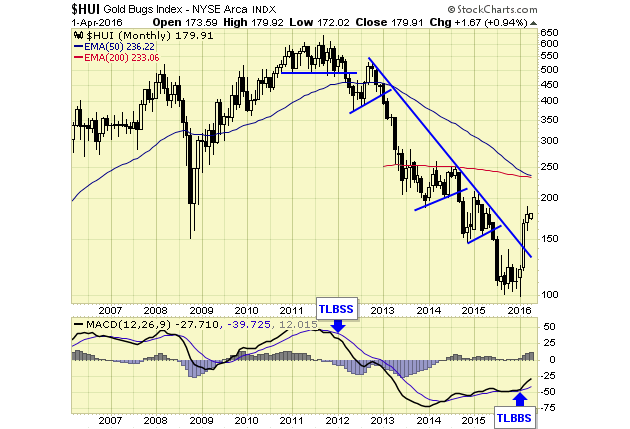
The gold sector is on a new major buy signal, therefore opening the opportunity of a new bull market. However, Commitment of Traders (COT) data remains in bear market values and is now at levels of previous tops. I remain patient and wait for confirmation, which is when speculation according to published COT data has returned to bull market values, and the 2015 high in gold prices near $1,300/oz is exceeded to the upside.
$HUI is on a new long-term buy signal, ending the sell signal from early 2012. (See chart above).
Long-term signals can last for months and years and are more suitable for the long-term investors.
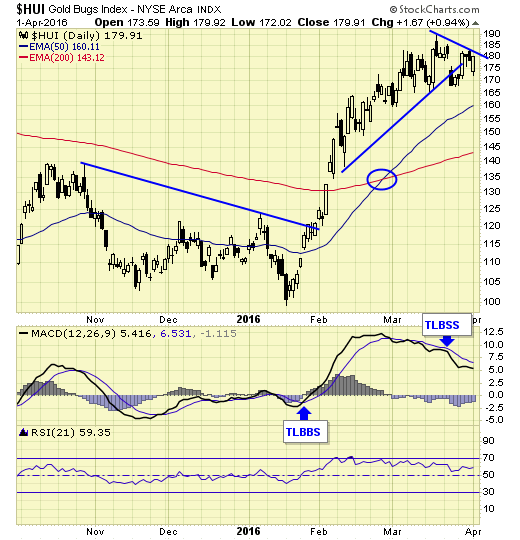
$HUI is on a short-term sell signal. Short-term signals can last for days and weeks and are more suitable for traders.
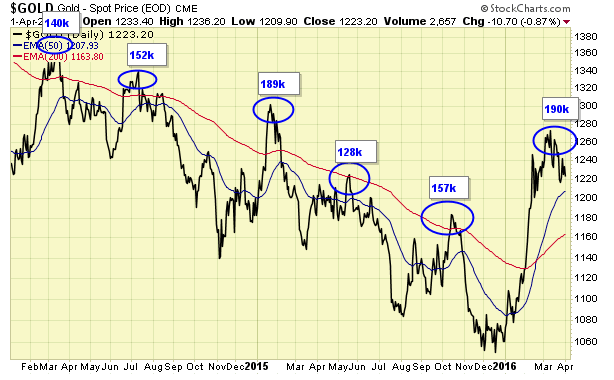
COT data remains in bear market values, and also below the 2015 high at 1300. Both factors are needed to confirm a new bull market.
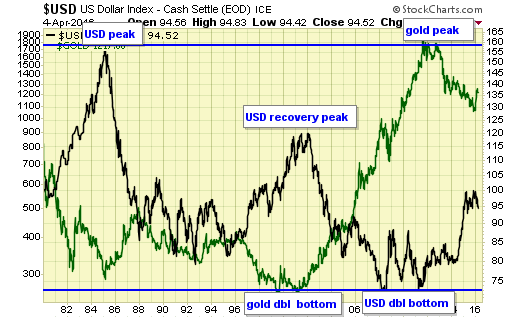
From the long-term perspective, gold and the dollar have always been in an inverse relationship, and that remains today. This chart aided us to consider gold in 2001, and to begin diversifying into USD in 2011.
related:
Jack Chan is the editor of Simply Profits at www.simplyprofits.org, established in 2006. Chan bought his first mining stock, Hoko Exploration, in 1979, and has been active in the markets for the past 37 years. Technical analysis has helped him filter out the noise and focus on the when, and leave the why to the fundamental analysts. His proprietary trading models have enabled him to identify the NASDAQ top in 2000, the new gold bull market in 2001, the stock market top in 2007, and the U.S. dollar bottom in 2011.
Disclosure:
This article does not constitute investment advice. Each reader is encouraged to consult with his or her individual financial professional and any action a reader takes as a result of information presented here is his or her own responsibility. By opening this page, each reader accepts and agrees to Streetwise Reports’ terms of use and full legal disclaimer. This article is not a solicitation for investment.
From time to time, Streetwise Reports LLC and its directors, officers, employees or members of their families, as well as persons interviewed for articles and interviews on the site, may have a long or short position in securities mentioned. Directors, officers, employees or members of their families are prohibited from making purchases and/or sales of those securities in the open market or otherwise during the up-to-four-week interval from the time of the interview until after it publishes.
All charts courtesy of Jack Chan.

April 6, 2016 …
It’s times like these — sideways markets trading in tight-but-volatile ranges — that try the souls of traders and investors everywhere.
Most traders, always overly eager to trade, try to step in and out of these kinds of markets for very short-term profits. The typical end result of all their actions: Making their broker rich.
Then there are others who take on new long positions, thinking that it’s just a pause in existing trends and that by adding to positions now, they’re setting themselves up for a home run. When in reality, many markets are actually getting ready to change trend, violently.
The hardest times for any trader or investor are ALWAYS periods like the recent months of sideways, go nowhere, tight-but-volatile market ranges. And almost always the best, most-profitable course of action is not to push the markets, but to lie in wait, like a lion tracking and stalking its prey.
 And so it is with me. For all my paying customers, I am lying in wait, stalking the best opportunities, ready to jump on them before you can bat an eye, to help make oodles of money for them. Money that can be kept and built on, not money made in a flash in the pan that can just as easily go up in smoke.
With all that in mind, this week’s column is a follow up to last week’s market road map column. Let’s see just how much has changed in the most important markets of all, starting with …
Gold: Last week, I told you that gold had elected a sell signal by closing below $1,227.10. Since then gold has fallen to as low as $1,210 (basis June futures), only to bounce back to the $1,234.70 level as I pen this column (Tuesday, April 5 at 5:00 am EST).
A stinking $24 trading range, with no gusto, in a week’s time. No opportunities there, even for short-term traders. Maybe for day traders, but for overnight or position traders, nothing but noise.
Any changes in trend in gold? None whatsoever. Merely a sloppy, go nowhere mess. Worth sticking your neck out? Hardly.
The trend remains negative, with the next move likely to bring gold down to support at $1,202, then bust through that to the most important support level at the $1,180 to $1,160 level …
Where, if that happens, I expect to release a MAJOR FLASH ALERT.
All of the above general comments equally apply to silver, platinum and palladium.
Crude oil: Last week I told you that crude oil had an important pivot point at the $39.25 level. When below it, the trend, short-term would be bearish. When above, the trend, short-term would be bullish.
Oil has opted to correct more than I had expected, staying below $39.25, and moving down toward the lower end of the trading range that I cited last week at the $36 level.
Overhead resistance still stands at $39.25 naturally, followed by $42. Overall, oil is doing what my neural net models called for, a largely sideways correction that will lead to a new level up in the spring to the $50 level.
Oil appears to be basing now, just below that $36 level, so don’t be surprised if oil soon takes off to the upside. Take advantage of it with any of the leveraged long crude oil ETFs.
Perhaps the most important market of all right now, and for the weeks and months to come …
The U.S. Dollar: Last week I told you how the dollar, as measured by the Dollar Index, was largely caught in a trading range for now, but within the context of a long-term bull market. Short-term support can be found at 93.197 on the Dollar Index, followed by 91.257.
Resistance will be found at 96.955 and then the former highs just above the 101 level.
Nothing has changed there. Over the past week, the dollar has traded in an extremely tight trading range, chopping up traders left and right and spitting them out as wounded animals.
And that is just the opening act of another major move for the dollar that will destroy even more investors and traders who continue, for some odd reason, to listen to all the pundits coming out of the woodwork who are again screaming about the death of the dollar — one well-known analyst, with alleged ties to the CIA, shouting the loudest, an analyst who has NEVER been right about any market let alone the dollar.
If you want to avoid losing money, simply ignore these harum-scarum analysts who don’t have a clue about real economic history and the forces that drive them. Listening to them is the fastest way to the poorhouse.
There is NO way the U.S. dollar is back in a major bear market. It is, conversely, in a major bull market and is merely taking a pause. The next move up in the U.S. dollar is going to knock your socks off with the Dollar Index moving from its current roughly 94 level to well over 105.
Chief reason: Deflation and the demise of …
The euro: Since last week, the euro has managed to eke out a new, short-term-range high at the 1.14385 level but there has been no change in trend to the upside. Just a short-term spike higher, the euro essentially catching its last breath of fresh air before rolling over and dying.
The new high at 1.14385 should prove formidable, while support remains under the market at 1.1030 followed by 1.08995. After that, support plunges to the 1.05 level, then 1.03 and then even lower.
The only thing holding the euro up, or should I say, suspending it in thin air, right now — is the fact that Janet Yellen has softened her tone on rate hikes here in the U.S.
But in the end, that won’t matter one bit. Yellen could lower rates here, and the euro will still meet its maker: It was a flawed currency from the outset, and now, every threat under the sun is combining at the same time to exploit the currency’s falls and take it under.
Markets have no mercy and take no prisoners. The euro is destined for failure due to the ignorance of the leaders who put it together; their ignorance of history, their ignorance of economics, and, perhaps most tragic of all, their ignorance of Europe and its many disparate cultures.
Dow Industrials: Last week, I told you the key resistance figures for the Dow Industrials are still the 17,901 and 18,500 level and …
Unless the Dow can get above both of those figures on a weekly closing basis, the bias toward the downside will remain the more probable path of direction.
The Dow hovered near the 17,900 level last week, but then started turning slightly lower. Major support still lies at the 16,652 and 14,687 levels.
Therefore, in the very short-term, the trading range is from 16,652 to 17,901.
A sloppy, wide trading range.
Nevertheless, every indicator I maintain and every neural net and AI model I run on the major U.S. stock indices points to a rout that will take the Dow Industrials down to the 13,900 area.
So stay alert, and stay tuned, and most of all, be patient. The best profits always come to those who are patient and not to those who are trigger happy.
Best wishes,
Larry
P.S. One year from today, you could be cracking open a bottle of Dom Pérignon and feasting on caviar to celebrate the outrageous gains you’ve made in the bull market of a lifetime … profits that could let you retire early and rich! OR you could be kicking yourself, muttering, “I wish someone had told me this would happen and how to take full advantage of it.” Well, that’s exactly what I am going to tell you in this report! Click here for information!

“Earnings don’t move the overall market… focus on the central banks and focus on the movement of liquidity… most people in the market are looking for earnings and conventional measures. It’s liquidity that moves markets.” Stanley Druckenmiller
Global liquidity conditions, as measured by BofA Merrill Lynch’s Global Liquidity Tracker, are still firmly in negative territory since mid-2015 (bottom panel). The most recent data shows a steep drop related to Japan, with three of the four components (Japan, Euro Area, and Emerging Markets) now below zero. Though the US is fractionally positive at 0.75, the continual tightening of liquidity conditions abroad is the greatest risk currently, aligning with Yellen’s cautious remarks on raising rates.



In Naples, riots against Renzi resulted in clashes between police and demonstrators. On Wednesday, Italy’s government had to address the plight of Italian banks which now seems to be significant as both houses of parliament blessed in a crisis meeting, voted to create a state fund for bad loans from. Resistance to Renzi’s idea was very limited. In Naples there were serious riots against it. In reality, Italy’s government has survived a vote of confidence in this decree involving a bank rescue. The Senate rushed together late on Wednesday afternoon. In the House of Lords, the vote was 171 for the plans, 105 against. This is now all about state guarantees for banks that could collapse under the weight of bad loans and that day is coming rapidly as all the QE efforts of the ECB do nothing to reverse the crisis in banking or the economy. Nonetheless, the House of Representatives had already passed the decree while Prime Minister Matteo Renzi had only a very thin majority in the Senate. The crisis appears to force the measure through demonstrating how bad the banks really are in Italy.
The new plan envisages that banks can bundle their bad loans into new financial products, and then sell them. But who will buy them? On Tuesday it was announced that the government plans to fund the money houses buy the bad loans. The decree also provides for the formation of a holding company to merge the 371 small credit unions. Therefore, it is placing the bad loans outside the banking system. The EU rules for bail-ins are breaking down. Each country is beginning to ignore Brussels and proceed in their own manner demonstrating that the ECB is really losing control.
Meanwhile, the ECB Chief Economist Peter Praet spoke at a conference in Frankfurt on Thursday. Effectively, the message was that the ECB is ready and willing to do “whatever is needed” to return inflation to target. Instead of looking at the current negative interest rate policy, they continue to see the solution to just be more of the same. Obviously, as banks continue to implode in Europe and smart capital flees to the USA, the ECB is incapable to reversing the trend. The cycle will play out and the look very bleak at least into 2018 for Europe.

“From top to bottom of the ladder, greed is aroused without knowing where to find ultimate foothold. Nothing can calm it, since its goal is far beyond all it can attain. Reality seems valueless by comparison with the dreams of fevered imaginations; reality is therefore abandoned.” ~ Emile Durkheim
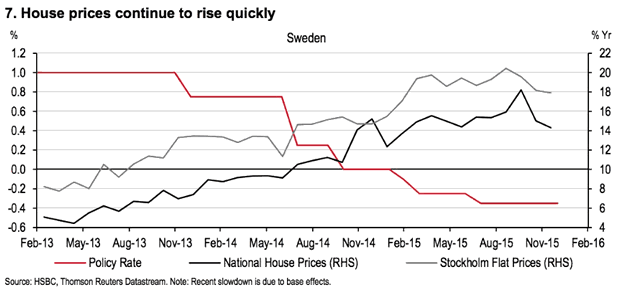
Sweden is already in the mature stages of experiencing a housing crisis. Take a look at the chart below. Home prices are surging simply because it is cheap to borrow money. The lower the interest payments, the more you can borrow. Hence, individuals throw caution to the wind and start chasing property because they believe prices will continue trending upwards. What they forget is that no market can trend upward forever.
More and more nations are embracing negative rates so as rates move into negative territory it will have the unintended consequence of fuelling another housing bubble, and suddenly property that appeared to be out of reach could be within reach, only because the monthly payment seems affordable. Eventually, the U.S is going to lower lending standards and when they do, expect the housing market to explode as there is a lot of pent-up demand. The public has been shut out of the markets for a long time, and when you give someone freedom after locking them up for a lengthy period, they go insane, and that is what lies in store for the housing market. The Fed has laid the path out, and this was planned years in advance. Take a look at the Swedish housing market as depicted in the chart below. The Chart for the US and UK housing markets will look 5 to 10 times worse.
The map below illustrates that the war on interest rate is gathering momentum
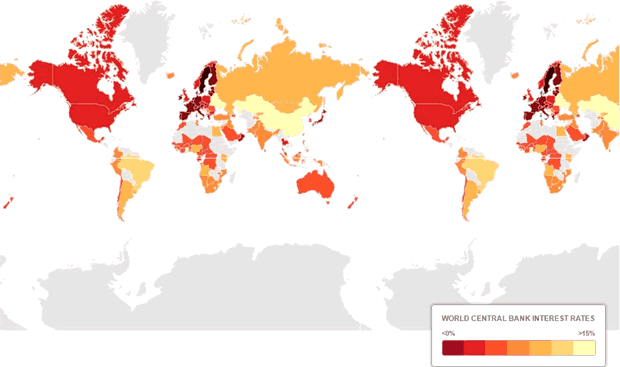
Source: The Telegraph
Additional dangers of negative rates
As more nations embrace the era of negative rates, no nation is going will be in a position to resist. The slogan will be “surrender or die” and nations will opt for surrender as no one wants to die. Negative rates will also fuel a massive new round of share buybacks. The Fed is trying to put on a brave act, but you can already see them backtracking from the strong stance they took last year. Now they are stating that all is not well, and the economic outlook is weaker than expected. They will have no option but to join the rat pack; in this instance, resistance is futile.
The corporate world has gone a massive share buyback binge, and this binge is not showing any signs of letting up. It allows corporations to borrow money for next to nothing and then use these funds to buy back massive amounts of shares and in doing boost the EPS (Earnings per share). Negative rates will provide rocket fuel to the share buyback programs. Corporate debt will soar to insane levels; if you think today’s levels are insane, you are in for a rude awakening as debt levels will soar beyond anyone’s imagination.
This video illustrates property prices surged an average of 50% in the past ten years; this how bubbles start
Suggested Plan of Attack
We live in a world of extreme greed, and our government seems to favour corporation fraud; against this backdrop, you need to do that which seems insane from a logical point of view. All strong Market corrections should be viewed as buying opportunities. From a mass psychology perspective, this is still the most hated bull market in history and until the masses embrace, it is destined to run a lot higher than most envision.
Additionally, it would be advisable to hold a core position in Gold; at some point in time Gold will start to react strongly to this massive form of currency debasement. Currencies are being destroyed on a global basis at a level never seen before. This will not end well, but as we have pointed out many times before, being right does not equate to market success. One has to look at the time factor, and most individuals do not have the staying power to bet against the Fed. Wall Street is full of tombstones of good men who were right but could not stay solvent long enough to benefit from their insights. Hence, we would not bet the house on Gold and nor should you. No matter how good an investment appears to be, one should never put all of one’s eggs in one basket
“Avarice is the sphincter of the heart.” ~ Matthew Green

-
I know Mike is a very solid investor and respect his opinions very much. So if he says pay attention to this or that - I will.
~ Dale G.
-
I've started managing my own investments so view Michael's site as a one-stop shop from which to get information and perspectives.
~ Dave E.
-
Michael offers easy reading, honest, common sense information that anyone can use in a practical manner.
~ der_al.
-
A sane voice in a scrambled investment world.
~ Ed R.
Inside Edge Pro Contributors

Greg Weldon

Josef Schachter

Tyler Bollhorn

Ryan Irvine

Paul Beattie

Martin Straith

Patrick Ceresna

Mark Leibovit

James Thorne

Victor Adair