
Market Opinion
“I believe deeply that it’s very important to the United States, to the economic health of the United States, that we maintain a strong dollar,” U.S. Treasury Secretary Geithner recently told reporters.
Indeed, it seems to be a pre-requisite to apply for the position of U.S. Treasury Secretary to be able to utter these words. In the meantime, the greenback seems to be falling further and further; the ‘strong dollar commitment’ appears to have become a farce. Just what, then, would be a strong dollar policy?
Bloomberg Radio asked me last week what I would like to hear from Federal Reserve (Fed) Chairman Bernanke to support the dollar. I responded he had done enough talk, and that I would like to see some action. Indeed, as Bernanke spoke at the Economic Club in New York on Monday, the dollar rallied for a few seconds when his speech was released; in it, Bernanke said, “our commitment to our dual objectives [price stability and full employment] … will help ensure that the dollar is strong…” The reason the dollar rallied was because initial media reports suggested the Fed will ensure the dollar is strong, whereas all Bernanke had said is that the Fed is committed to its dual mandate and, as a result, the dollar should be strong.
Let’s look at the action, then. The Fed has been buying hundreds of billions worth of government bonds and mortgage-backed securities (MBS) by printing dollars—not currency in circulation, but virtual dollars by entering a few keystrokes on the Fed’s computers; in Fed talk, we talk about an expanded Fed balance sheet, as the size of the Fed’s balance sheet represent the dollars that have been “printed.” Generally speaking, when you increase the supply of something—be that gadgets or dollars—the value of any one gadget—or dollar—should fall assuming constant demand. Our interpretation—Fed actions do not support a strong dollar.
…..read the rest of this extensive article HERE.
Axel Merk, Manager of the Merk Hard, Asian and Absolute Return Currency Funds, www.merkfunds.com, wrote the book on Sustainable Wealth. Merk is President & CIO of Merk Investments, LLC, an expert on hard money, macro trends and international investing. He is considered an authority on currencies. This report was prepared by Merk Investments LLC, and reflects the current opinion of the authors. It is based upon sources and data believed to be accurate and reliable. Opinions and forward-looking statements expressed are subject to change without notice. This information does not constitute investment advice. Foreside Fund Services, LLC, distributor.
BLACK SWAN CAPITAL FREE WEBINAR
Harnessing the Power of Emerging Market Currencies
Space is limited. Reserve your Webinar seat now:
Please join us this Thursday at 4:30 PM EST for a complete look at investing in Emerging Market Currencies.
Jack and JR will spend an hour with you in a live presentation covering…
· What is an Emerging Market Currency
· Why should you consider investing in Emerging Market Currencies
· Which Emerging Market Currencies are available to trade
· How can you trade them efficiently
· What are pitfalls of Emerging Market Currency trading
They’ll give you a detailed explanation of the mechanics and benefits to investing in emerging currencies.
PLUS…
Their 2 top Emerging Market Currency picks for 2010.
And stick around for a Q&A session to discuss any topics covered in the webinar.
Note: Room opens at 4:15 PM ET; webinar begins at 4:30 PM ET
Title: Harnessing the Power of Emerging Market Currencies
Date: Thursday, November 19, 2009
Time: 4:15 PM – 5:30 PM EST
After registering you will receive a confirmation email containing information about joining the Webinar.
Thank you.
David Newman
Director of Sales and Marketing
Black Swan Capital
dnewman@blackswantrading.com
IMPORTANT: viewing the Webinar requires you have Java software downloaded on your computer. If you do not have Java already installed you can quickly and easily download it here: www.java.com
System Requirements
PC-based attendees
Required: Windows® 2000, XP Home, XP Pro, 2003 Server, Vista
Macintosh®-based attendees
Required: Mac OS® X 10.4 (Tiger®) or newer
Edmund Conway says that the country’s leaders risk creating the same type of asset bubble that floored Japan.
Every economist has a favourite fact about the Chinese economy. Mine is this: every month the country generates so much surplus cash from trade that it could afford to go out and buy three of Britain’s biggest companies – say, British Telecom, Rolls Royce and J Sainsbury. Every single month.
The £9.8 billion that Kraft proposed this week to spend on Cadbury’s? China could have generated that much in little over a week – not funny money, but cold hard cash. Should it decide to go out and spend, it could afford any company it wanted – Google, Goldman Sachs, RBS. Only, it has more sense.
Or does it?
…..read more HERE
The ultimate gold bubble test
Dear Reader, In the past three months, there’s been a very popular – and very wrong – thing to say about owning gold.
I hear it a lot from inexperienced Wall Street analysts, bloggers, and money managers who spend little time living in the “real world”.
Here’s what they’re saying: “Gold is way too popular now… It’s near the end of its bull market.” The recommended “action to take” is to cash in your gold profits and move on to something different.
I can tell you that taking this advice is a big mistake. Anyone who believes gold is too popular with the mainstream public simply doesn’t know who the mainstream public is… and they don’t understand how bull markets end.
Sure… gold is up big since it broke out to a new high in September. In just over two months, it has climbed from $950 an ounce to $1,100 an ounce.
Gold is also enjoying a lot of mainstream press these days. Six years ago, when I would tell someone I was placing a significant portion of my net worth in gold, they’d look at me like I was crazy. Now, they nod and say, “I heard something about gold the other day on TV.”
That’s as far as the average Joe goes with his interest in gold. This is why gold is nowhere near a “blow off” top. Two days ago, at the Stansberry & Associates Alliance Conference, I showed folks how to perform the ultimate test of whether an asset is “too popular” or “in a bubble.” Here it is:
Ask 100 people on the street if they own gold. See what they say.
Don’t ask folks who read newsletter writers like Doug Casey or Porter Stansberry. Don’t ask folks who you regularly talk investments with. Ask randomly chosen members of the public if they know why gold is “real money.” Why gold has climbed from $650 to $1,100 in the last three years.
I guarantee you the average person on the street is going to look at you like you asked him which airline offers nonstop flights to Venus…
He’s going to have no idea what you are talking about. He’s heard about gold on the news a few times, but he can’t tell you why gold is rising, who is buying it, or why it is the best form of money mankind has ever found.
Gold is divisible, portable, lasting, consistent the world ‘round, useful in industry… and as master speculator Doug Casey reminds us, gold cannot be created out of thin air by a government. In other words, you actually have to work and save in order to build a gold hoard. You can’t “Bernanke” your way to real gold wealth.
The people who realize this – like billionaire hedge-fund manager John Paulson and super investor Chris Weber – are getting more publicity now than they were six years ago. But it’s nowhere near enough publicity for a seasoned investor to say, “Gold is too popular.”
When a bull market gets too popular, it looks like tech stocks did back in 1999. This was when everybody and his brother bragged at the office Christmas party about making a fortune in Cisco or Microsoft. It was when schoolteachers, personal trainers, and cab drivers suddenly became tech stock experts. Folks knew what “bandwidth,” “routers,” and “e-commerce” meant. Only when an asset enjoys that sort of widespread attention can you say it’s too popular.
I can’t say that about gold right now… not after talking with friends who do not invest… not after talking with the people sitting next to me on the plane. The public still has no idea what “bullion” really is… or how the government’s reckless “tax and spend” behaviour is clobbering the dollar. Don’t believe me? Just ask ‘em.
There could come a time when almost everyone you know is trading gold stocks like they did tech stocks in 1999… or discussing the virtues of gold as a form of savings. But few people do this now.
Which means that, while the gold market may be overbought in the very short term, the real, long-term move in gold has much farther to run.
Good investing
Brian Hunt
Editor’s note: Brian Hunt is a regular contributor to DailyWealth, a free investment newsletter focused on the world’s best contrarian opportunities. We write with a simple belief in mind: You don’t have to take big risks to make big money with your investments. Sign up today to read more investment ideas from Brian.
This article from the Creative Education site Minyanville.com Get a Free Membership HERE (top right)
Hunting Down Predators for Big Returns
Christian Andreach isn’t betting on a strong rebound here in the US. But the 36-year-old professional stock picker is wagering on faster growth overseas, a view confirmed by the many C-suite executives he chats with every week.
“They see things getting a little better,” says Andreach, a managing director at Manning & Napier Advisors. “Things are stabilizing. That said, those same companies are looking abroad for the next leg of growth.”
Andreach agrees. So, along with six other managers and analysts that run Manning & Napier’s Equity Series fund (EXEYX), he has placed big bets on companies with large global footprints. The team uses a bottom-up approach that isn’t tied to one style: They look at growth, cyclical, and deep-value plays.
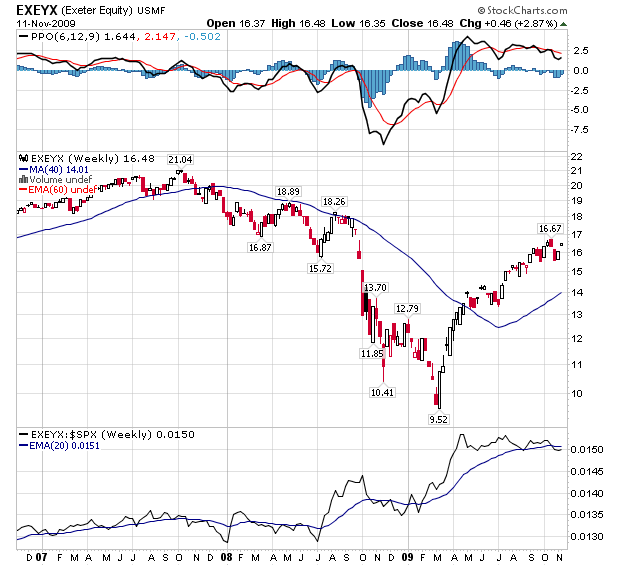
The strategy works. Morningstar fund analysts write that EXEYX has produced outsized returns in a variety of buoyant markets, and has also held up better than nearly all its rivals in bear markets.
Through November 9, the five-star fund’s 10-year annualized return of 5.95% leads the S&P 500 by 6.39 percentage points, and bests its Morningstar rivals by 8.12 percentage points, placing it in the top 1% of its category.
The no-load fund, with $1 billion in assets, has an expense ratio of 1.05%, and minimum investment of $2,000.
Recently, we caught up with Andreach at his office in Fairport, New York. We talked about his top picks right now, including Google (GOOG), Monsanto (MON), and General Mills (GIS), and why he’s steering clear of the banks.
Minyanville: Explain the fund’s investment strategy for us.
Christian Andreach: We have three strategies. First, there is the “profile strategy”: We look at companies that have strong market positions, good growth prospects, and are selling at reasonable prices. We look to buy a stock when it is trading at around 20% below fair value.
Minyanville: And the second strategy?
Andreach: We employ something we call the “hurdle rate strategy.” It’s our strategy for investing in cyclical industries. Whenever returns are very high in an industry, competition comes in and that drives returns down below the hurdle rate, the break-even rate of return on investment. We like to invest when industry returns are low and capacity is exiting the business and sell when industry returns are high and capacity is turning into the business.
Minyanville: The final strategy?
Andreach: It’s our “bankable deal strategy.” This is our deep-value strategy. We estimate a fair value of an enterprise and look to buy it at $0.50 on the dollar. Price becomes its own catalyst. At a certain level, market forces come in and realize the value in the enterprise.Minyanville: You also target companies that benefit from the pain of their competitors. Elaborate on that for us.
Andreach: We might not be able to bank on the macro outlook providing a strong tailwind to business, but we might have identified a troubled competitor losing market share. So we can invest in the company on the other side, which is gaining. In sum, we are looking to capitalize on the companies that are exploiting the weakness of others.
Andreach: Exactly. It’s also why we like Southwest Airlines (LUV). We see them as the low-cost operator in the industry. Demand is still a wild card. In response, supply is coming out of the airline industry. That supply is coming out from Southwest competitors. So, when demand comes back, Southwest will be in an advantaged position — they didn’t cut back on supply, and they have a low-cost position that will help them with price.
Minyanville: Your holdings carry much less debt than the typical large growth fund.
Andreach: It’s a bi-product of our investment strategies. When we invest in a company, we will penalize that company in terms of the price we’re willing to pay for it if they have what we see as excess leverage. As a firm, we are biased against credit risk.
Minyanville: How important is management to you?
Andreach: It is important. We want to make sure that we’re on the same page as management.
That being said, we are investing in a business. The quality of the business is more important than just the individuals running that business.
I’m not saying that management is irrelevant. It’s just that even the best management team will have a hard time creating shareholder value in a business that just isn’t a value generative business. Even the nicest, smartest guys in the room won’t push us into an investment that doesn’t fit what we do.
Minyanville: You beat 99% of your peers over the 10-year period. What does your team do differently than the competition?
Andreach: First, we have defined investment strategies.
Second, each strategy has a certain pricing discipline associated with it. It must fit our knitting and it must sell at a price that affords us an attractive rate of return going forward.
Third, when we buy a stock, we have set a fair value for that stock. We are specific about when we buy and sell. We just don’t let things run. We have a risk-managed approach that dictates when we get in and out of positions.
Minyanville: Let’s do some stock picking. What is your thesis on Google, the fund’s largest holding?
Andreach: We are going to reach a tipping point when those 18- to 24-year-olds in college and business schools will become brand managers. They will know that the consumers of tomorrow are online and are on their cell phones. You will see a fall in traditional media.
This will help players like Google. The company is active where the eyeballs are. Google is where we will see secular growth going forward. We are now in the middle of a major advertising recession, but you wouldn’t know that if you looked at Google’s numbers. They are taking gobs of share of a very large pie.
Minyanville: How about Monsanto? Looks to me like you have been adding to this one.
Andreach: Yes, this is a simple story. There are some near-term issues, but the fact is that the developing world is growing. There is an emerging middle class, which is demanding more protein. That means you have to raise more animals, which means you need more animal feed. So you need more corn and beans.
Minyanville: But there’s a relatively fixed stock of acreage.
Andreach: Right, so you need to increase the yield on each acre. Monsanto provides the tools necessary to improve yields.
Minyanville: The stock is down about 15% over the last six months.
Andreach: The stock price hasn’t been performing that great recently. Over the next year or so, bottom-line growth will be challenged. They have a Roundup business that has suffered from an influx of Chinese generic product, so they had to lower prices. But that will work itself out over the next year or so. Then the market will once again focus on the underlying growth in the drivers of the company’s profile going forward.
Minyanville: Turning to consumer staples, what’s to like about General Mills and Kellogg (K)?
Andreach: We bought these back in April. We are biased toward companies that have stable demand for their products. Both of these companies do. They sell at reasonable valuations, and they have very strong cost controls.
Also, if you believe in a return to some level of inflation, then you should focus on companies that show an ability to offset that inflation.
Minyanville: How do you feel about the banks?
Andreach: The truth is, we are still working through the process of getting the banks healthy. We are seeing elevated loan delinquencies. The yield curve is very steep right now. It’s tough to see how it will get much better for plain vanilla banks than it is now. And, of course, there is the commercial real-estate shoe that some feel has yet to fall. Banks are one area that we have a hard time getting comfortable with.
Minyanville: Thanks for your time, Christian.
Here are the categories on Minyanville.com:
BUSINESS & MARKETS LIFE & MONEY AUDIO & VIDEO FAMILY & FINANCE SUBSCRIPTIONS & PRODUCTS OPTIONSMITH BY STEVE SMITH BUZZ & BANTER JEFF COOPER’S DAILY MARKET REPORT FLEXFOLIO HOOFY & BOO 5 THINGS RANDOM THOUGHTS UMV MINYANLAND EMAIL ALERTS MV EXCHANGE ARCHIVES THE WEEK’S ARTICLES DICTIONARY PROFESSORS
-
I know Mike is a very solid investor and respect his opinions very much. So if he says pay attention to this or that - I will.
~ Dale G.
-
I've started managing my own investments so view Michael's site as a one-stop shop from which to get information and perspectives.
~ Dave E.
-
Michael offers easy reading, honest, common sense information that anyone can use in a practical manner.
~ der_al.
-
A sane voice in a scrambled investment world.
~ Ed R.
Inside Edge Pro Contributors

Greg Weldon

Josef Schachter

Tyler Bollhorn

Ryan Irvine

Paul Beattie

Martin Straith

Patrick Ceresna

Mark Leibovit

James Thorne

Victor Adair