
Market Opinion
From: Jamie Switzer [mailto:Jamie.SWITZER@raymondjames.ca]
Sent: Tuesday, May 04, 2010 12:42 PM
To: undisclosed-recipients:
Subject: *** Portfolio Recommendation: Buy Portfolio Protection through the iPath S&P 500 Short Term Volatility Index ***
Action: Buy iPath S&P 500 Short Term Volatility Index (VXX-US)
Price on May 4th: $22.60
Update May 7th:
We are enjoying extremely quick paper profits after three days of extreme volatility to finish the week. We would not recommend buying this position at this time as the market has run too hard, too fast to the downside and should see a bounce early next week. While the VXX is not directly correlated to market performance, is does reflect overall market sentiment and usually rises and falls inversely to the performance of the S&P 500 in the US. Given all the headwinds we are facing, we would strongly recommend adding this as a line of insurance or defense in your portfolio if we see a relief rally early next week. A buy in the mid $20 level should be a decent entry level with much more upside potential than downside in the short term.
Volatility is a clear sign of a market top. The triple digit up and down moves on the TSX and the Dow in the last few days has caused us to turn cautious on the markets. The 15-month rally is arguably quite stretched and the headline events of the past few weeks – Goldman Sachs, Greece and now the Gulf of Mexico oil disaster – are doing damage to investor confidence.
Investors need to realize that the rally in stocks has to a large degree been created on a wave of liquidity even though the mainstream media has continually cited an improving economy and good corporate earnings as the basis for the ongoing rise in stocks. Careful examination of U.S. economic statistics indicates a very mixed picture and that the economy is very dependant government spending, stimulus and easy money. Although corporate earnings should remain strong for the 2nd and possibly 3rd quarter, we believe that economic headwinds in the second half of 2010 could prove very challenging for the markets.
Most investors tend to become uncomfortable when they see a significant decline in the value of the portfolio. Therefore, in order to limit losses when equity markets pullback, investors can either a) sell the majority of their equity positions or b) build in a layer of portfolio protection – commonly referred to as hedging. For a number of reasons, including the difficult nature of trying to time the markets, it is much wiser to add a layer of portfolio protection, so that you can continue to collect dividends from your high quality stocks.
The iPath S&P 500 Short Term Volatility Index (VXX) is an excellent way to add a layer of portfolio protection. Simply put, when markets drop, volatility increases. And because VXX tracks volatility, then it will increase in price when the S&P 500 declines.
Please contact us by phone to discuss this recommendation and how it fits with your overall investment strategy.
Marc and Jamie
If you would like to receive our “Weekly Wrap”, please click HERE to subscribe.
Please check out our website at:
http://www.raymondjames.ca/jamieswitzer
This recommendation may not be suitable for all individuals. As each situation is different, please arrange to contact us to discuss and determine the suitability of this security to your own individual circumstances. This message is only to be read by the addressee and is not for public distribution. The sender is not responsible for distribution of this message beyond the addressee intended. All information in this message is confidential to the addressee and should be treated as such. Raymond James Ltd. is a member CIPF. This expresses the opinions of the authors, Marc Latta and Jamie Switzer, and not necessarily reflects those of Raymond James.
Please check out our website at:
http://www.raymondjames.ca/jamieswitzer
If you would like to receive our “Weekly Wrap”, please click HERE to subscribe.
JAMIE SWITZER | Raymond James Ltd.
Senior Vice President, Financial Advisor
North Vancouver IAS
PH: 604.981.3355 | FAX: 604.981.3376
jamie.switzer@raymondjames.ca
MARC LATTA | Raymond James Ltd.
Senior Vice President, Financial Advisor
PH:604-981-3366 | FAX: 604.981.3376
marc.latta@raymondjames.ca
Suite 480, 171 West Esplanade
North Vancouver, British Columbia

This newsletter expresses the opinions of the writers, Marc Latta and Jamie Switzer, and not necessarily those of Raymond James Ltd. (RJL) Statistics and factual data and other information are from sources believed to be reliable but their accuracy cannot be guaranteed. It is for information purposes only and is not to be construed as an offer or solicitation for the sale or purchase of securities. It is not meant to provide legal, taxation, or account advice; as each situation is different, please seek advice based on your specific circumstance. RJL and its officers, directors, employees and their families may from time to time invest in the securities discussed in this newsletter. It is intended for distribution only in those jurisdictions where RJL is registered as a dealer in securities. Any distribution or dissemination of this newsletter in any other jurisdiction is strictly prohibited. This newsletter is not intended for nor should it be distributed to any person residing in the USA. Within the last 12 months, Raymond James Ltd. has undertaken an underwriting liability or has provided advice for a fee with respect to the securities of the Royal Bank of Canada. Raymond James Ltd is a member of the Canadian Investor Protection Fund.
Please check out our website at:
http://www.raymondjames.ca/jamieswitzer
If you would like to receive our “Weekly Wrap”, please click HERE to subscribe.
Market Summaries
S&P/TSX Composite down 0.20% to 12211 (up 4.00% year-to-date)
S&P/TSX Venture Composite up 0.01% to 1673 (up 14.31% ytd)
Dow Jones Industrial Avg down 1.70% to 11204 (up 5.60% ytd)
Nasdaq Composite down 2.70% to 2461 (up 8.50% ytd)
Oil (West Texas Intermediate) up $1.73 to $86.15 (up $6.79 ytd)
Gold (Spot USD/oz) up $21.60 to $1179.20 (up $82.25 ytd)
The Importance of Personalizing Your Portfolio
Over the past 10 years retirees have seen more than their fair share of turmoil that has roiled the markets; starting with the tech wreck, then 911, the credit crisis and now the sovereign debt crisis in Greece. No wonder an overwhelming number of retirees have shifted their investments out of stocks and into the perceived safety of GIC’s, bonds and other types of fixed-income investments. However, with interest rates at historically low levels, are they setting themselves up for another financial shock when rates eventually rise? The fact remains that retirees still need a portion of their portfolio in high quality growth investments in order to avoid outliving their portfolios. Growth investments, like stocks, provide the necessary protection against inflation, taxes and current near zero interest rate environment.
At retirement, investors have typically been taught to become more risk averse by reducing their exposure to equities and other growth assets in favour of fixed income securities. One of the commonly used rules of thumb is to allocate your age in bonds. Therefore, at 65 years of age, an investor should hold 65% bonds, and 35% equities. But the problem with this and other types of traditional cookie cutter retirement approaches is that they don’t take into account the individual’s specific objectives, such as; attitude towards risk, net worth, tax bracket, investment knowledge and estate plans.
One can argue that the whole notion of retirement, in the traditional sense, is slowly becoming a thing of the past. People are not only living longer, but they are choosing to remain in the workforce for a whole host of reasons, including the obvious need to supplement income from retirement savings. As a result, that is creating a broad range of financial circumstances for investors that lead to a much more personalized investment program, compared with the largely shared retirement mindset of the past.
Regardless of the fact that stocks should still play a significant investment role for retirees, fixed-income investments are the anchor in any conservatively managed portfolio and help investor’s weather financial storms like the 2008-09 crises. But fixed income does not necessarily mean that retirees have to settle for 1.5% GIC’s. Unfortunately, the financial industry in general does a poor job at educating investors about the range of safe income producing securities. Investors need to become more aware that fixed-income is a much bigger marketplace than just the posted GIC rate lit up in the windows of the banks.
Exploring the wide range of investment options available today can be a daunting task for the majority of investors. Nevertheless, the best thing that retirees can do for themselves is to educate themselves through books and specific material, as well as talking with a financial expert. All too often retirees make the mistake of buying into a product or group of funds that are marketed as retirement income solutions as they promise to pay a fixed percentage shareholders. The problem is that these are produced for the masses, carry hidden costs and can be extremely volatile because they are equities disguised as fixed income. A personalized retirement solution certainly takes more effort and expertise to build, however, there are significant advantages versus watered down mass marketed products.
– Marc & Jamie
Soundbites
- Despite fears that the rising interest rates may cool off the housing sector, recent sales of luxury homes in Vancouver are telling a different story. Through the first quarter, Vancouver boasts the country’s largest sale ($10.06 million on the Westside), while the city’s most expensive listing sits at a whopping $22 million in Shaughnessy. The condo market is sizzling as well on the high-end, with one sale being done at $5.69 million. Realtors attribute the flurry of buying to speculators from Mainland China, driving up the volume of luxury home buying by 184% over ‘09’s first quarter. Vancouver leads the country with “entry-level” luxury homes starting at $2 million followed by Toronto and Montreal Island (both at $1.5 million).
- The US Coast Guard is warning that the Gulf of Mexico oil rig disaster will develop into one of the worst spills in US history if the leaking well is not sealed. BP, which leases the Deepwater Horizon platform, is in the process of operating four robotic subs nearly 5000 feet below in an effort to cap two leaks in the pipe that connected the rig to the wellhead. Despite these efforts, oil continues to leak and a giant slick with a 1000-km circumference is now within 30 kms of the ecologically fragile Louisiana coast. Coast Guard Rear Admiral Mary Landry addressed a news conference in New Orleans saying, “I am going to say right up front: The BP efforts to secure the blowout have not yet been successful.” The rig, which BP leases from Houston-based contractor Transocean, collapsed last Thursday after a Tuesday afternoon explosion that killed 11 workers. Aside from the submarines, a fleet of 49 skimmers, tugs, barges and recovery boats have been deployed by BP in an effort to limit the damage.
- The banker at the centre of the Goldman Sachs Group Inc fraud allegations staunchly denied any wrongdoing at the Senate hearings held last week. Fabrice Tourre attended the meeting with a number of colleagues and as a group fielded numerous questions from lawmakers at the Capitol Hill hearing. “I am saddened and humbled by what happened in the market in 2007 and 2008,” said Tourre, “but I believe my conduct was proper.” Despite the denials of the Goldman group throughout the hearing, lawmakers routinely pointed to emails and other documents in a binder showing how the company engaged in unethical behaviour by betting against various products they were peddling to their own investors. “Goldman’s actions demonstrate that it often saw its clients not as valuable customers, but as objects for their own profit,” said Senator Carl Levin, who is overseeing the investigation. “This matters because instead of doing well when its clients did well, Goldman Sachs did well when its clients lost money. Its conduct brings into question the whole function of Wall Street.”
Marketwatch – A Look at the Week’s Newsmakers
Research In Motion Ltd (RIM) – gathered analyst and industry heavyweights in Florida to provide a sneak peek at its new and improved OS 6.0 operating system, designed to go head-to-head with its competitors. Apple’s iPhone and Motorola’s Droid have been increasingly cutting into RIM’s marketshare and the company is under pressure to match some of the recent progress their competition has made. The more touch-friendly operating system and display was being championed by analyst at RIM’s annual Wireless Enterprise Symposium in Orlando, with one analyst referring to the mood in the room as “shock and awe.”
Greystar Resources Ltd (GSL) – shares were clobbered in Monday’s session, falling almost 50% after the company was notified by the Columbian government that it must conform to new mining laws. The Ministry of the Environment, Housing and Territorial Development (MAVDT) has requested a new Environmental Impact Assessment (EIA) for its Angostura property, which is home to one of the world’s largest undeveloped gold & silver deposits. Incoming CEO Steve Kesler was shocked by the ruling and added that the company was under the impression Angostura would be “grandfathered” and avoid any changes to the mining code. The new rules essentially ban mining in Columbia’s Paramo ecosystem and once again raises the question as to whether Columbia truly is “open for business” as they have stated many times in recent months. This news also spooked investors in Ventana Gold and Galway Resources which are also situated in Columbia.
Barrick Gold Corp (ABX) – the world’s biggest gold miner is enjoying the fruits of finally shedding its monstrous hedge book, reporting record profits Wednesday. Barrick earned $758 million USD for the quarter, well above the $371 million it reported a year ago. Revenue nearly doubled to $1.8 billion and operating cash flow tripled to $1.05 billion. Gold production shot up 19%, bring total output to 2.08 million ounces alongside strong copper output of 100 million pounds (up 5.20%). In a period of rising costs, Barrick has also been able to improve its net cost per ounce of gold from $404 an ounce to $342. Clearly, this company known more for consistent disappointments is moving in the right direction.
“Quote of the Day”
“The trouble with America is that there are far too many wide-open spaces surrounded by teeth.” – Charles Luckman
JAMIE SWITZER | Raymond James Ltd.
Senior Vice President, Financial Advisor
North Vancouver IAS
PH: 604.981.3355 | FAX: 604.981.3376
jamie.switzer@raymondjames.ca
MARC LATTA | Raymond James Ltd.
Senior Vice President, Financial Advisor
PH:604-981-3366 | FAX: 604.981.3376
marc.latta@raymondjames.ca
Suite 480, 171 West Esplanade
North Vancouver, British Columbia
This newsletter expresses the opinions of the writers, Marc Latta and Jamie Switzer, and not necessarily those of Raymond James Ltd. (RJL) Statistics and factual data and other information are from sources believed to be reliable but their accuracy cannot be guaranteed. It is for information purposes only and is not to be construed as an offer or solicitation for the sale or purchase of securities. It is not meant to provide legal, taxation, or account advice; as each situation is different, please seek advice based on your specific circumstance. RJL and its officers, directors, employees and their families may from time to time invest in the securities discussed in this newsletter. It is intended for distribution only in those jurisdictions where RJL is registered as a dealer in securities. Any distribution or dissemination of this newsletter in any other jurisdiction is strictly prohibited. This newsletter is not intended for nor should it be distributed to any person residing in the USA. Within the last 12 months, Raymond James Ltd. has undertaken an underwriting liability or has provided advice for a fee with respect to the securities of the Royal Bank of Canada. Raymond James Ltd is a member of the Canadian Investor Protection Fund.
Stockscores.com Perspectives for the week ending May 3, 2010
In this week’s issue:
Weekly Commentary
Strategy of the Week
Stocks That Meet The Featured Strategy

Over the past couple of months, I have taught a number of people how to trade through the Stockscores Live Trading classes. Over the course of three days, students learn the components of chart patterns, how to put those components together to find the most predictive chart patterns, risk management, rules for entry and exit, the processes for identifying trades and how to put it all together to trade well. We spend a lot of time looking at charts and, on the final day, I actually look for and execute real trades so that all the pieces can come together in to something meaningful.
These classes give attendees every rule that I follow in my own trading. The content is the product of my 20 years of trading through trial and error. I encourage my students to not seek out other methods after the leave the class because I just don’t think they need to do anything more than what I have taught them. The course content is complete.
This is not to say that there are not other ways to trade the market. There are probably thousands of ways to trade stocks and it is possible to come up with new ways by going through the same process that I go through when I am developing new strategies. However, I have found that there are also a lot of bad ways to trade the market and most people don’t like to put in the time and effort to develop their own method to trade with.
When the class is over, I would say that my students feel a great sense of optimism although this may be countered with a feeling of being overwhelmed. There is a lot of information in these classes and for those who are early in the process of learning about trading, it is a lot to take in.
Taking one of my trading classes will not make anyone a successful trader. It is a good step toward that goal and one that will save the aspiring trader a lot of time and money. However, there are other things that need to be done in order to get to the point of trading success. Whether you have taken one of my classes or learned how to trade somewhere else, there are things that you need to do in order to be successful.
- Get the StockSchool Pro Free


DisnatDirect named the number one Canadian brokerage for Traders by Surviscor! Open and Fund a brokerage account with DisnatDirect and receive the StockSchool Pro home study course free, including special Pro level access through the DisnatDirect client website. Offer only available to Canadian residents. For information, click HERE
- Get the StockSchool Pro Free
First, each student needs to go back to each individual trading skill and make sure that they understand it. The tendency is to start with the final result, which is to try and buy stocks breaking from a good chart pattern. However, there are many different skills that go in to that simple statement. What makes a good chart pattern? How do you manage risk? Each of these components can also be broken down in to many other skills.
I teach my class in small pieces and I am sure that most other trading approaches can be broken down in to small pieces as well. It is much easier to learn something when you take it one small, manageable component at a time.
Consider learning to play a song on the piano. A student who tries to play the song from start to finish after seeing someone do it once will fail. However, if they learn it one note a time, never moving on to the next note until the prior notes are learned, the learning process is simple. Learning the first note is easy, moving on to two notes and then three and four is also pretty simple. As long as you never move to the next note in the song until you have the notes before it learned, you will build up the muscle memory to make playing the whole song possible.
The same is true for trading. First learn inflection points, then use that to move on to support and resistance. Then optimism and pessimism and onward to the other components of chart patterns. As long as you go through each component one at a time and never move to the next until you understand the precedents, you will be able to read chart patterns. If you rush ahead and try to pick chart patterns without understanding each component first, you will have trouble.
Trading is simple as long as you give yourself the time to learn the basics first. Never move on to a new skill until you have its components skills understood. While this may seem like a tedious way to get to your goal, it will actually be the quickest way to success as you won’t waste time trying to do something that you don’t fully understand.
At the end of every class I teach, I always stress the importance of practice. Yes, you can learn the rules of trading in just a few days. However, every student has practice to do. There is no replacement for doing a skill over and over again until you get to the point that you don’t have to think about it, that it becomes natural. Nothing is easy until you practice it.
Have you ever noticed how people who are good at something make it look easy? How do you think they get to that point? If you have a good set of basic skills, the only other things you need are time and effort. Take your journey to trading mastery one step at a time. If you try to fly, you will only crash and burn.

The Stockscores Simple strategy uses the Stockscores indicators to identify stocks that may have predictive chart patterns. I run the Stockscores Simple Market Scan on Stockscores.com and then inspect the charts to see whether the stocks are making breaks from the right kind of chart pattern. I like to see stocks showing abnormal activity out of a period of quiet, sideways trading.
This week, I ran the Stockscores Simple Market Scan on the Canadian exchanges since they seem to be holding up better than the US markets. I found one stock that has the kind of price pattern that I look for.

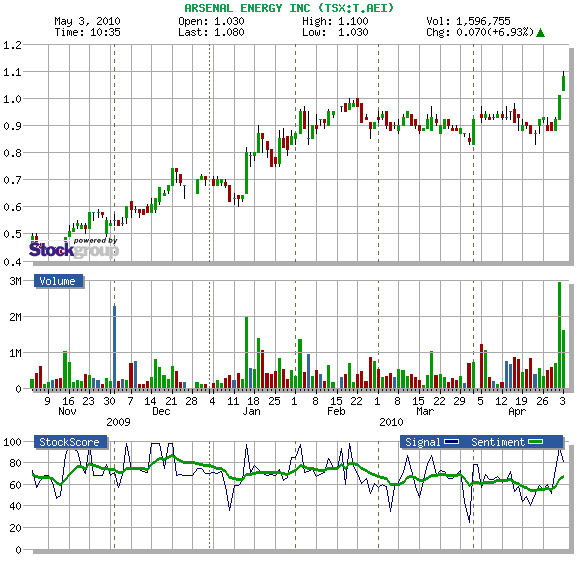
1. T.AEI
T.AEI has been trading in a narrow, sideways trading range since mid February. On Friday, it broke to the upside with strong volume support. This means the stock has a good probability that it will move higher in the weeks to come. Support at $0.88.
References
Get the Stockscore on any of over 20,000 North American stocks.
Background on the theories used by Stockscores.
Strategies that can help you find new opportunities.
Scan the market using extensive filter criteria.
Build a portfolio of stocks and view a slide show of their charts.
See which sectors are leading the market, and their components.
Click HERE for the Speaker Lineup and to Purchase the video if you want to learn from some of the worlds best traders including Tyler Bollhorn.

Tyler Bollhorn started trading the stock market with $3,000 in capital, some borrowed from his credit card, when he was just 19 years old. As he worked through the Business program at the University of Calgary, he constantly followed the market and traded stocks. Upon graduation, he could not shake his addiction to the market, and so he continued to trade and study the market by day, while working as a DJ at night. From his 600 square foot basement suite that he shared with his brother, Mr. Bollhorn pursued his dream of making his living buying and selling stocks.
Slowly, he began to learn how the market works, and more importantly, how to consistently make money from it. He realized that the stock market is not fair, and that a small group of people make most of the money while the general public suffers. Eventually, he found some of the key ingredients to success, and turned $30,000 in to half a million dollars in only 3 months. His career as a stock trader had finally flourished.
Much of Mr Bollhorn’s work was pioneering, so he had to create his own tools to identify opportunities. With a vision of making the research process simpler and more effective, he created the Stockscores Approach to trading, and partnered with Stockgroup in the creation of the Stockscores.com web site. He found that he enjoyed teaching others how the market works almost as much as trading it, and he has since taught hundreds of traders how to apply the Stockscores Approach to the market.
Disclaimer
This is not an investment advisory, and should not be used to make investment decisions. Information in Stockscores Perspectives is often opinionated and should be considered for information purposes only. No stock exchange anywhere has approved or disapproved of the information contained herein. There is no express or implied solicitation to buy or sell securities. The writers and editors of Perspectives may have positions in the stocks discussed above and may trade in the stocks mentioned. Don’t consider buying or selling any stock without conducting your own due diligence.
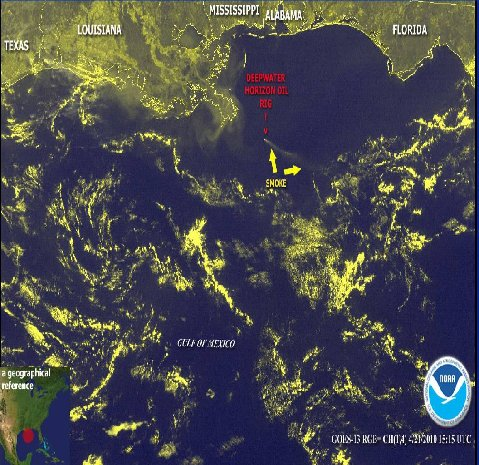
Louisiana is currently bracing itself for the big oil spill in the Gulf of Mexico to hit their shores with devastating consequences. This calamity brings back the experiences and lessons learned from previous oil spill disasters like the Exxon Valdez spill in 1989 and the 1969 Santa Barbara channel oil spill.
The oil spill in the Gulf of Mexico was caused by the recent explosion and sinking of the British Petroleum deep water Horizon drilling rig. The tragic loss of 11 lives and massive oil spill will result in yet another shutdown of any new offshore oil exploration.
British Petroleum (BP) will ultimately be held financially responsible even though the rig belongs to Transocean (RIG), the world’s biggest offshore drilling contractor. The rig was originally contracted through the year 2013 to BP and was working on BP’s Macondo exploration field in the Gulf of Mexico when the fire broke out.
…..read more HERE
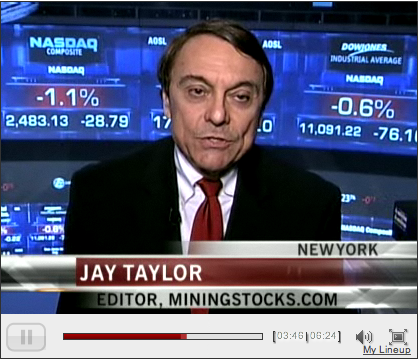
Gold has hit a 2010 high and its highest level since December. BNN speaks to Jay Taylor, president and CEO of Taylor Hard Money Advisors, and editor, Miningstocks.com about Gold and Mining Stocks.
-
I know Mike is a very solid investor and respect his opinions very much. So if he says pay attention to this or that - I will.
~ Dale G.
-
I've started managing my own investments so view Michael's site as a one-stop shop from which to get information and perspectives.
~ Dave E.
-
Michael offers easy reading, honest, common sense information that anyone can use in a practical manner.
~ der_al.
-
A sane voice in a scrambled investment world.
~ Ed R.
Inside Edge Pro Contributors

Greg Weldon

Josef Schachter

Tyler Bollhorn

Ryan Irvine

Paul Beattie

Martin Straith

Patrick Ceresna

Mark Leibovit

James Thorne

Victor Adair