
Investment/Finances
Comment by Richard Russell of Dow Theory Letters – “I take the action of the stock and bond markets this week (and particularly today) very seriously. Extreme caution is advised. The primary trend of the market is bearish, and the secondary trend may now be turning down”.
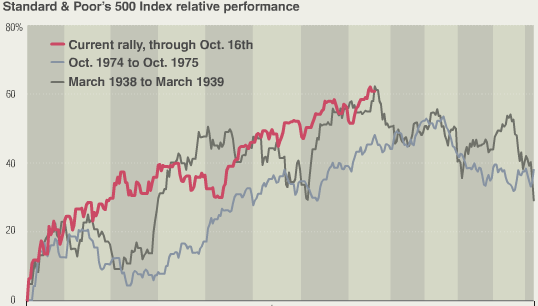
This Chart by Bloomberg for perspective:
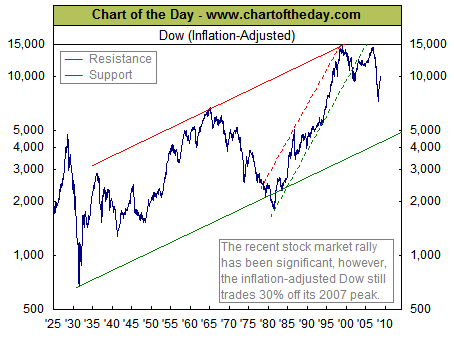
“For some long-term perspective, today’s chart illustrates the Dow adjusted for inflation since 1925. There are several points of interest. For one, when adjusted for inflation, the bear market that concluded in the early 1980s was almost as severe as the one that concluded in the early 1930s. Also, the inflation-adjusted Dow is now a little more than double where it was at its 1929 peak and trades a mere 51% above its 1966 peak – not that spectacular of a performance considering the time frames involved. It is also interesting to note that the Dow is up 54% from its March 9, 2009 low which is actually slightly more than what the inflation-adjusted Dow gained from its 1966 peak to today.”
Sign up for FREE http://www.chartoftheday.com/ HERE.
Next chart via Victor Adair.

More Richard Russell – “”I was most interested in the latest comments from Lowry’s. They report that their Buying Power Index has lost 15 points over the previous 5 trading days and regained “a rather anemic” 2 points yesterday (Thursday). On top of that, some of their short-term indices are overbought, and they believe caution is now warranted. And so do I.”
This Chart by Bloomberg for perspective:
Sign up for FREE http://www.chartoftheday.com/ HERE.
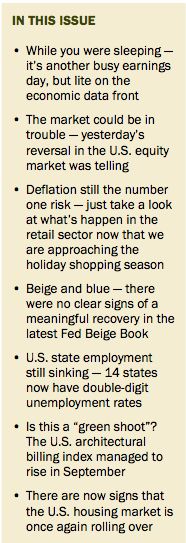
For a country that is a play on the global economy, what struck me about the Bank of Canada’s latest policy announcement on the global outlook were the words “significant fragilities remain.” ….read more HERE
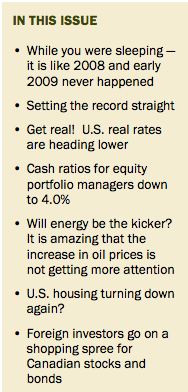
The beauty of having an extensive distribution list is that I can really get a gauge of investor sentiment based on the replies I receive on a daily basis. I recall all too well one Merrill financial advisor who wrote me back in the fall of 2007 and lamented about how wrong I was and why it was that I couldn’t be more like the bullish Milton Ezrati. There were countless others of these types of letters back at the top of the market and they served to harden my resolve; perhaps the same can be said today.
….read all below HERE.
….read all above HERE.
The Myth of the Rational Market, by Justin Fox, is an account—popular but thorough—of the roots, rise, triumph and ongoing fall of the theory of efficient markets in finance. This school of thought is an exemplary specimen of a type of social science that flourished after World War II: It has mathematical models at its center, has supposedly been empirically validated by statistical analyses, is indifferent to history and to institutions, and takes as an axiom that people are intelligent, farsighted and greedy. Unlike many economic theories, the efficient-market school has been influential beyond academia. It helped reshape ideas about how companies should be run, how executives should be paid, and indeed how the economy should be regulated (or not) to promote the general welfare. (In comic-book form: A mild-mannered social science by day, at night efficient-market theory puts on a cloak of ideology and struggles for the Capitalist Way.) The theory contributed, arguably, to setting up the crisis that has gripped the world economy since 2007. Its story is of much more than just scholarly interest……much more HERE.
-
I know Mike is a very solid investor and respect his opinions very much. So if he says pay attention to this or that - I will.
~ Dale G.
-
I've started managing my own investments so view Michael's site as a one-stop shop from which to get information and perspectives.
~ Dave E.
-
Michael offers easy reading, honest, common sense information that anyone can use in a practical manner.
~ der_al.
-
A sane voice in a scrambled investment world.
~ Ed R.
Inside Edge Pro Contributors

Greg Weldon

Josef Schachter

Tyler Bollhorn

Ryan Irvine

Paul Beattie

Martin Straith

Patrick Ceresna

Mark Leibovit

James Thorne

Victor Adair