
Investment/Finances
Today’s swollen fiscal deficits and public debt are fueling concerns about sovereign risk in many advanced economies. Traditionally, sovereign risk has been concentrated in emerging-market economies. After all, in the last decade or so, Russia, Argentina and Ecuador defaulted on their public debts, while Pakistan, Ukraine and Uruguay coercively restructured their public debt under the threat of default.
But, in large part — and with a few exceptions in Central and Eastern Europe — emerging-market economies improved their fiscal performance by reducing overall deficits, running large primary surpluses, lowering their stock of public debt-to-GDP ratios and reducing the currency and maturity mismatches in their public debt. As a result, sovereign risk today is a greater problem in advanced economies than in most emerging-market economies.
Indeed, rating-agency downgrades, a widening of sovereign spreads and failed public-debt auctions in countries like the United Kingdom, Greece, Ireland and Spain provided a stark reminder last year that unless advanced economies begin to put their fiscal houses in order, investors, bond-market vigilantes and rating agencies may turn from friend to foe. The severe recession, combined with the financial crisis during 2008-09, worsened developed countries’ fiscal positions, owing to stimulus spending, lower tax revenues and backstopping, and ring-fencing of their financial sectors.
The impact was greater in countries that had a history of structural fiscal problems, maintained loose fiscal policies and ignored fiscal reforms during the boom years. In the future, a weak economic recovery and an aging population are likely to increase the debt burden of many advanced economies, including the United States, the United Kingdom, Japan and several euro-zone countries.
More ominously, monetization of these fiscal deficits is becoming a pattern in many advanced economies, as central banks have started to swell the monetary base via massive purchases of short- and long-term government paper. Eventually, large monetized fiscal deficits will lead to a fiscal train wreck and/or a rise in inflation expectations that could sharply increase long-term government bond yields and crowd out a tentative and so far fragile economic recovery.
Fiscal stimulus is a tricky business. Policymakers are damned if they do and damned if they don’t. If they remove the stimulus too soon by raising taxes, cutting spending and mopping up the excess liquidity, the economy may fall back into recession and deflation. But if monetized fiscal deficits are allowed to run, the increase in long-term yields will put a chokehold on growth.
Countries with weaker initial fiscal positions — such as Greece, the United Kingdom, Ireland, Spain and Iceland — have been forced by the market to implement early fiscal consolidation. While that could be contractionary, the gain in fiscal-policy credibility might prevent a damaging spike in long-term government-bond yields. So early fiscal consolidation can be expansionary on balance.
For the Club Med members of the euro zone — Italy, Spain, Greece and Portugal — public-debt problems come on top of a loss of international competitiveness. These countries had already lost export-market shares to China and other low value-added and labor-intensive Asian economies. Then a decade of nominal-wage growth that out-paced productivity gains led to a rise in unit labor costs, real exchange-rate appreciation and large current-account deficits.
The euro’s recent sharp rise has made this competitiveness problem even more severe, reducing growth further and making fiscal imbalances even larger. So the question is whether these euro-zone members will be willing to undergo painful fiscal consolidation and internal real depreciation through deflation and structural reforms in order to increase productivity growth and prevent an Argentine-style outcome: exit from the monetary union, devaluation and default. Countries like Latvia and Hungary have shown a willingness to do so. Whether Greece, Spain and other euro-zone members will accept such wrenching adjustments remains to be seen.
The United States and Japan might be among the last to face the wrath of the bond-market vigilantes: the dollar is the main global reserve currency and foreign-reserve accumulation — mostly U.S. government bills and bonds — continues at a rapid pace. Japan is a net creditor and largely finances its debt domestically.
But investors will become increasingly cautious even about these countries if the necessary fiscal consolidation is delayed. The United States is a net debtor with an aging population, unfunded entitlement spending on social security and health care, an anemic economic recovery and risks of continued monetization of the fiscal deficit. Japan is aging even faster and economic stagnation is reducing domestic savings, while the public debt is approaching 200 percent of GDP.
The United States also faces political constraints to fiscal consolidation: Americans are deluding themselves that they can enjoy European-style social spending while maintaining low tax rates, as under President Ronald Reagan. At least European voters are willing to pay higher taxes for their public services.
If America’s Democrats lose in the mid-term elections this November, there is a risk of persistent fiscal deficits as Republicans veto tax increases while Democrats veto spending cuts. Monetizing the fiscal deficits would then become the path of least resistance: running the printing presses is much easier than politically painful deficit reduction.
But if the United States does use the inflation tax as a way to reduce the real value of its public debt, the risk of a disorderly collapse of the U.S. dollar would rise significantly. America’s foreign creditors would not accept a sharp reduction in their dollar assets’ real value that debasement of the dollar via inflation and devaluation would entail. A disorderly rush to the exit could lead to a dollar collapse, a spike in long-term interest rates and a severe double dip recession.
Nouriel Roubini is a professor of economics at the Stern School of Business at New York University and chairman of Roubini Global Economics. — Ed.
Article from the Korea Herald
Obama says the feds ‘saved’ 2 million jobs. But the cost of each job saved was as much as $65 million, according to our not-very-precise accounting.
Was it worth it?
Yesterday, we went on at some length as to why government jobs weren’t the same as private sector jobs. Since they’re never put to the test of the market, you never know whether they are worth having, let alone saving. Do they add to the sum of human wealth and happiness…or do they subtract from it? No one knows for sure.
But here’s the strange and remarkable thing; modern economists actually would prefer jobs that are NOT worth doing.
……..read more HERE
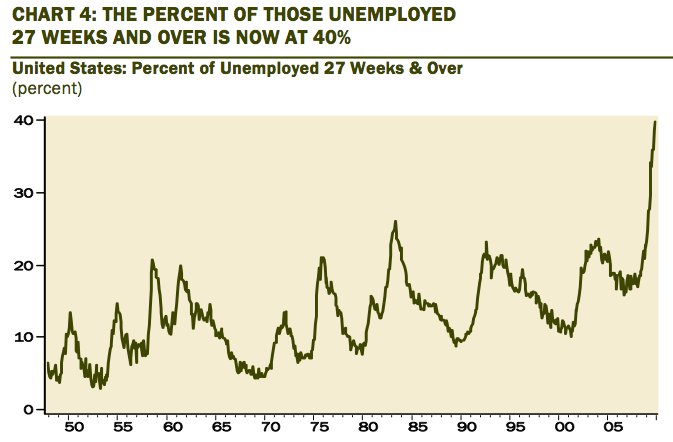
- We started the decade with a national payroll level of 130.8 million, we finished the decade basically unchanged at 130.9 million
- The details of today’s U.S. nonfarm payroll were very soft.
- It’s not just the magnitude of the job declines but how widespread they are that is disturbing
- The Canadian employment number also came in below expected, at -2,600 in December versus consensus forecast of 20,000.
- Investor complacency running high — there are now 3x as many bulls as there are bears.
…..read more HERE.
The credit crunch continues, with businesses large and small finding that their bankers remain exceedingly stingy in the wake of the 2008 financial debacle.
“We need to see banks making more loans to their business customers,” Federal Deposit Insurance Corporation (FDIC) Chairwoman, Sheila Bair, told reporters recently after the FDIC released figures showing that the amount of loans outstanding in the nation’s banks fell $210.4 billion in the third quarter of 2009. That is the largest quarterly decline since the FDIC began tracking loans in 1984.
If we dig inside these data, we see that business lending has contracted at a much faster pace than consumer lending. This trend is not merely a function of contracting economic activity, it is also a function of the fact that banks have been deemphasizing business lending for many, many years.
Numbers from the FDIC reflect this shift over the past decade. At the end of the third quarter of 1999, the assets of the nation’s banks totaled $5.5 trillion. As of September 30 of this year, bank assets had grown to $13.2 trillion. But commercial and industrial loans outstanding barely budged, only growing from $947 billion a decade ago to $1.27 trillion by September 30 this year. Meanwhile, loans secured by real estate increased from $1.43 trillion in the fall of 1999 to $4.5 trillion this fall. And investment in securities doubled, rising from $1.03 trillion to $2.4 trillion.
This secular shift away from “productive” lending to businesses toward “nonproductive” lending to consumers creates a new kind of structural weakness for the American economy.
Robert Prechter makes the point in the November edition of the Elliott Wave Theorist that banks have lent sparingly to businesses for the past 35 years. Businesses report that since 1974, ease of borrowing was either worse or the same as it was the prior quarter, meaning that – at least according to business owners – loans have been increasingly hard to get the entire time.
Unfortunately, from a macroeconomic perspective, lending to consumers rather businesses is a suboptimal emphasis/counterproductive exercise.
Prechter writes in his book Conquer the Crash that the lending process for businesses “adds value to the economy,” while consumer loans are counterproductive, adding costs but no value. The consumer may call his borrowing “productive,” but it surely does not create capital, i.e., build shops or factories or manufacture tools and dies that enhance the productivity of human labor. The banking system, with its focus on consumer loans, has shifted capital from the productive part of the economy, people who have demonstrated a superior ability to invest or produce (creditors) to those who have demonstrated primarily a superior ability to consume (debtors).
Total household debt peaked in 2008 at $13.8 trillion, with $10.5 trillion of that being mortgage debt. And as Sean Corrigan explained, “Houses are nonproductive assets, financed with a great deal of leverage.” And while homeowners reap the services provided by homes slowly over time, houses “deliver a large dollop of uncompensated purchasing power up front to their builders or to those cashing out of the market,” making housing “the ultimate engines of created credit on the upswing, and…among the more dangerous deflators on the way down.”
In the last decade, the US system of fractional-reserve banking has created what Frank Shostak calls “empty money,” which masquerades as genuine money when in fact “nothing has been saved.” This explosion of money was created through the banking system, as consumers gorged themselves on nonproductive assets like houses, autos, and big-screen TVs. These purchases gave the illusion of economic growth and good times, but in reality weakened the process of wealth formation; instead of building capital, this system wasted it.
Meanwhile, businesses that create wealth-producing jobs have stagnated. The workforce was induced into working for enterprises that represent malinvestment: home and commercial construction, as well as other real- estate-related jobs, and businesses dependent on consumer consumption.
Unfortunately, the federal and state governments constantly enact legislation that makes the employment of workers more costly and in turn makes business expansion riskier. So wealth-producing businesses, like metal fabrication and the like, have every incentive not to borrow money from a bank to expand their operations and not to wander into a wider thicket of onerous employment rules by hiring more workers. Instead, the entrepreneur puts energy into obtaining a low-interest mortgage and buying a big house, or dabbling in real-estate development and speculation. Besides, up until this current meltdown the entrepreneur could obtain a real-estate loan much more easily than a business loan.
Those in Washington are doing all they can to promote the continued destruction of capital and wealth. Policies like “cash for clunkers”; tax credits for home buyers; the bailing out of the big banks, Fannie, Freddie, and the auto companies; and keeping interest rates near zero only serve to promote speculation and consumer consumption. Instead, Washington should be lowering taxes and the costs of hiring employees, especially in industries that produce capital and wealth.
Regards,
Douglas French,
for The Daily Reckoning
Joel’s Note: Douglas French is president of the Mises Institute and author of Early Speculative Bubbles & Increases in the Money Supply. He received his masters degree in economics from the University of Nevada, Las Vegas, under Murray Rothbard with Professor Hans-Hermann Hoppe serving on his thesis committee.
We’re happy to have been able to bring you Mr. French’s insights and suggest (at least) a few hours trolling the net for his back catalogue. The Mises.org website is a good place to start if you’re interested in Austrian economic theory, as is our own Richebächer Letter, edited by Rob Partenteau. We trust you’ll find both of immense value to your continuing investment education.
And we’ll have to leave it there for today. Your editor’s flight has been called and he’s still half an airport away from the gate. Ugh…
If you wish to comment on anything in today’s issue, drop us a line at the address below.
Until tomorrow…
Cheers,
Joel Bowman
Managing Editor of The Daily Reckoning
joel@dailyreckoning.com
“Spain has failed to escape a wave of sovereign debt warnings from international ratings agencies that have roiled financial markets this week, despite the government’s serious efforts to rein in a runaway budget deficit.”
“In Europe, Ireland, Portugal and even France are under pressure to rein in rising budget deficits. And deeply troubled Greece has become the first euro-currency country to be whacked.”
Standard & Poor’s Corp. Wednesday lowered its ratings outlook on Spain to negative, saying the country will probably see “significantly lower” gross domestic product growth and “persistently high fiscal deficits relative to peers over the medium term.”
“The timing is unexpected and very negative from what I’ve been able to read,” Dirk Schnitker, trader at CM Capital Markets Bolsa said.
Formerly an engine of euro-zone job creation and economic growth, Spain last year suffered an abrupt reversal of fortune when the global financial crisis precipitated the collapse of the country’s formerly buoyant construction industry. Though the wider euro zone returned to growth in the third quarter, the Spanish economy continued to contract.
….from today’s Wall Street Journal article
Governments warned over debts
“In Europe, Ireland, Portugal and even France are under pressure to rein in rising budget deficits. And deeply troubled Greece has become the first euro-currency country to be whacked.”
….from today’s Globe and Mail article
-
I know Mike is a very solid investor and respect his opinions very much. So if he says pay attention to this or that - I will.
~ Dale G.
-
I've started managing my own investments so view Michael's site as a one-stop shop from which to get information and perspectives.
~ Dave E.
-
Michael offers easy reading, honest, common sense information that anyone can use in a practical manner.
~ der_al.
-
A sane voice in a scrambled investment world.
~ Ed R.
Inside Edge Pro Contributors

Greg Weldon

Josef Schachter

Tyler Bollhorn

Ryan Irvine

Paul Beattie

Martin Straith

Patrick Ceresna

Mark Leibovit

James Thorne

Victor Adair