
Daily Updates
In this week’s issue:

You cannot expect to do well in the market if you look at investing in a normal way. By definition, being average is doing what most other people do and since investing is largely a psychological game, doing what other people do is only natural. Average results come from normal people acting in normal ways.
To beat the market, you have to be different.
Not necessarily in a straight jacket bouncing off padded walls different, just a little off.
Here are 10 things that may help you be a better investor, some ways to think differently from the crowd in that pursuit to achieve market dominance.
1. Do not think about making money, think about losing money – the first step toward success is accepting that losing is part of trading. You will not be right all of the time, you cannot always trade your way out of a bad situation. There will be times when you simply have to walk away with a loss. The key is to keeping the losses small and manageable. When the market proves you wrong, take the loss.
2. Do not think you can average down to win – it is a logical idea, add more to a losing position with the expectation that the market must eventually go your way. Many times this strategy will work but, when it does not work, the loss may be insurmountable. The market does not eventually have to go your way.
3. Do not think that your success is entitled – you may make a great trade, pick a really great stock and have a feeling like you really have the market figured out. Forget your gloating, no one ever has the market figured out. We must always remember that we have to work as smart for the next trade as we did for the last.
4. Do not think that talent is required – making money in any trading endeavor is a small part technical skill and a big part emotional management. Learn to limit losses, let winners run and be selective with what you trade. Emotional mastery is more important than stock picking skill.
5. Do not think that you can tell the market what to do – the market does not care about you, it does not know that you want to make a profit. You are the slave, the market is your master. Be obedient and do what the market tells you to.
6. Do not think you are competing against other traders – trading success comes to those who overcome themselves, it is you and your persistent desire to break trading rules that is the ultimate adversary. What others are doing is of little consequence, only you can react to the market and achieve your success.
7. Do not think that Fear and Greed can ever be positive – in life, fear can keep us from harm, greed can give us the motivation to work hard. In the market, these two emotional forces will lead to losses. If your decisions are governed by either or both you will most certainly find that your money escapes you.
8. Do not think you will remember everything you learn – every trade provides a lesson, some valuable education on what to do and what not to do. However, it is likely that your lessons will contradict one another and lead you to forget many of them. Write down the knowledge that you accumulate, return to this trading journal so that you can retain some value from the lessons taught by the market. Remember, the market is cruel, it gives the test first and the lesson after.
9. Do not think that being right will lead to profits – you may be exactly right about what the fundamentals are and what they are worth. However, timing is everything, if your expectations for the future are ill timed, you may find yourself losing more than you can tolerate. Remember, the market can be wrong longer than you can be liquid.
10. Do not think you can overcome the laws of probability – traders tend to be gamblers when they face a loss and risk averse when the have a potential for gain. They would rather lock in a sure profit and gamble against a probable loss even if the expected value of doing so is irrational. Trading is a probability game, each decision should be made on the basis of the best expected value and not what feels best.

The best Stockscores Market Scan strategy for finding position trading opportunities is the Stockscores Simple. Over the past few months, with a weak market, not too many opportunities have appeared but conditions are beginning to improve. Last week, my pick on STAA was found with this strategy and it made a good move this week, up 18% this week (RIMM moved higher this week as well but that was not found with the Stockscores Simple).
I ran this strategy again this week and found one stock out of those that the Market Scan highlighted. It is a stock that I featured in my daily newsletter earlier in the week, but the chart still looks good now so I discuss here as well.

1. T.PRU
T.PRU is breaking out to new highs and through long term resistance. Volume picked up this week as buyers start to take notice of the stock. While most stocks are pretty beat up, this one is showing optimism and looks more likely to go higher than lower. Support at $3.15.

References
This is not an investment advisory, and should not be used to make investment decisions. Information in Stockscores Perspectives is often opinionated and should be considered for information purposes only. No stock exchange anywhere has approved or disapproved of the information contained herein. There is no express or implied solicitation to buy or sell securities. The writers and editors of Perspectives may have positions in the stocks discussed above and may trade in the stocks mentioned. Don’t consider buying or selling any stock without conducting your own due diligence.
Back To Top
As a general rule, the most successful man in life is the man who has the best information
Country Risk – Where the political and economic stability of the host country is questionable, and abrupt changes in the business environment could adversely affect profits or the value of the company’s assets.
Resource Nationalism – The tendency of people and governments to assert control, for strategic and economic reasons, over natural resources located on their territory.
The major benefit for developing countries from natural resource development comes in the form of:
- Employment/wages
- Government revenues – taxes, royalties or dividends
There can also be indirect benefits such as knowledge and technology transfers. Foreign investments can also involve infrastructure investments, sometimes on a massive scale, like electricity, water supplies, roads, railways, bridges and ports.
Today many governments are looking at ways to get more money from miners as companies report record profits – the higher the returns and the higher the profits, the greedier governments become. As commodity prices rise governments try to boost their share of the proceeds from their countries energy and mining sectors.
The PricewaterhouseCoopers Mine 2011 survey highlights what governments across the globe are looking at in regards to the world’s top 40 miners:
- Achieved net profits of $110b last year
- Halved their debt
- Built cash reserves of $105bn
- Announced capital programs of $300b for 2011
In 2011, Resource nationalism became the number one risk for mining companies.
Miners are an easy target as mining is a long term investment and one that is especially capital intensive – mines are also immobile, so miners are at the mercy of the countries in which they operate. Outright seizure of assets happens using the twin excuses of historical injustice and environmental/contractual misdeeds. There is no compensation offered and no recourse.
“Resource nationalism is taking other forms as well, including greater controls on foreign participation, mandated beneficiation, use it or lose it demands and mandated government participation.” Ernst & Young Global Mining & Metals Leader Mike Elliott
The result is a spate of recent news regarding resource nationalism:
- A government backed ouster of Brazilian mining giant Vale SA’s CEO, Roger Agnelli. Brazil’s government is considering a proposal that would make it easier to raise or lower mining royalties – depending on economic conditions and minerals prices – as part of a broad overhaul in Brazil’s mining sector which includes revamping the licensing process and boosting state income from mining companies.
- Panama recently repealed part of its mining code allowing investments from foreign governments.
- A handful of African countries have also increased tax revenue from miners in recent years – ie Ghana plans to double royalties on mining to increase government revenues
- South Africa is pushing to nationalize its mines and banks. The Youth League wants the government to take 60% of private mining assets without compensation to distribute wealth and create jobs. As part of an empowerment drive South Africa’s mining charter already calls for 26 percent of the mining industry – in Africa’s largest economy – to be transferred to black owners by 2014
- Papua New Guinea introduced a plan to hand state ownership of mineral and energy resources to landowners – a move that may prove disastrous to foreign miners and their shareholders
- President Hugo Chavez nationalized Venezuela’s gold industry
- Peruvian president Humala (recently elected) promised, during his election campaign, to initiate windfall taxes on mine profits and to harden tax and royalty regimes
- Australia and Chile are proposing fresh tax or royalty regimes
- In the past 12-18 months at least 25 countries have increased or announced intentions to increase their government take from resources via taxes or royalties
- Zimbabwe now requires foreign owned companies “indigenize” their operations in the country – by transfering at least 51% ownership to locals. Youth Development, Indigenisation and Empowerment Minister Saviour Kasukuwere rejected a number of foreign companies plans and set a 14-day ultimatum for the submission of what he considers “acceptable” plans
Skills Shortage
A combination of mass retirements and increasing natural resource demand from emerging economies has created a crisis in the resource extraction sector – one which is definitely not on investor’s radar screens.
Increased resource demand is driving demand for skilled workers. A shortage of skilled workers remains the second biggest business risk for mining in 2011 (as it was in 2010) and is forecast to be the number two risk for miners again in 2012.
Skills shortages are global, shortages are happening in South Africa, Australia, Canada and South America. A skills shortage slows growth and increases costs, projects are being deferred or even cancelled outright due to the inability to staff operations – tighter labor markets also provide unions with greater bargaining powers when dealing with companies over wage settlements and other disputes.
The Mining Industry Human Resources Council (MIHRC) estimates that over 60,000 people employed in the mining sector are expected to retire by 2020 but that the industry will need an additional 100,000 people just to maintain current levels of production.
The Petroleum Human Resources Council of Canada warned a severe oil patch labor shortage is looming and that the “patch” will need to hire 24,000 new employees by 2014.
Weak metal prices during the 1980s and 1990s killed the resource sector’s intake of talent – there’s not many people between 30 and 50 in mining anymore.
The existing shortage of skilled personnel, the imminent retirement of so many baby boomers (many are mid level managers), the skills supply gap in the 1980’s and 1990’s combined with the mining sector being in direct competition with the energy sector for people to train means prospects are bleak for either industry to obtain the necessary bodies and minds.
Analysts say attracting and retaining increasingly scarce skills will:
- Accelerate cost increases
- Squeeze profit margins
- Threaten the viability of some marginal projects
The pool of available skill sets, the mine executives/managers, the miners, the engineers, drillers, geologists, mechanics, and other trades needed isn’t very deep. This labor shortage is going to increasingly hurt the industry in the coming years.
Conclusion
Many governments are reviewing old agreements and renegotiating contracts. There are now many places, and the number is seemingly growing every day, where shareholders could, without warning, receive news that their operations have been taken over by the government and/or its friends, or that permits are suddenly suffering delays or have been cancelled outright.
We’ve seen far too many instances of companies and their shareholders losing assets that were lawfully theirs. If the management side of the companies we invest in is so important then maybe we should start regarding the management of the country they operate in as at least as important?
Mining sector employment trends are closely connected to:
- Global economic growth
- Commodity prices
- Intensity of exploration and or production levels
- State of mineral reserves
Currently many mining companies are having trouble finding skilled workers – there is a “massive talent gap.” And it’s going to get worse – the oldest baby boomers are turning 65 years old in 2011 – and the global mining industry is experiencing the biggest wave of workforce retirements in 70 years.
In the next five years one-third of the mining workforce will be eligible for retirement. According to the Mining Industry Human Resources (MiHR) Council’s latest labor market information report, “Canadian Mining Industry Employment and Hiring Forecasts 2010” the mining industry will need approximately 100,000 new workers by 2020.
As if the mining sector didn’t already have enough to worry about.
Mine production of many metals is showing a number of similarities:
- Slowing production and dwindling reserves at many of the world’s largest mines
- The pace of new elephant-sized discoveries has decreased in the mining industry
- All the oz’s or pounds are never recovered from a mine – they simply becomes too expensive to recover
Increasingly we will see falling average grades being mined, mines becoming deeper, more remote and come with increased political and nationalization risk. Extraction of metals from the mined ore will become increasingly more complex and expensive, even more so when one considers the effects of Peak Oil – the cost of technology innovation to power mining will be very high.
Broad spectrum peak commodities is a cause for concern over the longer term.
In the shorter to medium term there are several serious concerns in regards to global resource extraction that we need to consider:
- Resource nationalism
- Country risk
- A looming skills shortage
Junior resource companies with fully staffed, secure projects in safe, stable countries should be on every investors radar screen. Are they on yours?
If not, maybe they should be.
Richard (Rick) Mills
rick@aheadoftheherd.com
www.aheadoftheherd.com
If you’re interested in learning more about the junior resource sector, bio-tech and technology sectors please come and visit us at www.aheadoftheherd.com
Site membership and our AOTH newsletter are free. No credit card or personal information is asked for.
***
Richard is host of Aheadoftheherd.com and invests in the junior resource sector. His articles have been published on over 300 websites, including: Wall Street Journal, SafeHaven, Market Oracle, USAToday, National Post, Stockhouse, Lewrockwell, Uranium Miner, Casey Research, 24hgold, Vancouver Sun, SilverBearCafe, Infomine, Huffington Post, Mineweb, 321Gold, Kitco, Gold-Eagle, The Gold/Energy Reports, Calgary Herald, Resource Investor, Mining.com, Forbes, FNArena, Uraniumseek, and Financial Sense.
***
Legal Notice / Disclaimer
This document is not and should not be construed as an offer to sell or the solicitation of an offer to purchase or subscribe for any investment. Richard Mills has based this document on information obtained from sources he believes to be reliable but which has not been independently verified; Richard Mills makes no guarantee, representation or warranty and accepts no responsibility or liability as to its accuracy or completeness. Expressions of opinion are those of Richard Mills only and are subject to change without notice. Richard Mills assumes no warranty, liability or guarantee for the current relevance, correctness or completeness of any information provided within this Report and will not be held liable for the consequence of reliance upon any opinion or statement contained herein or any omission. Furthermore, I, Richard Mills, assume no liability for any direct or indirect loss or damage or, in particular, for lost profit, which you may incur as a result of the use and existence of the information provided within this Report.
QE Watch
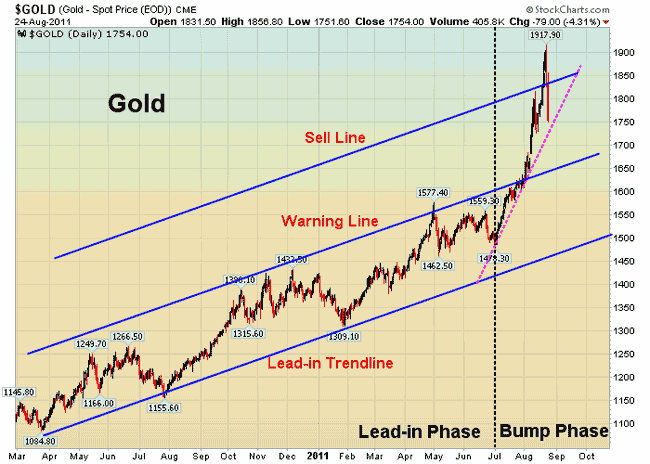
All the world is waiting for the words from the great god Bennie Bernanke. Bernanke is the recognized ultimate expert on the Great Depression of the 1930s. After laboriously studying the Great Depression, “What’s this?” It appears that at one point the Fed shrunk the money supply, thereby sending the already-staggering economy into a hell-hole with the Dow falling to a price of 41 in July 1932.
God-awful mistake realized Bernanke, and at one point Bernanke actually apologized on the part of the Fed for the Fed’s unforgivable mistake. Silently, Bernanke swore to himself, “This will never happen on my watch. When the economy slumps, feed it with money, more and more money, and if the dollar tanks, so be it.” – Richard Russell of Dow Theory Letters
Metal Versus Metal Stocks
Gold versus Gold stocks. A topic near and dear to my heart. One that I have studied relentlessly for the past several years. I am no mining expert. I am not the one that can point you to the next “ten bagger” in the junior mining sector. But I have been right in insisting that my subscribers favor Gold over Gold stocks and I continue to favor Gold (and silver) over the companies that dig these metals out of the ground. This is sector analysis, not an individual firm analysis.
Gold stocks are undervalued say the Gold stock bulls. The fundamentals are improving thanks to a rising “real” price of Gold. These things are true. But a “value trap” is believing that things that are cheap can’t get cheaper. They can.
Now, I trade Gold stocks, I don’t hold them for the long term. My long term investment for this secular precious metals bull market is physical Gold held outside the banking system, and a little bit of silver. Why? Because Gold stocks are not Gold, they are a paper derivative of Gold. And when the poop hits the fan, like it did briefly a few short weeks ago, Gold stocks get thrown out with other stocks. Sure, they may hold up better than base metal stocks or banking stocks, but a break even proposition when Gold is rocketing higher seems like a poor trade to me. I’d rather hold the GLD ETF and make some fiat money rather than be loyal to the Gold stock cause and not make any money.
When the Gold sector is healthy and in “proper” alignment, the juniors should be leading the seniors higher. One can use a ratio of the GDX ETF (i.e. the senior miners) to the GDXJ ETF (i.e. the junior miners) to get a sense of whether the seniors or juniors are outperforming. Here’s the data during one of the bigger bull runs of this secular Gold bull market (a GDX:GDXJ ratio chart over the past 6 months):
….read more & view charts HERE
Uranium and Potash Stocks on the “Frontier”
Operating out of Uruguay, Carlos Andres’ Frontier Research Report provides a vastly different perspective. In this exclusive interview withThe Energy Report, he gives us some insights on global mineral exploration and production in areas that are more “out of the way” than what we usually consider. He tells us about two very exciting companies with huge investment potential in projects located in Namibia and Ethiopia.
The Energy Report: Carlos, as publisher of the Frontier Research Report based in Uruguay, you seek out attractive undervalued situations in the metals mining area and in energy and agricultural minerals. Can you explain your philosophy in making investment selections for the portfolio that you follow?
Carlos Andres: Sure. We’ve chosen the junior exploration space because we believe it gives investors the best bang for their buck. It’s high risk but it can also provide the highest imaginable returns. By investing in well-researched companies, with strong management and highly prospective projects, investors can make many multiples of their initial investments as companies successfully transition from explorer through development to producer.
However, we can dramatically reduce the risk involved without reducing the upside by doing our homework. We apply our well-honed expertise and lengthy experience to differentiate opportunities that may appear high risk on the surface but actually have critical value drivers in their favor. With this in mind, we target emerging and frontier markets because investors and analysts tend to lack knowledge of or experience with these countries, and therefore tend to associate fear and high risk with them. In contrast to this tendency, refined expertise and experience can be the biggest differentiators in clearing the fog of “perceived” risk in order to unearth overlooked opportunities in these less traveled and less understood markets.
Emerging and frontier markets provide opportunities to buy high-quality companies at a discount simply because of the “perceived” risk factor. So we look at places such as Mongolia, which is a resource-rich country that is just beginning to realize the benefits of 20 years of liberalizing its markets. As a result, foreign direct investment has been steadily increasing, the rich resource endowment is starting to be developed and the country is experiencing historic economic growth. From a broader perspective, there are emerging and frontier market economies in South America, Southeast Asia and Africa with similar stories, although they all have their own unique twists. Countries like Colombia, Peru, Chile, Brazil, Guyana, Argentina, Ghana, Namibia, Tanzania, Botswana, Ethiopia, Indonesia, Papua New Guinea and others all play an important role in meeting historic and rapidly increasing global demand for natural resources.
TER: You live in Uruguay, which is a place most people have maybe heard of but couldn’t find on a map to save their lives.
CA: That’s probably true. Many think it’s a landlocked dictatorship in South America. They have the South America part right. Still others boldly identify it as a country in Southeast Asia. Yes, it’s off the radar for most, but a lovely place nonetheless.
TER: You obviously have a different perspective on viewing resource companies and opportunities there versus somebody who does this from a nice office in a high-rise building somewhere in the U.S. or Canada. Can you give us a little perspective from your point of view and tell us what investors there think if they’re even involved in these kinds of investments?
CA: Sure. From a retail investor standpoint, I’m not sure how folks in South America invest their money. But I do know that in terms of wealth generation and economic growth, natural resources play a big role. How much of the capital investment comes from South America itself and how much of it comes from the major capital markets like Canada, London or Australia, I’m not sure. But South American retail investment is growing and therefore transaction and market cap levels in the local stock markets in places like Peru, Colombia and Chile are growing. As a result, there are mergers in the works between these exchanges to develop a world-class capital market in South America, if that’s any indicator. This is also prompting many Canadian-, Australian- and London-listed miners to adopt local listings in the South American countries in which they do business. This is a growing trend, and companies often proudly report the percentage of their share ownership that is local. Certainly the focus down here among the general population is natural resources. That is how most wealth is generated, whether it’s in agriculture, forestry, mining, or oil and gas. It is a significant factor here and there is an acceptance of it and orientation toward it.
TER: Rising prices and struggling economies are causing many countries to rethink their tax and mineral royalty laws to increase their percentage take of the commodities produced by private companies. How is this going to affect companies developing new mines and producing from existing ones?
CA: Governments in countries that are rich in natural resources with populations that may be relatively poor are going to look toward their natural resource endowments to provide economic relief to their populations. Natural resource extraction is often one of the bigger contributors to an emerging country’s economic growth. It’s quite natural for governments to look to it as a source of revenue and they are going to want a bigger piece of the pie. The question is how far is the government going to take it—either in the form of royalties against revenue or increasing income taxes against company profits. A government can also take an ownership interest in the company, which some do. Sometimes governments will pay for this interest, thereby becoming a JV partner or sometimes they do not. Depending on the details and the manner in which these reforms are introduced, companies and foreign investment capital often successfully endure the burden. However, in a worst case scenario, governments can also outright nationalize a company and take it over. We’ve seen this in Bolivia and Venezuela, for example, with another round of gold mining nationalization on the horizon apparently, and South Africa is threatening such legislation.
On the other hand, in Ghana, a very mining friendly country, it is required by law that when you get your mining permit, 10% of the company will go to the government for free. And it works very well because the government approached the issue in a mature and transparent way in consultation with the industry. Many of the gold majors profitably operate mines there and it is a premier exploration destination in Africa. Ghana is the second largest gold producer in Africa, behind South Africa. In addition, the government imposes royalties on revenue and income taxes on profits.
So if an explorer or a producing major is assessing various emerging or frontier markets, these are important considerations. Typically, a happy medium can be found between the industry and constructive governments seeking to increase the benefits to citizens from their natural resource endowments. However, companies have to remain ever vigilant in watching for changes in government attitudes. Reading the tea leaves is an important skill set for mining managers.
TER: So, a risk factor component is incorporated into the prices of many of these companies that have big operations in those areas. I guess that’s the price you have to pay if you want to play the game?
CA: That’s right. It’s part of the equation.
TER: There was quite a bit of controversy recently with the Australian government wanting to raise taxes on the mining industry there. Will that have an impact on future development?
CA: The Australian government at the time was led by Kevin Rudd, the former prime minister—and he is the former Prime Minister for a reason. He proposed a 40% super-profits tax on mining companies across the board. It was done by surprise without consulting the industry at all. The number appeared to be picked arbitrarily without taking into account the profitability of Australia’s mining sector or its ability to pay the tax. Obviously, miners have varying ranges of profitability so some might be able to pay it and some might not. The government just threw a big number out there. It was a big and unnecessary risk politically and Kevin Rudd lost.
Mining companies got up in arms and the public was sober and rational enough to recognize that the mining industry represents a significant part of the Australian economy and a lot of jobs. Ultimately, Kevin Rudd had to step down. The government has now gone into negotiations with the big mining companies, which have acknowledged that they are willing to pay some higher taxes, but it has to be done rationally and intelligently. What has happened is, instead of extending to all mining companies in all mineral sectors, now it seems to be focused on the bulk mining industries, like coal and iron ore, but it likely won’t affect gold or silver mining companies and a lot of the mineral miners outside of the bulk industrial commodity sphere. It also appears that the tax will be less than 40% when implemented but it is still in negotiation. In the meantime, mining and exploration in Australia continues.
TER: You follow at least a couple of companies in your portfolio in the energy and mineral fields. One Australian name is Bannerman Resources Ltd. (TSX:BAN; ASX:BMN), which is a uranium explorer and developer with a big project in Namibia. How will the recent Chinese takeover offer impact the company’s prospects?
CA: We like Bannerman a lot. China has 26 nuclear power plants currently under construction. Russia, South Korea and India have another 21 under construction between them. As a result, they are all shopping for a stable supply of uranium. Namibia is one of the more stable uranium rich countries in which to go shopping, to keep all these new reactors fed. Namibia is home to the largest uranium mine in the world, the Rossing mine, owned by Rio Tinto and is the fourth largest uranium producer. Currently, the country only has two advanced-stage deposits. One is owned by Bannerman and is known as the Etango project. The other is owned by Extract Resources Ltd. (TSX:EXT; ASX:EXT). Both represent world-class deposits in terms of size.
We like Namibia as a mining jurisdiction. It represents a somewhat mature and stable mining friendly jurisdiction, despite the fact that it had a recent hiccup where the minister of Mining and Energy proposed government ownership of the country’s mining licenses and the imposition of a super-profits tax. But the uproar has calmed down as discussions have taken place and the government has made it clear that it has no intention of killing the goose that lays the golden eggs. So Namibia represents a fairly stable mining jurisdiction. When the nuclear energy companies around the world go shopping for sources of uranium for their power plants, they obviously want a stable supply from jurisdictions that are outside geopolitical hotspots, which are prevalent in the Northern Hemisphere at the moment. Of course, this isn’t always possible. For example, Kazakhstan is the largest uranium producer in the world but hardly the most stable place to mine. It has evolved into that position over the last few years.
In contrast, Namibia has been a stable mining jurisdiction for a long time. So in this context, Bannerman has a very attractive established deposit where it has defined 213 million pounds (Mlb.) of uranium. That’s a lot of uranium and it is currently selling in the spot market for about $50/pound (lb.). This makes the resource worth $10 billion (B) while the company’s current market cap is $100 million (M) with about $20M in the bank. The mine may cost $700M to build and it may need to come back to capital markets sometime next year for more cash. However, Bannerman has a definitive feasibility study that is due to be completed by the first quarter of next year. A positive study will enhance shareholder value and set the stage for a mine development decision and bank financing.
In this sense, Bannerman is extraordinarily cheap at current prices on an enterprise value per pound basis and it will likely be taken over sooner or later by someone. The company is in discussions with Indian, South Korean and Russian groups in addition to the Chinese. The Chinese bid failed because Bannerman decided that China was trying to take advantage of a weak market to get an extremely valuable resource for almost nothing. Kudos to management for holding out. I hope it can continue to hold out for a better offer. The one Achilles’ heel is its low cash position. But we feel that it could probably come back to the market and get more cash if necessary given the high value that the project represents and its advanced nature. The company also needs a $70/lb. uranium price to unlock the true value of the project. Given the supply/demand picture shaping up in the uranium market over the medium to long term, we suspect it will get it. The price of uranium had just reached $70/lb. when Fukushima hit and that cut it down to the $50/lb. range.
TER: Most of us know that the Chinese are out there trying to tie up almost every available resource in the world that will supply them with raw materials. What impact do you think that is having on resource investments in general?
CA: That is a good question and it’s an important one to contemplate as an investor. Mining projects around the world are confronted by governments that want a bigger piece of the pie and at worst might want to nationalize their projects. In addition, big, state-owned enterprises coming from China, India and others are looking to buy publicly traded mining companies outright. Thus, capital coming from the main public natural resource markets like Canada, the UK and Australia, has to compete with these forces around the world.
It is impossible to say how this competition will play out in the end, but I don’t think state-owned enterprises and national governments can run Western capital off the playing field because the mature natural resource markets in the world are in the West. The expertise for finding these resource deposits and defining, developing and operating mines actually rests in the West as well. They need Western capital, expertise and technology to operate effectively. So a balance will have to be found between the giant state-owned enterprises from emerging countries like China and India, and Western capital, technology and management. How it plays out in the end is anybody’s guess. But eventually market and geopolitical action will define the balance. It’s probably safe to assume that in meeting their resource needs, behemoths like China and India will have to be content, at least to some extent, on being customers rather than owners.
TER: Another area that is generating quite a bit of excitement because of the growing need for food is the potash business, which produces fertilizer. Can you give us a little background on what’s going on there?
CA: Most people probably don’t realize that the fertilizer used to grow the food they eat does not come from animal manure; it is mined. There is a complex of three minerals—nitrogen, potassium (potash) and phosphorus—that makes up the bulk of fertilizers used around the world. Potash, in particular, is interesting from a supply/demand perspective because, in terms of production, it is the rarest of the three. It is also bulk mined and, thus, is mined and priced by the ton. The commercially viable and producing deposits are extremely deep—1,000 meters underground. So, consider that this bulk-mined commodity has to be brought up from the depths by the ton and shipped by the train carload. It is a very capital intensive mining development enterprise compared to developing your average gold mine. When you talk about developing a potash mine, we’re talking about $3B–$4B, whereas you can often develop an open-pit gold mine for roughly $100M–$200M.
What is even more intriguing is that the world’s potash supplies are highly concentrated. You only have commercially viable potash deposits in 12 countries being produced by 13 companies, resulting in 80% of this bulky product being exported for use in some 160 countries. So, you have very constrained supply amidst broad global demand.
On the demand side of the equation, China and India have huge populations, in case you didn’t know. This requires them to tax their arable land very heavily, hence creating a large and growing demand for potash. China is planting much of its arable land three times a year to meet rising food demand. That kind of activity strips the land bare of the nutrients it needs, requiring heavy use of fertilizers such as potash. This dynamic is playing out across Asia as its population increases, urbanization continues, the middle-class grows, and incomes rise. One last piece of that puzzle is the geography of potash supplies. Potash production is dominated by Saskatchewan Canada; Russia; and Belarus. Belarus is right next door to its dominant and overbearing neighbor, Russia. A vast majority of the world’s available potash comes from those sources alone. Think about the geopolitical consequences of Russia and Canada controlling this critical agricultural fertilizer. It makes for a very interesting story.
To make a long story longer, demand is rising dramatically, led by Asia, and potash is an irreplaceable fertilizer. There is no substitute. The majority of the world’s potash is controlled by two countries, and supplies, although voluminous underground, are costly to mine and distribute. As a result, demand is rapidly outstripping supply, leading to a dramatic rise in potash prices over the last few years. This creates an opportunity to explore for and develop supplies that are both geographically diversified and located at shallower depths, making them cheaper to mine.
TER: Well, if Canada ever goes Communist, we’re in trouble.
CA: That’s right. And, just to add a little to the drama, because Belarus is in very deep economic trouble at the moment, Russia has taken a huge interest in a state-owned potash company, Belaruskali. In order to secure financing, Belarus has had to put up that company as collateral. So, Russia now has its teeth in the Belarus supply as well. The price peaked in 2008 just before the global financial crisis at something like $1,000/ton, where over the recent decade it had been $50–$200/ton. It has fallen back down to $400–$500/ton. That price level now makes certain locations or mines possible that weren’t possible at lower prices. The higher prices are driving potash exploration.
TER: What do you like there as an attractive investment opportunity?
CA: At the moment, we’ve recommended Allana Potash (TSX.V:AAA; OTCQX:ALLRF). It represents a high-risk, yet potential high-reward situation that is located in Ethiopia. This frontier market is slowly opening its markets and stabilizing both economically and politically, featuring a democratic government. In the process the country has become mining-friendly and is experiencing historic economic growth. However, it is early in its development and, therefore, still carries substantial jurisdictional risk. What’s exciting about Allana’s Dallol deposit is that it is massive in size, high grade and sits at very shallow depths in comparison to the deposits in Saskatchewan or Russia. It is also attractive to China and India because it is located outside of the geopolitical influence of Canada and Russia. As a result of this and the fact that Ethiopia is rich in other important resources, both China and India are very active there. They are building out infrastructure to help stabilize the economy and promote its growth in order to extract those resources securely.
Another interesting fact is that Allana is a Forbes & Manhattan (F&M) deal. We didn’t know that when we first began looking at the company. F&M CEO Stan Bharti is a big driver behind the development of the Dallol potash project. These folks are proven mine developers. Allana has defined a huge resource that’s open in all directions. It’s a promising project and the company has roughly $60M in cash headed by a proven management team. There are two critical risks facing the project. One is the country risk we just spoke of and the other is the very hot and remote location of the deposit, where the lack of transportation infrastructure is an issue. Product has to be shipped roughly 600 miles from the desert valley-like location to get to the main port in Djibouti. Allana will transport the potash by truck initially. What will really unlock value here is the proposed railroad, which needs to find funding. The government of Ethiopia is mining friendly and supportive of this project and the Chinese and Indians have both pledged a great deal of money to develop railroad infrastructure. The big question is: When will this railroad development take place relative to Allana’s potash mine development? We are bullish on the company despite the risks mentioned. We believe the strategic importance and location of the project, along with the deep pockets and influence of the Chinese and the Indians, will go a long way to mitigate risks.
TER: That’s definitely one to keep our eyes on. The potential is certainly big, and it sounds like a matter of timing and financing now. Do you have any closing thoughts you’d like to leave with us?
CA: During a down market, we always encourage investors to remember that to profit in the high-risk, high-reward exploration space we have to buy low and sell high. Therefore, down markets are our best friends. It allows us to purchase well-researched high-quality companies at steeply discounted prices and this greatly reduces our risk. Further, we believe uranium and potash are critical natural resources where demand is rising faster than the ability of miners to supply it. Therefore, these are good sectors in which to deploy capital at current prices. Of course, this should be done with speculative capital only and no leverage so that you have the staying power to wait for the trend to catch up.
On the supply front, all mining is capital intensive. It takes a long time, in terms of years, and a lot of expertise in the face of extraordinary risk before a deposit can be found, defined, developed and brought into production. We believe that the demand part of this current equation is sustainable because of the structural demographic changes happening in Asia to drive prices higher.
Despite current market turmoil, the trends driving higher prices are here to stay, making this a lucrative space. We don’t want investors to lose sight of that when they are thinking about short-term market volatility. So, the trick is to not be afraid but to buy good quality companies when they’re cheap, like now. Then we hold on for the ride because eventually market turmoil gives way to underlying fundamental supply and demand dynamics.
TER: We greatly appreciate your insight.
CA: Thanks for having me.
Carlos Andres is the managing editor and chief analyst of the Frontier Research Report, a natural resource–oriented monthly investment newsletter focused on high-risk, high-reward junior exploration companies in emerging and frontier markets. Mr. Andres applies a potent mix of world-class expertise and lengthy experience in identifying countries and companies where “perceived” risk is much higher than “actual” risk, providing opportunities to profit significantly on the difference. Mr. Andres has been a natural resource analyst and investor for over 15 years.
Source: Zig Lambo of The Energy Report (8/25/11)
August 26th, 2011
email: newsletters@theenergyreport.com
http://www.theenergyreport.com
The Energy Report – http://www.theenergyreport.com – a unique, free site, featuring summaries of articles from major publications, specific recommendations from newsletter writers, analysts and portfolio managers covering the fossil, nuclear, renewable, and alternative energy sectors. We welcome your commentsmailto:newsletters@theenergyreport.com
-
I know Mike is a very solid investor and respect his opinions very much. So if he says pay attention to this or that - I will.
~ Dale G.
-
I've started managing my own investments so view Michael's site as a one-stop shop from which to get information and perspectives.
~ Dave E.
-
Michael offers easy reading, honest, common sense information that anyone can use in a practical manner.
~ der_al.
-
A sane voice in a scrambled investment world.
~ Ed R.
Inside Edge Pro Contributors

Greg Weldon

Josef Schachter

Tyler Bollhorn

Ryan Irvine

Paul Beattie

Martin Straith

Patrick Ceresna

Mark Leibovit

James Thorne

Victor Adair