
With the Markets confusing many, both bulls and bears, below is a good piece of what to expect. We are in bear territory, but the bounces will be brutal, and people will trade based on greed and fear. These last day’s “bull”, has probably a little more to go, before we once again reverse down. Another Greek weekend coming up…
Daily Updates
Downside potential is easily to the 950-1000 range in the S&P 500, but we don’t have to see it all right away if we’re truly in a bear market. Traditionally, we often see a September/October low followed by a healthy rally into the end of the year. I suspect when a low forms here in October a sizeable rally could very well unfold, but it could be a bull trap. – Mark Leibovit’s comments to Michael Campbell September 28th/2011
Big Risk of a Collapse Happening
With Manic Markets, it is crucial to evalue both long and short term charts and levles often. We wrote of the Squeeze set up three days ago. Once again, the markets bounced off the support levels, and fooled too many of the new “smart” shorts. Our long term scenario is intact, and we still believe the big dynamics on the downside will evolve later this autumn. There is a big risk of a Collapse happening, just when everybody is sucked into the long trade, and shorts have given up. For now, let’s review the short term charts, all hitting resistance levels. – The Trader www.thetrader.se
(Ed Note: Latest comment Oct 7th at the bottom of this post)
S&P 500 Index

Euro Stoxx 50 Index

Frankfurt DAX

Market Collapse around the corner? Remember 2008?
10/05/11 – If History is to repeat, we got the perfect short term bottom placed yesterday. In this move up, shorts will be losing faith in their positions, and cover furiously. The last leg up should take place over the coming days/ weeks, before we get the total breakdown of the “system”. Probable scenario or not, you decide, but the charts sure resemble 2008. For the full Chartology, check here.
SPX Weekly 10/05/11
(Click on chart for Larger Image)

SPX Daily. 10/05/11
(Click on chart for Larger Image)

Make or Break-Chartology 10/03/11
(Charts of US, European, Germany, Spain, Italy, Hong Kong,
With Markets falling hard in today’s session, let’s review some important Index Charts. We wrote of the big sell formation last week. We are now trading on those support levels. Will the market fool everybody again, bounce up, and confuse both bulls and bears?
As HFT are dominating all trading, we might just get that flash crash again. Market is sitting on critical levels, especially the SPX. Below charts with important levels to watch. Make or Break, yet again.
SPX sitting on the Edge….

NDX on some critical support levels.

Stoxx 50. Off the lows and trapped in a short term trading range.

DAX. Also off the lows, finding a trading range.

Spain Ibex Index also off the lows.

Italy is in deep crap, but the Index is actually showing some signs of life. Let’s see if the support levels hold.

The biggest Dog of all, Hang Seng, has put in a formidable sell off lately, not receiving the attention we expected. Remember, this is the growth market….

Continue holding that Cash
From DShort;
In November of 2007 as our risk ratio indicator was plunging into what should have been a “buying zone” of extreme bearishness, the buy/sell timing indicator was just beginning to initiate a “sell” signal, warning that prices were moving lower. As a result, each successive turn UP of the risk ratio indicator remained short lived as investors were sucked into short-term rallies that ultimately failed. It wasn’t until May of 2009 that both the risk ratio indicator and the buy/sell timing indicator gave“longer term” investors an all clear signal to move cash back into risk based assets.
Today, we are witnessing exactly the same set up. The risk ratio indicator is at levels that are bearish enough to warrant a rally. However, with the timing indicator on a clear “sell” signal, that rally should be sold into. ….
(Click on Chart for a Larger Chart)

For Latest Updates visit The Trader HERE
Despite the risks and unfavorable public opinion associated with offshore drilling, the truth remains that the keys to unlock the planet’s vast remaining oil resources lie beneath ocean floors, in places like the Gulf of Mexico, Brazil and even the Arctic. In this exclusive interview with The Energy Report, noted commodities expert Amine Bouchentouf tells us why he likes the prospects for oil explorers and producers and how the potash business is fueling food production for a growing world.
The Energy Report: Thank you for joining us this afternoon Amine. You wrote Commodities for Dummies and are a partner in Commodities Investors LLC, an advisory firm. What prompted you to reach out to a non-expert audience?
Amine Bouchentouf: I started investing in commodities around the year 2000, and in 2005 we saw an explosion of products for retail and institutional investors covering the commodities markets. In conjunction with that, I also noticed a lack of information for investors about commodities. That’s howCommodities for Dummies was born; it’s a one-stop guide for investors looking to get exposure to commodities. Why the “For Dummies” series? I felt it’s the Walt Disney of guide books: helpful, easy-to-understand and trusted by everyone. Since I wanted to provide investors with insightful, unbiased and trustworthy advice on different commodities, it made a lot of sense to partner with the series. Oil, natural gas, coal and fertilizers are all part of the commodities that I cover in-depth in my book.
The first edition came out in 2007 and a second edition this year. The book has done extremely well and is really a testament to the growing demand for our industry and for hard assets in general.
TER: Concerns about global population growth and demand for higher-quality food in developing economies have made the fertilizer market a hot topic. What should the average retail investor know about this sector?
AB: The fertilizer space is extremely interesting. If you want to get the broadest exposure to agribusiness then you have got to look at the fertilizer space, which gives you exposure to everything from coffee and orange juice to cattle and corn. The United Nations is predicting a population explosion between now and 2050. With that comes a natural rise in food demand. As we’re increasing available acreage to produce grains and livestock, we need fertilizers to increase yields and make larger-scale agriculture possible in hard-to-farm climates. The fertilizer market was relatively weak 10 years ago, but we’ve since seen prices start to go sky-high in response to increased demand.
If you want a long-term play in hard assets, the fertilizer market is a great way to get exposure to the commodity and agribusiness story. I’ve been looking at the space for a long time and I first recommended Potash Corp. (POT:TSX; POT:NYSE) when it was $12 a share. Had you followed my recommendation you would be sitting on returns of 420%. Now I’m in the process of looking for the next Potash Corp. Which company is going to provide me with that kind of explosive growth? There are certainly a few candidates out there. Allana Potash Corp. (AAA:TSX; ALLRF:OTCQX) is very interesting. The company has operations in Ethiopia, which gives you a unique access point to Africa, the Middle East and Southeast Asia—some of the world’s fastest growing economic blocks. You’d be surprised to know that the infrastructure in Ethiopia is world-class, with modern port, railway and road infrastructure. In addition, the mining laws are very friendly. Finally, the operating costs are low since the potash deposits in Ethiopia are near the surface, only about 100 meters (m) from the surface.
Another company worth a look is Karnalyte Resources Inc. (KRN:TSX). This is an exploration and development company that has potential to build a 2 Mt./year potash facility. It has very strong industry fundamentals and an experienced management team. It can provide you with a good solid exposure to this space.
TER: Where are they located?
AB: They’re up in Saskatchewan with over 85,000 acres of property. Their Wynard Carnallite project is an exploration and early stage pre-development property with a main zone of carnallite and sylvinite, which are minerals containing potassium. The attractive thing about this project is that they will be using what is called “solution mining,” which involves pumping a fluid into the mineral deposit through a drilled well. The carnallite mineral containing the potassium dissolves in this fluid to form a brine solution, which is pumped back to the surface. The potassium and magnesium minerals are then recovered from the solution and processed. Compared to conventional mining methods, this mining process has lower capital costs, shorter time to production, and lower environmental impact.
TER: Have any other companies in that field caught your eye?
AB: One of the best places for agribusiness in the world is Brazil. Brazil is essentially the “Saudi Arabia” of food since it has tremendous water resources and fertile land. I’ve been spending quite a lot of time in Brazil and it’s really a spectacular country to invest in. Brazil is currently the world’s second-largest importer of nitrogen, phosphates and potassium, the three principal chemicals used as fertilizers. The internal demand market is there and the deposits are there, so it makes sense for companies to exploit the potash resources inside the country.
There are a couple of companies in the Brazilian fertilizer space that are worth looking at. Verde Potash (NPK:TSX.V) is an interesting play. Verde has both conventional potash and thermo-potash projects in the state of Minas Gerais, the greenbelt of Brazil’s fertilizer market. They also have developed a new technology in association with Cambridge University in the U.K. to combine potassium with a mixture of salts to create water-soluble potash. If the technology is proven to be economically viable it could create a lot of upside for investors.
Another interesting company is Potassio do Brasil, which is still in pre-IPO mode. It has large reserves in the Amazon region, which shares similar potash characteristics to the world-renowned Saskatchewan basin of Canada. It has mineral rights along 400km in the Amazon basin, close to the 1.1 billion ton (Bt.) Petrobras property, and it also has an active drilling and exploration program. This is a company I’m keeping an eye on.
TER: Oil has been bouncing around in the $80-$100/barrel range for the past year. Where do you think oil is headed, and what opportunities do you see in this space?
AB: Oil is one of my favorite commodities because it is such a global business and it is such a challenging business. Right now I want to see how the situation in Europe develops. At the same time, it’s important to look at the demand side. If Europe blows up, what happens to demand from Europe and what are the spillover effects in the United States and China? The demand picture is still robust in emerging markets. China has become one of the big drivers of oil demand growth along with India and the United States. The United States is still the largest consumer of oil in the world. That’s an important fact to keep in mind. Supply-side disruption, whether in Nigeria or Libya or wherever else, can really send prices forward. On a macro level, I do think OPEC has done a terrific job of managing expectations and has been able to meet demand in a steady and consistent manner.
As far as specific plays, I’m always looking in the energy/equity space for oil companies that can provide good exposure. The offshore exploration companies offer interesting opportunities. Brazil, for example, announced major discoveries by Petrobras (PBR:NYSE) in its pre-salt basins. This has the potential to catapult Brazil into the top-three holders of oil reserves in the world. The exploration upside can be tremendous. Companies such as Transocean Ltd. (RIG:NYSE; RIGN:SIX), Noble Energy, Inc. (NBL:NYSE), Diamond Offshore Drilling Inc. (DO:NYSE) and Hercules Offshore Inc. (HERO:NASDAQ) can provide significant upside. Noble, for example, is already growing and its day rates are increasing. If you want to get more regional exposure, you can always look at Hercules Offshore, which provides Gulf of Mexico exposure. After the BP Plc. (BP:NYSE; BP:LSE) oil spill, we saw permitting essentially grind to a halt. The federal government had a public relations and environmental nightmare on its hands. So it was not going to move forward with permitting drilling activity in the Gulf of Mexico at that time. Now we’re seeing permitting come back to normal levels. It’s not quite to pre-BP oil spill levels but it’s getting close. A company such as Hercules Offshore, which had made some solid acquisitions in that region, gives you exposure as regulations relax.
Another area that is off the radar screen of investors is the Arctic, which can provide tremendous upside. The U.S. Geological Survey estimates that there may be up to 450 bbl. of oil equivalent in the Arctic, which is like discovering two Saudi Arabias of oil! We saw in September Exxon Mobil Corp. (XOM:NYSE) and Rosneft Oil (ROSNS:RTS), one of Russia’s biggest oil companies and one of the top majors in the world, sign an exploration agreement to go up to the Arctic and start a $2.2B exploration campaign. They’re expecting to find very, very large reserves up in the Arctic, close to 50 billion barrels (bbl.) of crude, which is just a gigantic number—that’s the equivalent of bringing another Libya into the market. Royal Dutch Shell Plc (RDS.A:NYSE; RDS.B:NYSE) has been present in the Arctic for three decades and has some interesting activities there; in fact Shell is set to begin an extensive drilling program in the Alaskan Arctic that could yield some large discoveries.
Another company I like that can give you pure Arctic exposure is Cairn Energy Plc. (CNE.L:LSE). Cairn is a Scottish company that has been active in Southeast Asia for a long time and has had tremendous success there. They’ve discovered offshore wells near Bangladesh and India and have a proven track record of creating shareholder value. Cairn has now shifted its focus towards the Arctic. This is another exploration and production company that can get that upside Arctic exposure you’re looking for.
TER: Are there any other spaces in the market you’re watching?
AB: I think the MLP (master limited partnership) space is very interesting. It’s not a space that a lot of people understand. As an investor, I like MLPs because they provide you with two things: physical commodity exposure and high yields. An MLP will distribute all of its cash back to its shareholders. It’s not uncommon to see MLPs that have yields of 8%, 10% and in some unusual cases as high as 18%. I believe a company such as Enbridge Energy Partners, L.P. (EEP/EEQ:NYSE) is a good way to get MLP exposure. They’re in crude oil and natural gas as well as transportation and storage, with really great exposure to the energy basin of North America. I think the company is going to deploy a lot of capital to grow a lot of different projects, especially in the Bakken Shale, which is an area that you have to be in as an investor. I highly recommend investors take a look at Enbridge as an MLP with some solid yields.
Another area I like is the LNG space. I think Teekay LNG Partners, L.P. (TGP:NYSE) is a world-class LNG company. We saw them provide a large cash distribution in the second quarter. Their yield right now is at about 7½%. In addition, it’s acquiring four more LNG carriers between now and 2012. I think these capital expenditure investments are going to generate a lot of cash-flow for the company going forward. Teekay and Enbridge are both solid companies.
TER: What final thoughts do you have that our readers can take away as far as the whole commodity sector and energy in particular?
AB: The energy space is wide and vast. You have to be very selective as to which type of assets you want to be in. You can find some tremendous upside in the mid-cap space as well as in the small caps and the offshore drillers. But, you have to be very, very selective. That said, my forecast for energy, particularly oil, is upward. The supply situation remains very tight and the demand from Asia and emerging markets is rising. If you want to benefit, you have to invest in specific companies.
TER: Thanks for your time, Amine, and the valuable insights you’re provided for our readers.
AB: Thanks for having me.
Amine Bouchentouf is a best-selling author and globally recognized expert in the commodities markets. He is the author of the best-seller Commodities for Dummies, (Wiley), which provides factual insight and analysis on energy, metals and agribusiness. Amine’s market reports and recommendations are read by over 42,000 investors each month. He is also a founder of Commodities Investors LLC, an advisory firm that advises investors on investment allocations into natural resources. He is fluent in English, French, Arabic and Portuguese and graduated from Middlebury College with a degree in economics. You can follow him on www.commodities-investors.com,www.hardassetsinvestor.com/the-commodity-investor andwww.twitter.com/commodityinvst. Please feel free to email him with any inquiries at:amine@commodities-investors.com.
Want to read more exclusive Energy Report interviews like this? Sign up for our free e-newsletter, and you’ll learn when new articles have been published. To see a list of recent interviews with industry analysts and commentators, visit our Exclusive Interviews page.
DISCLOSURE:
1) Zig Lambo of The Energy Report conducted this interview. He personally and/or his family own shares of the following companies mentioned in this interview: None.
2) The following companies mentioned in the interview are sponsors of The Energy Report: Allana Potash, Verde Potash, Karnalyte Resources, Royal Dutch Shell, Enbridge Energy Partners and Teekay LNG Partners.
3) Amine Bouchentouf: I personally and/or my family own shares of the following companies mentioned in this interview: Petrobas and Noble. I personally and/or my family am paid by the following companies mentioned in this interview: None.
SIGNS OF THE TIMES:
“Global Meltdown: Investors Are Dumping Nearly Everything”
– CNBC, September 22
“The lack of direction from European leaders is troublesome for investors looking for some profound announcement coming from European leaders as to what they’re going to do to rectify the crisis.”
– CNN Money Report, September 23
We have often noted that policymaking has been a scam that only appears to work when the business and stock market cycles are trending up. And as was heard on the old and dreadful Vancouver Stock Exchange “So long as the stock is going up the public will believe the most absurd stories.”
One of the most absurd promotions has been that a committee of wise economists can manage the economy, and so long as they could keep credit expanding they had the public’s confidence.
Since April, they have been unable to keep things from going down and are losing credibility.
Another quote shows growing frustration:
“Investors just want to know, even if it is just a Band-Aid, that there’s some cure that’s going to be announced.”
– Chief Investment Strategist, September 23
“Divided We Fail – The World Needs Quick & Collective Action”
– Economy Watch, September 27
a) The main belief has been that policymakers have the ability to prevent bad things from happening.
b) Another one is that when “bad” happens it can be rectified.
If “a” was valid, “b” would not be necessary.
These have been the two main theories that have been around since Bagehot floated them in 1873 – as that bubble was concluding. That post-bubble contraction prevailed from 1873 to 1895.
In 1929 Bagehot was in the minds of central bankers and the Fed discounted liberally during that impossible crash. They have followed the same policy on this contraction, which is now being seen as ineffective.
In the early 1930s the establishment understood that the crash was caused by the bubble. The SEC and Glass-Steagall acts were intended to prevent another bubble and they did not work.
Essentially since the 1960s, interventionist economists have assumed that the Fed is a perfect instrument and revised history in blaming Fed leadership for erroneously tightening credit. Newspapers of the day report that the Fed was trying to inflate credit.
As any trader would know – liquidity disappeared – as it does following any great financial mania.
The other part of the above quote about “Divided…” included “We need a strong political will around the world.”
Policymakers and their toadies sense that their great interventions are not working. Rather than criticizing central banking as a perfect instrument, the establishment is laying the blame upon individuals. The old ad hominem argument in 21st century guise.
The problem continues with the establishment being overweight theories and underweight common sense. A painful rebalancing continues.
* * * * *
Perspective
Lady Bountiful has been in retreat as the tag team of Mother Nature and Mister Margin wrest control from policymakers. Actually, the Fed never really has had control over the treasury curve and credit spreads.
The brain-dead “Operation Twist” did not work when earnestly imposed in the 1960s, and now is quickly being seen as doubtful policy. Independent of this folly, long-dated treasuries have had an outstanding run.
The action is working on a major top, which the “Twist” is helping create.
Chubby Checker and his important hit of 1960 – “The Twist” is in the financial media. Many of today’s central bankers were not of age then, and may not know one of the variations “Let’s Twist Again”.
The establishment will be discussing damage control, but it is too early for us to do a full post mortem.
This hit is confirming that seasonally September can be bad.
So can October, but it is also known as the month that ends panics.
On the bounce out of August we wondered if that hit was enough to clear the air. We concluded that the relentless widening of corporate spreads would overwhelm the possibility of either an engineered or natural end to the pressures.
The question now is the same. Is it over?
The Dow is making the third test of the August low.
Corporate bonds from the Baa out to Junk continue to decline in price as spreads widen.
Baa yields have increased by 20 bps as the spread widened by 20 bps. At the other end, Junk yields increased by 92 bps with 100 beeps of widening.
As spreads reversed to widening in May we thought it would trend towards possible dislocation in the fall. That’s what usually happens at the end of a cyclical party in spreads. The change so far is significant, but not in a panic.
In so many words, this sector was in the “Get me in!” mode (“GMI!”) into April. It is not yet “GMO!”.
Policymaking
“No warning can save people determined to grow suddenly rich.”
The observation was made by Lord Overstone, a prominent banker, in the mid-1800s. History shows that during an era of financial speculation virtually all facets of a society participate – one way or another. The observation means that there is nothing that can be done to prevent or curb speculation – when it is time.
Given the cyclical nature of market history, the opposite condition holds. And that is when a financial mania completes there is nothing anyone or any agency can do to prevent a speculative collapse – when it is time.
That occurred with the 2008 Crash. The first business cycle out of that crash started in June 2009 and likely ended in May of this year. That would be with the speculative highs for stocks, corporate bonds and commodities.
Today’s financial problems have often occurred and are due to exceptional speculation by individuals, corporations and government.
Remedies that were exciting and revolutionary in the early 1930s have become the established way of doing things. The problem is that Keynes and his disciples were so ignorant of financial history that they thought that personal revelations were new science. Worse, some of the ideas were so old that they dated back to Ancient Rome.
It can be said that the distortions induced by Rome’s version of the New Deal contributed to its ultimate failure.
However, when it was on it was celebrated as the “Genius of the Emperor”, but it was used by the bureaucracy to change the country from a republic to a police state.
More recently, the notion that throwing credit at a credit contraction will make it go away dates back Edward Missleden who had a personal revelation inspired the hardship initiated by the banking crash of 1618 to 1623.
Understandably, such wisdom seems mainly to be “revealed” in desperate financial conditions. The next important example was made by John Law (the first truly reckless modern central banker) following the end of a long and dynamic expansion in 1716.
The next such discovery about using credit to prevent a credit contraction was made by Walter Bagehot who was editor of The Economist as the 1873 bubble was topping.
Keynes seemed unaware that bubbles were dangerous and suffered a significant loss during the 1929 Crash. He “took a bath” and thoroughly perplexed invented the “liquidity preference”.
Markets have a way of creating genius. The old saying is that the higher a bull market goes the more geniuses there are. A variation is that the moment someone with a PhD in currency and interest-rate manipulation gets appointed as Fed Chairman he becomes a genius.
Even greater accolades are visited upon the government official who, by fate, presides over a “new financial era”. Andrew Mellon was Treasury Secretary during the “Roaring Twenties” and was celebrated as the greatest since Alexander Hamilton. Then Robert Rubin had the watch when another new financial era began, and was granted the accolade.
Volatility during Ben Bernanke’s reign will deny the accolade.
Nevertheless, Bernanke has been appointed to genius status, whose latest exercise in tautology is noted on the attached chart.
A recent FT article on the latest in rescue plans observes that it “requires psychiatric rather than financial assessment.”
The reason for this is that the “new” concept “would have the features of a CDO of a CDO, a highly leveraged security which proved toxic in 2007-2008”. With the contraction it seems that financial wizards in the brokerage business found refuge in government.
Clearly, policymakers have become fanatical and the latest experiment will not work. The literature provides no evidence of the senior central bank ever preventing a full-blown financial mania, which supports Overstone’s observation. There is no evidence of the senior central bank ever preventing a severe and lengthy post-bubble contraction.
STOCK MARKETS
Commodities and corporate bonds are making new lows for the move that started in April. Volatility prevails in the stock market such that it continues to test the August low.
The latter seems to be the most responsive to the “rescues” engineered by increasingly desperate fanatics. Quite likely, commodity and bond traders are more skeptical than stock investors are.
Our work in April suggested a cyclical bear for stocks, commodities and corporate bonds that could last for more than a year.
We will stay with that, but we are uncertain about the action in October.
Link to September 30, 2011 ‘Bob and Phil Show’ on Howestreet.com:
http://talkdigitalnetwork.com/2011/09/quarter-blues/
“If inflation falls too low or inflation expectations fall too low, that would be something we have to respond to because we do not want deflation.”
– Ben Bernanke, September 29, 2011
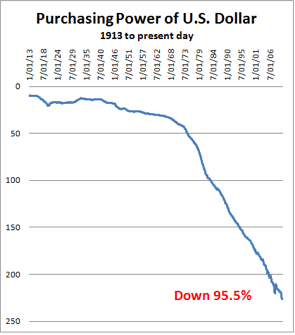
· The Fed opened its doors for “business” in January, 1914.
· President Nixon stopped payments of gold in 1971.
· The only reason why Keynesianism and central banking are still in play is that it transfers wealth to the State.
· Bernanke’s recent observation is absurd.
INSTITUTIONAL ADVISORS
WEDNESDAY, OCTOBER 5, 2011
BOB HOYE
PUBLISHED BY INSTITUTIONAL ADVISORS
The above is part of Pivotal Events that was
published for our subscribers September 30, 2011.

This is what we wrote July 15 in our DVT submission on long government bonds:
“Despite all the talk of inflation and raising rates to combat it, US long bond and the recent whisper of QEIII show that deflation is still the unnamed fight the stock markets and Fed Chairman Bernanke are waging down below in the deep. The above chart shows the 125 day moving average turning up in May, the same month that begins a strong seasonal period according to the work by Don and Brooke. We own a substantial position in Canadian long AAA bonds and a smaller one in US bonds. Interesting how the bond markets sold off Wednesday after the Bernanke testimony but closed up on the day! Thursday was down based on the debt ceiling fight and a fall in jobless claims.”

For most client portfolios we still hold between 40 and 70% long bonds, primarily Canadian but we do hold some US. Though we have become slightly extended in the near term we have not received any outright sell signals yet. Weakness in equities which is expected to continue into earnings season and a Greek resolution may provide the opportunity to protect significant gains.
EQUITIES – S&P 500, Shanghai: Some Canaries in the Coal Mines

This is what we wrote July 15 in our DVT submission on the S&P:
“Despite the euphoria from the QEIII talk the broader markets look tired and the action Wednesday was not encouraging in the near term. We expect stock markets to mish mash through earnings season and present better buying opportunities between now and October, despite the Google bounce.”
……and here is the same chart today

Like the comments made for a bond sale, equity purchases may still be premature. Near term targets suggest 1010 on the S&P and will provide excellent risk-to-reward in selected sectors.
China

This is what we wrote July 15 in our DVT submission on the Shanghai:
The Shanghai, representing the domestic Chinese investor has not done much in the last year and a half, and yet is critical to the global picture (RSI has been muted for sometime). Overhead resistance is nearby, as the country, who believes in centrally planning a market-based economy, continues to raise bank reserve requirement (and other tactics) to cool inflation.
……and here is the same chart today

As you can see we are reaching support at the June 2010 lows. The Shanghai market matters as a driver of the global economy. The downtrend which began later than year in 2010 was a warning that the equity up move based on markets that were on steroids (QEI and QEII) were a bit of a mirage.
Gold

Based on extreme readings in bullish sentiment, we exited all gold bullion positions in mid August and went modestly short. Today, bearish readings are high, inclining to look to cover the gold short position and re-enter on the long side. Confirmation requires patience and a game plan.
In summation, while the volatility is extreme and headlines thick with anxiety, a pre-planned, methodological approach to markets provides opportunities to realise conservative, absolute returns. Investing based on reactions to media or daily market events is fatiguing and difficult. If you are wondering just what to do, call us – we’re built for this.
It’s hard to believe autumn’s days are here already. As the poet Charles Bukowski wrote, “The days run away like wild horses over the hills.” The leaves are already turning. The air is getting cooler. The sunsets come earlier. The fall seasonal brews have been tapped.
I love the changing of the seasons, and it always puts me in a thoughtful mood. I guess because it makes me more conscious of the passage of time, something you can lose in the day-to-day tending to a life.
Such thinking also tends to force some perspective. I think the world is full of opportunity. I think it is a great time to be an investor. Of course, with the constant onslaught of depressing news out there, it’s not always easy to remain alert to these opportunities.
Recently I received an email from a reader of my Capital & Crisis newsletter. I thought the email echoed pretty well some of the concerns investors have right now, so I’d like to take the opportunity to address a few of those points today.
“If the bank stocks run into trouble and there is less liquidity in the market, will that not impact on business in general? Will it not affect businesses that are otherwise well run and in good shape? Will it not bring about a contraction overall?”
The short answers are yes, yes and yes. But those things are hard to predict. In fact, I would say they are impossible to predict reliably and make money. If what I’m saying weren’t true, then a lot more economists would be richer investors. Yet the greatest investors — Graham, Buffett, Klarman, Greenblatt, Whitman, Lynch and many others — are not economists. Not only that, but they pretty much ignored economic forecasting altogether.
In my experience, there is little point in going through life thinking every year is going to be 1929. As an investor, you have to invest through good times and bad. I gave you my personal example, in which I’ve managed my own money through two periods when the market was cut in half from peak to trough (2000-2002 and 2007-2009) yet each time my account rose in value far more than it fell going in. The same was true in Capital & Crisis in the latter crash. (It wasn’t around for the first one.) I think this 2011 episode will bring the same result.
“Now, I know that you believe in finding businesses for which all the fundamentals are good, but surely these too will be negatively impacted if the above scenario is correct. You quoted Buffett as to the fear factor — ‘Be fearful when others are greedy and greedy when others are fearful’ — but is it not still early days? Do you not think that the fear factor will rise still more if the above scenario comes to pass?”
We don’t know if these are the early days. Things could get worse or they could get better. I come at these things with wide historical perspective. I can show you how every decade there are people who think it is end of days. Yet each time, humanity figures out a way to move forward and markets recover. Then the market cycle repeats, endlessly, through the years.
What’s interesting in our times is that we’ve had several crises packed closely together. And things seem to unfold at hyper speed. But otherwise, I am of the opinion that what we are suffering from is just another turn of the market wheel in a long history of such turns.
Humanity has done an awful lot of self-defeating things. Yet somehow, here we are. Despite all that the 20th century threw at it, the stock market still produced many sparkling gems, a long list of iconic franchises — Wal-Mart, Microsoft, McDonald’s, Home Depot, Apple and many more. I think the 21st century will be no different. We’ll have many calamities, but we’ll also create many opportunities.
I believe in people and incentives and the idea that the true economics of a business will prove out over time. I believe in the classic principles of investing for the long haul that have served so many so well. I believe in patience and discipline.
“So, I guess that really I would like to know if you think that we are on the cusp of a crisis or just a temporary slowdown.”
I’ll give you the only possible honest answer: I don’t know. But here is what few others will tell you: You don’t have to know the answer to that question to succeed as an investor. George Soros, the billionaire speculator, once said, “My financial success stands in stark contrast with my ability to forecast events.” And Warren Buffett said, “Forecasts may tell you the a great deal about the forecaster, but nothing about the future.”
It’s something of a myth that great investors are great forecasters. They aren’t — and they realize they aren’t. They play the odds, buying cheap stocks in good businesses, backing talented people and sticking with their winning investment philosophies even when (and especially when) times got tough.
I wouldn’t invest unless you are in it for the long haul, unless you can hold onto a name for a few years. Don’t bother buying stocks if you are not committed as an owner. Think of stocks like real estate. You don’t go around willy-nilly buying real estate. Why? Because you know it is not easy to sell. It’s a hassle. So you are careful about what you buy.
This is why, getting back to the reader’s initial concern, the much-ballyhooed benefit of “liquidity” — the ability to buy and sell with ease without impacting the price of the asset — is the most overblown idea on the planet as far as finance goes. In 1960, the stock market turned over about 14% of its names. Meaning, people held stocks for, on average, seven years. Nobody complained about liquidity. Today, the whole market turns over in less than eight months. There are few owners anymore.
In the end, there will always be people telling you what can’t be done. I’ve heard this chorus since I started writing Capital & Crisis for the public in 2004. But I feel oddly optimistic. I feel like now is one of those times — like the pit of 2008 and early 2009 — at which we’ll look back and be glad we stayed in the game.
Of course, only time will tell. Until then, don’t forget to enjoy the present — the tasty fall brews, the company of friends and family and “the teeming autumn, big with rich increase” — as the old Bard had it.
Regards,
Chris Mayer,
for The Daily Reckoning
Chris Mayer is managing editor of the Capital and Crisis and Mayer’s Special Situations newsletters. Graduating magna cum laude with a degree in finance and an MBA from the University of Maryland, he began his business career as a corporate banker. Mayer left the banking industry after ten years and signed on with Agora Financial. His book, Invest Like a Dealmaker, Secrets of a Former Banking Insider, documents his ability to analyze macro issues and micro investment opportunities to produce an exceptional long-term track record of winning ideas.
Video Report: Legally Collect Thousands of Dollars Each Year…From the OTHER government-backed retirement program! Finally – you can get on the inside! Here’s why you must do so now…
-
I know Mike is a very solid investor and respect his opinions very much. So if he says pay attention to this or that - I will.
~ Dale G.
-
I've started managing my own investments so view Michael's site as a one-stop shop from which to get information and perspectives.
~ Dave E.
-
Michael offers easy reading, honest, common sense information that anyone can use in a practical manner.
~ der_al.
-
A sane voice in a scrambled investment world.
~ Ed R.
Inside Edge Pro Contributors

Greg Weldon

Josef Schachter

Tyler Bollhorn

Ryan Irvine

Paul Beattie

Martin Straith

Patrick Ceresna

Mark Leibovit

James Thorne

Victor Adair