
Daily Updates
In an interview with The Banking Conversation, commodities Bull Jim Rogers explains why he thinks the U.S. dollar is headed for big trouble, and why he thinks commodity prices will be headed upward. Rogers also offers some interesting thoughts about the problems that investors — particularly those who identify bubbles or manias early on — face toward the end of bull markets.
INTERNATIONAL. Marc Faber the Swiss fund manager and Gloom Boom & Doom editor said government spending and low interest rates will keep the US deficit “very high” and will spur inflation.
Speaking at an US Global Investors event, Faber said Interest rates will be kept “artificially low” and remain “near zero for a long time” in the US, Faber said Thursday in a presentation broadcast on the Internet.
….read more HERE.
Quotable
“Run for your life from any man who tells you that money is evil. That sentence is the leper’s bell of an approaching looter.” – Ayn Rand
FX Trading – Divergence confusionism…
A very astute member of Black Swan services pointed out the latest growing divergence between the bond price action the last couple of days, and the dollar…The question: What does it mean?
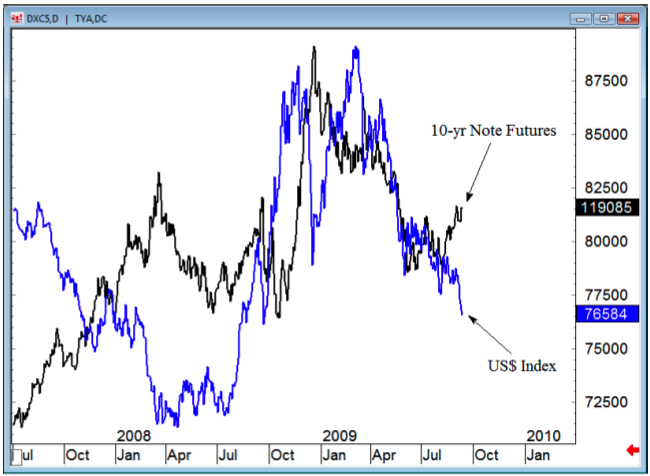
The short answer may be that global markets are now normalized and the tight correlations we’ve been witnessing the last several years, during both the boom and the bust, are changing.
The chart above compares the US$ index with the 10-year Note futures. The reason this is a divergence, compared to the recent past, is because higher 10-year Note prices have usually defined risk aversion, and risk aversion is usually met by a rising dollar. We know that’s not happening.
But this divergence, or differing environments i.e. risk aversion versus risk appetite, can best be viewed comparing the 10-yr Note futures to the S&P 500 futures index. Since mid-August, this pair has started to move together—higher stocks and higher bond prices.

If this represents some outside portfolio flow into the US, why is the US dollar getting creamed?
And if the US dollar is getting creamed, why are people buying paper denominated in US dollars—10-yr Treasuries?
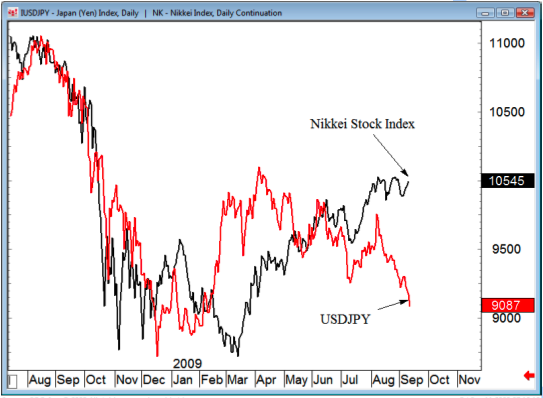
This isn’t the only major change in correlation we are witnessing, we see a major “divergence” (divergence based on past price action, doesn’t necessarily make it a divergence now; we need Mr. Hindsight’s visionary powers to prove that) between the Japanese stock market and USD-Japanese yen pair. Good news for Japan is finally also being reflected in the Japanese yen. In the past, any good news—reflected by the stock market—was usually met with a weaker yen as it juiced local risk appetite to go offshore for yield. Maybe this can be more easily explained by the weight of portfolio flow into Japan on optimism the new regime will make some real changes.
Back to the buck vs. 10-year Note “divergence”….
Does a weak currency have to be met by weak bond prices i.e. does selling the currency automatically mean selling the bonds? Not necessarily if the government is issuing and buying at the same time (or maybe domestic consumer savings is growing rapidly and going there).
Buying bonds domestically and using the currency internationally as rocket fuel to boost other asset markets in the hopes of reviving demand based on asset wealth effect i.e. implicit weak dollar policy, could be the game Uncle Sam and his advisory staff are playing.
There has been much talk, and obviously much price action, to support the idea the US dollar is now the world carry trade currency i.e. with short-term yields being so low— grabbing the mantle from Japan. Maybe!
But if we consider real yields (nominal minus inflation) on the 10-year Notes, the US is still among the highest of the major currency countries. We are not sure if this indicates there may be a floor on the dollar, as global investors can buy relative safe yield cheaply. Or whether it means nothing at all and the US dollar has become the carry trade currency of choice.
Or of course a third options, the bond guys see troubles ahead and are positioning before the double-dip hits the fan. Place your bets.
Black Swan Capital LLC
www.blackswantrading.com
Market Buzz – Look to Selectivity For Opportunity, Not Liquidity
The current rallying cry for a continued up-tick in the markets is liquidity, liquidity, liquidity. Fundamentals should take a back seat because there is so much liquidity (capital) to be put to work and it will eventually find its way all in on equities.
So with all this money parked in money market accounts just ready to pounce on the markets, they could not go anywhere but up. The problem is we heard the same liquidity talk during the peak of the bubble in late 2007. The reality is that the mountain of money is no higher or lower than it was when the market was scraping to new lows in 2008. Money market funds back then held relatively the same $3.5 trillion that they do today. Curious is it not?
We believe investors should continue to invest long term, but remain cautions, get great advice, and do not speculate. Invest based on fundamentals – strong, cash flow producing companies with solid businesses and real earnings.
If you are looking for growth, try to uncover companies that continue producing above-average earnings growth, not just those that are producing what some analysts call “better-than-expected” earnings that actually compare very poorly year-over-year. Moreover, while we recognize it is currently difficult, look for companies that have recently upped their earnings guidance and possess solid balance sheets with limited to no debt, giving them protection and staying power if the predicted “V” shaped recovery turns into an “L” or double dips.
It remains a stock pickers market and these types of companies do exist, one just has to dig a little deeper, but the rewards can make the effort more than worth it.
Specifically, from our Canadian Small-Cap Universe (www.keystocks.com), we highlight Bridgewater Systems Corporation (BWC:TSX), a communications software provider which has been our top rated Small-Cap tech in 2009, which has seen its shares jump 172 per cent year-to-date from $2.50 to close this week at $6.80.
Why the jump you ask? Bridgewater has upped its revenue and earnings guidance twice this year, boasts a pristine balance sheet with over ($2.30 per share) and no debt. This past week, Bridgewater announced US$18.8 million in additional orders from Verizon Wireless (VZ:NYSE), one of its major wireless customers.
While our outlook remains cautious given the market’s strength since early March in the face a tepid (at best) economic background, there remain some excellent select opportunities to profit long term. We urge you to stick with trusted advice and remain very selective.
Looniversity – Capital Pool Company Program 101
The Capital Pool Company (CPC) Program is a unique listing vehicle offered exclusively by TSX Venture Exchange. The program is generally thought to cut the costs of access to the public markets when compared to a traditional initial public offering (IPO) and brings together an experienced team of directors in a public company with an emerging company that needs financing/strategy and management expertise.
In the CPC program, a capital pool company is created through a quazi-IPO on the TSX Venture Exchange. This company looks for a promising private company or asset to acquire. The capital pool company must acquire a company or asset within 24 months of listing on TSX Venture. This is called a qualifying transaction. After a successful qualifying transaction, the capital pool company becomes a regular listed company on TSX Venture. Generally, at least one of the directors of the initial CPC stays on the board of the combined entity once the QT has occurred. Depending on the needs of the situation, several directors will continue on with the new board.
Put it to Us?
Q. When I review stocks for selection in my portfolio I often use the price-to-earnings ratio (PE) as criteria. However, I find many stock websites list the PE on a stock as N/A. Why is that?
– Charlie Soles; Calgary, Alberta
A. Basically, a reported reading of “N/A” for a stock’s PE ratio typically means one of two things. Depending on what web service you are utilizing, the simplest explanation is that there is no data at time of reporting to calculate this ratio. This will be the case with a newly listed company that have yet to release earnings or have not reported four quarterly reports (four quarters are required to calculate a trailing annual PE). The second reason could be that the earnings number is negative (loss). Negative P/E ratios are mathematically possible, but because they are generally not accepted by the financial community, they are usually reported as “N/A,” or not applicable. The P/E ratio is calculated as the stock’s current price divided by its earnings per share (EPS).
KeyStone -Why Subscribe?
Trading Track Record
Stockscores.com Perspectives for the week ending August 22, 2009

This may be a short commentary for the newsletter but I think it will have a lot of value for all traders. Print it out and read it often.
1. Buying a weak stock is like betting on a slow horse. It is retarded.
2. Stocks are only cheap if they are going higher after you buy them.
3. Never trust a person more than the market. People lie, the market does not.
4. Controlling losers is a must; let your winners run out of control.
5. Simplicity in trading demonstrates wisdom. Complexity is the sign of inexperience.
- Get the StockSchool Pro Free

- DisnatDirect named the number one Canadian brokerage for Traders by Surviscor! Open and Fund a brokerage account with DisnatDirect and receive the StockSchool Pro home study course free, including special Pro level access through the DisnatDirect client website. Offer only available to Canadian residents. For information, click here
6. Have loyalty to your family, your dog, your team. Have no loyalty to your stocks.
7. Emotional traders want to give the disciplined their money.
8. Trends have counter trends to shake the weak hands out of the market.
9. The market is usually efficient and can not be beat. Exploit inefficiencies.
10. To beat the market, you must have an edge.
11. Being wrong is a necessary part of trading profitably. Admit when you are wrong.
12. If you do what everyone is doing you will be average, so goes the definition.
13. Information is only valuable if no one knows about it.
14. Lower your risk till you sleep like a baby.
15. There is always a reason why stocks go up or down, we usually only learn the reason when it is too late.
16. Trades that make a lot of intellectual sense are likely to be losers.
17. You do not have to be right more than you are wrong to make money in the market.
18. Don’t worry about the trades that you miss, there will always be another.
19. Fear is more powerful than greed and so down trends are sharper than up trends.
20. Analyze the people, not the stock.
21. Trading is a dictators game; you can not trade by committee.
22. The best traders are the ones who do not care about the money.
23. Do not think you are smarter than the market, you are not.
24. For most traders, profits are short term loans from the market.
25. The stock market can not be predicted, we can only play the probabilities.
26. The farther price is from a linear trend, the more likely it is to correct.
27. Learn from your losses, you paid for them.
28. The market is cruel, it gives the test first and the lesson afterward.
29. Trading is simple but it is not easy.
30. The easiest time to make money is when there is a trend.

I made a typo in the symbol of one of the featured stocks last week, it should have been FSII and not FSSI. Sorry.
I ran the same sort of Market Scan this week as last, looking for stocks trading abnormal volume and breaking through resistance. I check the charts for good chart patterns and if the risk reward relationship looks good, I consider it a good trading opportunity.
Here are this week’s findings:

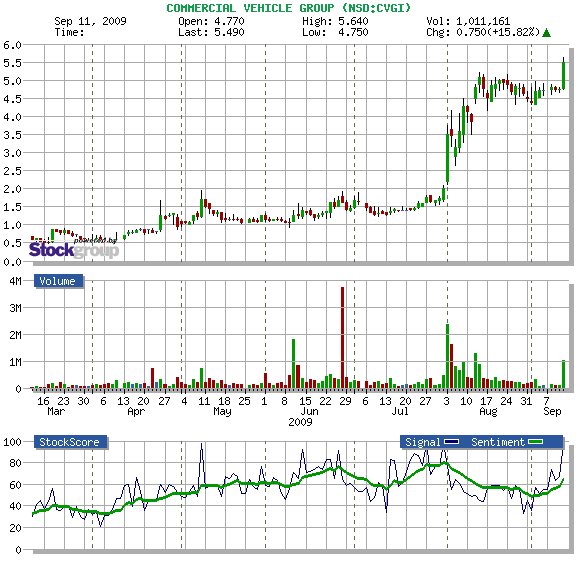
1. CVGI
CVGI has not been in a narrow trading pattern for very long but is making a good break from low price volatility after beginning its upward trend about 6 weeks ago. It looks like it wants to continue higher in the weeks to come. Support at $4.60.
2. NURO
NURO is a stock that I featured in the Daily newsletter a few months ago and since then it has not done much. Today it made a big break out on big volume and looks like it is ready to move in to an upward trend. Support at $1.77

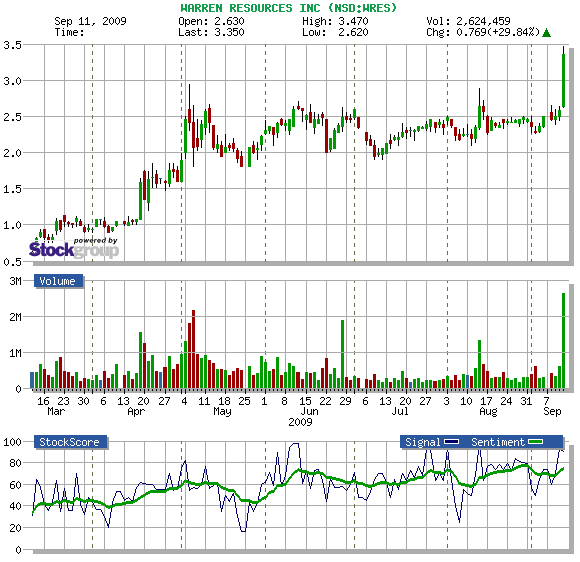
3. WRES
WRES is my favorite chart this week, a very clean breakout from an ascending triangle pattern. Volume support is very strong, this is a near perfect set up. Support at $2.26.
Tyler Bollhorn started trading the stock market with $3,000 in capital, some borrowed from his credit card, when he was just 19 years old. As he worked through the Business program at the University of Calgary, he constantly followed the market and traded stocks. Upon graduation, he could not shake his addiction to the market, and so he continued to trade and study the market by day, while working as a DJ at night. From his 600 square foot basement suite that he shared with his brother, Mr. Bollhorn pursued his dream of making his living buying and selling stocks.
Slowly, he began to learn how the market works, and more importantly, how to consistently make money from it. He realized that the stock market is not fair, and that a small group of people make most of the money while the general public suffers. Eventually, he found some of the key ingredients to success, and turned $30,000 in to half a million dollars in only 3 months. His career as a stock trader had finally flourished.
Much of Mr Bollhorn’s work was pioneering, so he had to create his own tools to identify opportunities. With a vision of making the research process simpler and more effective, he created the Stockscores Approach to trading, and partnered with Stockgroup in the creation of the Stockscores.com web site. He found that he enjoyed teaching others how the market works almost as much as trading it, and he has since taught hundreds of traders how to apply the Stockscores Approach to the market.
References
Get the Stockscore on any of over 20,000 North American stocks.
Background on the theories used by Stockscores.
Strategies that can help you find new opportunities.
Scan the market using extensive filter criteria.
Build a portfolio of stocks and view a slide show of their charts.
See which sectors are leading the market, and their components.
Disclaimer
This is not an investment advisory, and should not be used to make investment decisions. Information in Stockscores Perspectives is often opinionated and should be considered for information purposes only. No stock exchange anywhere has approved or disapproved of the information contained herein. There is no express or implied solicitation to buy or sell securities. The writers and editors of Perspectives may have positions in the stocks discussed above and may trade in the stocks mentioned. Don’t consider buying or selling any stock without conducting your own due diligence.
-
I know Mike is a very solid investor and respect his opinions very much. So if he says pay attention to this or that - I will.
~ Dale G.
-
I've started managing my own investments so view Michael's site as a one-stop shop from which to get information and perspectives.
~ Dave E.
-
Michael offers easy reading, honest, common sense information that anyone can use in a practical manner.
~ der_al.
-
A sane voice in a scrambled investment world.
~ Ed R.
Inside Edge Pro Contributors

Greg Weldon

Josef Schachter

Tyler Bollhorn

Ryan Irvine

Paul Beattie

Martin Straith

Patrick Ceresna

Mark Leibovit

James Thorne

Victor Adair