
Daily Updates
Editor Note: Highly recommend that you take a monday morning visit to Don Vailoux’s monday report where he analyses an astonishing 40 plus Stocks, Commodities and Indexes.
6 charts and commentary below:
The Bottom Line
Swing trading strategies remain the same. Purchases of equities and equity ETFs are not compelling at current levels. Intermediate upside is limited and downside risk is significant. Most equities and indices are trading substantially above their 50 and 200 day moving averages. A return to these moving averages implies significant losses from current levels. Downside risk is expected to be tempered somewhat by continuing weakness in the U.S. Dollar. Look for a shallow correction between now and late October followed by a significant upside move into next spring.
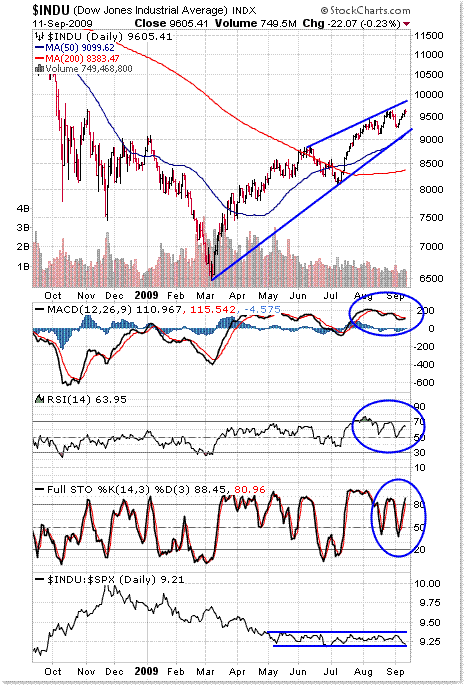
The Dow Jones Industrial Average gained 164.14 points (1.74%) last week. Intermediate trend remains up. The Average has formed a rising wedge pattern. It remains well above its 50 and 200 day moving averages. MACD is trending lower from a short term overbought level. RSI and Stochastics are short term overbought, but continue to trend higher. Strength relative to the S&P 500 Index remains neutral. Volume continues to trend lower.
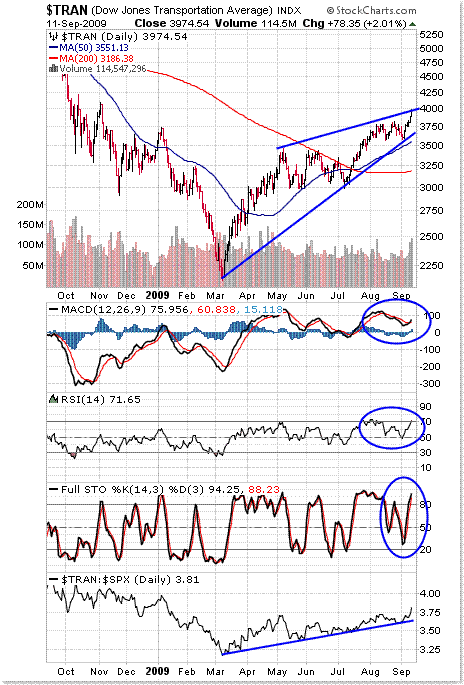
The Dow Jones Transportation Average added 211.66 points (5.62%) last week. Intermediate trend remains up. A rising wedge pattern has formed. The Average remains well above its 50 and 200 day moving averages. MACD is trending lower from a short term overbought level. RSI at 71.65% and Stochastics are short term overbought, but continue to trend higher. Strength relative to the S&P 500 Index remains positive. Volume continues to trend lower.
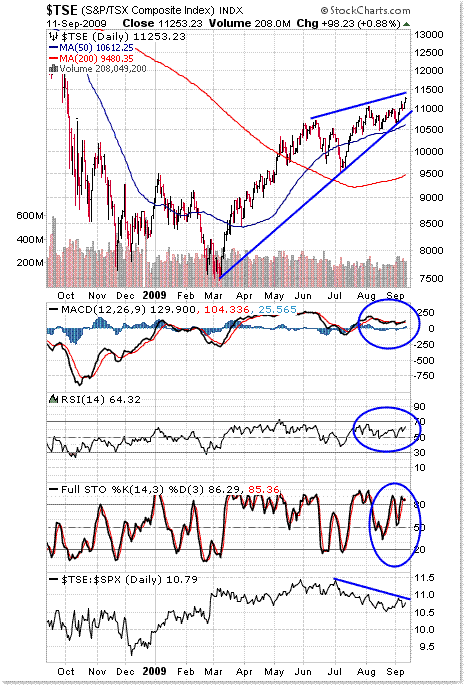
The TSX Composite Index increased 235.76 points (2.14%) last week. Intermediate trend remains up. A rising wedge pattern has formed. The Index remains well above its 50 and 200 day moving averages. MACD continues to trend lower from a short term overbought level. RSI and Stochastics are short term overbought, but continue to trend lower. Strength relative to the S&P 500 Index remains negative.
The Canadian Dollar gained 0.83 last week. Intermediate trend remains up. Resistance is at 93.95 and in a band above 96.69. MACD is trending lower from a short term overbought level. RSI is neutral. Stochastics are short term overbought, but continue to trend higher.

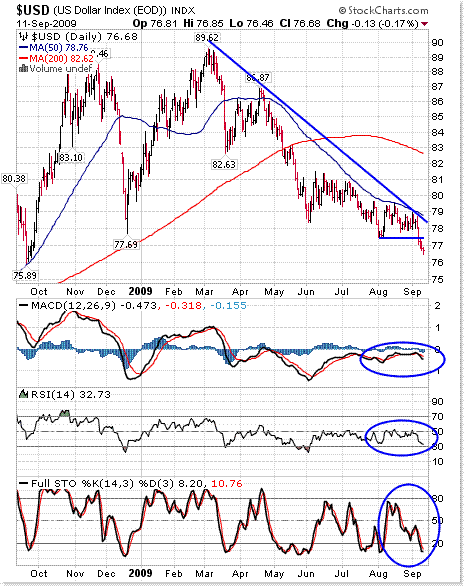
The U.S. Dollar dropped 1.48, broke support at 77.43 and resumed an intermediate downtrend last week. Next support is at 75.89. MACD continues to trend lower. RSI and Stochastics are short term oversold, but continue to trend lower.
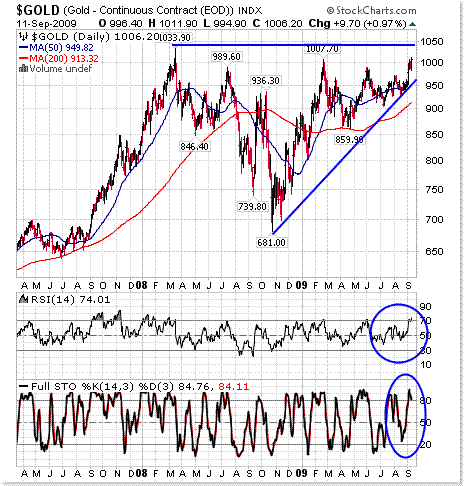
Gold added another $11.80 U.S. per ounce last week. It broke resistance at $1007.70. Next resistance is at its all time high at $1,033.90 U.S. Short term momentum indicators are overbought (e.g. RSI at 74.01%) but continue to trend higher. Preferred strategy is to purchase/add to positions on weakness.closer to its 50 day moving average at $949.82.
Don Vialoux has 37 years of experience in the Investment Industry. He is a past president of the Canadian Society of Technical Analysts (www.csta.org) and a former technical analyst at RBC Investments. Now he is the author of a daily letter on equity markets available free on the internet. The reports can be accessed daily right here at www.dvtechtalk.com.
Impossible! That’s what institutional investors say about “Timing the Market”. Mr. Vialoux will explain that, indeed, it can be done with the appropriate analysis. He also will explain why timing the market will be important during the next decade. Buy and Hold strategies are not working anymore; Investors are looking for alternatives. Mr. Vialoux will demonstrate four techniques that can be used to time intermediate stock market swings lasting 5-15 months. The preferred investment vehicles for investing in intermediate stock market swings are Exchange Traded Funds.
Comments in Tech Talk reports are the opinion of Mr. Vialoux. They are based on technical, fundamental and/or seasonal data that is believed to be accurate. The comments are free. Mr. Vialoux receives no remuneration from any source for these services. Comments should not be considered as advice to buy or to sell a security. Investors, who respond to comments in Tech Talk, are financially responsible for their own transactions.
FX Trading – Hats off to China—They have made their intentions clear.
“China has proven again and again to be many steps ahead of its Western counterparts. It is in their interest to do so—so their actions cannot be faulted in the game of great powers. Those going into China to manufacture know the rules (most of them), China has clearly established the ground rules both explicitly; and implicitly by actions. They make no secret of the fact they want to receive technology transfer as quid pro quo, requiring domestic production for access, instead of just shipping in goods, as happens in a trade relationship almost every place else on the planet. Chinese policymakers make no secret of the fact they want foreigners to establish a domestic partner so that said technology can be replicated by a Chinese domestic firm and sold into the Chinese domestic market. Western manufacturers volitionally accept this situation. A situation they don’t seem to accept anywhere else.”
….read more HERE.
Brief comment below from the Ledendary Trader Dennis Gartman. For subscription information for the 5 page plus Daily Gartman Letter L.C. contact – Tel: 757 238 9346 Fax: 757 238 9546 or E-mail:dennis@thegartmanletter.com HERE to subscribe at his website.
“We, however, as a consumer stand fully in favor of “dumping. If some companies wish to “dump” their goods into our market at prices below the cost of production we say “Good on’em and very good on us,” for we get the benefits of low and lower prices, while those industries competing learn to hone their production even more sharply in order to compete effectively.” – Dennis Gartman
Ed Note: Below is a small excerpt from Mark Leibovit’s tremendous 11 page VR Gold Letter. The VR Gold Letter is published WEEKLY. This excerpt from 9/06/09.
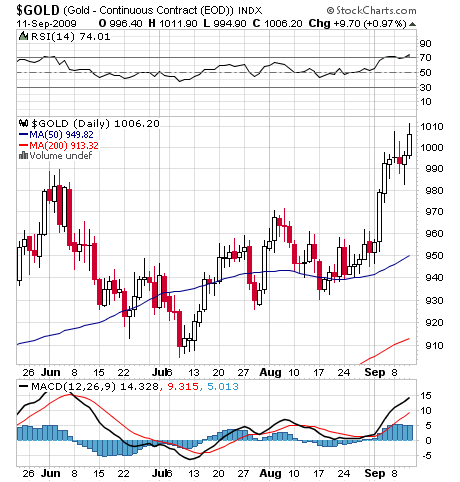
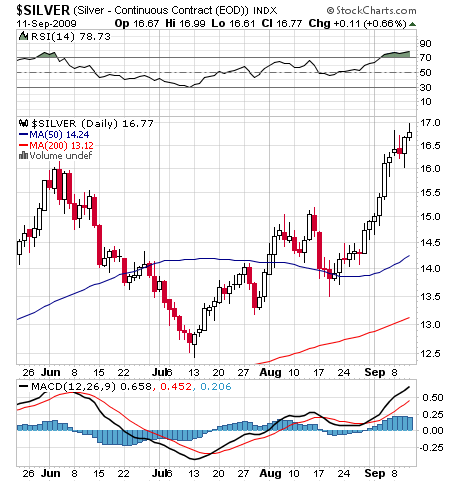
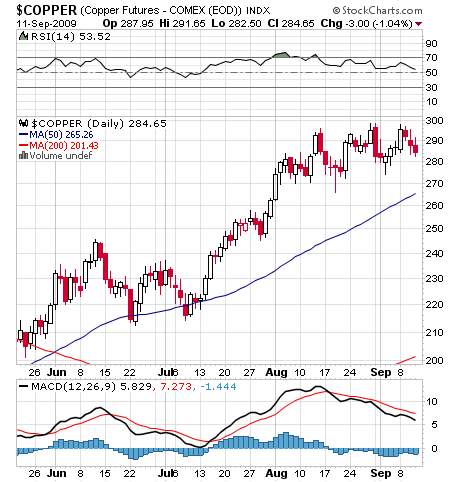
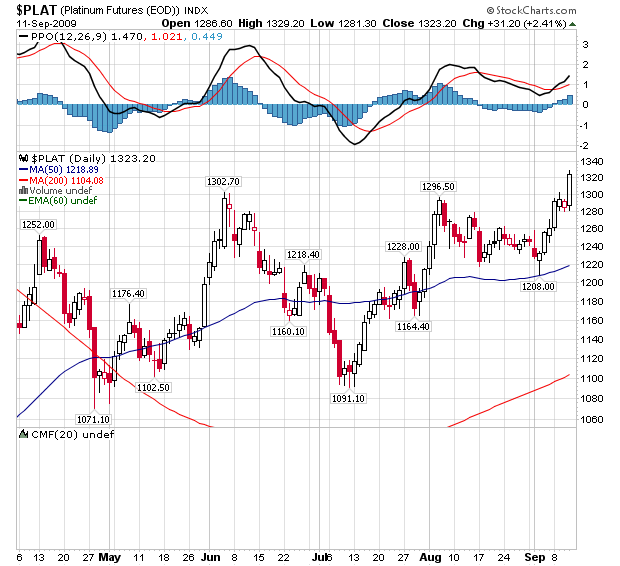
Gold futures settled at a new record Friday, with the September gold contract ending up $9.50, or 1%, at $1,004.90 an ounce on the Comex division of the New York Mercantile Exchange, the highest settlement for a nearby gold contract. The earlier record was $1,003.20 hit on March 18, 2008. The September contract rose to $1,011.90 earlier. Spot gold was up 8.70 at 1005.10 after hitting a high 1013.10. Silver gave up most of its gains and finished up just 0.06 to 16.73 after trading as high as 17.02 this morning. Platinum was up 32 to 1317 and hit a one-year high of 1327. Copper futures reversed earlier gains and settled down 0.0300 at 2.8465. If it walks and quacks like a duck, it must be a duck. In other words, its a bull market, so enjoy it!
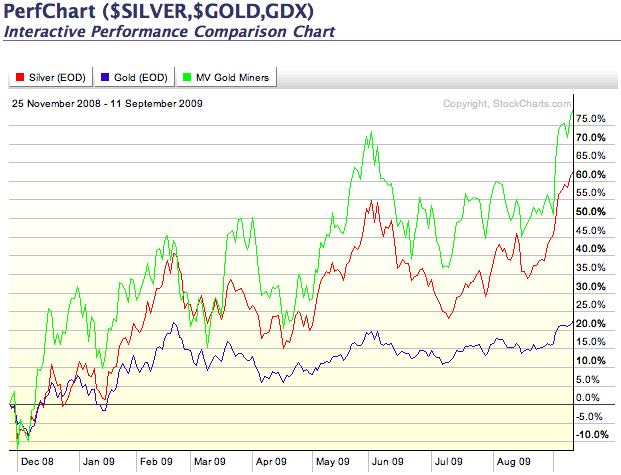
No market goes up everyday and at some point we’re going to see a correction, but my guess its not going to happen here. The breakout in Gold this past week is meaningful whether we cleared the record 1036 high or not. Technical measurements still point to as high as 1300 which has nothing to do with my bigger picture target of 3000 which I’ve talking about for several years.
Remember, my ‘Rule of 10’? Ten times the Dow Industrials breakout level of
1000 (from 1982) gave us 10,000. Homes that used to sell for $30,000 traded
at $300,000. Crude oil rallied from $14.00 in 1988 to $144.00 in 2008. Gold’s
low was posted in 1999 just $300. If we’re in a twenty-year up cycle in Gold (as
I believe), we will see Gold at $3000 by 2019-2020. If you could triple your
money in the next 10 years, would you consider doing it? Of course you
would!
I am very pleased with the outcome of the Annual Forecast Model projection. Who else would have told you that you would see a high for the year in Gold in September when that forecast was published in January?
If you know of that forecast, I sure would like to see it, but I assure you they didn’t draw you a picture. A picture is worth a 1000 words! If you sell Gold here and your gold shares, you have made money. I have done my job and the cost of this subscription was earned many times over. This Model is the closest I have to a crystal ball and the ball has not gone fuzzy – yet!
The VR Gold Letter is available to Platinum subscribers for only an additional $20 per month, while for Silver subscribers the price is only an additional $70.00 per month. Prices are going up very shortl, so act now! Separately, the VR Gold Letter retails for $1500 a year! The VR Gold Letter is published WEEKLY. It is 10 to 16 pages jam-packed with commentary and charts. Please call or email us right away. Tel: 928-282-1275. Email: mark.vrtrader@gmail.com .

Marks VRTrader Silver Newletter covers Stock, TSE Stocks, Bonds, Gold, Base Metals, Uranium, Oil and the US Dollar.
More kudos – Mark Leibovit was named the #1 Intermediate Market Timer for the 10 year period ending in 2007; the #1 Intermediate Market Timer for the 3 year period ending in 2007; the #1 Intermediate Market Timer for the 8 year period ending in 2007; and the #8 Intermediate Market Timer for the 5 year period ending in 2007. NO OTHER ANALYST SURVEYED APPEARED IN ALL FOUR CATEGORIES FOR INTERMEDIATE MARKET TIMING AS PUBLISHED IN TIMER DIGEST JANUARY 28, 2008!
For a trial Subscription of The VR Silver Newsletter covering Stocks, Bonds, Gold, US Dollar, Oil CLICK HERE
Canadian Firms Step Up Search for Rare-Earth Metals
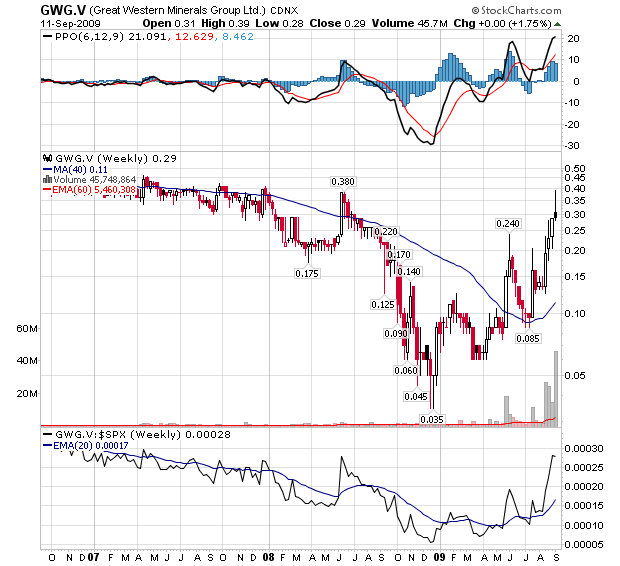
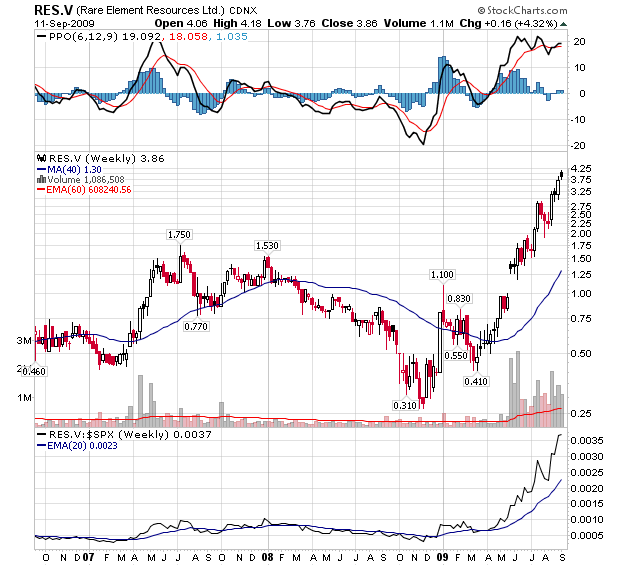
“Great Western Minerals Group, Rare Element Resources, Avalon Rare Metals and Neo Material Technologies are among the Canadian companies exploring for resources outside China. Their shares have surged in recent weeks amid strong volumes.”
BANGALORE — China may lose its near-monopoly on producing so-called rare-earth metals used in hybrid cars and computer hard disks as a host of smaller Canadian companies develop fresh sources of supply over the coming years.
The drive to open new mines comes as Beijing shows signs of tightening restrictions on exports of the metals. Their great magnetic capacity and resistance to high temperatures make the minerals essential components in a variety of technologies, including fuel-efficient cars and wind energy turbines.
Demand for rare-earth metals is likely to increase between 10 percent and 20 percent each year, analysts say, thanks to growing demand for elements like neodymium, which is used in making hybrid electric vehicles and generators for wind turbines.
But supplies are limited. China, which produces about 97 percent of world’s rare-earth metals, curbs exports through quotas and additional duties. In addition, rare-earth metals like neodymium, terbium, dysprosium and yttrium are difficult to mine and process.
Against that backdrop, a handful of Canadian miners are exploring for new supplies in South Africa, Brazil and the United States while pushing ahead with existing projects. Their success could ease fears that manufacturers may find themselves with few, if any, reliable sources of vital rare-earth metals. Such concerns have also raised the share prices of many of these speciality miners.
“There has been increased interest to look into ways to mine rare earth out of China, specially given the protectionism China is applying to its resources,” said Frederic Bastien, an analyst at Raymond James.
Great Western Minerals Group…..
Rare Element Resources…..
Avalon Rare Metals….
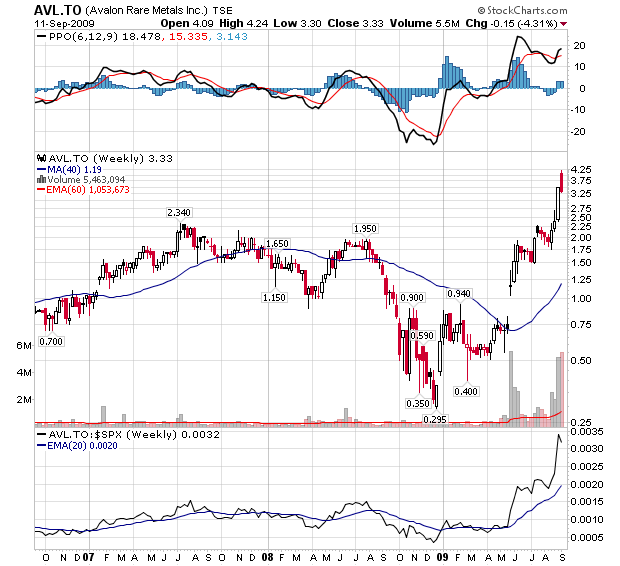
and Neo Material Technologies are among the Canadian companies exploring for resources outside China. Their shares have surged in recent weeks amid strong volumes.
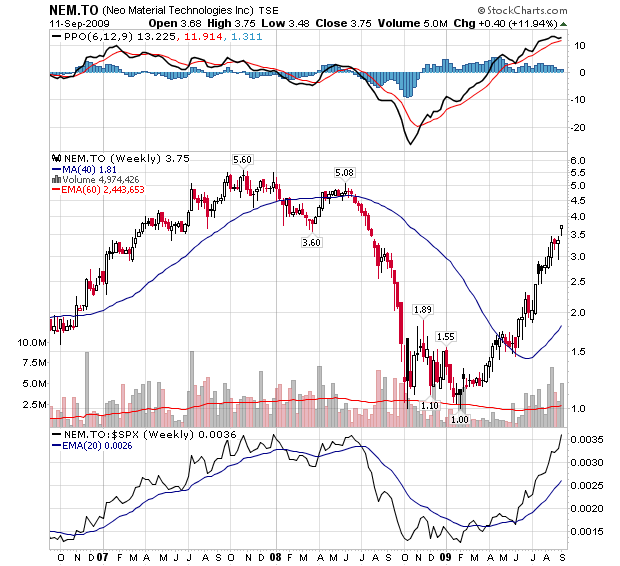
Analysts say the rally is partly fueled by speculation that these companies would stand to gain if China goes ahead with proposed export curbs.
In August, China’s Ministry of Industry and Information Technology submitted a report on its rare-earth industry that includes proposals for further restrictions on exports and an outright ban on foreign shipments of a few key rare-earth metals.
But surely, Mr. Bastien said, companies face an uphill task to make their projects commercially viable, and it could take a few years for them to do so.
Jack Lifton, an independent rare-earth metals expert, said that China had reduced exports of the metals since 2004. If that policy continues, the world could face a huge shortfall.
“At end of 2015, China will no longer be exporting rare-earth metals,” he said. “If the West has not found its own manufacturing, then the West will be no longer making rare-earth-based end products.”
Rare-earth metals companies outside China, mostly based in Canada, Australia and the United States, expect to begin their projects in next three to four years.
By 2014, said James Engdahl, chief executive of Great Western Minerals, China will essentially have shut off exports of the minerals because its industries will be requiring everything produced there. “We as a company have been preparing for that.”
The junior explorer, which owns rare-earth properties in Canada and is based in the province of Saskatchewan, now gets raw materials from China to feed alloy plants in the United States. It expects to start production of the metals from its South African project within the next three years.
Constantine Karayannopoulos, chief executive of Neo Material Technologies, one of the few Western companies to have rare-earth processing plants in China, said that China would continue to regulate the sector.
However, he said he did not expect a complete ban on exports of heavy rare-earth metals like dysprosium and terbium.
Analysts expect demand for the metals to skyrocket as they are used in hybrid cars to preserve magnetic properties of metal alloys at high temperatures.
“The draft report is more sort of a flagpole test for reaction reflecting Chinese policy,” Mr. Karayannopoulos said.
“I think for any modern state and any state signatory to the W.T.O.,” he said, referring to the World Trade Organization, “restricting the export of any material which has a stranglehold in the world is just a nonstarter.”
That said, the relationship that Neo Material has cemented with Mitsubishi suggests the level of concern within Japan about Chinese rare-earth supplies.
Neo Material, which is also involved in development of heavy rare-earth resources at the Pitinga tin mine in Brazil, has signed an agreement with Mitsubishi under which the two companies would explore outside of China. The Japanese company is also financing development costs of Neo’s Brazil project.
Japan is one of the largest consumer of rare-earth metals, using them mainly in manufacturing batteries, cameras and laser equipment.
Econophysicist Predicts Date of Chinese Stock Market Collapse–Part III
First came the prediction, then the prediction came true. Now the econophysicist explains how he did it.
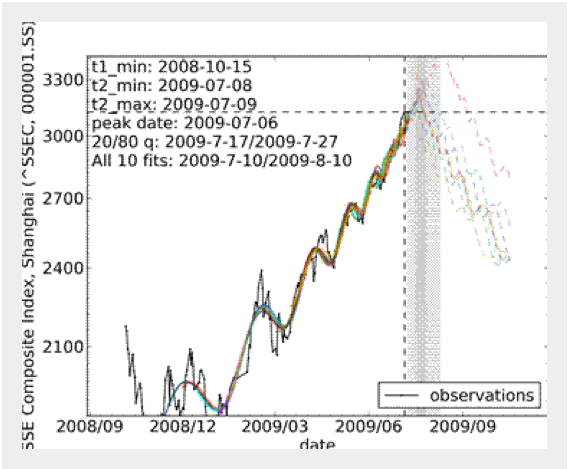
Back in July, econophysicist Didier Sornette at the Swiss Federal Institute of Technology in Zurich and a few pals predicted the impending collapse of the Shanghai Composite stock market index.
Their evidence was that the index had been growing at a faster than exponential rate, which was clearly measurable and obviously unsustainable. But Sornette and co were less forthcoming about how they were able to say a collapse was imminent. I was sceptical of this prediction and said so.
And yet at the beginning of August, the Shanghai Composite dropped by about 20 per cent and I was forced to eat my words, puzzled though I still was to their method.
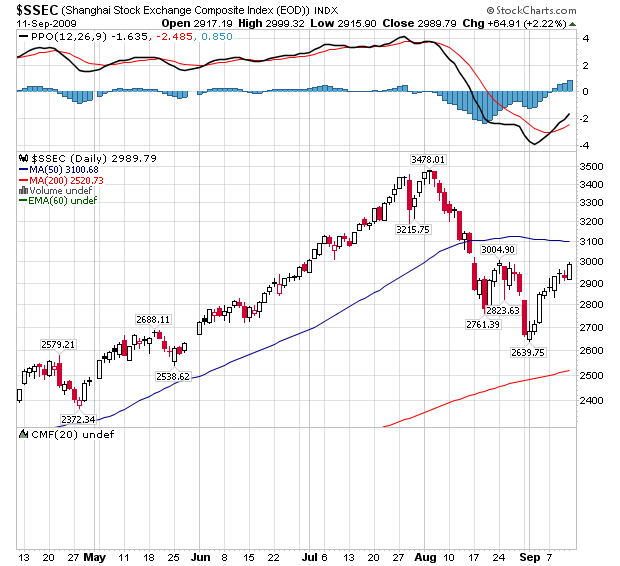
Today, Sornette and co publish the method they use to make their prediction. Their method is a synthesis of ideas from the economic theory of rational expectation bubbles, from the imitation and herding behaviour of investors and traders and from the mathematical and statistical physics of bifurcations and phase transitions.
From this, they say they have discovered an unambiguous signature of a bubble market about to collapse in the form of super-exponential growth decorated with logarithmic oscillations as in the diagram above.
Sornette says he has used this method to predict the collapse of several bubbles in the last few years, including the collapse of the oil bubble last year and the US housing market in 2006.
That’s important work which could have a profound impact on economic models. If Sornette and his colleagues have put their money where there mouths are, they ought to be super rich by now.
One interesting aspect of Sornette’s predictions is that the team claim that they will not affect the market in a way that changes the forecast.
“Even in the presence of investors fully informed of the presence of the bubble and with the knowledge of its end date, it remains rational to stay invested in the market to garner very large returns since the risk of a crash remains finite.”
Of course, the end of a bubble doesn’t always imply a crash, just a change from super exponential growth to some other kind of market dynamics.
But if Sornette’s forecasts prove reliable, the herding behaviour of traders and investors makes it seem inevitable that they will trigger crashes. If that happens, they will become self-fulfilling prophecies that will generate some interesting dilemmas for traders and regulators alike.
Ref: arxiv.org/abs/0909.1007: Bubble Diagnosis and Prediction of the 2005-2007 and 2008-2009 Chinese stock market bubbles
By combining (i) the economic theory of rational expectation bubbles, (ii) behavioral finance on imitation and herding of investors and traders and (iii) the mathematical and statistical physics of bifurcations and phase transitions, the log-periodic power law model has been developed as a flexible tool to detect bubbles. The LPPL model considers the faster-than-exponential (power law with finite-time singularity) increase in asset prices decorated by accelerating oscillations as the main diagnostic of bubbles. It embodies a positive feedback loop of higher return anticipations competing with negative feedback spirals of crash expectations. We use the LPPL model in one of its incarnations to analyze two bubbles and subsequent market crashes in two important indexes in the Chinese stock markets between May 2005 and July 2009. Both the Shanghai Stock Exchange Composite and Shenzhen Stock Exchange Component indexes exhibited such behavior in two distinct time periods: 1) from mid-2005, bursting in Oct. 2007 and 2) from Nov. 2008, bursting in the beginning of Aug. 2009. We successfully predicted time windows for both crashes in advance with the same methods used to successfully predict the peak in mid-2006 of the US housing bubble and the peak in July 2008 of the global oil bubble. The more recent bubble in the Chinese indexes was detected and its end or change of regime was predicted independently by two groups with similar results, showing that the model has been well-documented and can be replicated by industrial practitioners. Here we present more detailed analysis of the individual Chinese index predictions and of the methods used to make and test them.
-
I know Mike is a very solid investor and respect his opinions very much. So if he says pay attention to this or that - I will.
~ Dale G.
-
I've started managing my own investments so view Michael's site as a one-stop shop from which to get information and perspectives.
~ Dave E.
-
Michael offers easy reading, honest, common sense information that anyone can use in a practical manner.
~ der_al.
-
A sane voice in a scrambled investment world.
~ Ed R.
Inside Edge Pro Contributors

Greg Weldon

Josef Schachter

Tyler Bollhorn

Ryan Irvine

Paul Beattie

Martin Straith

Patrick Ceresna

Mark Leibovit

James Thorne

Victor Adair