
Daily Updates
One of Michael Campbell’s favorites, Black Swan Capital is offering Exclusively for readers and listeners of MoneyTalks a very SPECIAL OFFER.
In Today’s Currency Currents….

FX Trading – Stages of the dollar
Quotable
First witch: When shall we three meet again,
Second witch: In thunder, lightning, or in rain?
When the hurly-burly’s done,
When the battle’s lost and won.
Third witch: That will be ere the set of sun.
First witch: Where the place?
Second witch: Upon the heath.
Third witch: There to meet with Macbeth.
First witch: I come, Greymalkin!
Second witch: Paddock calls.
Third witch: Anon!
All: Fair is foul, and foul is fair:
Hover through the fog and filthy air. – (Macbeth, Act 1, Scene 1) William Shakespeare quote
FX Trading – Stages of the dollar
Maybe some of you have been receiving the same email I have been getting; it says the market will crash sometime between Thursday, September 17th and Monday, September 28th. I haven’t delved into the details of the prediction, and probably wouldn’t understand them if I did. But, with today being quadruple witching and all, I thought I’d share that warning.
Of course we are seemingly in the midst of a crash already, if you define your terms accordingly, it is the crash of the US dollar. But have we reached the climax stage? Probably not, as it seems the US government is playing the benign neglect game and liking how a weak dollar is juicing the US stock market—can you say wealth effect?
Thinking in terms of stages, below is repeat of a piece we wrote several moons ago that lays out the stages of the dollar. It’s a framework that can likely be applied to any currency and any asset market in general. If you’ve pinpointed exactly where we are in the dollar cycle, please let us know. Thanks.
——————————-
Seven Stages of the Dollar
It’s always difficult to pinpoint where we are in terms of a trend. Long-term trends in the currency markets have ranged from six to ten years, measured by the various bull and bear markets in the dollar since the inception of the free-floating currency market back in 1971. Here’s the pattern of long-term bear and bull markets in the dollar as measured by the US $ Index:
1971-1978: Seven-year bear market (President Nixon closes the gold window closed)
1978-1985: Six-year bull market (Fed Chairman Volcker squeezes inflation)
1985-1992: Seven-year bear market (Triggered by the Plaza Accord)
1992-2001: Ten-year bull market (Tech boom and money flow to US assets)
2001-2008: Seven year bear market (bottom on the credit crunch)
2008- ? : Next major bull market?
No one can say when multi-year bull and bear markets end without some perspective. But we can evaluate conditions as they develop that may indicate the potential for a change in the big trend. I use the boom/bust cycle of price action to help put this longer-term moves into some type of perspective.
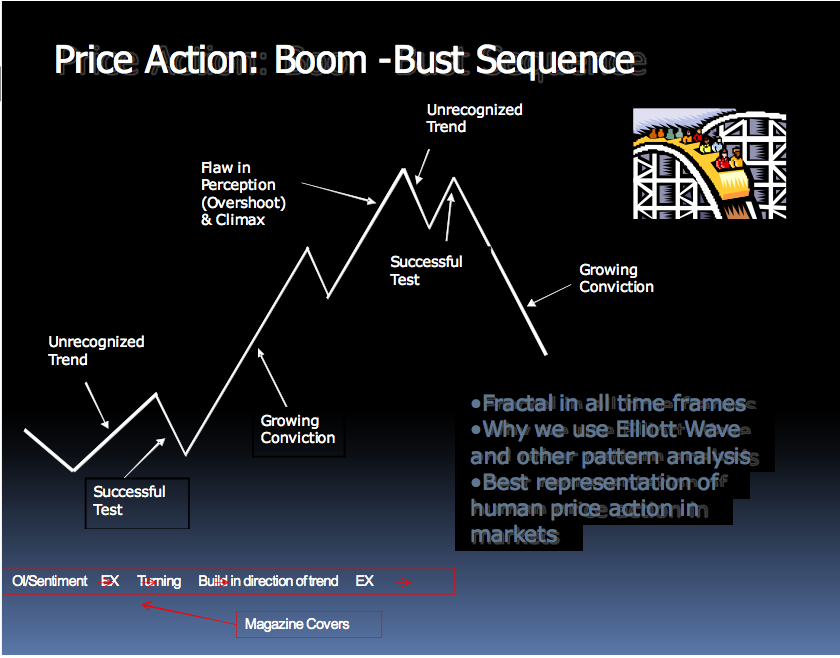
The dollar, especially from a longer term perspective, moves in waves—discernable waves based on human emotion and supported to differing degrees by the underlying economic fundamentals at various stages along the way. It sounds complicated but it’s not. Here’s an example of the waves or stages of the dollar in a boom/bust price cycle…
• Stage 1: The unrecognized trend – This is the early on stuff. It represents the beginning of a new trend that is recognized by only a few of the major players.
• Stage 2: The beginning of a self-reinforcing process – This is the stage where the consensus begins to realize there are real underlying fundamental reasons why this “new” trend has legs. This is the most powerful and longest leg or wave of the trend.
• Stage 3: The successful test – This is the pull-back that challenges the consensus view, it represents a significant retrace of the prior wave “self-reinforcing” wave. In the case of the dollar, the bear market correction we witnessed during 2005 is an example of a “successful test.”
• Stage 4: The growing conviction, resulting in a widening divergence between reality and expectations – This represents the last major leg or wave of the trend. It is supported by real fundamentals or expectations of how the fundamentals will play out, but it also represents the stage in which the currency is either “overvalued” or “undervalued” on a pure fundamental basis.
• Stage 5: The flaw in perceptions – This is the stage in the cycle when some of the major players begin to realize the currency cannot be supported by the fundamentals, as highlighted above.
• Stage 6: The climax – This is the final stage of the move, and represents the “overshoot” we often see in currency markets because they tend to be more sentiment driven and price-led than other asset markets.
• Stage 7: A self-reinforcing process in the opposite direction – The trend begins in the opposite direction.
So where are we now in terms of this dollar major bear or bull market?
For help, we paraphrase Joe Kennedy, former stock manipulator and SEC Chairman (things really haven’t changed much on the regulatory front have they ☺), when shoeshine boys start playing the FX market and all know the dollar is dead, and are making a killing short the dollar, it’s time to go long. That’s when you know we are very close to Stage 7, time to start looking in the other direction.
I think I’m going to have my shoes shined on my next trip, which is next week. I will keep you posted.
Jack Crooks
Black Swan Capital LLC
www.blackswantrading.com
Exclusively for readers/listeners/members of MoneyTalks a very SPECIAL OFFER.
Three Full Months of EVERYTHING We Do For Just $99!
Dear MoneyTalks Reader/Listener,
Exclusively for fans of MoneyTalks with Michael Campbell, we’d like to make you an EXCLUSIVE OFFER.
Sign up now to receive 3-months of ALL our advisory trading services and we’ll discount the price by more than 80% – three full months for less than one month’s cost! Plus if you like what you see you’ll continue getting all our trading services at the discounted rate of just $99 per month for as long as you want.
You see, we recently segmented our all-in-one newsletter, Currency Strategist, into four brand new, separate, focused newsletters. As we launch we thought we’d extend an opportunity for you to get in early …
At a very special price.
Everything listed below for 3 months … for just a onetime payment of $99.00.
The value of all these services together is $2,434.00 per year … or about $200 per month. We’re offering you the opportunity to get three full months for just $99.
That’s a difference of over $500.00 for the first three months, and …
With this offer you lock in forever additional savings of more than $100 each and every month off the total value of these services for as long as you remain a member.
As a member you’ll receive…
Currency Currents
Description: Macro view of the global economy and how it may impact currency prices.
Frequency: Daily
Price: Free
Currency Investor
Description: Designed to help investors ride intermediate- and long-term trends in major and select emerging market currencies.
Frequency: Monthly
Recommendations: Exchange Traded Funds (ETFs) [*Analysis and time frames also support multi-currency deposit investors.]
Everyday Price: $149 per year
Currency Options
Description: Designed to provide speculators with trading recommendations covering both the FX options listed on the International Securities Exchange (ISE)and currency futures options listed on the Chicago Mercantile Exchange (CME).
Frequency: Bi-weekly
Average Holding Period: Days or Weeks to months
Recommendations: International Securities Exchange (ISE)-listed FX Options or Chicago Mercantile Exchange (CME)-listed currency futures options
Everyday Price: $595 per year
Emerging Market Currencies
Description: Designed to help traders and speculators exploit short- and intermediate-term trading opportunities in the highly volatile and potentially profitable world of emerging market currencies.
Frequency: Bi-weekly
Average Holding Period: Weeks to months
Recommendations: Spot Forex
Everyday Price: $695 per year
Forex & Currency Futures Description: Designed to help short-term traders, using high leverage, spot trading opportunities among major currency pairs and cross rates.
Frequency: Daily
Average Holding Period: Intraday to several days
Recommendations: Spot Forex and Currency Futures
Everyday Price: $89 per month or $995 per year
[Note: All services include Flash Alerts delivered outside of regular publication dates to enter or exit positions as the market dictates.]
THIS IS WHERE YOU WIN …
As a fan of MoneyTalks, we’re offering you an outstanding deal.
Get three months of all our services for just a onetime payment of $99. That’s a savings of more than 83% on your first three months, and …
You lock in forever an additional savings of over 50% each and every month after that for as long as you remain a member.
Here’s some explanation on the different newsletters you’ll receive …
Our Emerging Market newsletter is geared towards specific emerging market commentary and takes time to evaluate individual countries and themes in depth. We will also recommend a balanced portfolio of currencies to hold as an emerging currency speculator.
In our Currency Options newsletter we are technical-minded, active, and a bit medium-term oriented … occasionally diverging from our longer-term fundamental market views. In addition to that, we incorporate a strict stop-loss guideline in our recommendations, usually around a 50-60% loss threshold, as well as a level at which to take partial profits. We believe this helps reduce the downside and allows for you to be more proactive in grabbing gains when you have them.
In the Forex & Currency Futures newsletter we are active and base most of our trade analysis on short-term technical setups — shooting to grab small open gains when we have them and keeping a skin in the game if we are fortunate to have latched on to a trend. That means you will consistently see recommendations to trade with at least two lots at a time. But remember: the size you trade and amount of leverage must make sense for your own account size and circumstances.
Within the monthly newsletter — Currency Investor — will reside the longer-term trend analysis work and thematic fundamental views incorporating a detailed look at weekly and monthly inter-market relationships between currencies, stocks, bonds and commodities.
Everything you read about above plus access to archives, webinar notifications, audio updates, special reports and more.
We work hard to consistently deliver, what we consider, the best currency trading newsletters available on the market today. We hope you’ll agree.
I urge you, if you were thinking about trading currencies, whether through options, ETFs, futures or Spot FX then don’t wait.
If you want an honest approach and a realistic look at currencies, you’ll have come to the right place.
If for any reason whatsoever you try us out and are unsatisfied with Black Swan’s currency newsletters within the first 30-days of your Membership, we’ll issue a full refund and our thanks for giving us a try.
Take advantage of this 30-day Risk Free offer!
So, if you’re ready to give us a try, Click Here to Sign Up
we’re looking forward to having you onboard with us!
P.S. As a BONUS, subscribe today and receive this 20-page Special Report:
Preparing for a Breakup in the European Monetary System
Most people are worried about the US dollar … and for good reason. These same people tend to see the euro as a real competitor vying for world reserve currency status. Many have been conditioned that way by the financial press. But we believe the risk of breakup in the European Monetary System is building rapidly. We examine the structure of this “artificial fiat currency” and why another downturn in the global economy could mean lights out for the euro. Be prepared.
Even if you decide to cancel, keep the report – it’s yours as a ‘thank you’ for giving us a try!
Even in tough times, which we recognize is on everyone’s mind these days, that’s a very reasonable price for the versatility and money-making potential packed into these newsletters. Of course, at a little over $3 per day you could instead put that money towards you’re morning cup of coffee on the way to work, I guess.
If you want to learn how to implement a solid approach to currency investing … or even if you’re just looking for well-researched trading and investing ideas …
Sincerely,
David Newman
Director of Sales and Marketing
Black Swan Capital
dnewman@blackswantrading.com
Toll-Free 866.846.2672
Futures, Forex and Option trading involves substantial risk, and may not be suitable for everyone. Trading should only be done with true risk capital. Past performance either actual or hypothetical is not indicative of future performance.
Black Swan Capital newsletter services are strictly informational publications and do not provide individual, customized investment advice. The money you allocate to futures or forex should be strictly the money you can afford to risk. Detailed disclaimer can be found at http://www.blackswantrading.com/disclaimer
(Ed Note: Good article)
The Post-Crash Party Continues
Gold took off yesterday…closing at $1020. Here at The Daily Reckoning, we’re impressed. But we’re not that impressed. Gold, of course, is half of our Trade of the Decade, which we announced almost 10 years ago. We’re bullish on the metal…have been for a very long time. But recent comments in this space have made readers wonder what the Hell is going on…so we will spend a few minutes clarifying.
First, we hope you bought gold many years ago. That would make it simpler. Then, we could say: hold! Gold is an antidote to paper. There is so much paper…and so much more apparently on the way…that the gold play seems like a winner. It’s a bet that the money system that has been around since August ’71 is going to fall apart.
We still think that is a good bet. Our Trade of the Decade remains. Buy gold on dips; sell stocks on rallies. We’ve done well with this trade; we’ll stick with it a bit longer.
But what if you don’t own gold? The yellow stuff is now over $1,000. In fact, it looks like $1,000 could be a new support level for the metal – with most of the support coming from the Chinese. China has relatively little gold in its central bank. It must see what we see – the weakness of the dollar and of the dollar-reserve monetary system. It must worry about the value of the $2 trillion or so it has in dollars. It must also wonder how it is going to run its economy if the dollar falls apart. American buyers were its consumers of first and last resort. To whom will China sell if its most important…
Read more HERE
Since founding Agora Inc. in 1979, Bill Bonner has found success and garnered camaraderie in numerous communities and industries. A man of many talents, his entrepreneurial savvy, unique writings, philanthropic undertakings, and preservationist activities have all been recognized and awarded by some of America’s most respected authorities. Along with Addison Wiggin, his friend and colleague, Bill has written two New York Times best-selling books, Financial Reckoning Day and Empire of Debt. Both works have been critically acclaimed and internationally. With political journalist Lila Rajiva, he wrote his third New York Times best-selling book, Mobs, Messiahs and Markets, which offers concrete advice on how to avoid the public spectacle of modern finance. Since 1999, Bill has been a daily contributor and the driving force behind The Daily.
Special Report:The Endless PAYCHECK PORTFOLIO: In three simple steps, unleash a steady flow of work-free income… starting with up to 75 automatic “paychecks” deposited directly into your account.
A fascinating thing just occurred in the global interest rate market: For the first time since 1993, it became cheaper to borrow dollars than Japanese yen! The three-month dollar-based London Interbank Offered Rate, or LIBOR, slumped to 0.292 percent, compared with the yen-based LIBOR rate of 0.352 percent.
I know. You’re thinking: “Who the heck cares?” But this development is big — and so are the potential implications. It’s all because of something called the “carry trade,” which I’m going to get into right now …
The Carry Trade Explained …
Let’s say you’re an international investor looking to boost your returns. One way to do that is to use leverage, or borrowed money. The cheaper you can borrow that money, and the greater the yield you can earn by investing it, the larger your returns. Every single basis point, or 1/100th of a percentage point, less you spend in borrowing costs falls right to your bottom line.
The carry trade is just a global version of this game. Investors seek out the lowest possible short-term funding costs by finding the economy whose central bank is being the most generous. Then they take that money, sell the country’s currency, and invest the funds in currency and asset markets that yield more.
That’s essentially what the world did for ages in Japan. Japan’s twin busts in stocks and real estate caused the country’s central bank to slash interest rates to near zero in the early 1990s. Japan also flooded its economy with trillions of yen in excess cash.
But the money wasn’t used by companies and consumers to spend and invest at home … they were burdened by excess capacity and gun-shy about borrowing after getting burned in stocks and real estate. Instead, the money was used by global investors to fund investments elsewhere.
There was enormous profit to be had in this game because the rest of the global economy did fairly well during Japan’s “Lost Decade.” You could borrow yen at, say, 0.5 percent and invest in places like the U.S. at around 5 percent. It was a veritable gravy train of profits, derailed occasionally by events like the Long-Term Capital Management blow up in 1998.
What the Carry Trade Did to the Yen and Global Markets …
And What We May See Happen Here
The mechanics of the carry trade require that you sell the carry currency and buy foreign currencies against it. So one of the side effects is that it depresses the value of the borrowed currency.
Another side effect is that the carry trade helps inflate global asset bubbles.
Last time around, it did this by transporting the excess liquidity being created in Japan to foreign shores.
Now, thanks to the Federal Reserve’s incredibly easy policy stance, we may be in for “Carry Trade Round Two.” Only this time it’s not Japan’s currency that’s being sold relentlessly to fund risky bets …
It’s our dollar!
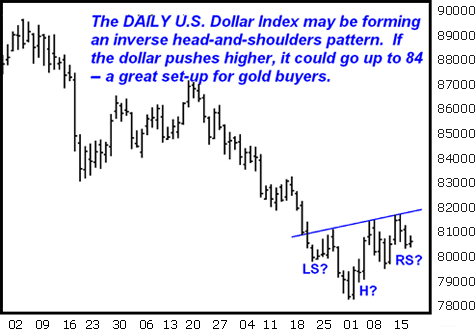
Look at the chart to the left of the U.S. Dollar Index (DXY), which measures the performance of the greenback against six major world currencies (the euro, yen, British pound, Canadian dollar, Swedish krona, and Swiss franc). It looks like a ski slope, pointing down and to the right.
Unfortunately for dollar-based consumers (that’s us!), the falling dollar has side effects. It drives up the cost of imports, raising our cost of living. It also boosts the price of commodities like gold and oil. And it means the cost of travelling abroad goes up, too.
However, you can actually PROFIT from the trend by socking money away in contra-dollar plays. That includes natural resource stocks, gold, and foreign short-term bonds and stocks. If you want to know more, I urge you to check out my colleague Larry Edelson’s blog. He’s got some great information for you there.
Until next time,
Mike Larson
About Money and Markets
For more information and archived issues, visit http://www.moneyandmarkets.com
Money and Markets (MaM) is published by Weiss Research, Inc. and written by Martin D. Weiss along with Nilus Mattive, Claus Vogt, Ron Rowland, Michael Larson and Bryan Rich. To avoid conflicts of interest, Weiss Research and its staff do not hold positions in companies recommended in MaM, nor do we accept any compensation for such recommendations. The comments, graphs, forecasts, and indices published in MaM are based upon data whose accuracy is deemed reliable but not guaranteed. Performance returns cited are derived from our best estimates but must be considered hypothetical in as much as we do not track the actual prices investors pay or receive. Regular contributors and staff include Kristen Adams, Andrea Baumwald, John Burke, Amy Carlino, Selene Ceballo, Amber Dakar, Dinesh Kalera, Red Morgan, Maryellen Murphy, Jennifer Newman-Amos, Adam Shafer, Julie Trudeau, Jill Umiker, Leslie Underwood and Michelle Zausnig.
Attention editors and publishers! Money and Markets issues can be republished. Republished issues MUST include attribution of the author(s) and the following short paragraph:
This investment news is brought to you by Money and Markets. Money and Markets is a free daily investment newsletter from Martin D. Weiss and Weiss Research analysts offering the latest investing news and financial insights for the stock market, including tips and advice on investing in gold, energy and oil. Dr. Weiss is a leader in the fields of investing, interest rates, financial safety and economic forecasting. To view archives or subscribe, visit http://www.moneyandmarkets.com
From time to time, Money and Markets may have information from select third-party advertisers known as “external sponsorships.” We cannot guarantee the accuracy of these ads. In addition, these ads do not necessarily express the viewpoints of Money and Markets or its editors. For more information, see our terms and conditions.
1. THE PRECIOUS METALS TUG OF WAR
When I get to the bottom
I go back to the top of the slide
Where I stop and turn
and I go for a ride … – Paul McCartney, 1968
As if on the playground slide, so aptly described 40 years ago by the Beatles Paul McCartney, gold and silver buyers and the commercial shorts are now locked in a struggle that will reveal whether we shall inflate out of our economic misery or whether deflation headwinds shall continue to constrain the US and most economies globally. For the past 18 months gold and silver prices have vacillated around $1000 and $14 respectively. There are many cross currents in this struggle. The outcome is uncertain in the short run. If gold holds above the $1000 per ounce level and silver above $17 we shall have our answer shortly.
Cross currents? First and foremost, the US Federal Reserve wants inflation. There is no more important philosophical foundation of the Bernanke Fed than “inflation targeting.” The belief in the Washington DC fishbowl, indeed most central bank boardrooms, is that inflation is the lesser of the two evils. An omniscient and independent Federal Reserve Bank has the necessary tools, according to monetary policy makers, to control this lesser evil. The Fed believes that deflation, once in control, will run its own price destroying course to exhaustion and then renewal. This seems to be anathema to Central Bankers.
But there is another major actor in this arms race. The grandiose fiscal plans of the Obama Administration and the Congress will have an impact. Even Warren Buffet who supported the new president recently noted,
“This fiscal year, though, the deficit will rise to about 13 percent of G.D.P., more than twice the non-wartime record. In dollars, that equates to a staggering $1.8 trillion. Fiscally, we are in uncharted territory.”
With current spending plans, net debt will increase to 56% of GDP leaving the US government no choice but to print (might I use the word, “invent”?) money – a lot of money. Mr. Buffet reckons that even if Americans saved $500 billion, Congress and the Administration would be forced to “find” another $900 billion. Under these circumstances and with $1 trillion in health care reform on the way, a much larger inflation fire will be lit.
Then, of course, we have China and India and perhaps the rest of the newly emerging world. China’s policy is to permit the purchase of silver in up to 5 kilogram bars by its citizens recently. So we come to the key point in the rapidly expanding drama. Chinese banks are requesting their gold, now stored in London, be returned to Hong Kong there to be safeguarded – an unusual move but one we think presages a new Asian gold repository for Asian Central bankers chastened by the recent turmoil in the West.
Will the commercial shorts in gold and silver be overrun? It has never happened in the past. Many investment bankers, viewing the extraordinarily high levels of investors long the gold and silver futures, are predicting a dramatic pullback in both gold and silver prices. They are warning investors to take profits. The commercial shorts have always reigned in the gold and silver spot markets in the past. One thing we are quite sure of – there is not enough physical gold and silver to cover the massive commercial short positions. At present gold producer Barrick is attempting to cover its naked hedges (shorts) and finding the going rough. Even if Barrick committed all its gold production for a year it would still fall far short of covering its hedge positions. In short, Barrick is naked.
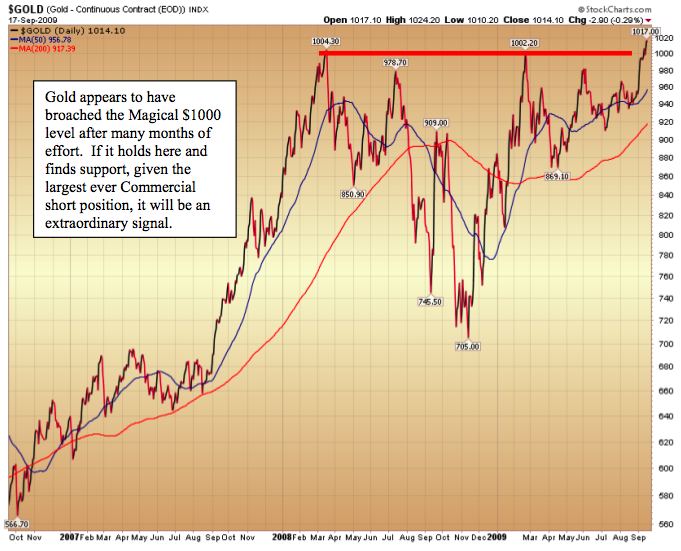
Given these competing cross-currents and the longer term necessity / inevitability of inflation we think that the commercial shorts will in fact be forced to cover. We are just not certain when that covering might occur. Obviously the commercials do not see this
eventuality the way we do – even as Barrick executives are trying to cover their shorts in some degree of panic.
Perhaps the much beloved and at the same time reviled John Maynard Keynes said it best in his seminal work, The Economic Consequences of the Peace following World War I in
1920.
“But who can say how much is endurable, or in what direction men will seek at last to escape from their misfortunes?”
“Thus the menace of inflationism described above is not merely a product of the war, of
which peace begins the cure. It is a continuing phenomenon of which the end is not yet in
sight.”
Is inflation ever a palatable solution? At present it seems to be the desired and most likely scenario for the US economy. The alternative, deflation, is quite out of the question. Yes Dear Discovery Investor gold is going much higher – it is just a matter of time.
You can sign up for Dr. Berry’s free Morning Notes HERE.
Michael Berry has been a portfolio manager for both Heartland Advisors and Kemper Scudder where he successfully managed small and mid cap value portfolios. Dr. Berry has specialized in the study of behavioral strategies for investing and has been published in a number of academic and practitioner journals. His definitive work on earnings surprise, with David Dreman, was published in 1995 in the Financial Analysts Journal.
Previously, Dr. Berry was a professor of investments at the Colgate Darden Graduate School of Business Administration at the University of Virginia and has also held the Wheat First Endowed Chair at James Madison University.
Dr. Berry is a respected and dynamic speaker. He regularly presents around the world on topics such as value investing, the role of Austrian Economics in investment management, behavioral investing strategies and is a specialist in developing case studies to teach investors how to invest. While a professor, he published a case book, Managing Investments: A Case Approach.
The material herein is for informational purposes only and is not intended to and does not constitute the rendering of investment advice or the solicitation of an offer to buy securities. The foregoing discussion contains forward-looking statements within the meaning of the Private Securities Litigation Reform Act of 1995 (The Act). In particular when used in the preceding discussion the words “plan,” confident that, believe, scheduled, expect, or intend to, and similar conditional expressions are intended to identify forward-looking statements subject to the safe harbor created by the ACT. Such statements are subject to certain risks and uncertainties and actual results could differ materially from those expressed in any of the forward looking statements. Such risks and uncertainties include, but are not limited to future events and financial performance of the company which are inherently uncertain and actual events and / or results may differ materially. In addition Dr. Berry may review investments that are not registered in the U.S. He owns shares and in Goldcorp, Senesco Technologies, Natural Blue, Horseshoe Gold, Derek Oil and Gas, Terraco Gold, Neuralstem, Piedmont Mining, MegaWest Energy, Valcent Products, CGX Energy, MacMillan Gold and Quaterra Resources. He has been awarded 250,000 options on Terraco Gold exercisable at C$.20 for 2 years, forattest to nor certify the correctness of any information in this note. Please consult your financial advisor and perform your own due diligence before considering any companies mentioned in this informational bulletin.
A brief excerpt of the lengthy daily internet comment by Richard Russell of Dow theory Letters. One of the best values anywhere in the financial world at only a $300 subscription to get his report daily for a year. HERE to subscribe.
The skepticism (even hatred) toward the gold advance is positively amazing. I remember back in the 1970s that people were surprised at rapidly climbing gold, but there was nothing like today’s cynicism and anger. I just received this mailing from a widely read advisory dated Sept. 8 — “Gold has just seen a big blowoff top with a minor penetration above $1,000, just to get everyone excited enough to buy in at the top. Silver has been even more exciting, which is typical for tops. Expect precious metals to head down to a major cycle low due in December.”
Jason Hamlin, founder of GoldStockBull, has put forward four major developments which he thinks all gold-believers should be aware of.
(1) China (today everything seems to depend on China) is encouraging its citizens to buy (accumulate) gold and repatriate any gold held in London. As recently as 2002, the possession of gold in private hands was prohibited in China — now we’re seeing a dramatic reversal of policy. “It’s glorious to buy and hold gold” is the official stance in China.
(2) Barrick Gold Corp. has decided to begin closing its huge gold hedge book. This will entail Barrick buying millions of ounces of gold which they have shorted. Barrick is preparing for a higher gold price. The word I hear is that Barrick has bought 2 million ounces of gold and is expected to buy another 3 million ounces. This is supposed to cut its hedge book by half. Russell Comment — What, only half?
(3) COMEX Commercial traders have taken the largest net short position ever against gold and silver. Normally this huge addition to supply would knock the precious metals down. But this has not happened, at least, so far. Evidently, buying in gold and silver has been powerful enough to pressure the commercial shorts. They will have to put out more shorts (a dangerous move) or be forced to cover (note:the commercials are usually the gold mining companies).
(4) Gold and silver have slipped into backwardation. This occurs when the price of a commodity for immediate (spot) delivery is higher than its price for future delivery. One interpretation is that people who control the supply of the metals can’t be persuaded to part with their supply, and this suggests that there is more demand for immediate physical delivery than there is an immediate supply of metals.
With the news that China and Russia are scrambling to build up their supply of gold, this could mean that the demand for gold is intense.
Adding to the above, the central banks have now turned into net buyers of gold rather than sellers.
All in all, the precious metals situation is now fascinating, and the anti-gold interests (those who create fiat currency, i.e., the central banks and the inflationists) may, at last, be facing an inglorious defeat.
…..read this excellent article HERE.
(Ed Note: Richard has a section on mining stocks. Suffice to say he still likes them)
The 84 yr. old writes a market comment daily since the internet age began. In recent years, he began strongly advocated buying gold coins in the late 1990’s below $300. His position before the recent crash was cash and gold.
There is little in markets he has not seen. Mr. Russell gained wide recognition via a series of over 30 Dow Theory and technical articles that he wrote for Barron’s during the late-’50s through the ’90s. Russell was the first (in 1960) to recommend gold stocks. He called the top of the 1949-’66 bull market. And almost to the day he called the bottom of the great 1972-’74 bear market, and the beginning of the great bull market which started in December 1974. He loaded up on bonds in the early 80’s when US Treasuries where yielding 18%.
-
I know Mike is a very solid investor and respect his opinions very much. So if he says pay attention to this or that - I will.
~ Dale G.
-
I've started managing my own investments so view Michael's site as a one-stop shop from which to get information and perspectives.
~ Dave E.
-
Michael offers easy reading, honest, common sense information that anyone can use in a practical manner.
~ der_al.
-
A sane voice in a scrambled investment world.
~ Ed R.
Inside Edge Pro Contributors

Greg Weldon

Josef Schachter

Tyler Bollhorn

Ryan Irvine

Paul Beattie

Martin Straith

Patrick Ceresna

Mark Leibovit

James Thorne

Victor Adair