
Daily Updates
IS SILVER MORE PRECIOUS THAN GOLD?
When one is doing a comparison of items as to their value a lot depends on the circumstances one is in. For example if you are lost in the desert and dying of thirst, water becomes very precious, yet it is one of the most abundant things on the planet.
Why is gold a $1000.00 per ounce and silver $17.00 per ounce when;
We have more gold above ground than silver.
We consume silver and store gold. One-day silver will be very scarce.
If you were in the hospital with 3rd degree burns what would you rather have, an ounce of gold or silver? Silver kills bacteria and can save your life. One wonders why silver is not used for the swine flue, if it really is a threat. [Can’t put a patent on silver maybe] Check out colloidal silver HERE.
Silver is about 10 times more plentiful in the earths crust then gold, why is it not 10 to 1 in price?
Silver is money same as gold, in the US Constitution a dollar is defined as 371.25 grains of silver. [400 grains per ounce] When Iraq was putting together their constitution, Jay Leno said, “Send them ours [constitution] as we are not using it any more”. How true.
In 1900 there was 1 billion oz. of gold above ground at $20.00 per oz. = 20 Billion
In 1900 there was 12 billion oz. of silver above ground at $0.65 per oz. = 7.8 Billion
Ratio was $20.00 divided by $0.65 = 30 oz. silver to 1 oz of gold
Ratio in market cap is 20 billion divided by 7.8 billion = 2.56 to 1
The Total amount of gold was worth 2.5 times more than silver in 1900
In 2009 there is approx. 5 billion oz. of gold at $1000.00 = 5 trillion dollars
In 2009 there is approx. 1 billion oz. of silver at $17.00 per oz. = 17 billion dollars
Ratio is $1000.00 divided by $17.00 = 58 to 1
Ratio in market cap is 5 trillion dollars divided by 17 billion dollars = 294 to 1
The Total amount of gold is worth approximately 294 times more than silver in 2009.
If we used 1900’s market cap at 2.5 to 1, silver’s price today would be, 5 trillion dollars worth of gold divided by 2.5 = 2 trillion dollars [silvers value] divided by 1 billion ounces of silver = $2000.00 per ounce.
Note: [I believe more silver would appear with higher prices, this is only meant to show how undervalued silver is]
Saying silver is undervalued is an understatement of the century, both gold and silver’s true cost of production is probably double their current price when you add all the other costs of exploration and such. Currency creation will drive the prices a lot higher in the near future and also one day soon, silver will be priced for its rarity and not for its cost of production as most silver is a by-product from gold, copper and zinc mines.
Getting back to the title of this article, is silver more precious than gold? Society today would have a hard time without silver as we consume it in so many products. I believe silver is more precious than gold, as to the value today, gold is more valuable in dollar terms. A more realistic dollar value today for gold would be $3000.00 per ounce and silver at $300.00 per ounce. This is a 10 to 1 ratio, common sense tells us that the ratio will turn in silvers favour in the future.
Check out these site’s as no one has done more for educating investors about silver and gold than Jim Sinclair at www.jsmineset.com or Ted Butler at www.butlerresearch.com or Bill Murphy at www.LeMetropoleCafe.com or Jason Hommel at www.silverstockreport.com/
The name SILVER is so precious no other word in the English language rhymes with it.
Wm. J Murray
President Silver Phoenix Resources Inc.
CNSX: SP
“From the prospector comes the salt of the earth”
: W J Murray
On reflection, I think that there are perhaps other, even larger, events in our future than the recent credit crisis and recession; yet, just as in 2006, there is a great deal of complacency. But as we will see, there are fingers of instability building up that have the potential to create large disruptions, both positive and negative, in our future. And for the political junkies in the room, I offer a brief insight into what may be one of the more intriguing behind-the-scenes developments in recent years. Now, to the letter.
IN THIS ISSUE:
Fingers of Instability
Ubiquity, Complexity Theory, and Sandpiles
Stability Leads to Instability
A Stable Disequilibrium
3 Billion and Counting
The Texas Senate Race – A Game Changer
60 Years and Counting
To trace something unknown back to something known is alleviating, soothing, gratifying and gives moreover a feeling of power. Danger, disquiet, anxiety attend the unknown – the first instinct is to eliminate these distressing states. First principle: any explanation is better than none… The cause-creating drive is thus conditioned and excited by the feeling of fear …” Friedrich Nietzsche
This weekend I turn 60 and have been a little more introspective than usual. I am often told that the letter I wrote well over three years ago on ubiquity and complexity theory and the future of the economy was the best letter I have ever done. I went back to read it, and it has aged well. I basically outlined how a financial crisis would unfold, and now it has.
On reflection, I think that there are perhaps other, even larger, events in our future than the recent credit crisis and recession; yet, just as in 2006, there is a great deal of complacency. But as we will see, there are fingers of instability building up that have the potential to create large disruptions, both positive and negative, in our future. And for the political junkies in the room, I offer a brief insight into what may be one of the more intriguing behind-the-scenes developments in recent years. Now, to the letter.
“Any explanation is better than none.” – Nietzsche
And the simpler the explanation, it seems in the investment game, the better. “The markets went up because oil went down,” we are told (except that when oil went up, then there was another reason for the movement of the markets). But we all intuitively know that things are far more complicated than that. However, as Nietzsche noted, dealing with the unknown can be disturbing, so we look for the simple explanation.
“Ah,” we tell ourselves, “I know why that happened.” With an explanation firmly in hand, we now feel we know something. And the behavioral psychologists note that this state actually releases chemicals in our brain that make us feel good. We become literally addicted to the simple explanation. The fact that what we “know” (the explanation for the unknowable) is irrelevant or even wrong is not important in achieving the chemical release. And thus we look for reasons.
The credit crisis happened because of Greenspan’s monetary policy. Or maybe it was a collective mania. Or any number of things. Just as the proverbial butterfly flapping its wings in the Amazon triggers a storm in Europe, maybe an investor in St. Louis triggered the credit crisis. Crazy? Maybe not. Today we will look at what complexity theory tells us about the reasons for earthquakes, tornados, and the movement of markets. Then we look at how the world and that investor in St. Louis are all tied together in a critical state. Of course, what state and how critical are the issues.
Ubiquity, Complexity Theory, and Sandpiles
We are going to start our explorations with excerpts from a very important book by Mark Buchanan, called Ubiquity: Why Catastrophes Happen. I HIGHLY recommend it to those of you who, like me, are trying to understand the complexity of the markets. Not directly about investing, although he touches on it, it is about chaos theory, complexity theory, and critical states. It is written in a manner any layman can understand. There are no equations, just easy-to-grasp, well-written stories and analogies.
As kids, we all had the fun of going to the beach and playing in the sand. Remember taking your plastic buckets and making sandpiles? Slowly pouring the sand into an ever bigger pile, until one side of the pile started an avalanche?
Imagine, Buchanan says, dropping one grain of sand after another onto a table. A pile soon develops. Eventually, just one grain starts an avalanche. Most of the time it is a small one, but sometimes it builds on itself and it seems like one whole side of the pile slides down to the bottom.
Well, in 1987 three physicists, named Per Bak, Chao Tang, and Kurt Weisenfeld, began to play the sandpile game in their lab at Brookhaven National Laboratory in New York. Now, actually piling up one grain of sand at a time is a slow process, so they wrote a computer program to do it. Not as much fun, but a whole lot faster. Not that they really cared about sandpiles. They were more interested in what are called nonequilibrium systems.
They learned some interesting things. What is the typical size of an avalanche? After a huge number of tests with millions of grains of sand, they found that there is no typical number. “Some involved a single grain; others, ten, a hundred or a thousand. Still others were pile-wide cataclysms involving millions that brought nearly the whole mountain down. At any time, literally anything, it seemed, might be just about to occur.”
The piles were indeed completely chaotic in their unpredictability. Now, let’s read this next paragraph from Buchanan slowly. It is important, as it creates a mental image that helps me understand the organization of the financial markets and the world economy. (emphasis mine)
“To find out why [such unpredictability] should show up in their sandpile game, Bak and colleagues next played a trick with their computer. Imagine peering down on the pile from above, and coloring it in according to its steepness. Where it is relatively flat and stable, color it green; where steep and, in avalanche terms, ‘ready to go,’ color it red. What do you see? They found that at the outset the pile looked mostly green, but that, as the pile grew, the green became infiltrated with ever more red. With more grains, the scattering of red danger spots grew until a dense skeleton of instability ran through the pile. Here then was a clue to its peculiar behavior: a grain falling on a red spot can, by domino-like action, cause sliding at other nearby red spots. If the red network was sparse, and all trouble spots were well isolated one from the other, then a single grain could have only limited repercussions. But when the red spots come to riddle the pile, the consequences of the next grain become fiendishly unpredictable. It might trigger only a few tumblings, or it might instead set off a cataclysmic chain reaction involving millions. The sandpile seemed to have configured itself into a hypersensitive and peculiarly unstable condition in which the next falling grain could trigger a response of any size whatsoever.”
Something only a math nerd could love? Scientists refer to this as a critical state. The term critical state can mean the point at which water would go to ice or steam, or the moment that critical mass induces a nuclear reaction, etc. It is the point at which something triggers a change in the basic nature or character of the object or group. Thus, (and very casually for all you physicists) we refer to something being in a critical state (or use the term critical mass) when there is the opportunity for significant change.
“But to physicists, [the critical state] has always been seen as a kind of theoretical freak and sideshow, a devilishly unstable and unusual condition that arises only under the most exceptional circumstances [in highly controlled experiments]… In the sandpile game, however, a critical state seemed to arise naturally through the mindless sprinkling of grains.”
Thus, they asked themselves, could this phenomenon show up elsewhere? In the earth’s crust, triggering earthquakes, or as wholesale changes in an ecosystem – or as a stock market crash? “Could the special organization of the critical state explain why the world at large seems so susceptible to unpredictable upheavals?” Could it help us understand not just earthquakes, but why cartoons in a third-rate paper in Denmark could cause worldwide riots?
Buchanan concludes in his opening chapter, “There are many subtleties and twists in the story … but the basic message, roughly speaking, is simple: The peculiar and exceptionally unstable organization of the critical state does indeed seem to be ubiquitous in our world. Researchers in the past few years have found its mathematical fingerprints in the workings of all the upheavals I’ve mentioned so far [earthquakes, eco-disasters, market crashes], as well as in the spreading of epidemics, the flaring of traffic jams, the patterns by which instructions trickle down from managers to workers in the office, and in many other things. At the heart of our story, then, lies the discovery that networks of things of all kinds – atoms, molecules, species, people, and even ideas – have a marked tendency to organize themselves along similar lines. On the basis of this insight, scientists are finally beginning to fathom what lies behind tumultuous events of all sorts, and to see patterns at work where they have never seen them before.”
Now, let’s think about this for a moment. Going back to the sandpile game, you find that as you double the number of grains of sand involved in an avalanche, the likelihood of an avalanche becomes 2.14 times more likely. We find something similar with earthquakes. In terms of energy, the data indicate that earthquakes become four times less likely each time you double the energy they release. Mathematicians refer to this as a “power law,” a special mathematical pattern that stands out in contrast to the overall complexity of the earthquake process.
Fingers of Instability
So what happens in our game? “… after the pile evolves into a critical state, many grains rest just on the verge of tumbling, and these grains link up into ‘fingers of instability’ of all possible lengths. While many are short, others slice through the pile from one end to the other. So the chain reaction triggered by a single grain might lead to an avalanche of any size whatsoever, depending on whether that grain fell on a short, intermediate or long finger of instability.”
Now, we come to a critical point in our discussion of the critical state. Again, read this with the markets in mind (again, emphasis mine):
“In this simplified setting of the sandpile, the power law also points to something else: the surprising conclusion that even the greatest of events have no special or exceptional causes. After all, every avalanche large or small starts out the same way, when a single grain falls and makes the pile just slightly too steep at one point. What makes one avalanche much larger than another has nothing to do with its original cause, and nothing to do with some special situation in the pile just before it starts. Rather, it has to do with the perpetually unstable organization of the critical state, which makes it always possible for the next grain to trigger an avalanche of any size.”
Now, let’s couple this idea with a few other concepts. First, Nobel laureate Hyman Minsky points out that stability leads to instability. The more comfortable we get with a given condition or trend, the longer it will persist and then, when the trend fails, the more dramatic the correction. The problem with long-term macroeconomic stability is that it tends to produce unstable financial arrangements. If we believe that tomorrow and next year will be the same as last week and last year, we are more willing to add debt or postpone savings in favor of current consumption. Thus, says Minsky, the longer the period of stability, the higher the potential risk for even greater instability when market participants must change their behavior. (And, three years later, we can now all see that truth. But it was not as obvious to a lot of people in 2006.)
Relating this to our sandpile, the longer that a critical state builds up in an economy, or in other words, the more “fingers of instability” that are allowed to develop a connection to other fingers of instability, the greater the potential for a serious “avalanche.”
Or, maybe a series of smaller shocks lessens the long reach of the fingers of instability, giving a paradoxical rise to even more apparent stability. As the late Hunt Taylor wrote, in 2006:
“Let us start with what we know. First, these markets look nothing like anything I’ve ever encountered before. Their stunning complexity, the staggering number of tradable instruments and their interconnectedness, the light-speed at which information moves, the degree to which the movement of one instrument triggers nonlinear reactions along chains of related derivatives, and the requisite level of mathematics necessary to price them speak to the reality that we are now sailing in uncharted waters.
“… I’ve had 30-plus years of learning experiences in markets, all of which tell me that technology and telecommunications will not do away with human greed and ignorance. I think we will drive the car faster and faster until something bad happens. And I think it will come, like a comet, from that part of the night sky where we least expect it.”
A second related concept is from game theory. The Nash equilibrium (named after John Nash) is a kind of optimal strategy for games involving two or more players, whereby the players reach an outcome to mutual advantage. If there is a set of strategies for a game with the property that no player can benefit by changing his strategy while (if) the other players keep their strategies unchanged, then that set of strategies and the corresponding payoffs constitute a Nash equilibrium.
A Stable Disequilibrium
So we ended up in a critical state of what Paul McCulley called a “stable disequilibrium.” We have players of this game from all over the world tied inextricably together in a vast dance through investment, debt, derivatives, trade, globalization, international business, and finance. Each player works hard to maximize their own personal outcome and to reduce their exposure to “fingers of instability.”
But the longer we go on, asserts Minsky, the more likely and violent an “avalanche” is. The more the fingers of instability can build. The more that state of stable disequilibrium can go critical on us.
Go back to 1997. Thailand began to experience trouble. The debt explosion in Asia began to unravel. Russia was defaulting on its bonds. Things on the periphery, small fingers of instability, began to impinge on fault lines in the major world economies. Something that had not been seen before happened: the historically sound and logical relationship between 29- and 30-year bonds broke down. Then country after country suddenly and inexplicably saw that relationship in their bonds begin to correlate, an unheard-of event. A diversified pool of debt was suddenly no longer diversified.
The fingers of instability reached into Long Term Capital Management and nearly brought the financial world to its knees.
So, where are the fingers of instability today? Where are the fault lines that could trigger another crisis? Are there any early warning signs? I see two possibilities, one positive and one negative.
Chad Starliper sent me the following graph. It shows the debt-to-GDP ratio for the US, adding in various levels of debt. For instance, the ratio of debt to GDP for all levels of government debt is 87%. But if you add household and business debt along with the GSE (government-sponsored enterprises) like Fannie and Freddie, the ratio rises to 331%. If you add in future benefits of Social Security and Medicare, the number becomes more like 1,000%.
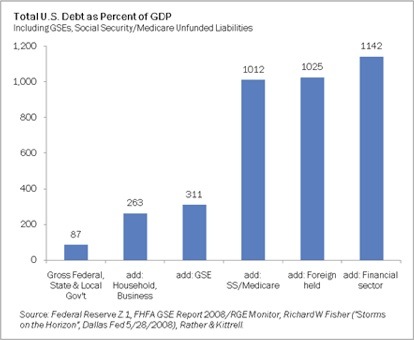
The Obama administration tells us that the government deficit is going to be well over $1 trillion a year for at least ten years. And that does not take into account the outlier years in the 2020s when the really heavy lifting of Social Security and Medicare kicks in.
There is a truism that goes a little like, “If something can’t happen, then it won’t.” Let me make a prediction. We won’t have a trillion-dollar deficit in ten years. Why? Because it can’t happen. The market will simply not allow it.
As I have written, we can run large deficits almost forever, as long as the deficits are less than nominal GDP. While it may not be the wise thing to do, it does not bring down the system.
But when you start adding to the deficit in amounts significantly larger than nominal GDP, there is a limit. Each dollar, like the grains of sand, adds to the potential instability of the system. Is it $2 trillion more? $3 trillion? No one can know, but the longer it goes, the worse the ensuing financial earthquake will be.
The current political class and their intentions are dangerously close to killing the golden goose. It is one thing to steal the eggs; it is an altogether different thing to kill the goose through ignorance of the consequences. And the size of the deficit, for as long as they plan to have it, will most assuredly kill the goose.
Just as I was writing in 2006 about the potential for a crisis, and yet the party went on for quite some time, I think the party can limp along now. But there will come a point when the party is over. Interest rates on the long end will rise precipitously, forcing mortgages up and making the deficit even worse. It will be an even worse crisis than the one we have just gone through. And there will be fewer options for policy makers, and none of them will be good or pleasant. And it will take most people unawares. They will see the current trend and project it into the future. And they will be hit hard.
Can we avoid this calamity? Yes, we can wrestle the US budget deficit back under some kind of control, close to nominal GDP or on a clear trajectory to get there within a reasonable time (say, a few years). As noted above, we can run deficits close to nominal GDP almost forever. But there is no political willpower to do that now. And so, the market will at some point force the hand of the political class. That investor in St. Louis, or China or (????) will decide not to buy government debt at such low rates. The avalanche will start. And everyone will be surprised at the ferocity of the crisis. Except you, gentle reader. You have been warned.
Let me re-emphasize that point. If we do not get our act together, the results could be truly serious. And it is not just the US. Japan, as I have written, unless it changes, will hit the wall in the next few years. There are some really sick actors in Europe. You are going to have to be far more nimble and prepared for this next crisis, should it arise, than you were for the last one. Over the next few months, I will be devoting some space to helping us think through how we do that.
3 Billion and Counting
And now for something a little more positive. From the beginning of the wireless revolution and the development of the internet, it was not until 2001 that we finally had one billion people connected. It only took another six years to add another billion. And sometime in 2011, somewhere in the world, we will add yet another billion. We are adding some 70,000 people a day, with smarter and cheaper computers, phones, and netbooks. By some estimates, there will be five billion connected to the network by 2015.
A study done in 2005 of 21 developing countries by Leonard Waverman of the London Business School “… showed that an extra 10 mobile phones per 100 people in a typical developing country leads to an additional 0.59% of growth in GDP per person.” (Jump Point)
Think of each one of those additional connected people as a grain of sand. We have already seen a large surge in productivity from the internet and mobile phones. Farmers in India now know what the prices are for their products and don’t have to take lowball offers from middlemen. Fishermen in Indonesia can call around and find where they can get the best price for their day’s catch.
Tom Hayes argues in his book Jump Point that, because of the growing connectivity, rather large changes are coming to the way we organize our lives. It is a very interesting book and one that I will review in depth at some point.
But what Hayes calls the Jump Point is what I referred to as critical mass. “In mathematics it is called a ‘jump discontinuity.’ In engineering, this is known as a ‘step phase change.’ In climatology, it is called an ‘abrupt delta.’ I call it a Jump Point – a change in the environment, in this case the business environment, so startling that we have no choice but to regroup and rethink the future.” (from the introduction)
Not all of the changes are benign. The potential for business and marketing models to be turned on their head is rather striking. I recommend the book to those who are thinking about the future. It is easy to read, provocative, and well written. You can get it at Amazon.com.
I wrote this three years ago: “Today more than ever your portfolio should be targeting absolute return strategies. In a world with fingers of instability that may be connected in ways we have not seen in the past, caution is the order of the day. If we do see a slowing US economy later this year, the average complacent investor is not going to be happy as his diversified portfolio all seems to be going south at the same time.”
That is still true today. To talk with my recommended managers around the world you can go to www.accreditedinvestor.ws if your net worth is $1.5 million or more. If you are in the US and are still on your way to becoming an accredited investor, you can sign up at http://www.cmgfunds.net/public/mauldin_questionnaire.asp
The Texas Senate Race – A Game Changer
Indulge me for a moment while I delve into a little inside politics. I used to be very involved in Texas politics, but when I sold my business in 1999 and had to go back to work for a living, I mostly left out political commitments, although I do keep up and have a lot of friends. There is something happening in Texas that has the potential to shake things up, and I thought I would give my readers a heads up.
Long-time Texas Senator Kay Bailey Hutchison has let everyone know that she intends to come back to Texas and run for governor next year against current governor Rick Perry, who is going to run for his third term. Hutchison has indicated that she will resign sometime this fall, which will give Perry the right to appoint a Senator to fill the seat. He has told associates that if he does, the appointment will be a game changer. Who in the Texas political landscape could be termed a game changer? Not one of the half dozen middle-aged white guys who would love the appointment. Not that some of them would be bad choices, just not a game changer. Another woman? There is not one who has run a statewide race and has the necessary experience.
Then there is my long-time good friend Michael Williams. Michael has run statewide three times as the chairman of the Texas Rail Road Commission which, despite the name, is responsible for energy as well as railroads. It is a very powerful post in Texas. He is wildly popular with the grass roots and conservatives in the state. He is one of the best speakers on the stump in the country. He has a powerful command of the energy problem we face. He is totally electable as a Senator. And he is black.
Now that is the definition of a game changer. He will burst on the national scene with a presence. If Governor Perry truly wants to do something that will change the game not just for Texas but for the country, he will appoint Michael at his first opportunity and allow him to run in the primary as a sitting Senator. Michael will be at my birthday party Saturday night, along with his beautiful and extremely smart wife, Donna. Next week on the 12th of October I will be hosting a small private fundraiser at my home for those interested in meeting Michael. You can click here to respond.
And for the locals wanting to help in the campaign, Michael’s web site is http://www.williamsfortexas.com.
60 Years and Counting
I turn 60 on Sunday, although we will be celebrating with parties on Friday and Saturday. For whatever reason, when I turned 50 I was apprehensive. I can quite honestly say that I am excited about this birthday, and the future. For all the problems we are facing as a country and as a world linked together, I think this is the most exciting time to be alive in the history of the world. And the next 30 years are going to be much better than the last 60!
And you, gentle reader, are part of my reason to be so optimistic about the future. I continue to be amazed that so many people find the writings of this humble analyst to be worth their time. In truth, we are all constantly bombarded with more and more emails, advertisements, phone calls, letters, books, papers, and information, and it is getting harder and harder to focus on what is really critical. You give me the most important gift that anyone can receive in the Information Age, and that is the gift of your attention. You have hundreds of opportunities to divert it elsewhere, and yet you give me some of your precious time. I am grateful, and will always strive to make this letter worthy of your interest.
Finally, my good friend Sir Ed Artis of Knightsbridge fame, who is now in the Philippines, writes that he urgently needs funds to ship needed medical and relief supplies that have been already donated and are waiting on the docks. The disaster in the Philippines is quite tragic and calls out to those of us around the world who can help. You can go to http://currentmissions.blogspot.com/ to learn more and to donate.
My daughter Tiffani points out that I have guests arriving for my party and I need to hit the send button, so have a great week. I am going to run and enjoy my friends and some great Texas barbeque.
Your always in a critical state analyst,
John Mauldin
John@FrontlineThoughts.com
Signup for John Mauldin’s free newsletter HERE.
John Mauldin is the President of Millennium Wave Advisors, LLC (MWA) which is an investment advisory firm registered with multiple states. John Mauldin is a registered representative of Millennium Wave Securities, LLC, (MWS) an NASD registered broker-dealer. MWS is also a Commodity Pool Operator (CPO) and a Commodity Trading Advisor (CTA) registered with the CFTC, as well as an Introducing Broker (IB). Millennium Wave Investments is a dba of MWA LLC and MWS LLC. All material presented herein is believed to be reliable but we cannot attest to its accuracy. Investment recommendations may change and readers are urged to check with their investment counselors before making any investment decisions.
Opinions expressed in these reports may change without prior notice. John Mauldin and/or the staffs at Millennium Wave Advisors, LLC may or may not have investments in any funds cited above.
Ed Note: Dennis Gartman will be speaking at the:
The Money Talks All Star Trading Super Summit
Saturday, October 24, 2009 -The Sheraton Vancouver Wall Centre
Click HERE for the Speaker Lineup and to REGISTER if you want to take advantage of this Event.
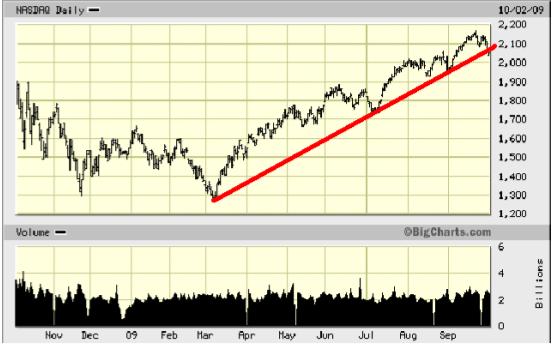
THE NASDAQ: It Had Better Hold!: The battle line is rather readily drawn, and the market has to… absolutely has to… hold today or things will turn very quickly for the worse. We shall pay special heed to the volume for if this trend lline breaks and if the volume swells it will be all the worse for those who are still bullish of stocks.
COMMODITY MARKETS ARE WEAK COMPARED TO FRIDAY MORNING,
and they are so despite the weaker US dollar, which would of course generally be positive of commodity prices. However, for the moment at least the commodity markets are looking on Friday’s employment statistics as evidence of weakening demand rather than of hoped-for strengthening demand and are pricing most commodities lower as a result.
Look then at what has happened to copper prices in the course of the past several weeks, having tried…unsuccessfully… to push upward through $3.00/lb since early August. The long term copper bulls will still argue… with some modest truth to their argument… that the uptrend extending back into the spring of last year obtains; however, day by day that argument’s underpinnings are being put to test. Since early September, each high in copper has been quietly but clearly lower, and so too each new interim low. Even the most bullish amongst us have to agree that copper can and likely shall trade down to $2.50/lb where long term support exists before this correction has run its course… and even then one has to wonder about copper’s ability to hold.

But copper is not alone in showing signs of weakness. Aluminium, traded on the LME, is now down just a bit more than 10% from its recent highs. Lead, although still in an uptrend, is putting that uptrend to test this morning, and is a bit more than 10% below its recent highs, and nickel… central to steel production… is down more than 15% from its recent highs. As we’ve said, copper has an M.A. degree in economics, but the base metals in aggregate have a Ph.D, and that Ph.D. would seem to suggest weakness rather than strength in this most basic commodities.
Ed Note: The Legendary Trader Dennis Gartman will be speaking at the:

The Money Talks All Star Trading Super Summit
Saturday, October 24, 2009 -The Sheraton Vancouver Wall Centre
Click HERE for the Speaker Lineup and to REGISTER if you want to take advantage of this Event.
This brief comment from the Legendary Trader Dennis Gartman. For subscription information for the 5 page plus Daily Gartman Letter L.C. contact – Tel: 757 238 9346 Fax: 757 238 9546 or E-mail:dennis@thegartmanletter.com HERE to subscribe at his website.
Mr. Gartman has been in the markets since August of 1974, upon finishing his graduate work from the North Carolina State University. He was an economist for Cotton, Inc. in the early 1970’s analyzing cotton supply/demand in the US textile industry. From there he went to NCNB in Charlotte, N. Carolina where he traded foreign exchange and money market instruments. In 1977, Mr. Gartman became the Chief Financial Futures Analyst for A.G. Becker & Company in Chicago, Illinois. Mr. Gartman was an independent member of the Chicago Board of Trade until 1985, trading in treasury bond, treasury note and GNMA futures contracts. In 1985, Mr. Gartman moved to Virginia to run the futures brokerage operation for the Virginia National Bank, and in 1987 Mr. Gartman began producing The Gartman Letter on a full time basis and continues to do so to this day.
Mr. Gartman has lectured on capital market creation to central banks and finance ministries around the world, and has taught classes for the Federal Reserve Bank’s School for Bank Examiners on derivatives since the early 1990’s. Mr. Gartman makes speeches on global economic and political concerns around the world.
This is going to be one of the most convoluted pieces I have ever written and a true test of my ability to explain things clearly. It’s going to be difficult.
First of all, there have been drill results released in the last two weeks that suggest the discovery of one of the biggest gold/silver discoveries in BC ever.
….read full article HERE.
For those market boosters who are prattling on about the possibility of a “jobless recovery,” I offer an invitation to join me for a breakfast of “fat-free bacon,” “eggless omelets,” and “no-carb bread.” As unappetizing as such a meal may sound, it would nevertheless offer more substance than the oxymoronic concept of an economic resurgence without job creation.
Those who do cling to the absurd belief that, absent exponential productivity gains, the economy can expand while workers are being laid off will undergo a massive test of their convictions now that it’s clear the employment picture is bleak. Today’s weaker-than-expected report on non-farm payrolls revealed that employers shed 263,000 jobs in September. The losses propelled the headline unemployment rate to a 26-year high of 9.8%. U6, the Bureau of Labor Statistics’ most complete measure of unemployment, has risen to a dismal 17%. This figure includes those people who want to work full time, but have simply given up looking, or who have accepted part-time work in the interim. As it is similar to the methodology used during the Great Depression, U6 offers better historical perspective on the severity of our current crisis.
Taken together with yesterday’s larger-than-expected pickup in unemployment claims (first time claims rose by 17,000 to 551,000), today’s report makes it certain that the job market is still contracting, even while some indicators like GDP and consumer confidence are moving in the opposite direction.
There is no question that the sense of panic has temporarily subsided. In recent interviews, Treasury Secretary Geithner has been almost giddy in his descriptions of the recovery – all the while crediting his own policies for averting disaster. Americans are once again taking the government’s bait by spending money they don’t have to buy things they can’t afford. Evidence of this trend was contained in data released earlier this week which showed that even while income growth was largely stagnant, U.S. consumers showed the biggest month-over-month increase in personal spending in ten years! With the same report showing a 25% drop in the savings rate, the source of the spending money is clear. But depleting savings and increasing borrowing does not a recovery make.
To really recuperate, the government must allow market forces to restructure our economy. The government and individuals must rein in their spending; we must replenish our stock of savings, allow interest rates to rise, asset prices to adjust to economic reality, insolvent businesses to fail, and wages to reflect productivity. To accomplish these goals, subsidies that distort market forces must be removed and regulations that undermine our competitiveness must be repealed.
None of this can be accomplished without a degree of short-term economic pain. However, if we endure it, the payback will be a real recovery with plenty of new jobs that don’t rely on government stimulus money. If we refuse to allow the economy to experience a real recession, we will never have the benefit of a real recovery. Instead, we get the “jobless recovery,” a veneer of apparently positive indicators that merely obscures the underlying rot.
Over the last few decades, our industrial job market has atrophied while service- and public-sector jobs have grown unsustainably. We must restore balance. New jobs will have to come from areas that produce goods; bloated service and government sectors must be allowed to shrink. By propping up the sectors that need to contract, and running staggering budget deficits, the government cuts off the capital necessary to fund sectors that need to expand.
In truth, many of the service-sector jobs that exist today, such as real estate sales, mortgage finance, home improvement, and auto sales, were created in an environment of ever-increasing home equity, rising stock prices, and almost unlimited access to cheap consumer credit. With home equity gone, stock markets flat, and credit depleted, Americans find themselves needing to save rather than spend. But Washington has put through policies that have counteracted our good instincts.
While we were focusing our economy on consumer spending, much of the rest of the world was saving for the future. As such, we must begin to produce more for export, so that we can sell goods to those who have the savings to pay for them. That is the only way we can repay our debts, replenish our savings, repair our infrastructure, and rebuild our industrial base.
Another prerequisite to any real economic expansion is the potential for business owners to earn profits. With increased regulation and higher taxes on the way, these incentives are being diminished. In fact, via a phenomenon called ‘regime uncertainty,’ our current policy path is actually encouraging businesses to contract in order to prepare for a more hostile business environment.
Robust economies utilize all spare capacity, or restructure it for better use. Having 17% of our able-bodied population sitting at home or working part-time at Cinnabon indicates that our present policies are weakening the economy – even if GDP is growing. There is no “jobless recovery,” only senseless cheerleading.
Founded in 1980 and headquartered in Westport, Connecticut, Euro Pacific is a full service, FINRA-registered broker/dealer that has historically been recognized for its expertise in foreign markets and securities. Through its direct relationships with countless foreign trading desks, the firm’s clients are able to avoid the large spreads often imposed by domestic market makers of foreign securities, thereby substantially reducing overall transaction costs. See The Euro Pacific Advantage
Though we offer access to all U.S. stocks and bonds, and are certainly knowledgeable in domestic investments, we specialize in international securities. By trading foreign stocks and bonds through Euro Pacific Capital, individual investors can benefit from our extensive experience in this highly specialized area. Euro Pacific Capital’s clients gain access to foreign markets which are out of reach for most individual investors trading through traditional brokerage firms. With Euro Pacific’s guidance, buying foreign stocks and bonds, and building a truly global portfolio, has never been easier. Let us put our experience to work for you.
Euro Pacific Capital does not engage in any market making activities, thus the firm’s individual and corporate clients can be assured that any recommendations given are free from the various conflicts of interest so prevalent among Wall Street brokerage firms.
Peter Schiff, the firm’s president, and a renowned pioneer in the field of international investing for individual investors, leads a team of investment professionals and support staff dedicated to the highest levels of customer service, a team literally searching the world over for valuable investment opportunities.
-
I know Mike is a very solid investor and respect his opinions very much. So if he says pay attention to this or that - I will.
~ Dale G.
-
I've started managing my own investments so view Michael's site as a one-stop shop from which to get information and perspectives.
~ Dave E.
-
Michael offers easy reading, honest, common sense information that anyone can use in a practical manner.
~ der_al.
-
A sane voice in a scrambled investment world.
~ Ed R.
Inside Edge Pro Contributors

Greg Weldon

Josef Schachter

Tyler Bollhorn

Ryan Irvine

Paul Beattie

Martin Straith

Patrick Ceresna

Mark Leibovit

James Thorne

Victor Adair